

of the United Kingdom’s capitol city.
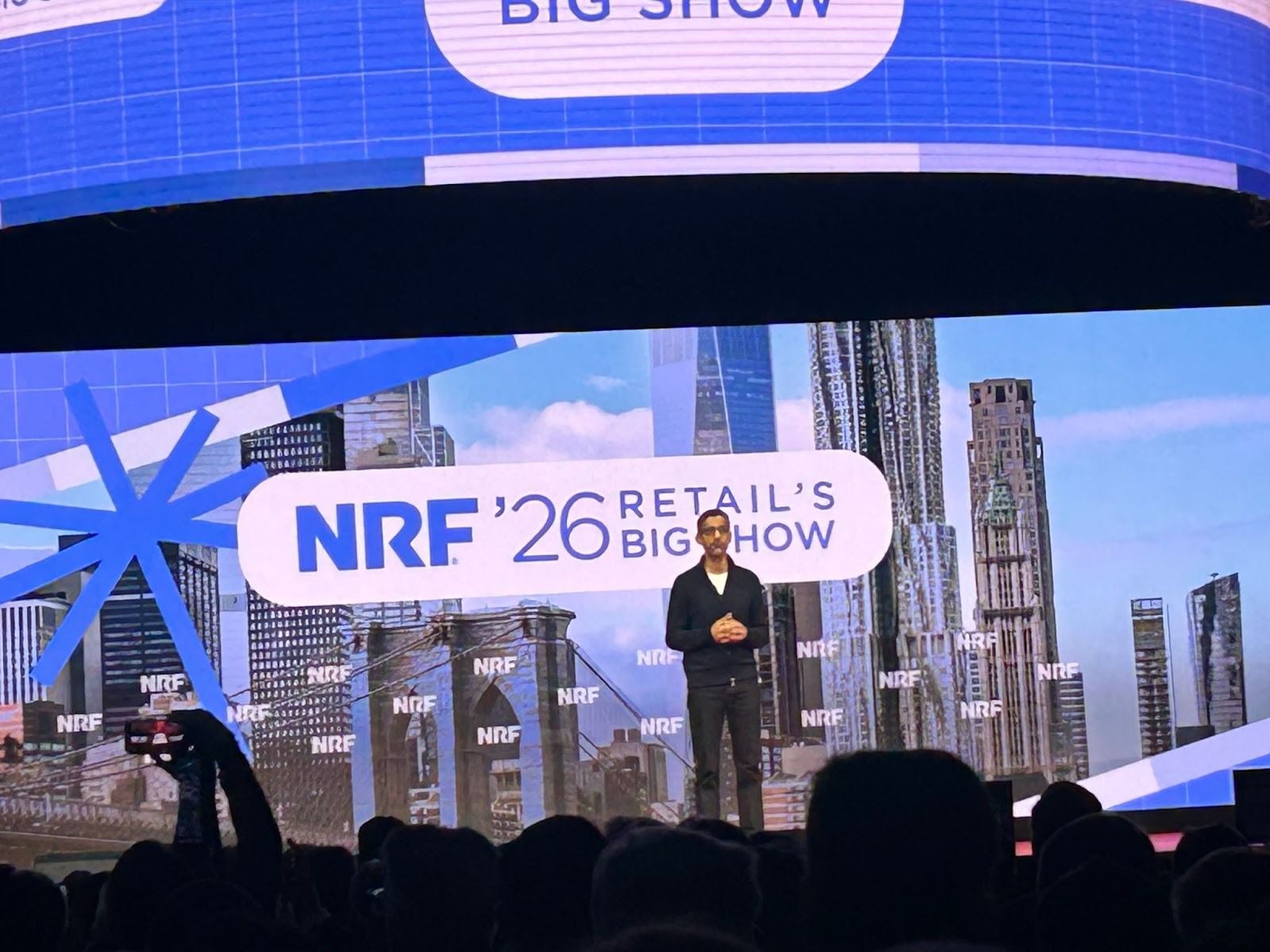
The National Retail Federation’s annual Big Show is intentionally designed to be the launchpad for the new year. Held a few weeks after the holiday season, it has set the tone for the year ahead, offering insights into economic headwinds, tech disruptions, and emerging opportunities for brands and retailers of all sizes and across categories. While the event has always put C-level retail executives in the spotlight, the most resounding audience response came when one (possibly surprising) person came to the stage: Google and Alphabet CEO Sundar Pichai.
During his opening remarks to the industry, Pichai shared Google’s broader vision for the AI era of retail, including several new solutions and capabilities that aim to support the end-to-end customer experience, from product discovery and comparison through to purchase and delivery. The foundation of this vision and associated end-to-end approach is the Universal Commerce Protocol (UCP), developed in partnership with industry leaders including Shopify, Etsy, Wayfair, Target, and Walmart, and endorsed by 20+ additional partners and advisors.
UCP is compatible with existing industry protocols, including Agent2Agent, the Agent Payments Protocol, and the Model Context Protocol, while accounting for the nuances of different commerce journeys that Google is positioned to best serve.
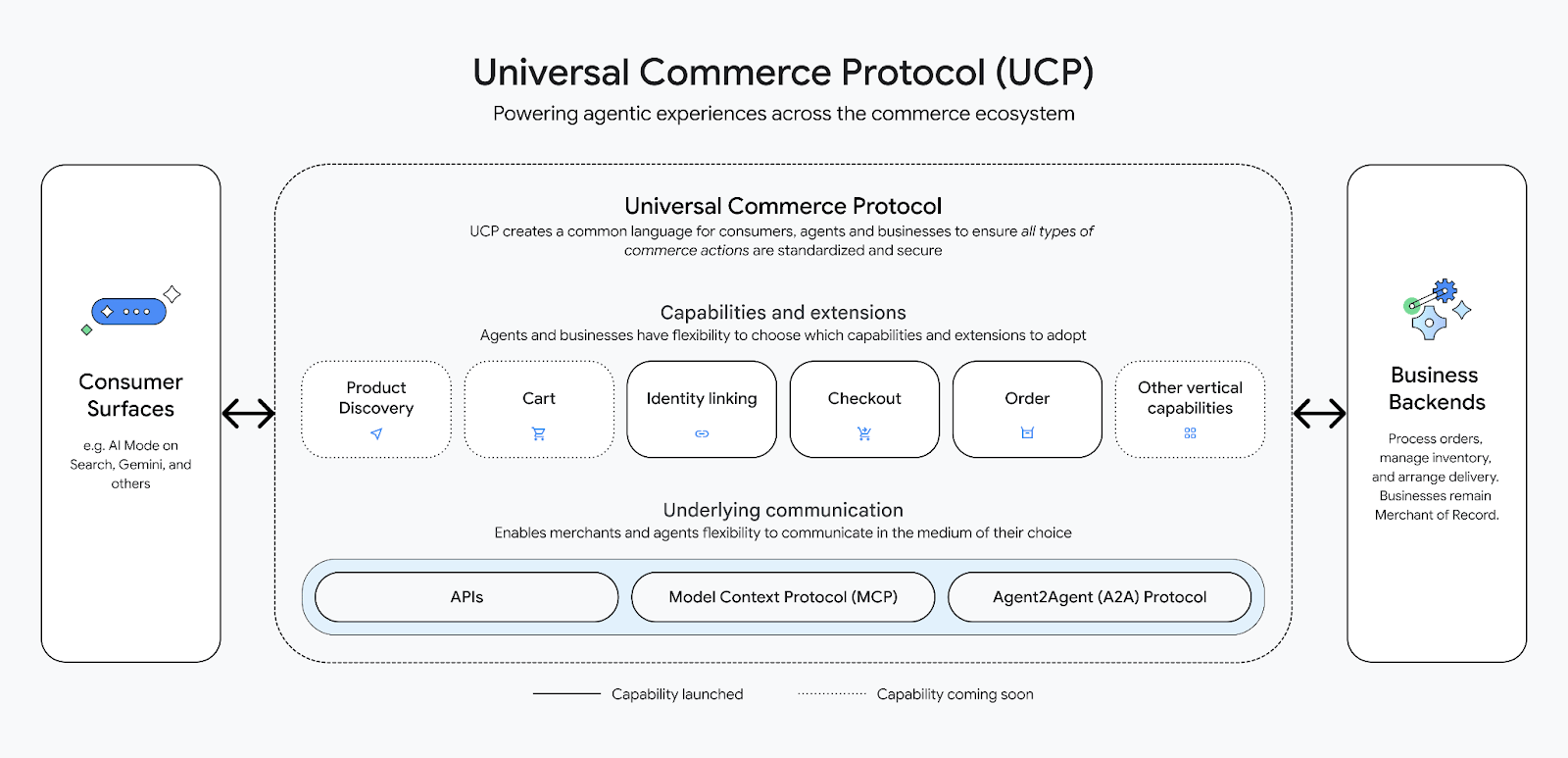
“It was built to meet the needs of retailers and customers, keeping the full customer relationship front and center from the moments of discovery in decision and beyond,” Pichai said. “You might wonder why we are introducing another protocol. It's important that the industry needs a protocol that works at global scale and takes into account the nuances of commerce journeys, and is a critical building block for it.”
During his talk, Pichai made a point to call out “the joy of shopping,” something that many players have understated in the quest for efficiency. And what’s most notable is how this “joy” can be created through each moment where a consumer engages with AI.
Discovery: Narrowing the Sea of Options
Despite the rise of competitive destinations, from AI apps like ChatGPT to social platforms like TikTok, Google Search still has dominant market share. That is why the company has focused strategically on building out its Shopping Graph to include the most relevant products, prices, and even store-level inventory availability.
Featuring more than 50 million product listings, more than two billion are refreshed every hour, and AI Mode will help ensure the most relevant products are delivered to shoppers based on their unique contexts and inquiries. And those inquiries can range from simple (“help me find the perfect dress for a Garden Party wedding” to complex “I need to pack for a two-week trip to Europe in the summer and I can only spend $300. What do you recommend?”).
“With AI mode, we are seeing these journeys move from keywords to natural conversations,” Pichai said. “For years, online shopping has been about keywords, filters, dropped out, menus and scrolling through multiple pages until you find what you want. Now you can type in exactly what you're looking for, including really specific details and quirks. AI can do the hard work narrowing it down to what you're most interested in buying. This is what's already happening when you use AI more in search, describe what you want to buy, you'll get relevant links, see your favorite brands or styles that reflect your personal preferences, and it's possible on more than just search.”
With UCP, merchants can deliver special prices or offers based on their behaviors or intent levels. Existing customers may get offers based on their past purchases, while new customers will get special “new member” pricing to not only drive acquisition but bring them into the merchant’s longer-term funnel for marketing and re-engagement.
Comparison and Selection: Aligning Recommendations to Personal Nuances
Gemini Enterprise for Customer Experience will also be fully integrated with UCP, it is already allowing companies like The Home Depot and McDonald’s to use agents to improve customer service. These agents use company customer data to support consumers across channels in the form of shopping assistants, support bots, agentic bots, and even more curated merchandising.
The Home Depot is integrating the shopping agent from Gemini Enterprise for CX to enhance its Magic Apron platform from a simple AI assistant to a true conversational expert companion for DIY consumers and pros. Customers can describe projects in plain language, and Magic Apron will now provide advice and personalized recommendations. In the near future, the platform will include advanced multimodal capabilities such as image upload and visualization, bringing that personalized guidance to the next level. By integrating real-time local store inventory and product locations, Magic Apron can add store wayfinding guidance to the experience, ultimately closing the loop between discovery, guidance, recommendation, selection, and purchase. Although these capabilities are currently only available in a select number of stores, the Home Depot plans to roll it out to its in-store experience nationwide over the coming months.
Kroger is also integrating AI into its branded app, allowing customers to get personalized recommendations and lists that align with specific diets, routines, occasions, and other parameters. Serving more than 60 million householders, Kroger knows firsthand just how nuanced the grocery-shopping experience is. While there is a routine aspect to the shopping experience, it can be very high effort and time intensive, especially if you’re shopping for different preferences and needs.
“Agentic commerce applied to food may not seem like the most transformational concept, but I would argue the exact opposite,” Yael Cosset, EVP and Chief Digital Officer for Kroger, said in the on-the-record press event ahead of UCP’s launch at NRF. “We're not necessarily new to personalization. Kolger pioneered customer data science and AI for the benefit of our customers over two decades ago, but agentic commerce integration in our experience, in our ecosystem of solutions, presents a true unique acceleration opportunity.”
While personalization historically once focused on optimization and finding the “best match” across dimensions, segments, and models, Cosset explained that agentic commerce and, specifically, Gemini Enterprise for Customer Experience, will allow them to marry context, intent, and their deep knowledge of their customers, to create a true shopping companion that eliminates the mental load of finding the right products at the right price.
“About half the country has food-related New Year’s resolutions; a lot of big commitments that are also very overwhelming,” Cosset explained. “I want to lower my sodium intake. I want to improve my protein intake. If I always cook the same thing, which we tend to do as a quick fix, you know, how do I get that inspiration? Remove the friction along the process of that journey, simplify the full end-to-end engagement.”
Purchase: Tailoring the Conversion Experience
When consumers are ready to make a purchase, they can do so right within the Google experience. But there are additional steps in the process, such as signing in, adding loyalty program information, entering the delivery address and preferred payment method.
“For an agentic transaction to work, the systems that govern each of these steps, they just have to all line up,” explained Vidhya Srinivasan, VP and GM of Advertising and Commerce at Google, in an on-the-record press event ahead of NRF. “They have to talk to each other, act on your behalf, and deal with things that don't work, because any breakdown in any part of this process basically means the transaction doesn't happen. UCP is a common language, and it sits between agentic experiences with consumer surfaces on one hand and then the business back-end on the other, so that the two can just work together seamlessly.”
All the different commerce actions, such as cart building and identity-linking checkout, remain standardized and secure. Srinivasan used an example of shopping for luggage: if a conversation starts in AI Mode and a customer finds a specific suitcase for an upcoming trip, they can complete the transaction right within the experience using Google Pay. The shopper can easily sign up for an account or enter their loyalty card information and then make a purchase without leaving the conversation. Merchants can even use the opportunity to recommend relevant, adjacent products that go with the suitcase, like packing cubes, to drive a final up-sell.
The brand/retailer is the official merchant of record, so they own every step of the experience, from purchase to post-purchase engagement, customer service, and returns. This idea of being the “merchant of record” or minimizing disintermediation, has come up quite a bit at the Big Show, so bringing that point front and center seemed to be a strategic choice for the Google team.
Delivery: Automating Logistics and Fulfillment
Pichai also revealed that Wing, the company’s drone delivery service, is expanding its partnership with Walmart, the symbolic cherry on top of Google’s UCP reveal and a possible indicator of how automation will drive the entire retail value chain.
Over the past year, the companies were able to double deliveries in existing markets and, as a result of their success, are expanding into more markets, including Houston, Orlando, Tampa, Charlotte, and other cities.
Who is the Favored Winner in the Agentic Race?
It's a tough question to answer, especially since we're so early in this new era of retail and much of the conversations at NRF have tied to diversification and partnership. But for some, Google is the most apt winner. That is, if they can maintain their focus.
"What I'm hearing personally from friends at Google is that Google is not a shopping company. However, they are a great search company," noted Anne Mezzenga of OmniTalk during a press breakfast with industry analysts, tech executives, and other influencers. "They also are a great AI company. But is it where we're going to shop? And should they win? Yes, should. Because they know not just about our search behavior, but they know when my birthday is, when my kids birthday is, the emails that I'm sending, what products I'm buying from, everything you know where I'm driving to where my home is. They have everything I am interacting with day to day in my Google ecosystem. Why shouldn't they be the ones to win here? But I don't know that they'll be able to do it."
Veteran tech journalist and founder of The Aisle, Jason Del Rey, added: "My number-one question coming out of that Google announcement was, Are they serious this time?"
The National Retail Federation’s annual Big Show is intentionally designed to be the launchpad for the new year. Held a few weeks after the holiday season, it has set the tone for the year ahead, offering insights into economic headwinds, tech disruptions, and emerging opportunities for brands and retailers of all sizes and across categories. While the event has always put C-level retail executives in the spotlight, the most resounding audience response came when one (possibly surprising) person came to the stage: Google and Alphabet CEO Sundar Pichai.
During his opening remarks to the industry, Pichai shared Google’s broader vision for the AI era of retail, including several new solutions and capabilities that aim to support the end-to-end customer experience, from product discovery and comparison through to purchase and delivery. The foundation of this vision and associated end-to-end approach is the Universal Commerce Protocol (UCP), developed in partnership with industry leaders including Shopify, Etsy, Wayfair, Target, and Walmart, and endorsed by 20+ additional partners and advisors.
UCP is compatible with existing industry protocols, including Agent2Agent, the Agent Payments Protocol, and the Model Context Protocol, while accounting for the nuances of different commerce journeys that Google is positioned to best serve.
“It was built to meet the needs of retailers and customers, keeping the full customer relationship front and center from the moments of discovery in decision and beyond,” Pichai said. “You might wonder why we are introducing another protocol. It's important that the industry needs a protocol that works at global scale and takes into account the nuances of commerce journeys, and is a critical building block for it.”
During his talk, Pichai made a point to call out “the joy of shopping,” something that many players have understated in the quest for efficiency. And what’s most notable is how this “joy” can be created through each moment where a consumer engages with AI.
Discovery: Narrowing the Sea of Options
Despite the rise of competitive destinations, from AI apps like ChatGPT to social platforms like TikTok, Google Search still has dominant market share. That is why the company has focused strategically on building out its Shopping Graph to include the most relevant products, prices, and even store-level inventory availability.
Featuring more than 50 million product listings, more than two billion are refreshed every hour, and AI Mode will help ensure the most relevant products are delivered to shoppers based on their unique contexts and inquiries. And those inquiries can range from simple (“help me find the perfect dress for a Garden Party wedding” to complex “I need to pack for a two-week trip to Europe in the summer and I can only spend $300. What do you recommend?”).
“With AI mode, we are seeing these journeys move from keywords to natural conversations,” Pichai said. “For years, online shopping has been about keywords, filters, dropped out, menus and scrolling through multiple pages until you find what you want. Now you can type in exactly what you're looking for, including really specific details and quirks. AI can do the hard work narrowing it down to what you're most interested in buying. This is what's already happening when you use AI more in search, describe what you want to buy, you'll get relevant links, see your favorite brands or styles that reflect your personal preferences, and it's possible on more than just search.”
With UCP, merchants can deliver special prices or offers based on their behaviors or intent levels. Existing customers may get offers based on their past purchases, while new customers will get special “new member” pricing to not only drive acquisition but bring them into the merchant’s longer-term funnel for marketing and re-engagement.
Comparison and Selection: Aligning Recommendations to Personal Nuances
Gemini Enterprise for Customer Experience will also be fully integrated with UCP, it is already allowing companies like The Home Depot and McDonald’s to use agents to improve customer service. These agents use company customer data to support consumers across channels in the form of shopping assistants, support bots, agentic bots, and even more curated merchandising.
The Home Depot is integrating the shopping agent from Gemini Enterprise for CX to enhance its Magic Apron platform from a simple AI assistant to a true conversational expert companion for DIY consumers and pros. Customers can describe projects in plain language, and Magic Apron will now provide advice and personalized recommendations. In the near future, the platform will include advanced multimodal capabilities such as image upload and visualization, bringing that personalized guidance to the next level. By integrating real-time local store inventory and product locations, Magic Apron can add store wayfinding guidance to the experience, ultimately closing the loop between discovery, guidance, recommendation, selection, and purchase. Although these capabilities are currently only available in a select number of stores, the Home Depot plans to roll it out to its in-store experience nationwide over the coming months.
Kroger is also integrating AI into its branded app, allowing customers to get personalized recommendations and lists that align with specific diets, routines, occasions, and other parameters. Serving more than 60 million householders, Kroger knows firsthand just how nuanced the grocery-shopping experience is. While there is a routine aspect to the shopping experience, it can be very high effort and time intensive, especially if you’re shopping for different preferences and needs.
“Agentic commerce applied to food may not seem like the most transformational concept, but I would argue the exact opposite,” Yael Cosset, EVP and Chief Digital Officer for Kroger, said in the on-the-record press event ahead of UCP’s launch at NRF. “We're not necessarily new to personalization. Kolger pioneered customer data science and AI for the benefit of our customers over two decades ago, but agentic commerce integration in our experience, in our ecosystem of solutions, presents a true unique acceleration opportunity.”
While personalization historically once focused on optimization and finding the “best match” across dimensions, segments, and models, Cosset explained that agentic commerce and, specifically, Gemini Enterprise for Customer Experience, will allow them to marry context, intent, and their deep knowledge of their customers, to create a true shopping companion that eliminates the mental load of finding the right products at the right price.
“About half the country has food-related New Year’s resolutions; a lot of big commitments that are also very overwhelming,” Cosset explained. “I want to lower my sodium intake. I want to improve my protein intake. If I always cook the same thing, which we tend to do as a quick fix, you know, how do I get that inspiration? Remove the friction along the process of that journey, simplify the full end-to-end engagement.”
Purchase: Tailoring the Conversion Experience
When consumers are ready to make a purchase, they can do so right within the Google experience. But there are additional steps in the process, such as signing in, adding loyalty program information, entering the delivery address and preferred payment method.
“For an agentic transaction to work, the systems that govern each of these steps, they just have to all line up,” explained Vidhya Srinivasan, VP and GM of Advertising and Commerce at Google, in an on-the-record press event ahead of NRF. “They have to talk to each other, act on your behalf, and deal with things that don't work, because any breakdown in any part of this process basically means the transaction doesn't happen. UCP is a common language, and it sits between agentic experiences with consumer surfaces on one hand and then the business back-end on the other, so that the two can just work together seamlessly.”
All the different commerce actions, such as cart building and identity-linking checkout, remain standardized and secure. Srinivasan used an example of shopping for luggage: if a conversation starts in AI Mode and a customer finds a specific suitcase for an upcoming trip, they can complete the transaction right within the experience using Google Pay. The shopper can easily sign up for an account or enter their loyalty card information and then make a purchase without leaving the conversation. Merchants can even use the opportunity to recommend relevant, adjacent products that go with the suitcase, like packing cubes, to drive a final up-sell.
The brand/retailer is the official merchant of record, so they own every step of the experience, from purchase to post-purchase engagement, customer service, and returns. This idea of being the “merchant of record” or minimizing disintermediation, has come up quite a bit at the Big Show, so bringing that point front and center seemed to be a strategic choice for the Google team.
Delivery: Automating Logistics and Fulfillment
Pichai also revealed that Wing, the company’s drone delivery service, is expanding its partnership with Walmart, the symbolic cherry on top of Google’s UCP reveal and a possible indicator of how automation will drive the entire retail value chain.
Over the past year, the companies were able to double deliveries in existing markets and, as a result of their success, are expanding into more markets, including Houston, Orlando, Tampa, Charlotte, and other cities.
Who is the Favored Winner in the Agentic Race?
It's a tough question to answer, especially since we're so early in this new era of retail and much of the conversations at NRF have tied to diversification and partnership. But for some, Google is the most apt winner. That is, if they can maintain their focus.
"What I'm hearing personally from friends at Google is that Google is not a shopping company. However, they are a great search company," noted Anne Mezzenga of OmniTalk during a press breakfast with industry analysts, tech executives, and other influencers. "They also are a great AI company. But is it where we're going to shop? And should they win? Yes, should. Because they know not just about our search behavior, but they know when my birthday is, when my kids birthday is, the emails that I'm sending, what products I'm buying from, everything you know where I'm driving to where my home is. They have everything I am interacting with day to day in my Google ecosystem. Why shouldn't they be the ones to win here? But I don't know that they'll be able to do it."
Veteran tech journalist and founder of The Aisle, Jason Del Rey, added: "My number-one question coming out of that Google announcement was, Are they serious this time?"
The National Retail Federation’s annual Big Show is intentionally designed to be the launchpad for the new year. Held a few weeks after the holiday season, it has set the tone for the year ahead, offering insights into economic headwinds, tech disruptions, and emerging opportunities for brands and retailers of all sizes and across categories. While the event has always put C-level retail executives in the spotlight, the most resounding audience response came when one (possibly surprising) person came to the stage: Google and Alphabet CEO Sundar Pichai.
During his opening remarks to the industry, Pichai shared Google’s broader vision for the AI era of retail, including several new solutions and capabilities that aim to support the end-to-end customer experience, from product discovery and comparison through to purchase and delivery. The foundation of this vision and associated end-to-end approach is the Universal Commerce Protocol (UCP), developed in partnership with industry leaders including Shopify, Etsy, Wayfair, Target, and Walmart, and endorsed by 20+ additional partners and advisors.
UCP is compatible with existing industry protocols, including Agent2Agent, the Agent Payments Protocol, and the Model Context Protocol, while accounting for the nuances of different commerce journeys that Google is positioned to best serve.
“It was built to meet the needs of retailers and customers, keeping the full customer relationship front and center from the moments of discovery in decision and beyond,” Pichai said. “You might wonder why we are introducing another protocol. It's important that the industry needs a protocol that works at global scale and takes into account the nuances of commerce journeys, and is a critical building block for it.”
During his talk, Pichai made a point to call out “the joy of shopping,” something that many players have understated in the quest for efficiency. And what’s most notable is how this “joy” can be created through each moment where a consumer engages with AI.
Discovery: Narrowing the Sea of Options
Despite the rise of competitive destinations, from AI apps like ChatGPT to social platforms like TikTok, Google Search still has dominant market share. That is why the company has focused strategically on building out its Shopping Graph to include the most relevant products, prices, and even store-level inventory availability.
Featuring more than 50 million product listings, more than two billion are refreshed every hour, and AI Mode will help ensure the most relevant products are delivered to shoppers based on their unique contexts and inquiries. And those inquiries can range from simple (“help me find the perfect dress for a Garden Party wedding” to complex “I need to pack for a two-week trip to Europe in the summer and I can only spend $300. What do you recommend?”).
“With AI mode, we are seeing these journeys move from keywords to natural conversations,” Pichai said. “For years, online shopping has been about keywords, filters, dropped out, menus and scrolling through multiple pages until you find what you want. Now you can type in exactly what you're looking for, including really specific details and quirks. AI can do the hard work narrowing it down to what you're most interested in buying. This is what's already happening when you use AI more in search, describe what you want to buy, you'll get relevant links, see your favorite brands or styles that reflect your personal preferences, and it's possible on more than just search.”
With UCP, merchants can deliver special prices or offers based on their behaviors or intent levels. Existing customers may get offers based on their past purchases, while new customers will get special “new member” pricing to not only drive acquisition but bring them into the merchant’s longer-term funnel for marketing and re-engagement.
Comparison and Selection: Aligning Recommendations to Personal Nuances
Gemini Enterprise for Customer Experience will also be fully integrated with UCP, it is already allowing companies like The Home Depot and McDonald’s to use agents to improve customer service. These agents use company customer data to support consumers across channels in the form of shopping assistants, support bots, agentic bots, and even more curated merchandising.
The Home Depot is integrating the shopping agent from Gemini Enterprise for CX to enhance its Magic Apron platform from a simple AI assistant to a true conversational expert companion for DIY consumers and pros. Customers can describe projects in plain language, and Magic Apron will now provide advice and personalized recommendations. In the near future, the platform will include advanced multimodal capabilities such as image upload and visualization, bringing that personalized guidance to the next level. By integrating real-time local store inventory and product locations, Magic Apron can add store wayfinding guidance to the experience, ultimately closing the loop between discovery, guidance, recommendation, selection, and purchase. Although these capabilities are currently only available in a select number of stores, the Home Depot plans to roll it out to its in-store experience nationwide over the coming months.
Kroger is also integrating AI into its branded app, allowing customers to get personalized recommendations and lists that align with specific diets, routines, occasions, and other parameters. Serving more than 60 million householders, Kroger knows firsthand just how nuanced the grocery-shopping experience is. While there is a routine aspect to the shopping experience, it can be very high effort and time intensive, especially if you’re shopping for different preferences and needs.
“Agentic commerce applied to food may not seem like the most transformational concept, but I would argue the exact opposite,” Yael Cosset, EVP and Chief Digital Officer for Kroger, said in the on-the-record press event ahead of UCP’s launch at NRF. “We're not necessarily new to personalization. Kolger pioneered customer data science and AI for the benefit of our customers over two decades ago, but agentic commerce integration in our experience, in our ecosystem of solutions, presents a true unique acceleration opportunity.”
While personalization historically once focused on optimization and finding the “best match” across dimensions, segments, and models, Cosset explained that agentic commerce and, specifically, Gemini Enterprise for Customer Experience, will allow them to marry context, intent, and their deep knowledge of their customers, to create a true shopping companion that eliminates the mental load of finding the right products at the right price.
“About half the country has food-related New Year’s resolutions; a lot of big commitments that are also very overwhelming,” Cosset explained. “I want to lower my sodium intake. I want to improve my protein intake. If I always cook the same thing, which we tend to do as a quick fix, you know, how do I get that inspiration? Remove the friction along the process of that journey, simplify the full end-to-end engagement.”
Purchase: Tailoring the Conversion Experience
When consumers are ready to make a purchase, they can do so right within the Google experience. But there are additional steps in the process, such as signing in, adding loyalty program information, entering the delivery address and preferred payment method.
“For an agentic transaction to work, the systems that govern each of these steps, they just have to all line up,” explained Vidhya Srinivasan, VP and GM of Advertising and Commerce at Google, in an on-the-record press event ahead of NRF. “They have to talk to each other, act on your behalf, and deal with things that don't work, because any breakdown in any part of this process basically means the transaction doesn't happen. UCP is a common language, and it sits between agentic experiences with consumer surfaces on one hand and then the business back-end on the other, so that the two can just work together seamlessly.”
All the different commerce actions, such as cart building and identity-linking checkout, remain standardized and secure. Srinivasan used an example of shopping for luggage: if a conversation starts in AI Mode and a customer finds a specific suitcase for an upcoming trip, they can complete the transaction right within the experience using Google Pay. The shopper can easily sign up for an account or enter their loyalty card information and then make a purchase without leaving the conversation. Merchants can even use the opportunity to recommend relevant, adjacent products that go with the suitcase, like packing cubes, to drive a final up-sell.
The brand/retailer is the official merchant of record, so they own every step of the experience, from purchase to post-purchase engagement, customer service, and returns. This idea of being the “merchant of record” or minimizing disintermediation, has come up quite a bit at the Big Show, so bringing that point front and center seemed to be a strategic choice for the Google team.
Delivery: Automating Logistics and Fulfillment
Pichai also revealed that Wing, the company’s drone delivery service, is expanding its partnership with Walmart, the symbolic cherry on top of Google’s UCP reveal and a possible indicator of how automation will drive the entire retail value chain.
Over the past year, the companies were able to double deliveries in existing markets and, as a result of their success, are expanding into more markets, including Houston, Orlando, Tampa, Charlotte, and other cities.
Who is the Favored Winner in the Agentic Race?
It's a tough question to answer, especially since we're so early in this new era of retail and much of the conversations at NRF have tied to diversification and partnership. But for some, Google is the most apt winner. That is, if they can maintain their focus.
"What I'm hearing personally from friends at Google is that Google is not a shopping company. However, they are a great search company," noted Anne Mezzenga of OmniTalk during a press breakfast with industry analysts, tech executives, and other influencers. "They also are a great AI company. But is it where we're going to shop? And should they win? Yes, should. Because they know not just about our search behavior, but they know when my birthday is, when my kids birthday is, the emails that I'm sending, what products I'm buying from, everything you know where I'm driving to where my home is. They have everything I am interacting with day to day in my Google ecosystem. Why shouldn't they be the ones to win here? But I don't know that they'll be able to do it."
Veteran tech journalist and founder of The Aisle, Jason Del Rey, added: "My number-one question coming out of that Google announcement was, Are they serious this time?"
The National Retail Federation’s annual Big Show is intentionally designed to be the launchpad for the new year. Held a few weeks after the holiday season, it has set the tone for the year ahead, offering insights into economic headwinds, tech disruptions, and emerging opportunities for brands and retailers of all sizes and across categories. While the event has always put C-level retail executives in the spotlight, the most resounding audience response came when one (possibly surprising) person came to the stage: Google and Alphabet CEO Sundar Pichai.
During his opening remarks to the industry, Pichai shared Google’s broader vision for the AI era of retail, including several new solutions and capabilities that aim to support the end-to-end customer experience, from product discovery and comparison through to purchase and delivery. The foundation of this vision and associated end-to-end approach is the Universal Commerce Protocol (UCP), developed in partnership with industry leaders including Shopify, Etsy, Wayfair, Target, and Walmart, and endorsed by 20+ additional partners and advisors.
UCP is compatible with existing industry protocols, including Agent2Agent, the Agent Payments Protocol, and the Model Context Protocol, while accounting for the nuances of different commerce journeys that Google is positioned to best serve.
“It was built to meet the needs of retailers and customers, keeping the full customer relationship front and center from the moments of discovery in decision and beyond,” Pichai said. “You might wonder why we are introducing another protocol. It's important that the industry needs a protocol that works at global scale and takes into account the nuances of commerce journeys, and is a critical building block for it.”
During his talk, Pichai made a point to call out “the joy of shopping,” something that many players have understated in the quest for efficiency. And what’s most notable is how this “joy” can be created through each moment where a consumer engages with AI.
Discovery: Narrowing the Sea of Options
Despite the rise of competitive destinations, from AI apps like ChatGPT to social platforms like TikTok, Google Search still has dominant market share. That is why the company has focused strategically on building out its Shopping Graph to include the most relevant products, prices, and even store-level inventory availability.
Featuring more than 50 million product listings, more than two billion are refreshed every hour, and AI Mode will help ensure the most relevant products are delivered to shoppers based on their unique contexts and inquiries. And those inquiries can range from simple (“help me find the perfect dress for a Garden Party wedding” to complex “I need to pack for a two-week trip to Europe in the summer and I can only spend $300. What do you recommend?”).
“With AI mode, we are seeing these journeys move from keywords to natural conversations,” Pichai said. “For years, online shopping has been about keywords, filters, dropped out, menus and scrolling through multiple pages until you find what you want. Now you can type in exactly what you're looking for, including really specific details and quirks. AI can do the hard work narrowing it down to what you're most interested in buying. This is what's already happening when you use AI more in search, describe what you want to buy, you'll get relevant links, see your favorite brands or styles that reflect your personal preferences, and it's possible on more than just search.”
With UCP, merchants can deliver special prices or offers based on their behaviors or intent levels. Existing customers may get offers based on their past purchases, while new customers will get special “new member” pricing to not only drive acquisition but bring them into the merchant’s longer-term funnel for marketing and re-engagement.
Comparison and Selection: Aligning Recommendations to Personal Nuances
Gemini Enterprise for Customer Experience will also be fully integrated with UCP, it is already allowing companies like The Home Depot and McDonald’s to use agents to improve customer service. These agents use company customer data to support consumers across channels in the form of shopping assistants, support bots, agentic bots, and even more curated merchandising.
The Home Depot is integrating the shopping agent from Gemini Enterprise for CX to enhance its Magic Apron platform from a simple AI assistant to a true conversational expert companion for DIY consumers and pros. Customers can describe projects in plain language, and Magic Apron will now provide advice and personalized recommendations. In the near future, the platform will include advanced multimodal capabilities such as image upload and visualization, bringing that personalized guidance to the next level. By integrating real-time local store inventory and product locations, Magic Apron can add store wayfinding guidance to the experience, ultimately closing the loop between discovery, guidance, recommendation, selection, and purchase. Although these capabilities are currently only available in a select number of stores, the Home Depot plans to roll it out to its in-store experience nationwide over the coming months.
Kroger is also integrating AI into its branded app, allowing customers to get personalized recommendations and lists that align with specific diets, routines, occasions, and other parameters. Serving more than 60 million householders, Kroger knows firsthand just how nuanced the grocery-shopping experience is. While there is a routine aspect to the shopping experience, it can be very high effort and time intensive, especially if you’re shopping for different preferences and needs.
“Agentic commerce applied to food may not seem like the most transformational concept, but I would argue the exact opposite,” Yael Cosset, EVP and Chief Digital Officer for Kroger, said in the on-the-record press event ahead of UCP’s launch at NRF. “We're not necessarily new to personalization. Kolger pioneered customer data science and AI for the benefit of our customers over two decades ago, but agentic commerce integration in our experience, in our ecosystem of solutions, presents a true unique acceleration opportunity.”
While personalization historically once focused on optimization and finding the “best match” across dimensions, segments, and models, Cosset explained that agentic commerce and, specifically, Gemini Enterprise for Customer Experience, will allow them to marry context, intent, and their deep knowledge of their customers, to create a true shopping companion that eliminates the mental load of finding the right products at the right price.
“About half the country has food-related New Year’s resolutions; a lot of big commitments that are also very overwhelming,” Cosset explained. “I want to lower my sodium intake. I want to improve my protein intake. If I always cook the same thing, which we tend to do as a quick fix, you know, how do I get that inspiration? Remove the friction along the process of that journey, simplify the full end-to-end engagement.”
Purchase: Tailoring the Conversion Experience
When consumers are ready to make a purchase, they can do so right within the Google experience. But there are additional steps in the process, such as signing in, adding loyalty program information, entering the delivery address and preferred payment method.
“For an agentic transaction to work, the systems that govern each of these steps, they just have to all line up,” explained Vidhya Srinivasan, VP and GM of Advertising and Commerce at Google, in an on-the-record press event ahead of NRF. “They have to talk to each other, act on your behalf, and deal with things that don't work, because any breakdown in any part of this process basically means the transaction doesn't happen. UCP is a common language, and it sits between agentic experiences with consumer surfaces on one hand and then the business back-end on the other, so that the two can just work together seamlessly.”
All the different commerce actions, such as cart building and identity-linking checkout, remain standardized and secure. Srinivasan used an example of shopping for luggage: if a conversation starts in AI Mode and a customer finds a specific suitcase for an upcoming trip, they can complete the transaction right within the experience using Google Pay. The shopper can easily sign up for an account or enter their loyalty card information and then make a purchase without leaving the conversation. Merchants can even use the opportunity to recommend relevant, adjacent products that go with the suitcase, like packing cubes, to drive a final up-sell.
The brand/retailer is the official merchant of record, so they own every step of the experience, from purchase to post-purchase engagement, customer service, and returns. This idea of being the “merchant of record” or minimizing disintermediation, has come up quite a bit at the Big Show, so bringing that point front and center seemed to be a strategic choice for the Google team.
Delivery: Automating Logistics and Fulfillment
Pichai also revealed that Wing, the company’s drone delivery service, is expanding its partnership with Walmart, the symbolic cherry on top of Google’s UCP reveal and a possible indicator of how automation will drive the entire retail value chain.
Over the past year, the companies were able to double deliveries in existing markets and, as a result of their success, are expanding into more markets, including Houston, Orlando, Tampa, Charlotte, and other cities.
Who is the Favored Winner in the Agentic Race?
It's a tough question to answer, especially since we're so early in this new era of retail and much of the conversations at NRF have tied to diversification and partnership. But for some, Google is the most apt winner. That is, if they can maintain their focus.
"What I'm hearing personally from friends at Google is that Google is not a shopping company. However, they are a great search company," noted Anne Mezzenga of OmniTalk during a press breakfast with industry analysts, tech executives, and other influencers. "They also are a great AI company. But is it where we're going to shop? And should they win? Yes, should. Because they know not just about our search behavior, but they know when my birthday is, when my kids birthday is, the emails that I'm sending, what products I'm buying from, everything you know where I'm driving to where my home is. They have everything I am interacting with day to day in my Google ecosystem. Why shouldn't they be the ones to win here? But I don't know that they'll be able to do it."
Veteran tech journalist and founder of The Aisle, Jason Del Rey, added: "My number-one question coming out of that Google announcement was, Are they serious this time?"
The National Retail Federation’s annual Big Show is intentionally designed to be the launchpad for the new year. Held a few weeks after the holiday season, it has set the tone for the year ahead, offering insights into economic headwinds, tech disruptions, and emerging opportunities for brands and retailers of all sizes and across categories. While the event has always put C-level retail executives in the spotlight, the most resounding audience response came when one (possibly surprising) person came to the stage: Google and Alphabet CEO Sundar Pichai.
During his opening remarks to the industry, Pichai shared Google’s broader vision for the AI era of retail, including several new solutions and capabilities that aim to support the end-to-end customer experience, from product discovery and comparison through to purchase and delivery. The foundation of this vision and associated end-to-end approach is the Universal Commerce Protocol (UCP), developed in partnership with industry leaders including Shopify, Etsy, Wayfair, Target, and Walmart, and endorsed by 20+ additional partners and advisors.
UCP is compatible with existing industry protocols, including Agent2Agent, the Agent Payments Protocol, and the Model Context Protocol, while accounting for the nuances of different commerce journeys that Google is positioned to best serve.
“It was built to meet the needs of retailers and customers, keeping the full customer relationship front and center from the moments of discovery in decision and beyond,” Pichai said. “You might wonder why we are introducing another protocol. It's important that the industry needs a protocol that works at global scale and takes into account the nuances of commerce journeys, and is a critical building block for it.”
During his talk, Pichai made a point to call out “the joy of shopping,” something that many players have understated in the quest for efficiency. And what’s most notable is how this “joy” can be created through each moment where a consumer engages with AI.
Discovery: Narrowing the Sea of Options
Despite the rise of competitive destinations, from AI apps like ChatGPT to social platforms like TikTok, Google Search still has dominant market share. That is why the company has focused strategically on building out its Shopping Graph to include the most relevant products, prices, and even store-level inventory availability.
Featuring more than 50 million product listings, more than two billion are refreshed every hour, and AI Mode will help ensure the most relevant products are delivered to shoppers based on their unique contexts and inquiries. And those inquiries can range from simple (“help me find the perfect dress for a Garden Party wedding” to complex “I need to pack for a two-week trip to Europe in the summer and I can only spend $300. What do you recommend?”).
“With AI mode, we are seeing these journeys move from keywords to natural conversations,” Pichai said. “For years, online shopping has been about keywords, filters, dropped out, menus and scrolling through multiple pages until you find what you want. Now you can type in exactly what you're looking for, including really specific details and quirks. AI can do the hard work narrowing it down to what you're most interested in buying. This is what's already happening when you use AI more in search, describe what you want to buy, you'll get relevant links, see your favorite brands or styles that reflect your personal preferences, and it's possible on more than just search.”
With UCP, merchants can deliver special prices or offers based on their behaviors or intent levels. Existing customers may get offers based on their past purchases, while new customers will get special “new member” pricing to not only drive acquisition but bring them into the merchant’s longer-term funnel for marketing and re-engagement.
Comparison and Selection: Aligning Recommendations to Personal Nuances
Gemini Enterprise for Customer Experience will also be fully integrated with UCP, it is already allowing companies like The Home Depot and McDonald’s to use agents to improve customer service. These agents use company customer data to support consumers across channels in the form of shopping assistants, support bots, agentic bots, and even more curated merchandising.
The Home Depot is integrating the shopping agent from Gemini Enterprise for CX to enhance its Magic Apron platform from a simple AI assistant to a true conversational expert companion for DIY consumers and pros. Customers can describe projects in plain language, and Magic Apron will now provide advice and personalized recommendations. In the near future, the platform will include advanced multimodal capabilities such as image upload and visualization, bringing that personalized guidance to the next level. By integrating real-time local store inventory and product locations, Magic Apron can add store wayfinding guidance to the experience, ultimately closing the loop between discovery, guidance, recommendation, selection, and purchase. Although these capabilities are currently only available in a select number of stores, the Home Depot plans to roll it out to its in-store experience nationwide over the coming months.
Kroger is also integrating AI into its branded app, allowing customers to get personalized recommendations and lists that align with specific diets, routines, occasions, and other parameters. Serving more than 60 million householders, Kroger knows firsthand just how nuanced the grocery-shopping experience is. While there is a routine aspect to the shopping experience, it can be very high effort and time intensive, especially if you’re shopping for different preferences and needs.
“Agentic commerce applied to food may not seem like the most transformational concept, but I would argue the exact opposite,” Yael Cosset, EVP and Chief Digital Officer for Kroger, said in the on-the-record press event ahead of UCP’s launch at NRF. “We're not necessarily new to personalization. Kolger pioneered customer data science and AI for the benefit of our customers over two decades ago, but agentic commerce integration in our experience, in our ecosystem of solutions, presents a true unique acceleration opportunity.”
While personalization historically once focused on optimization and finding the “best match” across dimensions, segments, and models, Cosset explained that agentic commerce and, specifically, Gemini Enterprise for Customer Experience, will allow them to marry context, intent, and their deep knowledge of their customers, to create a true shopping companion that eliminates the mental load of finding the right products at the right price.
“About half the country has food-related New Year’s resolutions; a lot of big commitments that are also very overwhelming,” Cosset explained. “I want to lower my sodium intake. I want to improve my protein intake. If I always cook the same thing, which we tend to do as a quick fix, you know, how do I get that inspiration? Remove the friction along the process of that journey, simplify the full end-to-end engagement.”
Purchase: Tailoring the Conversion Experience
When consumers are ready to make a purchase, they can do so right within the Google experience. But there are additional steps in the process, such as signing in, adding loyalty program information, entering the delivery address and preferred payment method.
“For an agentic transaction to work, the systems that govern each of these steps, they just have to all line up,” explained Vidhya Srinivasan, VP and GM of Advertising and Commerce at Google, in an on-the-record press event ahead of NRF. “They have to talk to each other, act on your behalf, and deal with things that don't work, because any breakdown in any part of this process basically means the transaction doesn't happen. UCP is a common language, and it sits between agentic experiences with consumer surfaces on one hand and then the business back-end on the other, so that the two can just work together seamlessly.”
All the different commerce actions, such as cart building and identity-linking checkout, remain standardized and secure. Srinivasan used an example of shopping for luggage: if a conversation starts in AI Mode and a customer finds a specific suitcase for an upcoming trip, they can complete the transaction right within the experience using Google Pay. The shopper can easily sign up for an account or enter their loyalty card information and then make a purchase without leaving the conversation. Merchants can even use the opportunity to recommend relevant, adjacent products that go with the suitcase, like packing cubes, to drive a final up-sell.
The brand/retailer is the official merchant of record, so they own every step of the experience, from purchase to post-purchase engagement, customer service, and returns. This idea of being the “merchant of record” or minimizing disintermediation, has come up quite a bit at the Big Show, so bringing that point front and center seemed to be a strategic choice for the Google team.
Delivery: Automating Logistics and Fulfillment
Pichai also revealed that Wing, the company’s drone delivery service, is expanding its partnership with Walmart, the symbolic cherry on top of Google’s UCP reveal and a possible indicator of how automation will drive the entire retail value chain.
Over the past year, the companies were able to double deliveries in existing markets and, as a result of their success, are expanding into more markets, including Houston, Orlando, Tampa, Charlotte, and other cities.
Who is the Favored Winner in the Agentic Race?
It's a tough question to answer, especially since we're so early in this new era of retail and much of the conversations at NRF have tied to diversification and partnership. But for some, Google is the most apt winner. That is, if they can maintain their focus.
"What I'm hearing personally from friends at Google is that Google is not a shopping company. However, they are a great search company," noted Anne Mezzenga of OmniTalk during a press breakfast with industry analysts, tech executives, and other influencers. "They also are a great AI company. But is it where we're going to shop? And should they win? Yes, should. Because they know not just about our search behavior, but they know when my birthday is, when my kids birthday is, the emails that I'm sending, what products I'm buying from, everything you know where I'm driving to where my home is. They have everything I am interacting with day to day in my Google ecosystem. Why shouldn't they be the ones to win here? But I don't know that they'll be able to do it."
Veteran tech journalist and founder of The Aisle, Jason Del Rey, added: "My number-one question coming out of that Google announcement was, Are they serious this time?"
Continue Reading...

Insights and futurism for executives in eCom and Retail
Those things we shouldn’t say out loud? We say them on the private feed. Bi-weekly “after dark” podcasts and a members-only newsletter, just for subscribers.
Our research reports combine visionary thinking with data-backed findings from our own advisory panel, made up of leaders at brands you know and trust.
Upskill, cross-skill, and future-proof your teams with Future Commerce Learning, the leading digital eCommerce learning platform, created by professional educators.