

of the United Kingdom’s capitol city.
When I drop into Tilted, I’m doing far more than playing a video game. I’m entering a cultural centrifuge where identity, fandom, commerce, and narrative blend so seamlessly that it becomes hard to remember what came first.
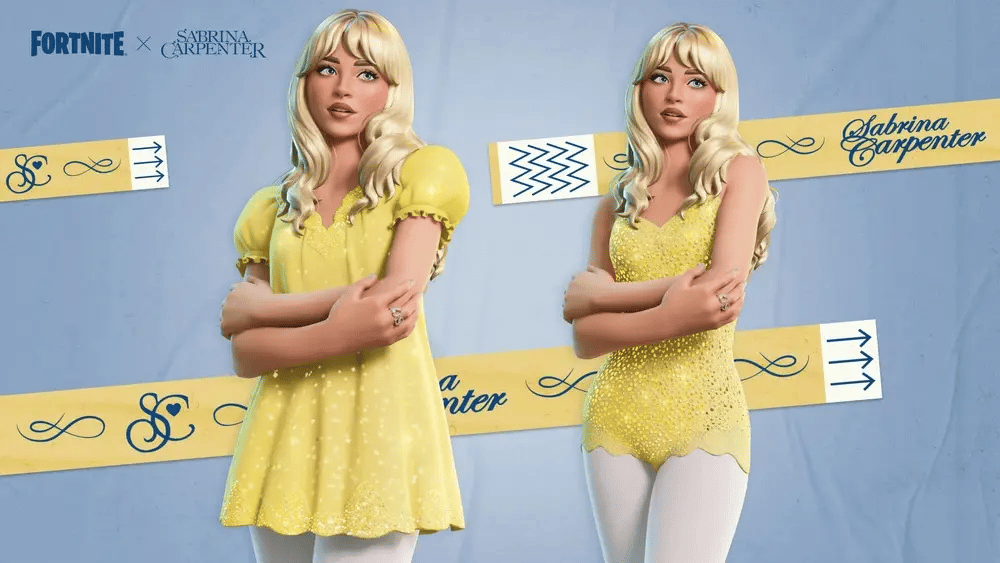
In this world, I am Shohei Ohtani. I’m wearing Puma x Beavis & Butt-Head sneakers and waiting to snipe Superman on top of the Springfield Nuclear Power Plant from The Simpsons. And that’s just today. Tomorrow, I’ll be Sabrina Carpenter, adorning my Puma x LaFrancé Butterfly ‘Pure Magenta/Ultra Violet’ kicks and driving my Porsche 918 Spyder through Battlewood Boulevard with Rumi from KPop Demon Hunters while we listen to “Bring Me To Life” from Evanescence.
This may sound absurd, even like a borderline fever dream. But in a platform like Fortnite, it’s the entire point.
No other platform, physical or virtual, allows this level of cultural interoperability. Fortnite is an engine for self-identity propelled by real-time culture cosplaying as a video game. It is an interconnected web of products, culture, and community-building that amplifies your ability to express identity at the intersection of culture and commerce (I know, how very meta of me.)
Retailers have long recognized the role of self-expression in consumerism. If I wear UGG boots, use a MacBook Air, drink PSLs from Starbucks, and wear a Yankees cap despite not being a baseball fan, this is a curated image I have intentionally formulated. I crafted it because the culture has taught me that these icons, together, convey who I am and how I should be interpreted.
So why do so many retailers fail to see this identity x commerce interaction as it exists in gaming, specifically Fortnite? Or is the problem that they do see it but fail to understand how to harness it? Entertainment partners get it. A few retailers, such as Nike, Balenciaga, Ralph Lauren, and Ferrari, do so to some extent. But partners like Marvel, DC, and the NFL, and even pop icons like Sabrina Carpenter and Kim Kardashian, live there. They build arcs, they remix worlds, and they become part of the collective memory. For a platform with 650 million registered users and about 1.3 million playing every day, it is clear that retailers are missing out on a significant opportunity.
Most retailers are stuck launching campaigns, while entertainers understand they need to launch realities.
The Rise of Digital Third Spaces
Third spaces have always been catalysts for igniting commerce and culture against identity. One of the greatest examples of a third space in recent history is the shopping mall. The opening scene of Fast Times at Ridgemont High shows the layers of this social environment, which is neither work nor home. It fosters community and a sense of belonging among people of all ages and classes. While there are arguments that the shopping mall is making a comeback in some ways, perhaps due to the 90s nostalgia porn Gen Z has created on social media, we also see that real-world third spaces are becoming more unaffordable for the average person than ever before. Enter virtual third spaces. Accenture finds that consumers’ desire for “virtual living” is gaining tremendous traction, with 39% of consumers saying they have already purchased virtual clothes or accessories for themselves or an avatar in the last year. One thing we all know about the digital world is that it offers unimaginable scaling power compared to its IRL counterparts, so let’s compare:
The largest shopping mall in the world is the Iran Mall in Tehran, Iran. It has a total floor area of 1.95 million square meters and a capacity of just over 200,000 visitors per day during busy seasons.
Fortnite, which we already know averages 1.3 million players per day, also holds the gaming record for the most concurrent players in a single day of 44.7 million. That’s 224X times the busiest day of the largest shopping mall on Earth.
Fortnite is the largest third space ever created. The next-best record for a video game is PUBG at 3.24 million. While Roblox breaks these records, it’s an incomparable platform that hosts almost 40 million user-generated games, played simultaneously rather than in a single cohesive game environment like Fortnite. Gen Alpha isn’t just shopping in malls. They’re also learning to shop in digital worlds. And these are fluid, expressive, and serialized digital worlds where identity is the highest form of currency.
The Buy Button of Self
On a recent episode of Decoded, customer experience expert and behavioral scientist Ken Hughes used Fortnite as an example to explain how we’re getting exposed to commerce, and in turn participating in commerce, at a younger age than ever.
“The first time kids become consumers is often in the virtual space, using virtual currency on a virtual product,” Hughes said. “[It’s something like] buying a Fortnite skin and they’re five or six or eight.”
He noted that historically, first-purchasing ages were much older. In that sense, Fortnite acts as a commerce training environment. This is supported by data that suggests gaming accounts for 32% of Gen Alpha’s overall digital spending compared to their online shopping spend, which accounts for only 27%.
If kids as young as five are making their first purchases in Fortnite using V-Bucks, their first wallet is digital. That means the first “brand” they have affinity for is digital, and their first frictionless checkout experience isn’t behind a counter but through a screen. And the reality is, Gen Alpha doesn’t even consider these to be “shopping experiences.” They don’t even see themselves as “spending money.” To them, it’s really just a self-expressive item they've acquired to showcase their identity in the online world they live in. There are a few reasons why that is: when you purchase a digital product like a Fortnite skin, you can wear it immediately; plus, the purchase experience itself is so organically embedded in the innate gaming experience that it’s just a moment in a much larger session.
Knowing this context, consider how Gen Alpha’s commerce expectations are being shaped in real time.
In Hughes’s framing, Fortnite isn’t teaching children how to play; it’s teaching them how to shop. But not in the transactional sense; rather, in the identity-driven sense, with an invisible price tag.
Virtual identity has long been considered a precursor to self-concept formation. Sherry Turkle, who has written on the sociology of digital identity, explained that online personas let young people “perform their emerging selves and experiment with identity.” A skin isn’t just an outfit, but an emotional artifact, language, posture, and social signal bundled into one.
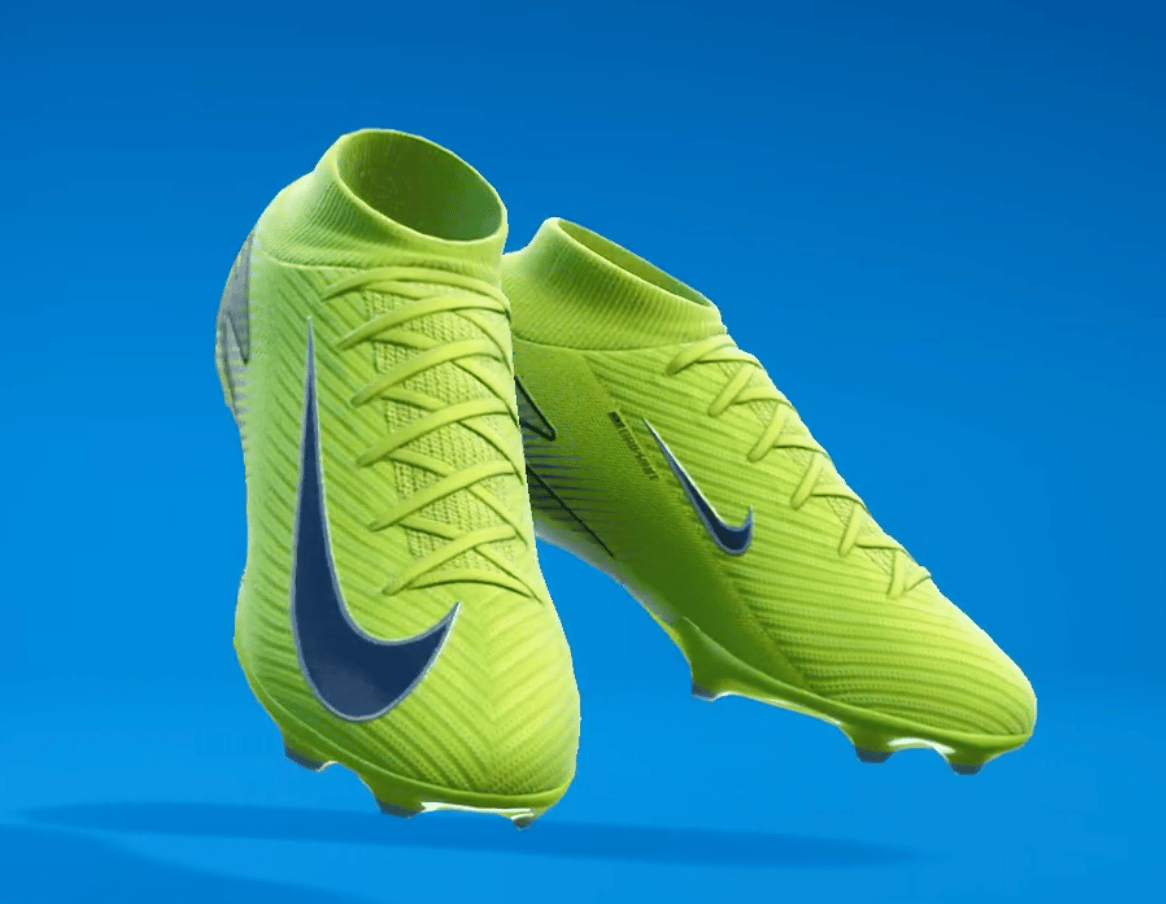
Meanwhile, Nick Yee’s research on the Proteus effect shows that avatars influence real-world behavior. When you inhabit a character, your behavior shifts toward the traits of that identity. If I am a 7-year-old football fan and my favorite player wears Nike Mercurial Superfly 10 Elite ‘Mad Voltage’ boots, when my avatar wears these, I embody the energy of Kylian Mbappé. If I am a 22-year-old who dreams of driving a Ferrari F40, I manifest the version of me who drives that car through my avatar. Whether I buy the real thing or not, the products I buy for my character become part of their identity as well as my identity, both during and after the gaming session. That level of brand intimacy is deeper than any physical retail experience could reasonably produce.
Game design strategist Amy Jo Kim would say Fortnite has perfected the “identity loop”: a cycle of expression, reinforcement, and reward that keeps players returning, purchasing, and evolving. And Adam Alter, whose research on habit formation in digital environments is widely cited from his bestseller Irresistible: The Rise of Addictive Technology and the Business of Keeping us Hooked, would recognize Fortnite’s monetization as a masterclass in emotional friction design. V-Bucks lower the psychological barriers to purchase while raising the emotional upside, creating a perfect storm for perpetual engagement and commerce.
Across all of this research, one truth emerges: Fortnite is creating a new logic of consumerism, where identity is the product and expression is the purchase. This feels like a seismic structural change to how we define and participate in commerce.
Identity becomes modular. Selfhood becomes remixable. Purchasing becomes a fluid, necessary act of self-expression.
Most retailers are sleeping on Fortnite because they see it as an expensive billboard. But the reality is that Fortnite isn’t ad media, it’s commerce infrastructure.
The Retail Gap
Despite a roster of retail partnerships, most brands have not leaned into Fortnite with the depth or ambition they bring to physical retail, experiential activations, or traditional IP collaborations.
Why? Because most brands still see Fortnite as an advertising surface, not as commerce infrastructure. Retailers underinvest in Fortnite because they misunderstand the medium.
Retailers think in terms of campaigns: drops, capsules, seasonal moments, and short-term KPIs. Fortnite thinks in worlds: persistent identities, evolving narratives, storied universes that grow and mutate over time.
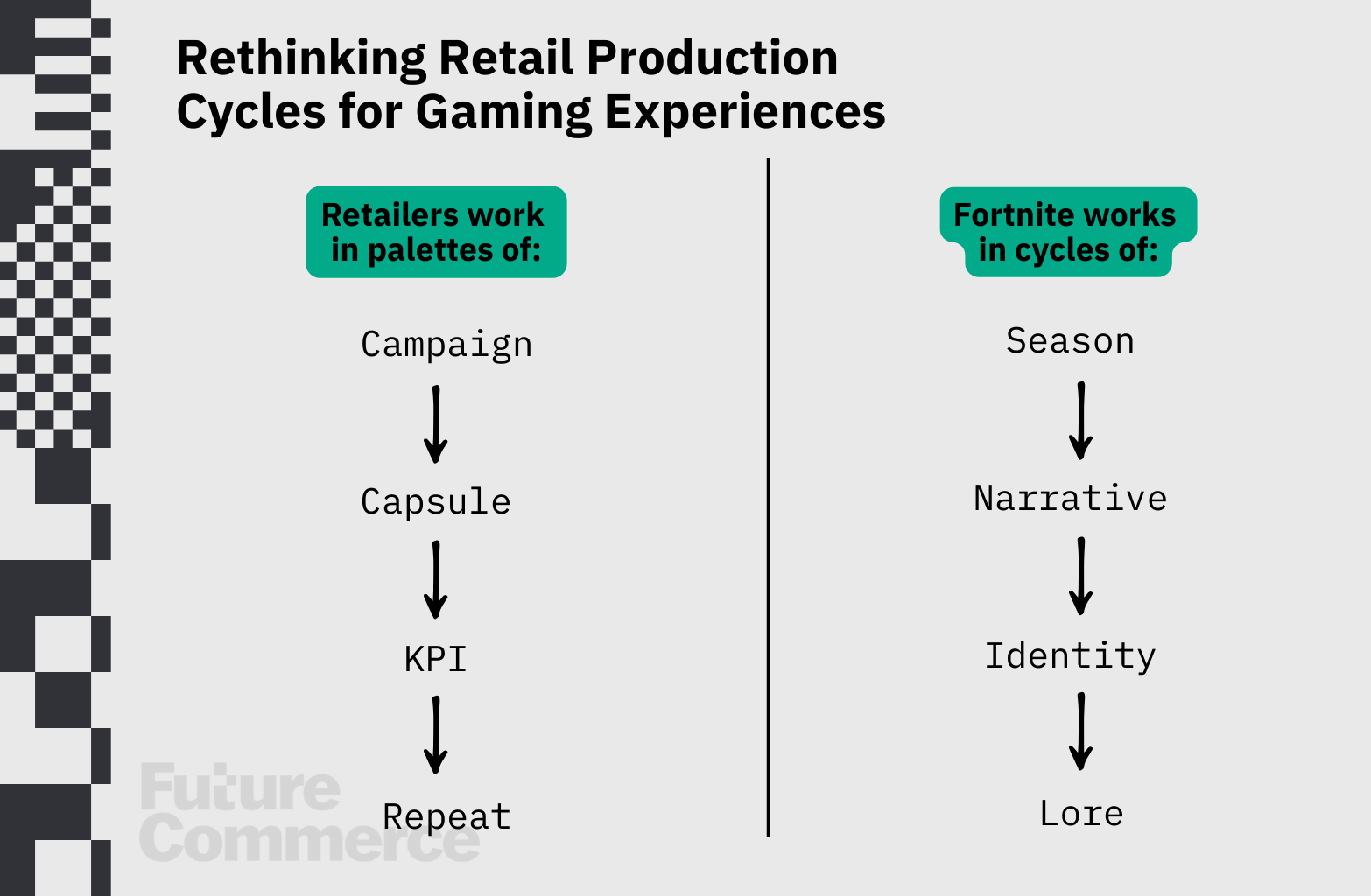
The massive retail players mentioned above have persisted for many decades because they understand they need to evolve to continuously fit their products to consumers’ ever-shifting identities and planes of reality. They know how their brand and products can fit distinctly into this infrastructure.
Until average retailers recognize that Fortnite is a place where identity is built, traded, and performed at scale—not a place where impressions are gathered—they’ll miss the cultural moment entirely.
While some execs may think Fortnite is the next Instagram, they should think about it as the next Manhattan.
Fortnite vs. Roblox: Apples and Oranges
The comparison to Roblox is inevitable in any discussion about commerce and gaming. Roblox might host more brand activations, more user-generated experiences, and more custom worlds, but Fortnite has something Roblox does not: cultural gravity.
Roblox is a creative playground. A vast toolkit. A blank canvas. Fortnite is something else entirely because it excels as a cultural amplifier.
It’s a single, cohesive world that everyone shares. A digital city-state. A curated, aesthetic-first cultural fabric woven from dozens of IPs, storylines, and design philosophies.
Fortnite is curated enough to maintain aesthetic consistency while still open enough to allow wildly different IPs to coexist. It’s structured like a narrative platform, including seasons, arcs, tensions, and reveals, which gives it an emotional register most digital worlds lack. One of the best and most recent examples of this was Quentin Tarantino’s promotion of Kill Bill: The Whole Bloody Affair through “Yuki’s Revenge” in Fortnite. Before I tell you how this appeared in Fortnite, we need a history lesson. It makes the strategy and execution of the collaboration that much sweeter, trust me.

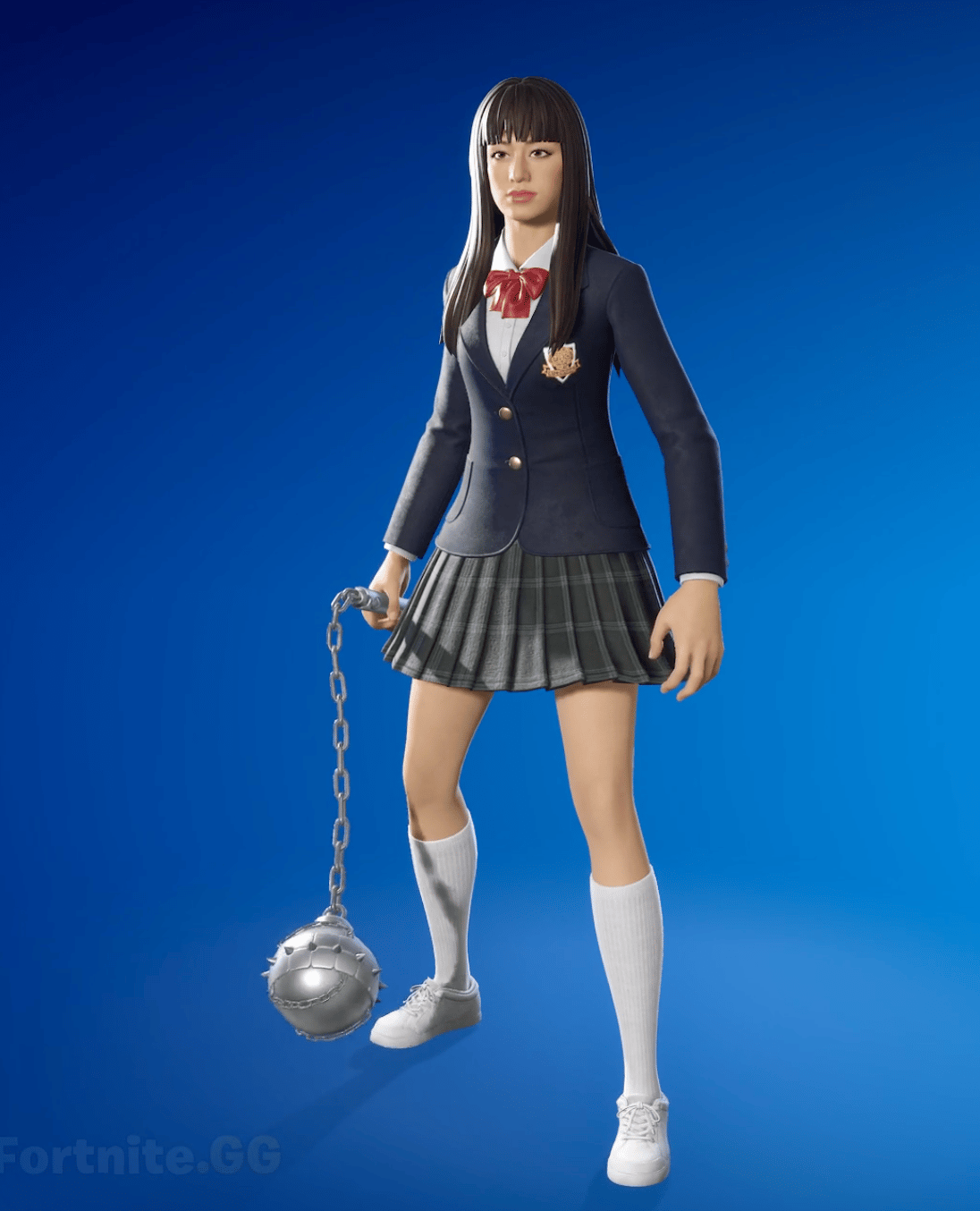
Yuki Yubari was a character concept of the sister of Gogo Yubari, the schoolgirl assassin from Kill Bill: Volume 1 (2003). In early drafts of Kill Bill, Tarantino wrote a sequence after Beatrix Kiddo’s (The Bride, Uma Thurman) fight with Vernita Green, where Yuki seeks vengeance for her sister’s death. However, this chapter was never filmed because it would’ve added too much runtime. Her story was cut but remained archived for years.
Twenty-two years later, Tarantino revived this and decided to turn the unfilmed chapter into an animated short built in the Unreal Engine (owned by Epic) using Fortnite assets, titled The Lost Chapter: Yuki’s Revenge. The short debuted inside Fortnite on November 30, 2025, as a cinematic experience that players could watch in-game. Even Uma Thurman herself reprised her role as The Bride via motion and voice capture! This crossed over with Fortnite’s Chapter Seven update, which included skins (The Bride and Yuki Yubari) as well as other accessories and weapons specific to Kill Bill.
Simultaneously, the theatrical release of Kill Bill: The Whole Bloody Affair is promoted across cinemas starting December 5, 2025, via Lionsgate. Of course, I saw this in the cinema with my husband, and it was incredible.
If you were a player in Fortnite, Yuki was a standard boss to beat each Battle Royale if you wanted access to her exclusive weapon, the Meteor Hammer. (Which you did, because it was so powerful, you just might win the game.)
It’s a lot to unpack, so let’s go through everything step by step.
They took a historical script from one of the most influential movie directors of our time. Then, they used Fortnite as the platform for the premiere and digital launch, including Fortnite-exclusive digital products and release IP. All of the components helped promote the real-world cinematic campaign for its theatrical release, achieving an unbelievable cross-audience reach. This is a new kind of hybrid launch with cross-medium storytelling. I can confidently say that no other gaming platform achieves this level of IP collaboration.
Fortnite makes moments. Roblox makes playgrounds. Roblox generates content. Fortnite doesn’t just generate culture, it’s part of it.
For retailers, that difference is everything. Consumers signal their identity through both creativity and shared culture. Fortnite’s role in shaping those shared cultural touchpoints is what makes it indispensable. Culture creates meaning, meaning creates desire, and desire fuels commerce.
Identity-First Merchandising
Consumers aren’t buying Fortnite skins because they’re cool. They’re buying skins to say, “This is who I am right now; this is who I want to be seen as in this moment.”
I may not think Hank Hill is cool, but I tell you what: there is something about his identity that I want people to know I resonate with, just in case they do too. If they do, we may share a brief moment of connection as we cross paths in our shared Battle Royale. In physical retail, this collaborative identity manifests with greater nuance as a sneaker drop, a cross-collab hoodie, or a beauty product favored by a particular creator. Logo peacocking can be another subtle (or not-so-subtle) way for people in the real world to symbolically posture an identity that others can attach to and empathize with. But in Fortnite, identity is explicit. You visibly become the thing you buy. For all intents and purposes, when I play Fortnite, I am Hank Hill (I actually am, though).
Retailers should understand this nuance and also note the speed at which Fortnite players swap identities. And Fortnite brings this experience to a Ho Notha Level, using its item shop to make identity expression through commerce instant and as its own form of cultural reactivity. The item shop reacts daily to what’s happening in the real world. Some items are triggered by predictable holidays like Halloween (enter the Ghostface skin). Some items are triggered by real-world events like the 2025 World Series (enter the Ohtahni skin). In fact, this report indicates that Gen Alpha assigns real value to digital products, explicitly stating, “[owning a rare Fortnite skin] can carry as much social bragging rights on the playground as owning a cool bike did for older generations.”
Just like the prestige of having a vintage Chanel bag from the 80s, imagine having a vintage Christmas Fortnite skin from 2018? Oh, the respect.
With the “speed of culture” among the most popular topics in culture and commerce in 2025, will digital gaming be the most influential commercial infrastructure of the next generation?
Imagine a world where a retailer doesn’t sell collections but sells personas: curated, narrative-driven identity bundles that evolve over time and across occasions. Fortnite already proves the demand, but retail has yet to catch up. The secret to Fortnite’s item shop is that it isn’t a shop at all, but a mirror. Players buy what reflects who they feel like being that day. The next day, they buy something else. Fortnite lets identity be episodic and even sporadic.
But the problem is that retail isn’t prepared for a world where consumers expect their identities to be serially reinvented. Some brands can barely comprehend how to accelerate product development cycles to align with social media trends. Fortnite is showing us that this is precisely where Gen Alpha is headed, and now is the time for retailers to seize the opportunity.
An identity-fluid customer is a high-LTV customer if you learn to merch for identity rather than for product.
Some research suggests that in-game spending is most highly correlated with self-expression. While most retailers obsess over “lifestyle merchandising,” Fortnite is showing them the power of identity merchandising.
What Retailers Should Build For
Retailers should treat Fortnite as a persistent brand world that can be extended, iterated on, and woven into a broader consumer journey. Stop trying to "activate" in Fortnite. Start thinking: What would it look like to exist there?
Design identity assets, not just products. Think in terms of avatar expression, narrative arcs, and cross-IP layering.
Build ongoing presence, not one-off activations. Entertainment partners dominate Fortnite because they understand serialized storytelling. Retailers need to embrace episodic identity.
Use Fortnite as a cultural R&D lab. The item shop refreshes daily. That’s a living dataset on how Gen Alpha expresses themselves, and it’s arguably the most valuable trend indicator a retailer could ask for. Fortnite should be the place retailers go to test identity narratives, see what resonates, and bring those learnings back to physical commerce.
As Mad Men taught us, retailers have long known that people express their identity through what they buy. A sneaker isn’t just a sneaker; it’s an expression of personal style. An iPhone isn’t just a phone; it’s an expression of taste and values. What’s missing is the extension of that identity-based collaboration between self and brand in digital form. Retailers view digital environments like Fortnite as advertising channels, which is inherently wrong. Fortnite is an environmental extension of their continued relationship with their audience.
Notice how I use the word “audience,” not “customer” or “consumer.” Your audience isn’t necessarily always buying something from you (which is what customer and consumer imply). Instead, they are part of your world, your universe, and your brand identity. Perhaps that’s why it’s been easier for the entertainment industry to see Fortnite for what it truly is. They view their audience and their emotional relationships with them as inherently ongoing — beyond the purchase of a ticket.
The Future Is Already Here
We are witnessing the emergence of a generation whose relationship to identity is fluid, remixable, interoperable, and purchasable. Fandom is a currency, and identity is collaborative. And what you buy is inseparable from who you are and who you are becoming.
Fortnite didn’t create this shift, but it accelerated it by emphasizing portable identity. It also encourages cultural interoperability and embeds commerce deeper into our sense of self at a much younger age.
Retailers can either step into that world or continue treating the most culturally potent platform of the decade as a place to run just another campaign.
When I am Marge Simpson in my Air Jordan “Fear” sneakers, the question isn’t “why are kids so obsessed with Fortnite?”
The question is: Why aren’t retailers?
When I drop into Tilted, I’m doing far more than playing a video game. I’m entering a cultural centrifuge where identity, fandom, commerce, and narrative blend so seamlessly that it becomes hard to remember what came first.
In this world, I am Shohei Ohtani. I’m wearing Puma x Beavis & Butt-Head sneakers and waiting to snipe Superman on top of the Springfield Nuclear Power Plant from The Simpsons. And that’s just today. Tomorrow, I’ll be Sabrina Carpenter, adorning my Puma x LaFrancé Butterfly ‘Pure Magenta/Ultra Violet’ kicks and driving my Porsche 918 Spyder through Battlewood Boulevard with Rumi from KPop Demon Hunters while we listen to “Bring Me To Life” from Evanescence.
This may sound absurd, even like a borderline fever dream. But in a platform like Fortnite, it’s the entire point.
No other platform, physical or virtual, allows this level of cultural interoperability. Fortnite is an engine for self-identity propelled by real-time culture cosplaying as a video game. It is an interconnected web of products, culture, and community-building that amplifies your ability to express identity at the intersection of culture and commerce (I know, how very meta of me.)
Retailers have long recognized the role of self-expression in consumerism. If I wear UGG boots, use a MacBook Air, drink PSLs from Starbucks, and wear a Yankees cap despite not being a baseball fan, this is a curated image I have intentionally formulated. I crafted it because the culture has taught me that these icons, together, convey who I am and how I should be interpreted.
So why do so many retailers fail to see this identity x commerce interaction as it exists in gaming, specifically Fortnite? Or is the problem that they do see it but fail to understand how to harness it? Entertainment partners get it. A few retailers, such as Nike, Balenciaga, Ralph Lauren, and Ferrari, do so to some extent. But partners like Marvel, DC, and the NFL, and even pop icons like Sabrina Carpenter and Kim Kardashian, live there. They build arcs, they remix worlds, and they become part of the collective memory. For a platform with 650 million registered users and about 1.3 million playing every day, it is clear that retailers are missing out on a significant opportunity.
Most retailers are stuck launching campaigns, while entertainers understand they need to launch realities.
The Rise of Digital Third Spaces
Third spaces have always been catalysts for igniting commerce and culture against identity. One of the greatest examples of a third space in recent history is the shopping mall. The opening scene of Fast Times at Ridgemont High shows the layers of this social environment, which is neither work nor home. It fosters community and a sense of belonging among people of all ages and classes. While there are arguments that the shopping mall is making a comeback in some ways, perhaps due to the 90s nostalgia porn Gen Z has created on social media, we also see that real-world third spaces are becoming more unaffordable for the average person than ever before. Enter virtual third spaces. Accenture finds that consumers’ desire for “virtual living” is gaining tremendous traction, with 39% of consumers saying they have already purchased virtual clothes or accessories for themselves or an avatar in the last year. One thing we all know about the digital world is that it offers unimaginable scaling power compared to its IRL counterparts, so let’s compare:
The largest shopping mall in the world is the Iran Mall in Tehran, Iran. It has a total floor area of 1.95 million square meters and a capacity of just over 200,000 visitors per day during busy seasons.
Fortnite, which we already know averages 1.3 million players per day, also holds the gaming record for the most concurrent players in a single day of 44.7 million. That’s 224X times the busiest day of the largest shopping mall on Earth.
Fortnite is the largest third space ever created. The next-best record for a video game is PUBG at 3.24 million. While Roblox breaks these records, it’s an incomparable platform that hosts almost 40 million user-generated games, played simultaneously rather than in a single cohesive game environment like Fortnite. Gen Alpha isn’t just shopping in malls. They’re also learning to shop in digital worlds. And these are fluid, expressive, and serialized digital worlds where identity is the highest form of currency.
The Buy Button of Self
On a recent episode of Decoded, customer experience expert and behavioral scientist Ken Hughes used Fortnite as an example to explain how we’re getting exposed to commerce, and in turn participating in commerce, at a younger age than ever.
“The first time kids become consumers is often in the virtual space, using virtual currency on a virtual product,” Hughes said. “[It’s something like] buying a Fortnite skin and they’re five or six or eight.”
He noted that historically, first-purchasing ages were much older. In that sense, Fortnite acts as a commerce training environment. This is supported by data that suggests gaming accounts for 32% of Gen Alpha’s overall digital spending compared to their online shopping spend, which accounts for only 27%.
If kids as young as five are making their first purchases in Fortnite using V-Bucks, their first wallet is digital. That means the first “brand” they have affinity for is digital, and their first frictionless checkout experience isn’t behind a counter but through a screen. And the reality is, Gen Alpha doesn’t even consider these to be “shopping experiences.” They don’t even see themselves as “spending money.” To them, it’s really just a self-expressive item they've acquired to showcase their identity in the online world they live in. There are a few reasons why that is: when you purchase a digital product like a Fortnite skin, you can wear it immediately; plus, the purchase experience itself is so organically embedded in the innate gaming experience that it’s just a moment in a much larger session.
Knowing this context, consider how Gen Alpha’s commerce expectations are being shaped in real time.
In Hughes’s framing, Fortnite isn’t teaching children how to play; it’s teaching them how to shop. But not in the transactional sense; rather, in the identity-driven sense, with an invisible price tag.
Virtual identity has long been considered a precursor to self-concept formation. Sherry Turkle, who has written on the sociology of digital identity, explained that online personas let young people “perform their emerging selves and experiment with identity.” A skin isn’t just an outfit, but an emotional artifact, language, posture, and social signal bundled into one.
Meanwhile, Nick Yee’s research on the Proteus effect shows that avatars influence real-world behavior. When you inhabit a character, your behavior shifts toward the traits of that identity. If I am a 7-year-old football fan and my favorite player wears Nike Mercurial Superfly 10 Elite ‘Mad Voltage’ boots, when my avatar wears these, I embody the energy of Kylian Mbappé. If I am a 22-year-old who dreams of driving a Ferrari F40, I manifest the version of me who drives that car through my avatar. Whether I buy the real thing or not, the products I buy for my character become part of their identity as well as my identity, both during and after the gaming session. That level of brand intimacy is deeper than any physical retail experience could reasonably produce.
Game design strategist Amy Jo Kim would say Fortnite has perfected the “identity loop”: a cycle of expression, reinforcement, and reward that keeps players returning, purchasing, and evolving. And Adam Alter, whose research on habit formation in digital environments is widely cited from his bestseller Irresistible: The Rise of Addictive Technology and the Business of Keeping us Hooked, would recognize Fortnite’s monetization as a masterclass in emotional friction design. V-Bucks lower the psychological barriers to purchase while raising the emotional upside, creating a perfect storm for perpetual engagement and commerce.
Across all of this research, one truth emerges: Fortnite is creating a new logic of consumerism, where identity is the product and expression is the purchase. This feels like a seismic structural change to how we define and participate in commerce.
Identity becomes modular. Selfhood becomes remixable. Purchasing becomes a fluid, necessary act of self-expression.
Most retailers are sleeping on Fortnite because they see it as an expensive billboard. But the reality is that Fortnite isn’t ad media, it’s commerce infrastructure.
The Retail Gap
Despite a roster of retail partnerships, most brands have not leaned into Fortnite with the depth or ambition they bring to physical retail, experiential activations, or traditional IP collaborations.
Why? Because most brands still see Fortnite as an advertising surface, not as commerce infrastructure. Retailers underinvest in Fortnite because they misunderstand the medium.
Retailers think in terms of campaigns: drops, capsules, seasonal moments, and short-term KPIs. Fortnite thinks in worlds: persistent identities, evolving narratives, storied universes that grow and mutate over time.
The massive retail players mentioned above have persisted for many decades because they understand they need to evolve to continuously fit their products to consumers’ ever-shifting identities and planes of reality. They know how their brand and products can fit distinctly into this infrastructure.
Until average retailers recognize that Fortnite is a place where identity is built, traded, and performed at scale—not a place where impressions are gathered—they’ll miss the cultural moment entirely.
While some execs may think Fortnite is the next Instagram, they should think about it as the next Manhattan.
Fortnite vs. Roblox: Apples and Oranges
The comparison to Roblox is inevitable in any discussion about commerce and gaming. Roblox might host more brand activations, more user-generated experiences, and more custom worlds, but Fortnite has something Roblox does not: cultural gravity.
Roblox is a creative playground. A vast toolkit. A blank canvas. Fortnite is something else entirely because it excels as a cultural amplifier.
It’s a single, cohesive world that everyone shares. A digital city-state. A curated, aesthetic-first cultural fabric woven from dozens of IPs, storylines, and design philosophies.
Fortnite is curated enough to maintain aesthetic consistency while still open enough to allow wildly different IPs to coexist. It’s structured like a narrative platform, including seasons, arcs, tensions, and reveals, which gives it an emotional register most digital worlds lack. One of the best and most recent examples of this was Quentin Tarantino’s promotion of Kill Bill: The Whole Bloody Affair through “Yuki’s Revenge” in Fortnite. Before I tell you how this appeared in Fortnite, we need a history lesson. It makes the strategy and execution of the collaboration that much sweeter, trust me.
Yuki Yubari was a character concept of the sister of Gogo Yubari, the schoolgirl assassin from Kill Bill: Volume 1 (2003). In early drafts of Kill Bill, Tarantino wrote a sequence after Beatrix Kiddo’s (The Bride, Uma Thurman) fight with Vernita Green, where Yuki seeks vengeance for her sister’s death. However, this chapter was never filmed because it would’ve added too much runtime. Her story was cut but remained archived for years.
Twenty-two years later, Tarantino revived this and decided to turn the unfilmed chapter into an animated short built in the Unreal Engine (owned by Epic) using Fortnite assets, titled The Lost Chapter: Yuki’s Revenge. The short debuted inside Fortnite on November 30, 2025, as a cinematic experience that players could watch in-game. Even Uma Thurman herself reprised her role as The Bride via motion and voice capture! This crossed over with Fortnite’s Chapter Seven update, which included skins (The Bride and Yuki Yubari) as well as other accessories and weapons specific to Kill Bill.
Simultaneously, the theatrical release of Kill Bill: The Whole Bloody Affair is promoted across cinemas starting December 5, 2025, via Lionsgate. Of course, I saw this in the cinema with my husband, and it was incredible.
If you were a player in Fortnite, Yuki was a standard boss to beat each Battle Royale if you wanted access to her exclusive weapon, the Meteor Hammer. (Which you did, because it was so powerful, you just might win the game.)
It’s a lot to unpack, so let’s go through everything step by step.
They took a historical script from one of the most influential movie directors of our time. Then, they used Fortnite as the platform for the premiere and digital launch, including Fortnite-exclusive digital products and release IP. All of the components helped promote the real-world cinematic campaign for its theatrical release, achieving an unbelievable cross-audience reach. This is a new kind of hybrid launch with cross-medium storytelling. I can confidently say that no other gaming platform achieves this level of IP collaboration.
Fortnite makes moments. Roblox makes playgrounds. Roblox generates content. Fortnite doesn’t just generate culture, it’s part of it.
For retailers, that difference is everything. Consumers signal their identity through both creativity and shared culture. Fortnite’s role in shaping those shared cultural touchpoints is what makes it indispensable. Culture creates meaning, meaning creates desire, and desire fuels commerce.
Identity-First Merchandising
Consumers aren’t buying Fortnite skins because they’re cool. They’re buying skins to say, “This is who I am right now; this is who I want to be seen as in this moment.”
I may not think Hank Hill is cool, but I tell you what: there is something about his identity that I want people to know I resonate with, just in case they do too. If they do, we may share a brief moment of connection as we cross paths in our shared Battle Royale. In physical retail, this collaborative identity manifests with greater nuance as a sneaker drop, a cross-collab hoodie, or a beauty product favored by a particular creator. Logo peacocking can be another subtle (or not-so-subtle) way for people in the real world to symbolically posture an identity that others can attach to and empathize with. But in Fortnite, identity is explicit. You visibly become the thing you buy. For all intents and purposes, when I play Fortnite, I am Hank Hill (I actually am, though).
Retailers should understand this nuance and also note the speed at which Fortnite players swap identities. And Fortnite brings this experience to a Ho Notha Level, using its item shop to make identity expression through commerce instant and as its own form of cultural reactivity. The item shop reacts daily to what’s happening in the real world. Some items are triggered by predictable holidays like Halloween (enter the Ghostface skin). Some items are triggered by real-world events like the 2025 World Series (enter the Ohtahni skin). In fact, this report indicates that Gen Alpha assigns real value to digital products, explicitly stating, “[owning a rare Fortnite skin] can carry as much social bragging rights on the playground as owning a cool bike did for older generations.”
Just like the prestige of having a vintage Chanel bag from the 80s, imagine having a vintage Christmas Fortnite skin from 2018? Oh, the respect.
With the “speed of culture” among the most popular topics in culture and commerce in 2025, will digital gaming be the most influential commercial infrastructure of the next generation?
Imagine a world where a retailer doesn’t sell collections but sells personas: curated, narrative-driven identity bundles that evolve over time and across occasions. Fortnite already proves the demand, but retail has yet to catch up. The secret to Fortnite’s item shop is that it isn’t a shop at all, but a mirror. Players buy what reflects who they feel like being that day. The next day, they buy something else. Fortnite lets identity be episodic and even sporadic.
But the problem is that retail isn’t prepared for a world where consumers expect their identities to be serially reinvented. Some brands can barely comprehend how to accelerate product development cycles to align with social media trends. Fortnite is showing us that this is precisely where Gen Alpha is headed, and now is the time for retailers to seize the opportunity.
An identity-fluid customer is a high-LTV customer if you learn to merch for identity rather than for product.
Some research suggests that in-game spending is most highly correlated with self-expression. While most retailers obsess over “lifestyle merchandising,” Fortnite is showing them the power of identity merchandising.
What Retailers Should Build For
Retailers should treat Fortnite as a persistent brand world that can be extended, iterated on, and woven into a broader consumer journey. Stop trying to "activate" in Fortnite. Start thinking: What would it look like to exist there?
Design identity assets, not just products. Think in terms of avatar expression, narrative arcs, and cross-IP layering.
Build ongoing presence, not one-off activations. Entertainment partners dominate Fortnite because they understand serialized storytelling. Retailers need to embrace episodic identity.
Use Fortnite as a cultural R&D lab. The item shop refreshes daily. That’s a living dataset on how Gen Alpha expresses themselves, and it’s arguably the most valuable trend indicator a retailer could ask for. Fortnite should be the place retailers go to test identity narratives, see what resonates, and bring those learnings back to physical commerce.
As Mad Men taught us, retailers have long known that people express their identity through what they buy. A sneaker isn’t just a sneaker; it’s an expression of personal style. An iPhone isn’t just a phone; it’s an expression of taste and values. What’s missing is the extension of that identity-based collaboration between self and brand in digital form. Retailers view digital environments like Fortnite as advertising channels, which is inherently wrong. Fortnite is an environmental extension of their continued relationship with their audience.
Notice how I use the word “audience,” not “customer” or “consumer.” Your audience isn’t necessarily always buying something from you (which is what customer and consumer imply). Instead, they are part of your world, your universe, and your brand identity. Perhaps that’s why it’s been easier for the entertainment industry to see Fortnite for what it truly is. They view their audience and their emotional relationships with them as inherently ongoing — beyond the purchase of a ticket.
The Future Is Already Here
We are witnessing the emergence of a generation whose relationship to identity is fluid, remixable, interoperable, and purchasable. Fandom is a currency, and identity is collaborative. And what you buy is inseparable from who you are and who you are becoming.
Fortnite didn’t create this shift, but it accelerated it by emphasizing portable identity. It also encourages cultural interoperability and embeds commerce deeper into our sense of self at a much younger age.
Retailers can either step into that world or continue treating the most culturally potent platform of the decade as a place to run just another campaign.
When I am Marge Simpson in my Air Jordan “Fear” sneakers, the question isn’t “why are kids so obsessed with Fortnite?”
The question is: Why aren’t retailers?
When I drop into Tilted, I’m doing far more than playing a video game. I’m entering a cultural centrifuge where identity, fandom, commerce, and narrative blend so seamlessly that it becomes hard to remember what came first.
In this world, I am Shohei Ohtani. I’m wearing Puma x Beavis & Butt-Head sneakers and waiting to snipe Superman on top of the Springfield Nuclear Power Plant from The Simpsons. And that’s just today. Tomorrow, I’ll be Sabrina Carpenter, adorning my Puma x LaFrancé Butterfly ‘Pure Magenta/Ultra Violet’ kicks and driving my Porsche 918 Spyder through Battlewood Boulevard with Rumi from KPop Demon Hunters while we listen to “Bring Me To Life” from Evanescence.
This may sound absurd, even like a borderline fever dream. But in a platform like Fortnite, it’s the entire point.
No other platform, physical or virtual, allows this level of cultural interoperability. Fortnite is an engine for self-identity propelled by real-time culture cosplaying as a video game. It is an interconnected web of products, culture, and community-building that amplifies your ability to express identity at the intersection of culture and commerce (I know, how very meta of me.)
Retailers have long recognized the role of self-expression in consumerism. If I wear UGG boots, use a MacBook Air, drink PSLs from Starbucks, and wear a Yankees cap despite not being a baseball fan, this is a curated image I have intentionally formulated. I crafted it because the culture has taught me that these icons, together, convey who I am and how I should be interpreted.
So why do so many retailers fail to see this identity x commerce interaction as it exists in gaming, specifically Fortnite? Or is the problem that they do see it but fail to understand how to harness it? Entertainment partners get it. A few retailers, such as Nike, Balenciaga, Ralph Lauren, and Ferrari, do so to some extent. But partners like Marvel, DC, and the NFL, and even pop icons like Sabrina Carpenter and Kim Kardashian, live there. They build arcs, they remix worlds, and they become part of the collective memory. For a platform with 650 million registered users and about 1.3 million playing every day, it is clear that retailers are missing out on a significant opportunity.
Most retailers are stuck launching campaigns, while entertainers understand they need to launch realities.
The Rise of Digital Third Spaces
Third spaces have always been catalysts for igniting commerce and culture against identity. One of the greatest examples of a third space in recent history is the shopping mall. The opening scene of Fast Times at Ridgemont High shows the layers of this social environment, which is neither work nor home. It fosters community and a sense of belonging among people of all ages and classes. While there are arguments that the shopping mall is making a comeback in some ways, perhaps due to the 90s nostalgia porn Gen Z has created on social media, we also see that real-world third spaces are becoming more unaffordable for the average person than ever before. Enter virtual third spaces. Accenture finds that consumers’ desire for “virtual living” is gaining tremendous traction, with 39% of consumers saying they have already purchased virtual clothes or accessories for themselves or an avatar in the last year. One thing we all know about the digital world is that it offers unimaginable scaling power compared to its IRL counterparts, so let’s compare:
The largest shopping mall in the world is the Iran Mall in Tehran, Iran. It has a total floor area of 1.95 million square meters and a capacity of just over 200,000 visitors per day during busy seasons.
Fortnite, which we already know averages 1.3 million players per day, also holds the gaming record for the most concurrent players in a single day of 44.7 million. That’s 224X times the busiest day of the largest shopping mall on Earth.
Fortnite is the largest third space ever created. The next-best record for a video game is PUBG at 3.24 million. While Roblox breaks these records, it’s an incomparable platform that hosts almost 40 million user-generated games, played simultaneously rather than in a single cohesive game environment like Fortnite. Gen Alpha isn’t just shopping in malls. They’re also learning to shop in digital worlds. And these are fluid, expressive, and serialized digital worlds where identity is the highest form of currency.
The Buy Button of Self
On a recent episode of Decoded, customer experience expert and behavioral scientist Ken Hughes used Fortnite as an example to explain how we’re getting exposed to commerce, and in turn participating in commerce, at a younger age than ever.
“The first time kids become consumers is often in the virtual space, using virtual currency on a virtual product,” Hughes said. “[It’s something like] buying a Fortnite skin and they’re five or six or eight.”
He noted that historically, first-purchasing ages were much older. In that sense, Fortnite acts as a commerce training environment. This is supported by data that suggests gaming accounts for 32% of Gen Alpha’s overall digital spending compared to their online shopping spend, which accounts for only 27%.
If kids as young as five are making their first purchases in Fortnite using V-Bucks, their first wallet is digital. That means the first “brand” they have affinity for is digital, and their first frictionless checkout experience isn’t behind a counter but through a screen. And the reality is, Gen Alpha doesn’t even consider these to be “shopping experiences.” They don’t even see themselves as “spending money.” To them, it’s really just a self-expressive item they've acquired to showcase their identity in the online world they live in. There are a few reasons why that is: when you purchase a digital product like a Fortnite skin, you can wear it immediately; plus, the purchase experience itself is so organically embedded in the innate gaming experience that it’s just a moment in a much larger session.
Knowing this context, consider how Gen Alpha’s commerce expectations are being shaped in real time.
In Hughes’s framing, Fortnite isn’t teaching children how to play; it’s teaching them how to shop. But not in the transactional sense; rather, in the identity-driven sense, with an invisible price tag.
Virtual identity has long been considered a precursor to self-concept formation. Sherry Turkle, who has written on the sociology of digital identity, explained that online personas let young people “perform their emerging selves and experiment with identity.” A skin isn’t just an outfit, but an emotional artifact, language, posture, and social signal bundled into one.
Meanwhile, Nick Yee’s research on the Proteus effect shows that avatars influence real-world behavior. When you inhabit a character, your behavior shifts toward the traits of that identity. If I am a 7-year-old football fan and my favorite player wears Nike Mercurial Superfly 10 Elite ‘Mad Voltage’ boots, when my avatar wears these, I embody the energy of Kylian Mbappé. If I am a 22-year-old who dreams of driving a Ferrari F40, I manifest the version of me who drives that car through my avatar. Whether I buy the real thing or not, the products I buy for my character become part of their identity as well as my identity, both during and after the gaming session. That level of brand intimacy is deeper than any physical retail experience could reasonably produce.
Game design strategist Amy Jo Kim would say Fortnite has perfected the “identity loop”: a cycle of expression, reinforcement, and reward that keeps players returning, purchasing, and evolving. And Adam Alter, whose research on habit formation in digital environments is widely cited from his bestseller Irresistible: The Rise of Addictive Technology and the Business of Keeping us Hooked, would recognize Fortnite’s monetization as a masterclass in emotional friction design. V-Bucks lower the psychological barriers to purchase while raising the emotional upside, creating a perfect storm for perpetual engagement and commerce.
Across all of this research, one truth emerges: Fortnite is creating a new logic of consumerism, where identity is the product and expression is the purchase. This feels like a seismic structural change to how we define and participate in commerce.
Identity becomes modular. Selfhood becomes remixable. Purchasing becomes a fluid, necessary act of self-expression.
Most retailers are sleeping on Fortnite because they see it as an expensive billboard. But the reality is that Fortnite isn’t ad media, it’s commerce infrastructure.
The Retail Gap
Despite a roster of retail partnerships, most brands have not leaned into Fortnite with the depth or ambition they bring to physical retail, experiential activations, or traditional IP collaborations.
Why? Because most brands still see Fortnite as an advertising surface, not as commerce infrastructure. Retailers underinvest in Fortnite because they misunderstand the medium.
Retailers think in terms of campaigns: drops, capsules, seasonal moments, and short-term KPIs. Fortnite thinks in worlds: persistent identities, evolving narratives, storied universes that grow and mutate over time.
The massive retail players mentioned above have persisted for many decades because they understand they need to evolve to continuously fit their products to consumers’ ever-shifting identities and planes of reality. They know how their brand and products can fit distinctly into this infrastructure.
Until average retailers recognize that Fortnite is a place where identity is built, traded, and performed at scale—not a place where impressions are gathered—they’ll miss the cultural moment entirely.
While some execs may think Fortnite is the next Instagram, they should think about it as the next Manhattan.
Fortnite vs. Roblox: Apples and Oranges
The comparison to Roblox is inevitable in any discussion about commerce and gaming. Roblox might host more brand activations, more user-generated experiences, and more custom worlds, but Fortnite has something Roblox does not: cultural gravity.
Roblox is a creative playground. A vast toolkit. A blank canvas. Fortnite is something else entirely because it excels as a cultural amplifier.
It’s a single, cohesive world that everyone shares. A digital city-state. A curated, aesthetic-first cultural fabric woven from dozens of IPs, storylines, and design philosophies.
Fortnite is curated enough to maintain aesthetic consistency while still open enough to allow wildly different IPs to coexist. It’s structured like a narrative platform, including seasons, arcs, tensions, and reveals, which gives it an emotional register most digital worlds lack. One of the best and most recent examples of this was Quentin Tarantino’s promotion of Kill Bill: The Whole Bloody Affair through “Yuki’s Revenge” in Fortnite. Before I tell you how this appeared in Fortnite, we need a history lesson. It makes the strategy and execution of the collaboration that much sweeter, trust me.
Yuki Yubari was a character concept of the sister of Gogo Yubari, the schoolgirl assassin from Kill Bill: Volume 1 (2003). In early drafts of Kill Bill, Tarantino wrote a sequence after Beatrix Kiddo’s (The Bride, Uma Thurman) fight with Vernita Green, where Yuki seeks vengeance for her sister’s death. However, this chapter was never filmed because it would’ve added too much runtime. Her story was cut but remained archived for years.
Twenty-two years later, Tarantino revived this and decided to turn the unfilmed chapter into an animated short built in the Unreal Engine (owned by Epic) using Fortnite assets, titled The Lost Chapter: Yuki’s Revenge. The short debuted inside Fortnite on November 30, 2025, as a cinematic experience that players could watch in-game. Even Uma Thurman herself reprised her role as The Bride via motion and voice capture! This crossed over with Fortnite’s Chapter Seven update, which included skins (The Bride and Yuki Yubari) as well as other accessories and weapons specific to Kill Bill.
Simultaneously, the theatrical release of Kill Bill: The Whole Bloody Affair is promoted across cinemas starting December 5, 2025, via Lionsgate. Of course, I saw this in the cinema with my husband, and it was incredible.
If you were a player in Fortnite, Yuki was a standard boss to beat each Battle Royale if you wanted access to her exclusive weapon, the Meteor Hammer. (Which you did, because it was so powerful, you just might win the game.)
It’s a lot to unpack, so let’s go through everything step by step.
They took a historical script from one of the most influential movie directors of our time. Then, they used Fortnite as the platform for the premiere and digital launch, including Fortnite-exclusive digital products and release IP. All of the components helped promote the real-world cinematic campaign for its theatrical release, achieving an unbelievable cross-audience reach. This is a new kind of hybrid launch with cross-medium storytelling. I can confidently say that no other gaming platform achieves this level of IP collaboration.
Fortnite makes moments. Roblox makes playgrounds. Roblox generates content. Fortnite doesn’t just generate culture, it’s part of it.
For retailers, that difference is everything. Consumers signal their identity through both creativity and shared culture. Fortnite’s role in shaping those shared cultural touchpoints is what makes it indispensable. Culture creates meaning, meaning creates desire, and desire fuels commerce.
Identity-First Merchandising
Consumers aren’t buying Fortnite skins because they’re cool. They’re buying skins to say, “This is who I am right now; this is who I want to be seen as in this moment.”
I may not think Hank Hill is cool, but I tell you what: there is something about his identity that I want people to know I resonate with, just in case they do too. If they do, we may share a brief moment of connection as we cross paths in our shared Battle Royale. In physical retail, this collaborative identity manifests with greater nuance as a sneaker drop, a cross-collab hoodie, or a beauty product favored by a particular creator. Logo peacocking can be another subtle (or not-so-subtle) way for people in the real world to symbolically posture an identity that others can attach to and empathize with. But in Fortnite, identity is explicit. You visibly become the thing you buy. For all intents and purposes, when I play Fortnite, I am Hank Hill (I actually am, though).
Retailers should understand this nuance and also note the speed at which Fortnite players swap identities. And Fortnite brings this experience to a Ho Notha Level, using its item shop to make identity expression through commerce instant and as its own form of cultural reactivity. The item shop reacts daily to what’s happening in the real world. Some items are triggered by predictable holidays like Halloween (enter the Ghostface skin). Some items are triggered by real-world events like the 2025 World Series (enter the Ohtahni skin). In fact, this report indicates that Gen Alpha assigns real value to digital products, explicitly stating, “[owning a rare Fortnite skin] can carry as much social bragging rights on the playground as owning a cool bike did for older generations.”
Just like the prestige of having a vintage Chanel bag from the 80s, imagine having a vintage Christmas Fortnite skin from 2018? Oh, the respect.
With the “speed of culture” among the most popular topics in culture and commerce in 2025, will digital gaming be the most influential commercial infrastructure of the next generation?
Imagine a world where a retailer doesn’t sell collections but sells personas: curated, narrative-driven identity bundles that evolve over time and across occasions. Fortnite already proves the demand, but retail has yet to catch up. The secret to Fortnite’s item shop is that it isn’t a shop at all, but a mirror. Players buy what reflects who they feel like being that day. The next day, they buy something else. Fortnite lets identity be episodic and even sporadic.
But the problem is that retail isn’t prepared for a world where consumers expect their identities to be serially reinvented. Some brands can barely comprehend how to accelerate product development cycles to align with social media trends. Fortnite is showing us that this is precisely where Gen Alpha is headed, and now is the time for retailers to seize the opportunity.
An identity-fluid customer is a high-LTV customer if you learn to merch for identity rather than for product.
Some research suggests that in-game spending is most highly correlated with self-expression. While most retailers obsess over “lifestyle merchandising,” Fortnite is showing them the power of identity merchandising.
What Retailers Should Build For
Retailers should treat Fortnite as a persistent brand world that can be extended, iterated on, and woven into a broader consumer journey. Stop trying to "activate" in Fortnite. Start thinking: What would it look like to exist there?
Design identity assets, not just products. Think in terms of avatar expression, narrative arcs, and cross-IP layering.
Build ongoing presence, not one-off activations. Entertainment partners dominate Fortnite because they understand serialized storytelling. Retailers need to embrace episodic identity.
Use Fortnite as a cultural R&D lab. The item shop refreshes daily. That’s a living dataset on how Gen Alpha expresses themselves, and it’s arguably the most valuable trend indicator a retailer could ask for. Fortnite should be the place retailers go to test identity narratives, see what resonates, and bring those learnings back to physical commerce.
As Mad Men taught us, retailers have long known that people express their identity through what they buy. A sneaker isn’t just a sneaker; it’s an expression of personal style. An iPhone isn’t just a phone; it’s an expression of taste and values. What’s missing is the extension of that identity-based collaboration between self and brand in digital form. Retailers view digital environments like Fortnite as advertising channels, which is inherently wrong. Fortnite is an environmental extension of their continued relationship with their audience.
Notice how I use the word “audience,” not “customer” or “consumer.” Your audience isn’t necessarily always buying something from you (which is what customer and consumer imply). Instead, they are part of your world, your universe, and your brand identity. Perhaps that’s why it’s been easier for the entertainment industry to see Fortnite for what it truly is. They view their audience and their emotional relationships with them as inherently ongoing — beyond the purchase of a ticket.
The Future Is Already Here
We are witnessing the emergence of a generation whose relationship to identity is fluid, remixable, interoperable, and purchasable. Fandom is a currency, and identity is collaborative. And what you buy is inseparable from who you are and who you are becoming.
Fortnite didn’t create this shift, but it accelerated it by emphasizing portable identity. It also encourages cultural interoperability and embeds commerce deeper into our sense of self at a much younger age.
Retailers can either step into that world or continue treating the most culturally potent platform of the decade as a place to run just another campaign.
When I am Marge Simpson in my Air Jordan “Fear” sneakers, the question isn’t “why are kids so obsessed with Fortnite?”
The question is: Why aren’t retailers?
When I drop into Tilted, I’m doing far more than playing a video game. I’m entering a cultural centrifuge where identity, fandom, commerce, and narrative blend so seamlessly that it becomes hard to remember what came first.
In this world, I am Shohei Ohtani. I’m wearing Puma x Beavis & Butt-Head sneakers and waiting to snipe Superman on top of the Springfield Nuclear Power Plant from The Simpsons. And that’s just today. Tomorrow, I’ll be Sabrina Carpenter, adorning my Puma x LaFrancé Butterfly ‘Pure Magenta/Ultra Violet’ kicks and driving my Porsche 918 Spyder through Battlewood Boulevard with Rumi from KPop Demon Hunters while we listen to “Bring Me To Life” from Evanescence.
This may sound absurd, even like a borderline fever dream. But in a platform like Fortnite, it’s the entire point.
No other platform, physical or virtual, allows this level of cultural interoperability. Fortnite is an engine for self-identity propelled by real-time culture cosplaying as a video game. It is an interconnected web of products, culture, and community-building that amplifies your ability to express identity at the intersection of culture and commerce (I know, how very meta of me.)
Retailers have long recognized the role of self-expression in consumerism. If I wear UGG boots, use a MacBook Air, drink PSLs from Starbucks, and wear a Yankees cap despite not being a baseball fan, this is a curated image I have intentionally formulated. I crafted it because the culture has taught me that these icons, together, convey who I am and how I should be interpreted.
So why do so many retailers fail to see this identity x commerce interaction as it exists in gaming, specifically Fortnite? Or is the problem that they do see it but fail to understand how to harness it? Entertainment partners get it. A few retailers, such as Nike, Balenciaga, Ralph Lauren, and Ferrari, do so to some extent. But partners like Marvel, DC, and the NFL, and even pop icons like Sabrina Carpenter and Kim Kardashian, live there. They build arcs, they remix worlds, and they become part of the collective memory. For a platform with 650 million registered users and about 1.3 million playing every day, it is clear that retailers are missing out on a significant opportunity.
Most retailers are stuck launching campaigns, while entertainers understand they need to launch realities.
The Rise of Digital Third Spaces
Third spaces have always been catalysts for igniting commerce and culture against identity. One of the greatest examples of a third space in recent history is the shopping mall. The opening scene of Fast Times at Ridgemont High shows the layers of this social environment, which is neither work nor home. It fosters community and a sense of belonging among people of all ages and classes. While there are arguments that the shopping mall is making a comeback in some ways, perhaps due to the 90s nostalgia porn Gen Z has created on social media, we also see that real-world third spaces are becoming more unaffordable for the average person than ever before. Enter virtual third spaces. Accenture finds that consumers’ desire for “virtual living” is gaining tremendous traction, with 39% of consumers saying they have already purchased virtual clothes or accessories for themselves or an avatar in the last year. One thing we all know about the digital world is that it offers unimaginable scaling power compared to its IRL counterparts, so let’s compare:
The largest shopping mall in the world is the Iran Mall in Tehran, Iran. It has a total floor area of 1.95 million square meters and a capacity of just over 200,000 visitors per day during busy seasons.
Fortnite, which we already know averages 1.3 million players per day, also holds the gaming record for the most concurrent players in a single day of 44.7 million. That’s 224X times the busiest day of the largest shopping mall on Earth.
Fortnite is the largest third space ever created. The next-best record for a video game is PUBG at 3.24 million. While Roblox breaks these records, it’s an incomparable platform that hosts almost 40 million user-generated games, played simultaneously rather than in a single cohesive game environment like Fortnite. Gen Alpha isn’t just shopping in malls. They’re also learning to shop in digital worlds. And these are fluid, expressive, and serialized digital worlds where identity is the highest form of currency.
The Buy Button of Self
On a recent episode of Decoded, customer experience expert and behavioral scientist Ken Hughes used Fortnite as an example to explain how we’re getting exposed to commerce, and in turn participating in commerce, at a younger age than ever.
“The first time kids become consumers is often in the virtual space, using virtual currency on a virtual product,” Hughes said. “[It’s something like] buying a Fortnite skin and they’re five or six or eight.”
He noted that historically, first-purchasing ages were much older. In that sense, Fortnite acts as a commerce training environment. This is supported by data that suggests gaming accounts for 32% of Gen Alpha’s overall digital spending compared to their online shopping spend, which accounts for only 27%.
If kids as young as five are making their first purchases in Fortnite using V-Bucks, their first wallet is digital. That means the first “brand” they have affinity for is digital, and their first frictionless checkout experience isn’t behind a counter but through a screen. And the reality is, Gen Alpha doesn’t even consider these to be “shopping experiences.” They don’t even see themselves as “spending money.” To them, it’s really just a self-expressive item they've acquired to showcase their identity in the online world they live in. There are a few reasons why that is: when you purchase a digital product like a Fortnite skin, you can wear it immediately; plus, the purchase experience itself is so organically embedded in the innate gaming experience that it’s just a moment in a much larger session.
Knowing this context, consider how Gen Alpha’s commerce expectations are being shaped in real time.
In Hughes’s framing, Fortnite isn’t teaching children how to play; it’s teaching them how to shop. But not in the transactional sense; rather, in the identity-driven sense, with an invisible price tag.
Virtual identity has long been considered a precursor to self-concept formation. Sherry Turkle, who has written on the sociology of digital identity, explained that online personas let young people “perform their emerging selves and experiment with identity.” A skin isn’t just an outfit, but an emotional artifact, language, posture, and social signal bundled into one.
Meanwhile, Nick Yee’s research on the Proteus effect shows that avatars influence real-world behavior. When you inhabit a character, your behavior shifts toward the traits of that identity. If I am a 7-year-old football fan and my favorite player wears Nike Mercurial Superfly 10 Elite ‘Mad Voltage’ boots, when my avatar wears these, I embody the energy of Kylian Mbappé. If I am a 22-year-old who dreams of driving a Ferrari F40, I manifest the version of me who drives that car through my avatar. Whether I buy the real thing or not, the products I buy for my character become part of their identity as well as my identity, both during and after the gaming session. That level of brand intimacy is deeper than any physical retail experience could reasonably produce.
Game design strategist Amy Jo Kim would say Fortnite has perfected the “identity loop”: a cycle of expression, reinforcement, and reward that keeps players returning, purchasing, and evolving. And Adam Alter, whose research on habit formation in digital environments is widely cited from his bestseller Irresistible: The Rise of Addictive Technology and the Business of Keeping us Hooked, would recognize Fortnite’s monetization as a masterclass in emotional friction design. V-Bucks lower the psychological barriers to purchase while raising the emotional upside, creating a perfect storm for perpetual engagement and commerce.
Across all of this research, one truth emerges: Fortnite is creating a new logic of consumerism, where identity is the product and expression is the purchase. This feels like a seismic structural change to how we define and participate in commerce.
Identity becomes modular. Selfhood becomes remixable. Purchasing becomes a fluid, necessary act of self-expression.
Most retailers are sleeping on Fortnite because they see it as an expensive billboard. But the reality is that Fortnite isn’t ad media, it’s commerce infrastructure.
The Retail Gap
Despite a roster of retail partnerships, most brands have not leaned into Fortnite with the depth or ambition they bring to physical retail, experiential activations, or traditional IP collaborations.
Why? Because most brands still see Fortnite as an advertising surface, not as commerce infrastructure. Retailers underinvest in Fortnite because they misunderstand the medium.
Retailers think in terms of campaigns: drops, capsules, seasonal moments, and short-term KPIs. Fortnite thinks in worlds: persistent identities, evolving narratives, storied universes that grow and mutate over time.
The massive retail players mentioned above have persisted for many decades because they understand they need to evolve to continuously fit their products to consumers’ ever-shifting identities and planes of reality. They know how their brand and products can fit distinctly into this infrastructure.
Until average retailers recognize that Fortnite is a place where identity is built, traded, and performed at scale—not a place where impressions are gathered—they’ll miss the cultural moment entirely.
While some execs may think Fortnite is the next Instagram, they should think about it as the next Manhattan.
Fortnite vs. Roblox: Apples and Oranges
The comparison to Roblox is inevitable in any discussion about commerce and gaming. Roblox might host more brand activations, more user-generated experiences, and more custom worlds, but Fortnite has something Roblox does not: cultural gravity.
Roblox is a creative playground. A vast toolkit. A blank canvas. Fortnite is something else entirely because it excels as a cultural amplifier.
It’s a single, cohesive world that everyone shares. A digital city-state. A curated, aesthetic-first cultural fabric woven from dozens of IPs, storylines, and design philosophies.
Fortnite is curated enough to maintain aesthetic consistency while still open enough to allow wildly different IPs to coexist. It’s structured like a narrative platform, including seasons, arcs, tensions, and reveals, which gives it an emotional register most digital worlds lack. One of the best and most recent examples of this was Quentin Tarantino’s promotion of Kill Bill: The Whole Bloody Affair through “Yuki’s Revenge” in Fortnite. Before I tell you how this appeared in Fortnite, we need a history lesson. It makes the strategy and execution of the collaboration that much sweeter, trust me.
Yuki Yubari was a character concept of the sister of Gogo Yubari, the schoolgirl assassin from Kill Bill: Volume 1 (2003). In early drafts of Kill Bill, Tarantino wrote a sequence after Beatrix Kiddo’s (The Bride, Uma Thurman) fight with Vernita Green, where Yuki seeks vengeance for her sister’s death. However, this chapter was never filmed because it would’ve added too much runtime. Her story was cut but remained archived for years.
Twenty-two years later, Tarantino revived this and decided to turn the unfilmed chapter into an animated short built in the Unreal Engine (owned by Epic) using Fortnite assets, titled The Lost Chapter: Yuki’s Revenge. The short debuted inside Fortnite on November 30, 2025, as a cinematic experience that players could watch in-game. Even Uma Thurman herself reprised her role as The Bride via motion and voice capture! This crossed over with Fortnite’s Chapter Seven update, which included skins (The Bride and Yuki Yubari) as well as other accessories and weapons specific to Kill Bill.
Simultaneously, the theatrical release of Kill Bill: The Whole Bloody Affair is promoted across cinemas starting December 5, 2025, via Lionsgate. Of course, I saw this in the cinema with my husband, and it was incredible.
If you were a player in Fortnite, Yuki was a standard boss to beat each Battle Royale if you wanted access to her exclusive weapon, the Meteor Hammer. (Which you did, because it was so powerful, you just might win the game.)
It’s a lot to unpack, so let’s go through everything step by step.
They took a historical script from one of the most influential movie directors of our time. Then, they used Fortnite as the platform for the premiere and digital launch, including Fortnite-exclusive digital products and release IP. All of the components helped promote the real-world cinematic campaign for its theatrical release, achieving an unbelievable cross-audience reach. This is a new kind of hybrid launch with cross-medium storytelling. I can confidently say that no other gaming platform achieves this level of IP collaboration.
Fortnite makes moments. Roblox makes playgrounds. Roblox generates content. Fortnite doesn’t just generate culture, it’s part of it.
For retailers, that difference is everything. Consumers signal their identity through both creativity and shared culture. Fortnite’s role in shaping those shared cultural touchpoints is what makes it indispensable. Culture creates meaning, meaning creates desire, and desire fuels commerce.
Identity-First Merchandising
Consumers aren’t buying Fortnite skins because they’re cool. They’re buying skins to say, “This is who I am right now; this is who I want to be seen as in this moment.”
I may not think Hank Hill is cool, but I tell you what: there is something about his identity that I want people to know I resonate with, just in case they do too. If they do, we may share a brief moment of connection as we cross paths in our shared Battle Royale. In physical retail, this collaborative identity manifests with greater nuance as a sneaker drop, a cross-collab hoodie, or a beauty product favored by a particular creator. Logo peacocking can be another subtle (or not-so-subtle) way for people in the real world to symbolically posture an identity that others can attach to and empathize with. But in Fortnite, identity is explicit. You visibly become the thing you buy. For all intents and purposes, when I play Fortnite, I am Hank Hill (I actually am, though).
Retailers should understand this nuance and also note the speed at which Fortnite players swap identities. And Fortnite brings this experience to a Ho Notha Level, using its item shop to make identity expression through commerce instant and as its own form of cultural reactivity. The item shop reacts daily to what’s happening in the real world. Some items are triggered by predictable holidays like Halloween (enter the Ghostface skin). Some items are triggered by real-world events like the 2025 World Series (enter the Ohtahni skin). In fact, this report indicates that Gen Alpha assigns real value to digital products, explicitly stating, “[owning a rare Fortnite skin] can carry as much social bragging rights on the playground as owning a cool bike did for older generations.”
Just like the prestige of having a vintage Chanel bag from the 80s, imagine having a vintage Christmas Fortnite skin from 2018? Oh, the respect.
With the “speed of culture” among the most popular topics in culture and commerce in 2025, will digital gaming be the most influential commercial infrastructure of the next generation?
Imagine a world where a retailer doesn’t sell collections but sells personas: curated, narrative-driven identity bundles that evolve over time and across occasions. Fortnite already proves the demand, but retail has yet to catch up. The secret to Fortnite’s item shop is that it isn’t a shop at all, but a mirror. Players buy what reflects who they feel like being that day. The next day, they buy something else. Fortnite lets identity be episodic and even sporadic.
But the problem is that retail isn’t prepared for a world where consumers expect their identities to be serially reinvented. Some brands can barely comprehend how to accelerate product development cycles to align with social media trends. Fortnite is showing us that this is precisely where Gen Alpha is headed, and now is the time for retailers to seize the opportunity.
An identity-fluid customer is a high-LTV customer if you learn to merch for identity rather than for product.
Some research suggests that in-game spending is most highly correlated with self-expression. While most retailers obsess over “lifestyle merchandising,” Fortnite is showing them the power of identity merchandising.
What Retailers Should Build For
Retailers should treat Fortnite as a persistent brand world that can be extended, iterated on, and woven into a broader consumer journey. Stop trying to "activate" in Fortnite. Start thinking: What would it look like to exist there?
Design identity assets, not just products. Think in terms of avatar expression, narrative arcs, and cross-IP layering.
Build ongoing presence, not one-off activations. Entertainment partners dominate Fortnite because they understand serialized storytelling. Retailers need to embrace episodic identity.
Use Fortnite as a cultural R&D lab. The item shop refreshes daily. That’s a living dataset on how Gen Alpha expresses themselves, and it’s arguably the most valuable trend indicator a retailer could ask for. Fortnite should be the place retailers go to test identity narratives, see what resonates, and bring those learnings back to physical commerce.
As Mad Men taught us, retailers have long known that people express their identity through what they buy. A sneaker isn’t just a sneaker; it’s an expression of personal style. An iPhone isn’t just a phone; it’s an expression of taste and values. What’s missing is the extension of that identity-based collaboration between self and brand in digital form. Retailers view digital environments like Fortnite as advertising channels, which is inherently wrong. Fortnite is an environmental extension of their continued relationship with their audience.
Notice how I use the word “audience,” not “customer” or “consumer.” Your audience isn’t necessarily always buying something from you (which is what customer and consumer imply). Instead, they are part of your world, your universe, and your brand identity. Perhaps that’s why it’s been easier for the entertainment industry to see Fortnite for what it truly is. They view their audience and their emotional relationships with them as inherently ongoing — beyond the purchase of a ticket.
The Future Is Already Here
We are witnessing the emergence of a generation whose relationship to identity is fluid, remixable, interoperable, and purchasable. Fandom is a currency, and identity is collaborative. And what you buy is inseparable from who you are and who you are becoming.
Fortnite didn’t create this shift, but it accelerated it by emphasizing portable identity. It also encourages cultural interoperability and embeds commerce deeper into our sense of self at a much younger age.
Retailers can either step into that world or continue treating the most culturally potent platform of the decade as a place to run just another campaign.
When I am Marge Simpson in my Air Jordan “Fear” sneakers, the question isn’t “why are kids so obsessed with Fortnite?”
The question is: Why aren’t retailers?
When I drop into Tilted, I’m doing far more than playing a video game. I’m entering a cultural centrifuge where identity, fandom, commerce, and narrative blend so seamlessly that it becomes hard to remember what came first.
In this world, I am Shohei Ohtani. I’m wearing Puma x Beavis & Butt-Head sneakers and waiting to snipe Superman on top of the Springfield Nuclear Power Plant from The Simpsons. And that’s just today. Tomorrow, I’ll be Sabrina Carpenter, adorning my Puma x LaFrancé Butterfly ‘Pure Magenta/Ultra Violet’ kicks and driving my Porsche 918 Spyder through Battlewood Boulevard with Rumi from KPop Demon Hunters while we listen to “Bring Me To Life” from Evanescence.
This may sound absurd, even like a borderline fever dream. But in a platform like Fortnite, it’s the entire point.
No other platform, physical or virtual, allows this level of cultural interoperability. Fortnite is an engine for self-identity propelled by real-time culture cosplaying as a video game. It is an interconnected web of products, culture, and community-building that amplifies your ability to express identity at the intersection of culture and commerce (I know, how very meta of me.)
Retailers have long recognized the role of self-expression in consumerism. If I wear UGG boots, use a MacBook Air, drink PSLs from Starbucks, and wear a Yankees cap despite not being a baseball fan, this is a curated image I have intentionally formulated. I crafted it because the culture has taught me that these icons, together, convey who I am and how I should be interpreted.
So why do so many retailers fail to see this identity x commerce interaction as it exists in gaming, specifically Fortnite? Or is the problem that they do see it but fail to understand how to harness it? Entertainment partners get it. A few retailers, such as Nike, Balenciaga, Ralph Lauren, and Ferrari, do so to some extent. But partners like Marvel, DC, and the NFL, and even pop icons like Sabrina Carpenter and Kim Kardashian, live there. They build arcs, they remix worlds, and they become part of the collective memory. For a platform with 650 million registered users and about 1.3 million playing every day, it is clear that retailers are missing out on a significant opportunity.
Most retailers are stuck launching campaigns, while entertainers understand they need to launch realities.
The Rise of Digital Third Spaces
Third spaces have always been catalysts for igniting commerce and culture against identity. One of the greatest examples of a third space in recent history is the shopping mall. The opening scene of Fast Times at Ridgemont High shows the layers of this social environment, which is neither work nor home. It fosters community and a sense of belonging among people of all ages and classes. While there are arguments that the shopping mall is making a comeback in some ways, perhaps due to the 90s nostalgia porn Gen Z has created on social media, we also see that real-world third spaces are becoming more unaffordable for the average person than ever before. Enter virtual third spaces. Accenture finds that consumers’ desire for “virtual living” is gaining tremendous traction, with 39% of consumers saying they have already purchased virtual clothes or accessories for themselves or an avatar in the last year. One thing we all know about the digital world is that it offers unimaginable scaling power compared to its IRL counterparts, so let’s compare:
The largest shopping mall in the world is the Iran Mall in Tehran, Iran. It has a total floor area of 1.95 million square meters and a capacity of just over 200,000 visitors per day during busy seasons.
Fortnite, which we already know averages 1.3 million players per day, also holds the gaming record for the most concurrent players in a single day of 44.7 million. That’s 224X times the busiest day of the largest shopping mall on Earth.
Fortnite is the largest third space ever created. The next-best record for a video game is PUBG at 3.24 million. While Roblox breaks these records, it’s an incomparable platform that hosts almost 40 million user-generated games, played simultaneously rather than in a single cohesive game environment like Fortnite. Gen Alpha isn’t just shopping in malls. They’re also learning to shop in digital worlds. And these are fluid, expressive, and serialized digital worlds where identity is the highest form of currency.
The Buy Button of Self
On a recent episode of Decoded, customer experience expert and behavioral scientist Ken Hughes used Fortnite as an example to explain how we’re getting exposed to commerce, and in turn participating in commerce, at a younger age than ever.
“The first time kids become consumers is often in the virtual space, using virtual currency on a virtual product,” Hughes said. “[It’s something like] buying a Fortnite skin and they’re five or six or eight.”
He noted that historically, first-purchasing ages were much older. In that sense, Fortnite acts as a commerce training environment. This is supported by data that suggests gaming accounts for 32% of Gen Alpha’s overall digital spending compared to their online shopping spend, which accounts for only 27%.
If kids as young as five are making their first purchases in Fortnite using V-Bucks, their first wallet is digital. That means the first “brand” they have affinity for is digital, and their first frictionless checkout experience isn’t behind a counter but through a screen. And the reality is, Gen Alpha doesn’t even consider these to be “shopping experiences.” They don’t even see themselves as “spending money.” To them, it’s really just a self-expressive item they've acquired to showcase their identity in the online world they live in. There are a few reasons why that is: when you purchase a digital product like a Fortnite skin, you can wear it immediately; plus, the purchase experience itself is so organically embedded in the innate gaming experience that it’s just a moment in a much larger session.
Knowing this context, consider how Gen Alpha’s commerce expectations are being shaped in real time.
In Hughes’s framing, Fortnite isn’t teaching children how to play; it’s teaching them how to shop. But not in the transactional sense; rather, in the identity-driven sense, with an invisible price tag.
Virtual identity has long been considered a precursor to self-concept formation. Sherry Turkle, who has written on the sociology of digital identity, explained that online personas let young people “perform their emerging selves and experiment with identity.” A skin isn’t just an outfit, but an emotional artifact, language, posture, and social signal bundled into one.
Meanwhile, Nick Yee’s research on the Proteus effect shows that avatars influence real-world behavior. When you inhabit a character, your behavior shifts toward the traits of that identity. If I am a 7-year-old football fan and my favorite player wears Nike Mercurial Superfly 10 Elite ‘Mad Voltage’ boots, when my avatar wears these, I embody the energy of Kylian Mbappé. If I am a 22-year-old who dreams of driving a Ferrari F40, I manifest the version of me who drives that car through my avatar. Whether I buy the real thing or not, the products I buy for my character become part of their identity as well as my identity, both during and after the gaming session. That level of brand intimacy is deeper than any physical retail experience could reasonably produce.
Game design strategist Amy Jo Kim would say Fortnite has perfected the “identity loop”: a cycle of expression, reinforcement, and reward that keeps players returning, purchasing, and evolving. And Adam Alter, whose research on habit formation in digital environments is widely cited from his bestseller Irresistible: The Rise of Addictive Technology and the Business of Keeping us Hooked, would recognize Fortnite’s monetization as a masterclass in emotional friction design. V-Bucks lower the psychological barriers to purchase while raising the emotional upside, creating a perfect storm for perpetual engagement and commerce.
Across all of this research, one truth emerges: Fortnite is creating a new logic of consumerism, where identity is the product and expression is the purchase. This feels like a seismic structural change to how we define and participate in commerce.
Identity becomes modular. Selfhood becomes remixable. Purchasing becomes a fluid, necessary act of self-expression.
Most retailers are sleeping on Fortnite because they see it as an expensive billboard. But the reality is that Fortnite isn’t ad media, it’s commerce infrastructure.
The Retail Gap
Despite a roster of retail partnerships, most brands have not leaned into Fortnite with the depth or ambition they bring to physical retail, experiential activations, or traditional IP collaborations.
Why? Because most brands still see Fortnite as an advertising surface, not as commerce infrastructure. Retailers underinvest in Fortnite because they misunderstand the medium.
Retailers think in terms of campaigns: drops, capsules, seasonal moments, and short-term KPIs. Fortnite thinks in worlds: persistent identities, evolving narratives, storied universes that grow and mutate over time.
The massive retail players mentioned above have persisted for many decades because they understand they need to evolve to continuously fit their products to consumers’ ever-shifting identities and planes of reality. They know how their brand and products can fit distinctly into this infrastructure.
Until average retailers recognize that Fortnite is a place where identity is built, traded, and performed at scale—not a place where impressions are gathered—they’ll miss the cultural moment entirely.
While some execs may think Fortnite is the next Instagram, they should think about it as the next Manhattan.
Fortnite vs. Roblox: Apples and Oranges
The comparison to Roblox is inevitable in any discussion about commerce and gaming. Roblox might host more brand activations, more user-generated experiences, and more custom worlds, but Fortnite has something Roblox does not: cultural gravity.
Roblox is a creative playground. A vast toolkit. A blank canvas. Fortnite is something else entirely because it excels as a cultural amplifier.
It’s a single, cohesive world that everyone shares. A digital city-state. A curated, aesthetic-first cultural fabric woven from dozens of IPs, storylines, and design philosophies.
Fortnite is curated enough to maintain aesthetic consistency while still open enough to allow wildly different IPs to coexist. It’s structured like a narrative platform, including seasons, arcs, tensions, and reveals, which gives it an emotional register most digital worlds lack. One of the best and most recent examples of this was Quentin Tarantino’s promotion of Kill Bill: The Whole Bloody Affair through “Yuki’s Revenge” in Fortnite. Before I tell you how this appeared in Fortnite, we need a history lesson. It makes the strategy and execution of the collaboration that much sweeter, trust me.
Yuki Yubari was a character concept of the sister of Gogo Yubari, the schoolgirl assassin from Kill Bill: Volume 1 (2003). In early drafts of Kill Bill, Tarantino wrote a sequence after Beatrix Kiddo’s (The Bride, Uma Thurman) fight with Vernita Green, where Yuki seeks vengeance for her sister’s death. However, this chapter was never filmed because it would’ve added too much runtime. Her story was cut but remained archived for years.
Twenty-two years later, Tarantino revived this and decided to turn the unfilmed chapter into an animated short built in the Unreal Engine (owned by Epic) using Fortnite assets, titled The Lost Chapter: Yuki’s Revenge. The short debuted inside Fortnite on November 30, 2025, as a cinematic experience that players could watch in-game. Even Uma Thurman herself reprised her role as The Bride via motion and voice capture! This crossed over with Fortnite’s Chapter Seven update, which included skins (The Bride and Yuki Yubari) as well as other accessories and weapons specific to Kill Bill.
Simultaneously, the theatrical release of Kill Bill: The Whole Bloody Affair is promoted across cinemas starting December 5, 2025, via Lionsgate. Of course, I saw this in the cinema with my husband, and it was incredible.
If you were a player in Fortnite, Yuki was a standard boss to beat each Battle Royale if you wanted access to her exclusive weapon, the Meteor Hammer. (Which you did, because it was so powerful, you just might win the game.)
It’s a lot to unpack, so let’s go through everything step by step.
They took a historical script from one of the most influential movie directors of our time. Then, they used Fortnite as the platform for the premiere and digital launch, including Fortnite-exclusive digital products and release IP. All of the components helped promote the real-world cinematic campaign for its theatrical release, achieving an unbelievable cross-audience reach. This is a new kind of hybrid launch with cross-medium storytelling. I can confidently say that no other gaming platform achieves this level of IP collaboration.
Fortnite makes moments. Roblox makes playgrounds. Roblox generates content. Fortnite doesn’t just generate culture, it’s part of it.
For retailers, that difference is everything. Consumers signal their identity through both creativity and shared culture. Fortnite’s role in shaping those shared cultural touchpoints is what makes it indispensable. Culture creates meaning, meaning creates desire, and desire fuels commerce.
Identity-First Merchandising
Consumers aren’t buying Fortnite skins because they’re cool. They’re buying skins to say, “This is who I am right now; this is who I want to be seen as in this moment.”
I may not think Hank Hill is cool, but I tell you what: there is something about his identity that I want people to know I resonate with, just in case they do too. If they do, we may share a brief moment of connection as we cross paths in our shared Battle Royale. In physical retail, this collaborative identity manifests with greater nuance as a sneaker drop, a cross-collab hoodie, or a beauty product favored by a particular creator. Logo peacocking can be another subtle (or not-so-subtle) way for people in the real world to symbolically posture an identity that others can attach to and empathize with. But in Fortnite, identity is explicit. You visibly become the thing you buy. For all intents and purposes, when I play Fortnite, I am Hank Hill (I actually am, though).
Retailers should understand this nuance and also note the speed at which Fortnite players swap identities. And Fortnite brings this experience to a Ho Notha Level, using its item shop to make identity expression through commerce instant and as its own form of cultural reactivity. The item shop reacts daily to what’s happening in the real world. Some items are triggered by predictable holidays like Halloween (enter the Ghostface skin). Some items are triggered by real-world events like the 2025 World Series (enter the Ohtahni skin). In fact, this report indicates that Gen Alpha assigns real value to digital products, explicitly stating, “[owning a rare Fortnite skin] can carry as much social bragging rights on the playground as owning a cool bike did for older generations.”
Just like the prestige of having a vintage Chanel bag from the 80s, imagine having a vintage Christmas Fortnite skin from 2018? Oh, the respect.
With the “speed of culture” among the most popular topics in culture and commerce in 2025, will digital gaming be the most influential commercial infrastructure of the next generation?
Imagine a world where a retailer doesn’t sell collections but sells personas: curated, narrative-driven identity bundles that evolve over time and across occasions. Fortnite already proves the demand, but retail has yet to catch up. The secret to Fortnite’s item shop is that it isn’t a shop at all, but a mirror. Players buy what reflects who they feel like being that day. The next day, they buy something else. Fortnite lets identity be episodic and even sporadic.
But the problem is that retail isn’t prepared for a world where consumers expect their identities to be serially reinvented. Some brands can barely comprehend how to accelerate product development cycles to align with social media trends. Fortnite is showing us that this is precisely where Gen Alpha is headed, and now is the time for retailers to seize the opportunity.
An identity-fluid customer is a high-LTV customer if you learn to merch for identity rather than for product.
Some research suggests that in-game spending is most highly correlated with self-expression. While most retailers obsess over “lifestyle merchandising,” Fortnite is showing them the power of identity merchandising.
What Retailers Should Build For
Retailers should treat Fortnite as a persistent brand world that can be extended, iterated on, and woven into a broader consumer journey. Stop trying to "activate" in Fortnite. Start thinking: What would it look like to exist there?
Design identity assets, not just products. Think in terms of avatar expression, narrative arcs, and cross-IP layering.
Build ongoing presence, not one-off activations. Entertainment partners dominate Fortnite because they understand serialized storytelling. Retailers need to embrace episodic identity.
Use Fortnite as a cultural R&D lab. The item shop refreshes daily. That’s a living dataset on how Gen Alpha expresses themselves, and it’s arguably the most valuable trend indicator a retailer could ask for. Fortnite should be the place retailers go to test identity narratives, see what resonates, and bring those learnings back to physical commerce.
As Mad Men taught us, retailers have long known that people express their identity through what they buy. A sneaker isn’t just a sneaker; it’s an expression of personal style. An iPhone isn’t just a phone; it’s an expression of taste and values. What’s missing is the extension of that identity-based collaboration between self and brand in digital form. Retailers view digital environments like Fortnite as advertising channels, which is inherently wrong. Fortnite is an environmental extension of their continued relationship with their audience.
Notice how I use the word “audience,” not “customer” or “consumer.” Your audience isn’t necessarily always buying something from you (which is what customer and consumer imply). Instead, they are part of your world, your universe, and your brand identity. Perhaps that’s why it’s been easier for the entertainment industry to see Fortnite for what it truly is. They view their audience and their emotional relationships with them as inherently ongoing — beyond the purchase of a ticket.
The Future Is Already Here
We are witnessing the emergence of a generation whose relationship to identity is fluid, remixable, interoperable, and purchasable. Fandom is a currency, and identity is collaborative. And what you buy is inseparable from who you are and who you are becoming.
Fortnite didn’t create this shift, but it accelerated it by emphasizing portable identity. It also encourages cultural interoperability and embeds commerce deeper into our sense of self at a much younger age.
Retailers can either step into that world or continue treating the most culturally potent platform of the decade as a place to run just another campaign.
When I am Marge Simpson in my Air Jordan “Fear” sneakers, the question isn’t “why are kids so obsessed with Fortnite?”
The question is: Why aren’t retailers?
Continue Reading...

Insights and futurism for executives in eCom and Retail
Those things we shouldn’t say out loud? We say them on the private feed. Bi-weekly “after dark” podcasts and a members-only newsletter, just for subscribers.
Our research reports combine visionary thinking with data-backed findings from our own advisory panel, made up of leaders at brands you know and trust.
Upskill, cross-skill, and future-proof your teams with Future Commerce Learning, the leading digital eCommerce learning platform, created by professional educators.