



The eTail West Rundown: AI Goes into Action Mode

Welcome to Friday, futurists.
Congrats to all who were lucky enough to bypass the massive snowstorms and enjoy a week of learning in Palm Springs. Our team faced a few obstacles along the way, but we eventually made it to the JW Marriott Palm Desert Resort & Spa and embarked on our usual marathon of sessions, briefings, and casual conversations about what’s really keeping merchants up at night.
The official eTail West After Dark party was a major moment. We loved meeting some new friends and reconnecting with old ones! Many thanks again to our sponsors, Commerce, Bidnamic, Ometria, RapidCanvas, and VirtuousAI, for their support.

One major takeaway from the content this year? AI-focused talks were less rhetorical and more practical. For example, Ashley Kick, VP of eCommerce and Digital Marketing for women’s fashion brand Dôen, noted that although consumers have adopted AI platforms at a breakneck pace, the brand must be mindful of when and how it uses these tools to support customer interactions.
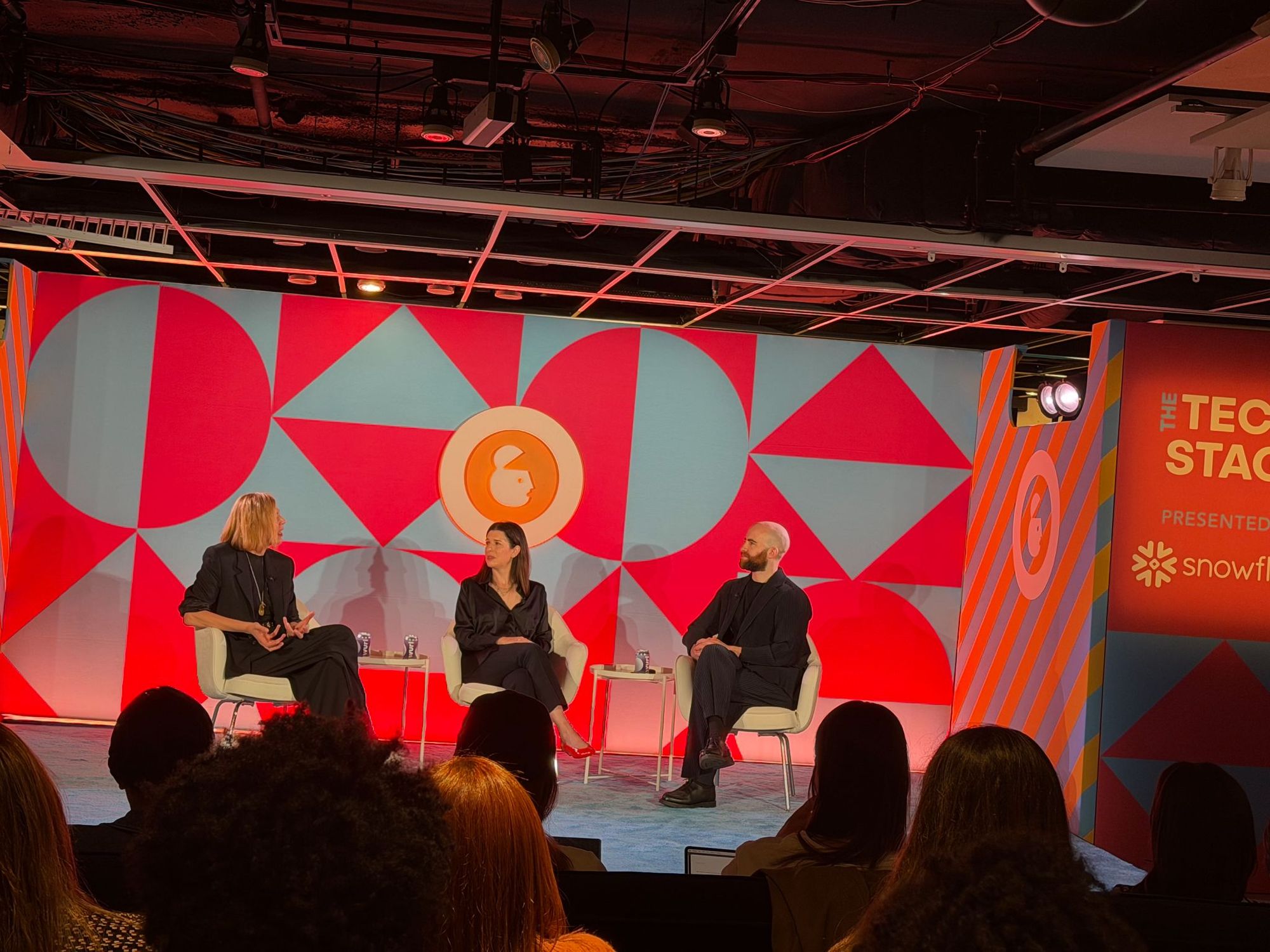
“We can't let robots determine the fate of our companies and our work,” Kick said in conversation with Kelly Thacker, Klaviyo’s VP of Product Marketing.
“For us, it's [determining] that middle ground where we're a very tactile brand. We bring a lot of depth and texture to the website and to the way we treat our clothes. We can't just expect a robot to be able to speak in our voice, speak to our experiences, and how we talk to our customer. The customer didn't fall in love with the robot.”
Instead, Dôen uses AI to make teams’ lives easier by eliminating manual work and empowering them to do more robust data analysis. This middle ground between man and machine was explored by brands across categories, including Sur La Table, Stitch Fix, and Crocs.
Removing the boring and mundane tasks so teams can do more and be more sounds incredibly valuable, especially when driving efficiency and enterprise value is top of mind for so many merchants. But beneath the surface lies an existential question for the industry, uncovered by our very own Brian Lange: “What do we lose when we eliminate the mundane?”
Listen to Phillip and Brian’s full recap of the show below:
Read on for more takeaways from eTail’s standout sessions.
P.S. After eTail, we stopped over at SoCom, the official conference for all things social commerce. Stay tuned for our coverage from that event on Monday.

If the Pants Fit, Wear Them. When consumers are shopping online, especially for something as personal and contextual as fashion, they’re not dissecting the technicalities of a PDP as an industry professional would. While they may consult product details, imagery, and size-selector tools, their shopping experience takes place through a lens of personal preference, long-term context, and individual story.
That’s why J. Crew Group shifted from a component-based strategy to an experience-based strategy for its eCommerce experience. Upon closer scrutiny, the team realized its PDPs were providing “conflicting guidance,” according to Ruchika Julapalli, SVP of Digital Experience and Technology at J.Crew.
“There was a lot of review content, and reviews might be hinting at sizes: if it’s a Cosmo pant, it’s on the larger side, so size down. Somewhere else in the experience, if you enter your height and weight, it would give you guidance on why it goes up or down. They weren't always saying the same thing, so it was kind of confusing.”
This was the catalyst moment for J. Crew to double down on review content. The company increased review volume by nearly 600%, refined return reasons to separate “wrong size” from “wrong fit,” and extracted granular tech pack data to inform product-specific size charts, which made recommendations more nuanced by the cut and style of each item.
AI-created review summaries then leveraged the robust underlying data to provide more detailed recommendations. PDPs reflect the reality of each garment, not a generic template, ultimately reducing returns, increasing confidence, and making the PDP a living layer of brand intelligence. Stylist guidance enriches some product pages by bringing data, tech, and merchandising together, helping customers understand how to style specific items and how that impacts the sizes they select.


Automation When it Matters. George Davis, CMO of Cozy Earth, and Tommy Kowalski, VP of Digital Commerce at HeyDude and Crocs, reframed AI as an operational lever. They bypassed theory and fluff and got right to the brass tacks, highlighting where AI is delivering measurable lift, and where human guardrails still matter most.
For Cozy Earth, the first major breakthrough was creative throughput. By embedding AI into briefing, ideation, and editing workflows, the brand scaled from roughly 50 ads per month to 400, which meant faster testing and sharper optimization. AI-driven lifecycle journeys replaced static batch sends, driving a 200–300% increase in revenue.
At Crocs and HeyDude, AI has accelerated the transformation of UGC and fueled double-digit acquisition growth, even amid traffic headwinds. The brands are now working to dynamically unify data across owned and partner channels, especially around sizing, which can sometimes be challenging as a full-size shoe company.
Although Cozy Earth’s work with AI is currently very reactive, Davis sees a near future when humans don’t need to be involved. “We're prompting it, we're telling it what to do, but even in the last few weeks, we built it out to where it owns workflows start to finish. And I think every area of the business will be owned, in some capacity, by agentic AI.”
Despite such a bold prediction, both Davis and Kowalski cautioned against unchecked automation. Cozy Earth saw satisfaction scores stumble in Q4 amid an AI-driven customer service push. “I think anywhere you're building trust between brand and consumer, it's important to keep the human there, at least for the time being,” Davis said.
Human guardrails are especially important in marketing and creative when brands, such as Crocs and HeyDude, have very distinct voices. “We have to continue to partner with vendors to put the guardrails in, to adapt our brand book and our brand voice so that, as we automate, it is really true to what they're saying,” Kowalski said. So if they get a text message from us, or an email, and then see an ad or an out-of-home campaign, the language is still the same.”


Where Taste Begins and Ends. As the traditional funnel collapses, brands are being forced to rethink where discovery begins. For brands like Sur La Table, their primary job should be to narrow experiences intelligently based on consumers’ wants, needs, and behaviors. While mass merchants and marketplaces focus on abundance, Sur La Table leans into thoughtful curation.
“We are a place for those people who see the kitchen as the most important room in the house,” noted Kristin Flor Perret, VP of Brand for Sur La Table. By leaning into confidence-building storytelling, the brand has elevated employee expertise and education as differentiators amid an endless sea of competitors. In fact, Sur La Table is the largest provider of recreational cooking classes in the US.
Stitch Fix has also leaned into radical personalization, but through innovative technology. Their AI-powered visualization tool allows customers to upload a selfie and see themselves styled in shoppable outfits. When you see yourself in the look, curated inspiration is contextualized, which activates motivation and purchase intent.
“We’re asking customers to do a lot of work. There’s overwhelming choice and it's putting the burden on them,” said Noah Zamansky, VP of Product and Client Experience at Stitch Fix. “We’re redefining that; we actually think shopping should start from inspiration, not from endless scrolling…We’re changing the psychology of the shopping experience.” These tech-enabled experiences augment the power of human stylists, who build relationships and candor with shoppers through tools like Stylist Connect.
Because Chinese Laundry is also in the fashion space, it too leans into occasion-based messaging and styling. As Sarah Zurrell, CMO of Chinese Laundry noted: “Variety doesn’t always bring joy; it sometimes creates friction. It’s our job as marketers to curate and to give the products that they’re really looking for.”
Brands are communicating these stories of taste and curation through new storytelling channels, such as TV advertising, allowing them to embrace more long-form storytelling rooted in brand positioning and emotional depth. “Storytelling is not a luxury item. I think it’s really infrastructure in the way that you need to think about it. If everything you’re putting out to somebody is ‘buy, buy, buy this thing,’ you’re not really making that connection,” advised Perret. Interestingly, Sur La Table has invested in both linear and connected TV because of the “incredible” reach of a 30-second story.
Because omnichannel engagement opportunities are so vast, the rules of measurement are evolving. Rather than over-indexing on last-click attribution, panelists encouraged using other KPIs, such as engagement, sharing behavior, session depth, and velocity-to-cart, that align more closely with immersive connection and emotional resonance.


Payment Flexibility as a Conversion Accelerant. The moment that matters most in eCommerce isn’t the final click. It’s earlier, as consumers search, discover, and experiment. That’s why brands are integrating payment-related content into the top of the funnel.
Whether through shopping assistants, search tools, or chatbots, finance options should appear when shoppers are still evaluating—and often are the right incentive to push them over the line. For example, in high-ticket categories like gaming PCs, flexible payment options can materially increase conversions.
Small UX changes can deliver outsized returns. Newegg tested a 0% promotional financing offer in Q4 of last year, and some “simple tweaks” to the product page led to significant GMV lifts and a 15X return on ad investment, according to Jack Phung, Senior Marketing Manager of Newegg.
“One of the challenging headwinds that we’re going to face in the industry this year is inventory cost increases due to AI demand,” Phung explained. “You probably hear about increases in NDR prices, GPU prices—all these individual components that go into a desktop PC or notebook. Unfortunately, all those prices are going to increase this year, so we want to be able to provide more flexible payment options for our shoppers.”
JD Sports saw the benefit of integrating flexible payment into Apple Pay. It may seem like a minor, cosmetic detail, but it played a seismic role in driving consumer adoption because it includes all of the customer’s profile information, such as preferred email and shipping address.
“We saw user adoption spike once that marketing really started to kick in, and I think that comes down to the consumer ultimately being able to have all of their stored information available as part of the Apple Pay wallet, and now this is just another option that's available to them,” said Henry Spear, SVP of Digital and Customer Care - North America, for JD Sports. “We're always trying to weigh what the consumer wants, what is available from a technology perspective, and finding that meeting in the middle of what that prioritization ultimately is.”



.svg)
