


of the United Kingdom’s capitol city.

Like any disruptive technology, the debates surrounding generative AI have operated in extremes. Early adopters have put generative AI on a pedestal, treating it as an all-in-one tool for consultative guidance, creative inspiration, and even emotional love and support. Detractors, meanwhile, have deemed AI a killer of creativity, a compressor of culture, and an enabler of simple, one-dimensional thinking.
In the context of commerce, the conversation has been just as polarizing. Is generative AI a robust tool for customer sovereignty, empowering them to take control over their browsing and buying journeys? Or is AI merely farming traffic, pushing consumers towards the same set of brands and products?
Methodology
We partnered with Cimulate to study the behavior of 1,000 US consumers ahead of the holiday season to understand their behaviors and perspectives. We found that, as with many things in life, the realities are far more nuanced than any headline has suggested.
In the first phase of the 2025 Holiday AI Shopping Benchmark, we found that generative AI platforms like ChatGPT, Perplexity, and Google Gemini are completely reframing the shopping journey for the modern consumer. AI has changed where people begin the shopping journey, how people decide what to buy, and what they expect from brands once intent is formed.
AI is becoming the new front door to commerce, and that has significant implications for merchants.
From Experimentation to Habit Formation
The first, most critical takeaway: AI is no longer a novelty. This data doesn’t speak solely to early adopters or tech-forward edge cases. AI has proven valuable to most consumers and is now officially a habitual tool.
Awareness exceeds 80% across Gen Z, Millennials, and Gen X, and nearly 70% of consumers already use generative AI platforms regularly. AI has even crossed the familiarity threshold and entered the mainstream of consumer behavior, with 52% of respondents saying they have used generative AI platforms to shop in the past.
What’s more telling, however, is intent. Nearly half of consumers (49%) say they would be likely to start researching gifts with AI this holiday season. A quarter said they were very likely to do so. A meaningful share of shoppers are now turning to ChatGPT, Perplexity, Gemini, and similar platforms before traditional search engines or retailer websites.
No clicking senselessly through results, hoping to find a relevant outcome. No more scrolling endlessly through lines of merchandise, hoping to be inspired.
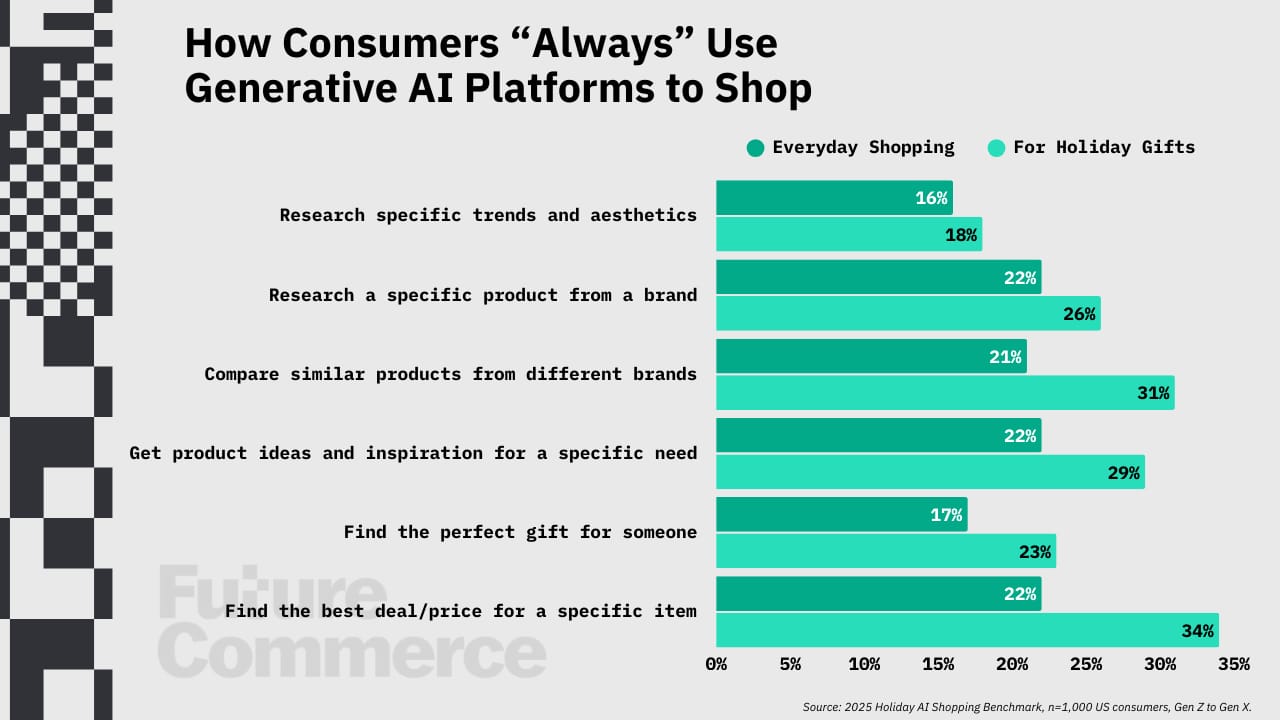
Instead, respondents are venturing to AI platforms first to find deals, get product ideas and inspiration, and research specific products from brands. They are offloading curiosity, uncertainty, and comparison to AI and seeing value in the outcomes, whether in time, effort, or money.
AI is no longer something consumers “try.” They’re reaching for it (and trusting it) in high-stakes moments, such as gifting and highly considered purchases.
AI’s True Role in the Funnel
Despite speculation about agentic checkout and autonomous purchasing, AI is found more valuable as a tool for aggregating options, synthesizing information, and validating choices. This is not where consumers want to complete transactions (yet).
When a generative AI platform makes a product recommendation, 77% of consumers are more likely to click through to a merchant's website to continue researching or to complete the purchase. Only 23% prefer to buy directly within the AI platform.
This is the critical nuance missing from much of the industry discourse. AI is not stealing conversion, but it is reshaping the funnel upstream.
AI platforms now do much of the work consumers once did across dozens of tabs and sites. It conducts research, narrows options, surfaces trade-offs, and finds the best deal. When a shopper lands on a brand or retailer site, they arrive with higher conviction and lower tolerance for friction. This sentiment was especially strong during the holiday shopping season, when consumers are increasingly turning to AI to make their lives easier and more efficient.
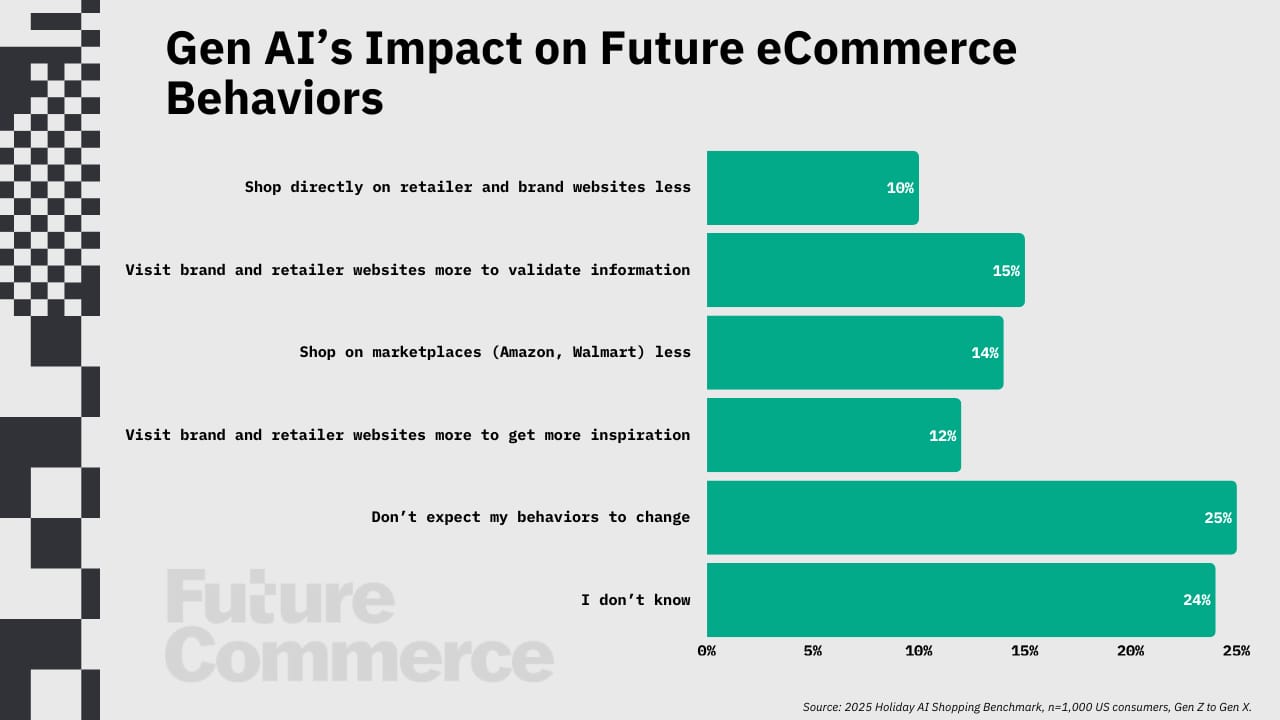
Only 10% of consumers said using AI to holiday shop this year would encourage them to visit branded eCommerce sites less frequently. AI is redefining what eCommerce sites are for.
These branded spaces are where decisions are confirmed, trust is won, and relationships are nurtured through robust storytelling and worldbuilding. While consumers may click through to fewer sites and visit less often, they are more engaged and are more likely to act.
The Trust-to-Utility Equation
Much has been made of trust as a barrier to AI adoption. The data provides additional context on how trust is earned and maintained among today’s consumers. Among consumers who have not yet used AI to shop, the top barriers connect to preference and comfort.
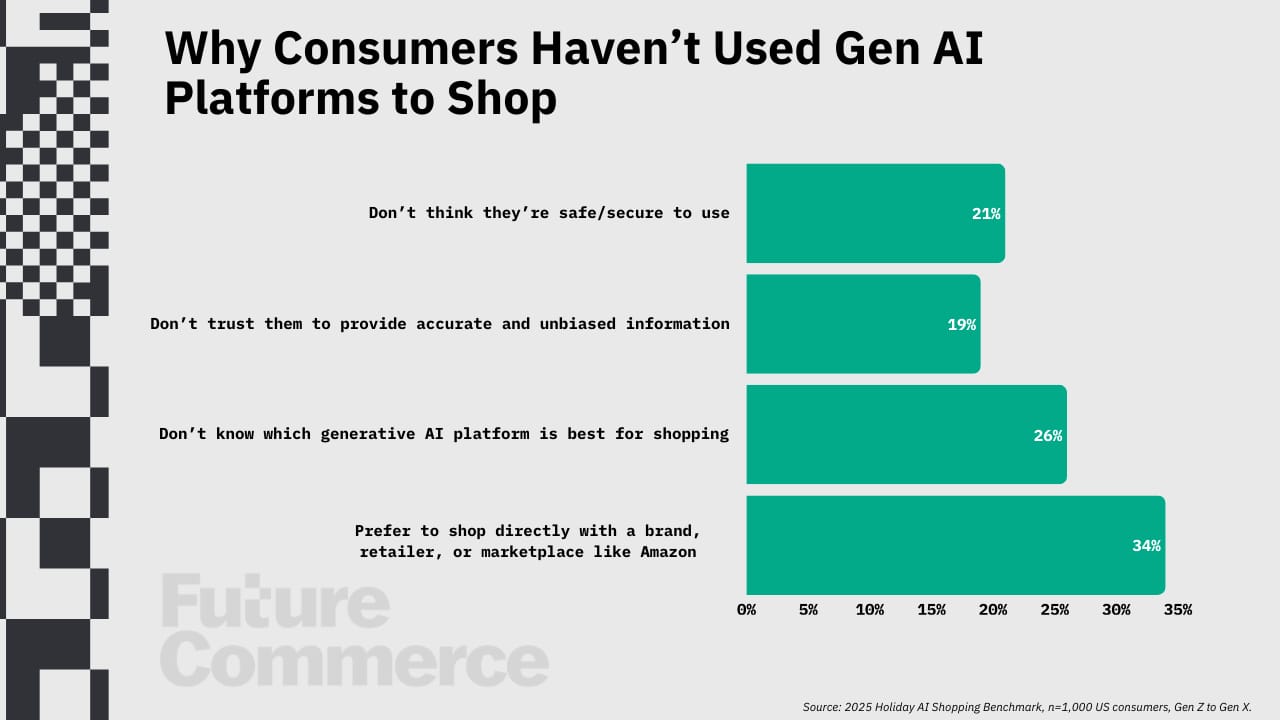
Looking at the broader dataset, though, trust is an inhibitor for only approximately 20%, and compared to other channels, AI fares surprisingly well, notably on par with search engines (41%) and brand websites (37%). A fair share of respondents said they trust AI more than social media (16%) and influencers (17%).
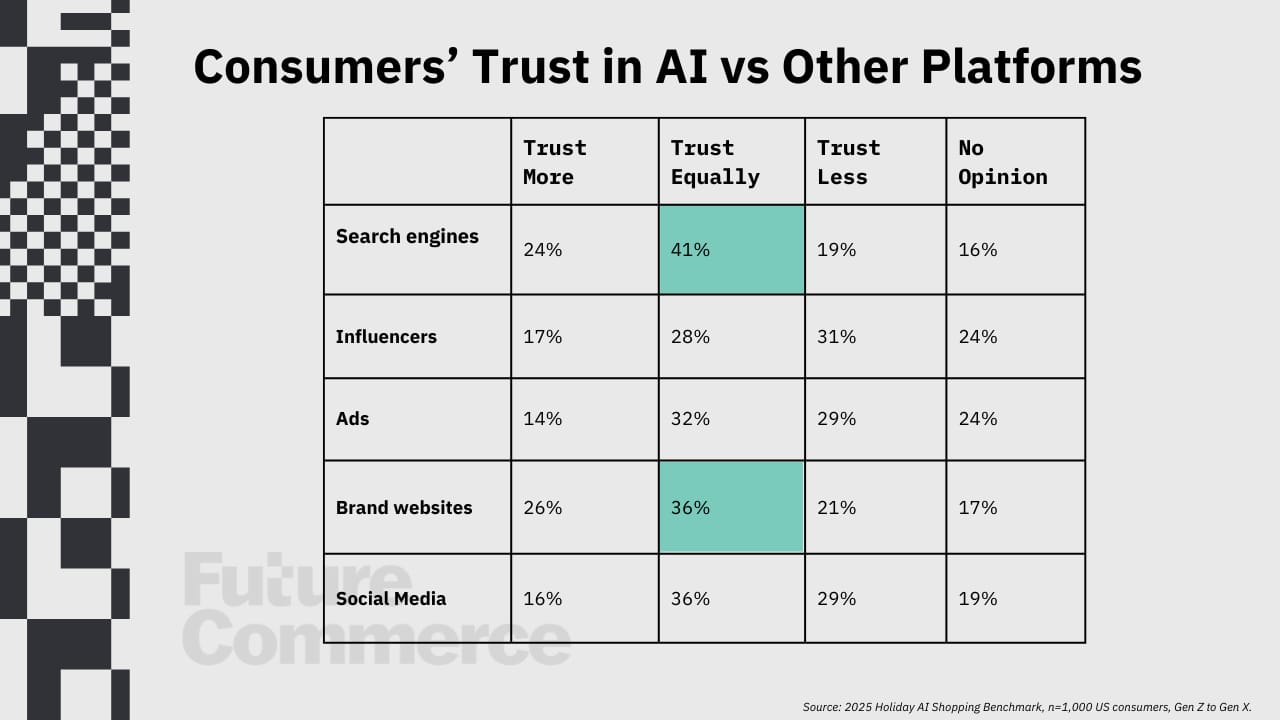
Surprisingly, Gen Z is showing more trust in AI than in the content they spend so much time consuming. With 21% saying they trust AI more than social media and one in five saying they trust AI more than influencers, there are early signs of how younger consumers perceive social feeds laden with sponsored content and algorithmic noise versus an always-available, contextual Answer Engine. After years of experiencing breakneck trend cycles and homogeneous culture, their fatigue is becoming more tangible.
But make no mistake, the consumers who use AI to shop, especially for holiday gifts, expect tangible value. And that value is tethered mainly to consumers’ wallets.
Deal Fatigue Is the Behavioral Unlock
AI has not yet earned the right to be the primary checkout lane, but price moves it closer.
More than 57% of consumers are so tired of hunting for deals that they want AI to handle price comparison on their behalf. Many shoppers already partially delegate price hunting to AI. Among those who have used AI for shopping, 60% have used it at least sometimes to find the best price on an item (22% always, 38% sometimes).
Nearly a third (31%) would even buy directly through an AI platform if it surfaced the best deal, regardless of whether they knew the brand and had shopped with it before. That figure jumps to 40% among Gen Z, showing a generational shift in how loyalty is formed and eventually negotiated.
Consumers use generative AI platforms to save them time, money, and mental energy. Twelve percent of consumers explicitly say they are “sick of hunting for deals” and would love for AI to do it for them. For Millennials, who often juggle careers, families, and financial pressures, that number is even higher (15%). Moreover, despite 31% of Millennials saying they’re “sick of AI being pushed on me,” the highest of any generation surveyed, 56% said they find the idea of AI-driven deal-hunting appealing.
This highlights the contrast between each generation's relationship with AI commerce. Gen Z is a generation seemingly at war with itself: when asked whether they'd buy from an unfamiliar retailer for an AI-surfaced deal, 40% said yes, 40% said they'd return to their preferred retailer, and only 19% were undecided.
Millennials, by contrast, present a paradox. The cohort most likely to experience AI fatigue is also the most likely to buy directly in-platform (28%) and to delegate deal hunting to AI. Whether these are the same individuals holding contradictory views or distinct sub-segments, the strategic implication is the same: Millennials are tired of promises of grandeur but are receptive to utility.
AI earns a seat at the table when it removes friction and ensures economic efficiency. When the value is clear, concerns around unfamiliar retailers or even new purchase paths recede into the background. From a strategic standpoint, this reframes AI’s so-called “killer feature.”
Where AI Wins (and Where It Doesn’t)
The data also clearly delineates which categories are most conducive to AI shopping. At Future Commerce, we believe that consumers are omnimodal. The channels they choose are based on their in-the-moment needs, goals, and contexts, which are further shaped by their past experiences, emotional triggers, and what they want from the shopping experience at that exact moment.
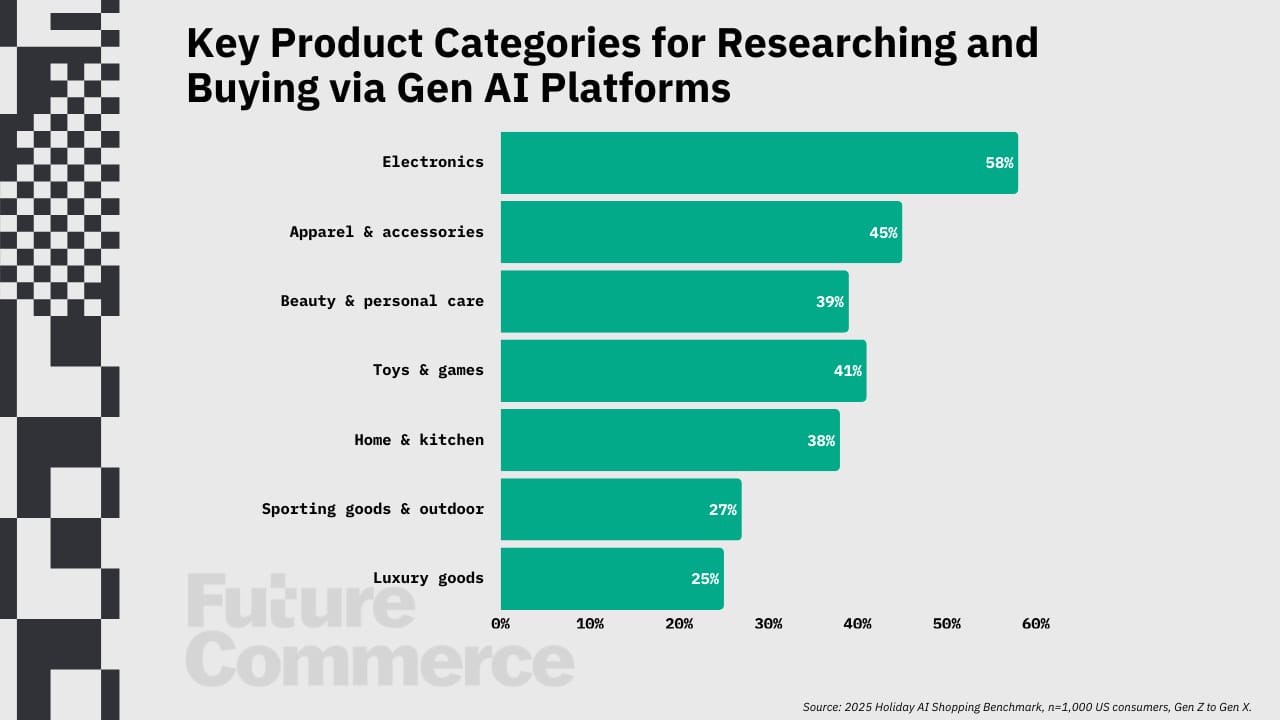
While holiday shopping, consumers are most likely to use AI to research or purchase products when knowing specifications leads to better decisions. Electronics lead the way, followed by apparel and accessories, toys and games, beauty, and home goods. These are categories where information density is high, and differentiation can be rationalized.
During the holiday season in particular, it’s about getting the best product at the best possible price; you can’t validate your decision thoroughly without the data to back it up.
At the other end of the spectrum, categories tied to symbolism, identity, and deep brand affinity—such as luxury and certain sporting goods—see significantly lower expected AI usage. This bifurcation matters because it presents opportunities at both ends of the spectrum.
In AI-strong categories, content must answer questions by focusing on structured data, detailed attributes, comparisons, and clear value propositions are essential. In AI-weaker categories, content must create desire through storytelling, worldbuilding, and emotional resonance.
Brands must understand the role AI plays for consumers when they shop in their category, then plan and design accordingly.
The Unexpected AI Casualty: Physical Retail
The most surprising finding in the research has nothing to do with eCommerce cannibalization. It has everything to do with how AI is impacting consumers’ perception of the shopping experience.
When you have all of the world’s brand and product options at your fingertips, and everything is organized, categorized, and prioritized for you, what benefit does going to a store bring? For some, it brings meaning, community, and belonging. For others, it brings nothing…so they’ll just stay home on the couch.
When asked how using AI to plan holiday shopping would impact behavior, 30% of consumers said they would visit physical stores less often. Only 10% said they would visit brand or retailer websites less. In other words, AI threatens physical retail three times more than branded eCommerce. Gen Z leads this shift, with 36% saying they expect to visit stores less after holiday shopping with AI.
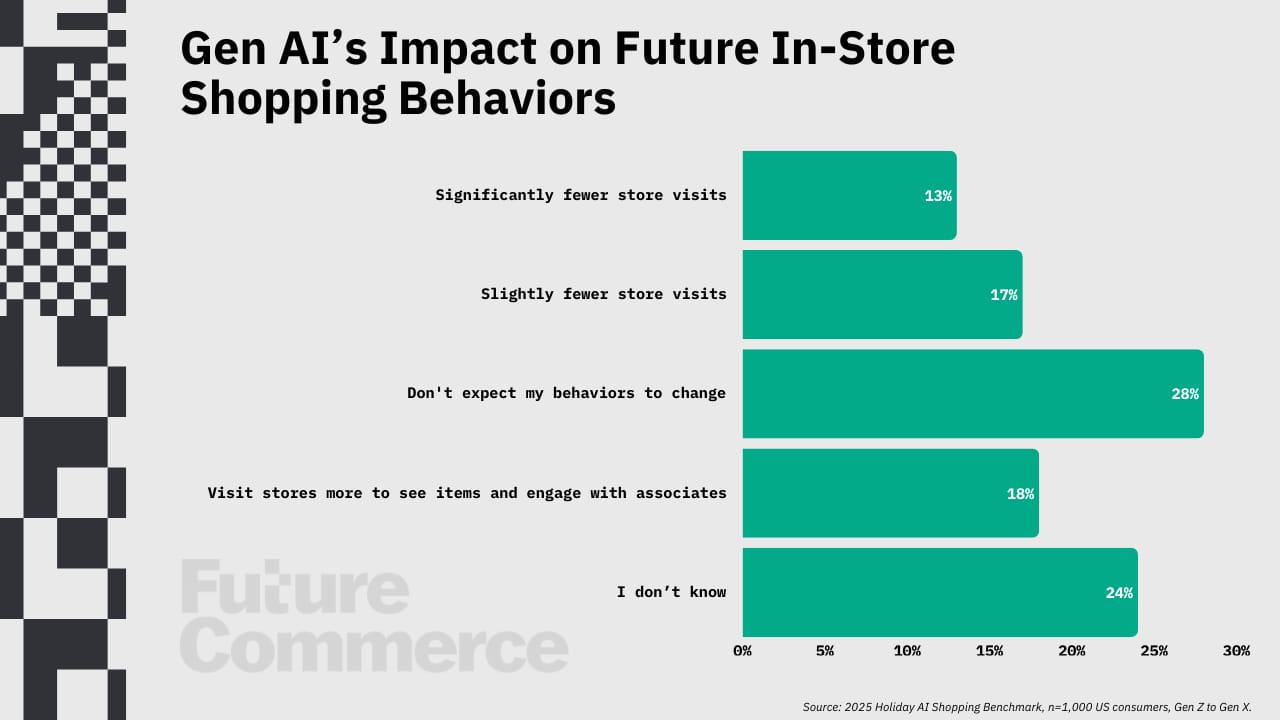
Compare this self-identified behavior with Gen X, where only 26% expect fewer visits. The gap reflects not just adoption rates, but fundamentally different relationships with physical space. The digital natives are restless.
For decades, brick-and-mortar retail’s value proposition has rested on discovery and comparison. AI now performs those functions faster, cheaper, and from the couch. These results aren’t meant to invalidate the value of brick-and-mortar itself. If anything, it confirms just how critical other components of the experience are. Unless stores offer something meaningfully different, such as access to community, high-value service, or cultural experiences, they risk losing relevance in the critical top and middle stages of the funnel altogether.
AI may remove the need to wander, but it doesn’t eliminate our innate need for authentic human connection and belonging.
What it All Means for Brands and Retailers
There are clear strategic and tactical implications of this research. And they impact teams across marketing, creative, digital, and operations.
Discovery now occurs through answer engines, so if brands are invisible to AI-mediated discovery, they risk being excluded from the consideration set entirely. As a result, they must become data-first, providing the rich, accurate, and structured data engines need to trust and validate a brand and/or product.
That doesn’t mean the eCommerce site no longer matters. With 77% of consumers saying they would opt in to click through to eCommerce sites from AI platforms sets the stage for on-platform advertising. This is a critical area we’re watching in 2026. Moreover, high-intent shoppers require a high-value experience. When consumers click through from AI platforms to eCommerce sites, they have a clear mission and vision for what they’re looking for. This changes what brand sites need to be: less discovery, more conversion. Landing pages for AI traffic should mirror the specificity of the query that produced them.
Sites should also provide the value that AI can’t. AI can gather information, research, and surface answers, but it can’t fully convey a brand’s lore or create story-centered belonging. That remains the domain of human-driven brand experiences.
The future of commerce will be shaped by brands that design for both data-rich environments that machines can trust and immersive, differentiated experiences that humans want to return to and share.
AI may be the front door to commerce. But what happens after someone walks through it is still up to brands.
And that is where the real opportunity lies.
Like any disruptive technology, the debates surrounding generative AI have operated in extremes. Early adopters have put generative AI on a pedestal, treating it as an all-in-one tool for consultative guidance, creative inspiration, and even emotional love and support. Detractors, meanwhile, have deemed AI a killer of creativity, a compressor of culture, and an enabler of simple, one-dimensional thinking.
In the context of commerce, the conversation has been just as polarizing. Is generative AI a robust tool for customer sovereignty, empowering them to take control over their browsing and buying journeys? Or is AI merely farming traffic, pushing consumers towards the same set of brands and products?
Methodology
We partnered with Cimulate to study the behavior of 1,000 US consumers ahead of the holiday season to understand their behaviors and perspectives. We found that, as with many things in life, the realities are far more nuanced than any headline has suggested.
In the first phase of the 2025 Holiday AI Shopping Benchmark, we found that generative AI platforms like ChatGPT, Perplexity, and Google Gemini are completely reframing the shopping journey for the modern consumer. AI has changed where people begin the shopping journey, how people decide what to buy, and what they expect from brands once intent is formed.
AI is becoming the new front door to commerce, and that has significant implications for merchants.
From Experimentation to Habit Formation
The first, most critical takeaway: AI is no longer a novelty. This data doesn’t speak solely to early adopters or tech-forward edge cases. AI has proven valuable to most consumers and is now officially a habitual tool.
Awareness exceeds 80% across Gen Z, Millennials, and Gen X, and nearly 70% of consumers already use generative AI platforms regularly. AI has even crossed the familiarity threshold and entered the mainstream of consumer behavior, with 52% of respondents saying they have used generative AI platforms to shop in the past.
What’s more telling, however, is intent. Nearly half of consumers (49%) say they would be likely to start researching gifts with AI this holiday season. A quarter said they were very likely to do so. A meaningful share of shoppers are now turning to ChatGPT, Perplexity, Gemini, and similar platforms before traditional search engines or retailer websites.
No clicking senselessly through results, hoping to find a relevant outcome. No more scrolling endlessly through lines of merchandise, hoping to be inspired.
Instead, respondents are venturing to AI platforms first to find deals, get product ideas and inspiration, and research specific products from brands. They are offloading curiosity, uncertainty, and comparison to AI and seeing value in the outcomes, whether in time, effort, or money.
AI is no longer something consumers “try.” They’re reaching for it (and trusting it) in high-stakes moments, such as gifting and highly considered purchases.
AI’s True Role in the Funnel
Despite speculation about agentic checkout and autonomous purchasing, AI is found more valuable as a tool for aggregating options, synthesizing information, and validating choices. This is not where consumers want to complete transactions (yet).
When a generative AI platform makes a product recommendation, 77% of consumers are more likely to click through to a merchant's website to continue researching or to complete the purchase. Only 23% prefer to buy directly within the AI platform.
This is the critical nuance missing from much of the industry discourse. AI is not stealing conversion, but it is reshaping the funnel upstream.
AI platforms now do much of the work consumers once did across dozens of tabs and sites. It conducts research, narrows options, surfaces trade-offs, and finds the best deal. When a shopper lands on a brand or retailer site, they arrive with higher conviction and lower tolerance for friction. This sentiment was especially strong during the holiday shopping season, when consumers are increasingly turning to AI to make their lives easier and more efficient.
Only 10% of consumers said using AI to holiday shop this year would encourage them to visit branded eCommerce sites less frequently. AI is redefining what eCommerce sites are for.
These branded spaces are where decisions are confirmed, trust is won, and relationships are nurtured through robust storytelling and worldbuilding. While consumers may click through to fewer sites and visit less often, they are more engaged and are more likely to act.
The Trust-to-Utility Equation
Much has been made of trust as a barrier to AI adoption. The data provides additional context on how trust is earned and maintained among today’s consumers. Among consumers who have not yet used AI to shop, the top barriers connect to preference and comfort.
Looking at the broader dataset, though, trust is an inhibitor for only approximately 20%, and compared to other channels, AI fares surprisingly well, notably on par with search engines (41%) and brand websites (37%). A fair share of respondents said they trust AI more than social media (16%) and influencers (17%).
Surprisingly, Gen Z is showing more trust in AI than in the content they spend so much time consuming. With 21% saying they trust AI more than social media and one in five saying they trust AI more than influencers, there are early signs of how younger consumers perceive social feeds laden with sponsored content and algorithmic noise versus an always-available, contextual Answer Engine. After years of experiencing breakneck trend cycles and homogeneous culture, their fatigue is becoming more tangible.
But make no mistake, the consumers who use AI to shop, especially for holiday gifts, expect tangible value. And that value is tethered mainly to consumers’ wallets.
Deal Fatigue Is the Behavioral Unlock
AI has not yet earned the right to be the primary checkout lane, but price moves it closer.
More than 57% of consumers are so tired of hunting for deals that they want AI to handle price comparison on their behalf. Many shoppers already partially delegate price hunting to AI. Among those who have used AI for shopping, 60% have used it at least sometimes to find the best price on an item (22% always, 38% sometimes).
Nearly a third (31%) would even buy directly through an AI platform if it surfaced the best deal, regardless of whether they knew the brand and had shopped with it before. That figure jumps to 40% among Gen Z, showing a generational shift in how loyalty is formed and eventually negotiated.
Consumers use generative AI platforms to save them time, money, and mental energy. Twelve percent of consumers explicitly say they are “sick of hunting for deals” and would love for AI to do it for them. For Millennials, who often juggle careers, families, and financial pressures, that number is even higher (15%). Moreover, despite 31% of Millennials saying they’re “sick of AI being pushed on me,” the highest of any generation surveyed, 56% said they find the idea of AI-driven deal-hunting appealing.
This highlights the contrast between each generation's relationship with AI commerce. Gen Z is a generation seemingly at war with itself: when asked whether they'd buy from an unfamiliar retailer for an AI-surfaced deal, 40% said yes, 40% said they'd return to their preferred retailer, and only 19% were undecided.
Millennials, by contrast, present a paradox. The cohort most likely to experience AI fatigue is also the most likely to buy directly in-platform (28%) and to delegate deal hunting to AI. Whether these are the same individuals holding contradictory views or distinct sub-segments, the strategic implication is the same: Millennials are tired of promises of grandeur but are receptive to utility.
AI earns a seat at the table when it removes friction and ensures economic efficiency. When the value is clear, concerns around unfamiliar retailers or even new purchase paths recede into the background. From a strategic standpoint, this reframes AI’s so-called “killer feature.”
Where AI Wins (and Where It Doesn’t)
The data also clearly delineates which categories are most conducive to AI shopping. At Future Commerce, we believe that consumers are omnimodal. The channels they choose are based on their in-the-moment needs, goals, and contexts, which are further shaped by their past experiences, emotional triggers, and what they want from the shopping experience at that exact moment.
While holiday shopping, consumers are most likely to use AI to research or purchase products when knowing specifications leads to better decisions. Electronics lead the way, followed by apparel and accessories, toys and games, beauty, and home goods. These are categories where information density is high, and differentiation can be rationalized.
During the holiday season in particular, it’s about getting the best product at the best possible price; you can’t validate your decision thoroughly without the data to back it up.
At the other end of the spectrum, categories tied to symbolism, identity, and deep brand affinity—such as luxury and certain sporting goods—see significantly lower expected AI usage. This bifurcation matters because it presents opportunities at both ends of the spectrum.
In AI-strong categories, content must answer questions by focusing on structured data, detailed attributes, comparisons, and clear value propositions are essential. In AI-weaker categories, content must create desire through storytelling, worldbuilding, and emotional resonance.
Brands must understand the role AI plays for consumers when they shop in their category, then plan and design accordingly.
The Unexpected AI Casualty: Physical Retail
The most surprising finding in the research has nothing to do with eCommerce cannibalization. It has everything to do with how AI is impacting consumers’ perception of the shopping experience.
When you have all of the world’s brand and product options at your fingertips, and everything is organized, categorized, and prioritized for you, what benefit does going to a store bring? For some, it brings meaning, community, and belonging. For others, it brings nothing…so they’ll just stay home on the couch.
When asked how using AI to plan holiday shopping would impact behavior, 30% of consumers said they would visit physical stores less often. Only 10% said they would visit brand or retailer websites less. In other words, AI threatens physical retail three times more than branded eCommerce. Gen Z leads this shift, with 36% saying they expect to visit stores less after holiday shopping with AI.
Compare this self-identified behavior with Gen X, where only 26% expect fewer visits. The gap reflects not just adoption rates, but fundamentally different relationships with physical space. The digital natives are restless.
For decades, brick-and-mortar retail’s value proposition has rested on discovery and comparison. AI now performs those functions faster, cheaper, and from the couch. These results aren’t meant to invalidate the value of brick-and-mortar itself. If anything, it confirms just how critical other components of the experience are. Unless stores offer something meaningfully different, such as access to community, high-value service, or cultural experiences, they risk losing relevance in the critical top and middle stages of the funnel altogether.
AI may remove the need to wander, but it doesn’t eliminate our innate need for authentic human connection and belonging.
What it All Means for Brands and Retailers
There are clear strategic and tactical implications of this research. And they impact teams across marketing, creative, digital, and operations.
Discovery now occurs through answer engines, so if brands are invisible to AI-mediated discovery, they risk being excluded from the consideration set entirely. As a result, they must become data-first, providing the rich, accurate, and structured data engines need to trust and validate a brand and/or product.
That doesn’t mean the eCommerce site no longer matters. With 77% of consumers saying they would opt in to click through to eCommerce sites from AI platforms sets the stage for on-platform advertising. This is a critical area we’re watching in 2026. Moreover, high-intent shoppers require a high-value experience. When consumers click through from AI platforms to eCommerce sites, they have a clear mission and vision for what they’re looking for. This changes what brand sites need to be: less discovery, more conversion. Landing pages for AI traffic should mirror the specificity of the query that produced them.
Sites should also provide the value that AI can’t. AI can gather information, research, and surface answers, but it can’t fully convey a brand’s lore or create story-centered belonging. That remains the domain of human-driven brand experiences.
The future of commerce will be shaped by brands that design for both data-rich environments that machines can trust and immersive, differentiated experiences that humans want to return to and share.
AI may be the front door to commerce. But what happens after someone walks through it is still up to brands.
And that is where the real opportunity lies.
Like any disruptive technology, the debates surrounding generative AI have operated in extremes. Early adopters have put generative AI on a pedestal, treating it as an all-in-one tool for consultative guidance, creative inspiration, and even emotional love and support. Detractors, meanwhile, have deemed AI a killer of creativity, a compressor of culture, and an enabler of simple, one-dimensional thinking.
In the context of commerce, the conversation has been just as polarizing. Is generative AI a robust tool for customer sovereignty, empowering them to take control over their browsing and buying journeys? Or is AI merely farming traffic, pushing consumers towards the same set of brands and products?
Methodology
We partnered with Cimulate to study the behavior of 1,000 US consumers ahead of the holiday season to understand their behaviors and perspectives. We found that, as with many things in life, the realities are far more nuanced than any headline has suggested.
In the first phase of the 2025 Holiday AI Shopping Benchmark, we found that generative AI platforms like ChatGPT, Perplexity, and Google Gemini are completely reframing the shopping journey for the modern consumer. AI has changed where people begin the shopping journey, how people decide what to buy, and what they expect from brands once intent is formed.
AI is becoming the new front door to commerce, and that has significant implications for merchants.
From Experimentation to Habit Formation
The first, most critical takeaway: AI is no longer a novelty. This data doesn’t speak solely to early adopters or tech-forward edge cases. AI has proven valuable to most consumers and is now officially a habitual tool.
Awareness exceeds 80% across Gen Z, Millennials, and Gen X, and nearly 70% of consumers already use generative AI platforms regularly. AI has even crossed the familiarity threshold and entered the mainstream of consumer behavior, with 52% of respondents saying they have used generative AI platforms to shop in the past.
What’s more telling, however, is intent. Nearly half of consumers (49%) say they would be likely to start researching gifts with AI this holiday season. A quarter said they were very likely to do so. A meaningful share of shoppers are now turning to ChatGPT, Perplexity, Gemini, and similar platforms before traditional search engines or retailer websites.
No clicking senselessly through results, hoping to find a relevant outcome. No more scrolling endlessly through lines of merchandise, hoping to be inspired.
Instead, respondents are venturing to AI platforms first to find deals, get product ideas and inspiration, and research specific products from brands. They are offloading curiosity, uncertainty, and comparison to AI and seeing value in the outcomes, whether in time, effort, or money.
AI is no longer something consumers “try.” They’re reaching for it (and trusting it) in high-stakes moments, such as gifting and highly considered purchases.
AI’s True Role in the Funnel
Despite speculation about agentic checkout and autonomous purchasing, AI is found more valuable as a tool for aggregating options, synthesizing information, and validating choices. This is not where consumers want to complete transactions (yet).
When a generative AI platform makes a product recommendation, 77% of consumers are more likely to click through to a merchant's website to continue researching or to complete the purchase. Only 23% prefer to buy directly within the AI platform.
This is the critical nuance missing from much of the industry discourse. AI is not stealing conversion, but it is reshaping the funnel upstream.
AI platforms now do much of the work consumers once did across dozens of tabs and sites. It conducts research, narrows options, surfaces trade-offs, and finds the best deal. When a shopper lands on a brand or retailer site, they arrive with higher conviction and lower tolerance for friction. This sentiment was especially strong during the holiday shopping season, when consumers are increasingly turning to AI to make their lives easier and more efficient.
Only 10% of consumers said using AI to holiday shop this year would encourage them to visit branded eCommerce sites less frequently. AI is redefining what eCommerce sites are for.
These branded spaces are where decisions are confirmed, trust is won, and relationships are nurtured through robust storytelling and worldbuilding. While consumers may click through to fewer sites and visit less often, they are more engaged and are more likely to act.
The Trust-to-Utility Equation
Much has been made of trust as a barrier to AI adoption. The data provides additional context on how trust is earned and maintained among today’s consumers. Among consumers who have not yet used AI to shop, the top barriers connect to preference and comfort.
Looking at the broader dataset, though, trust is an inhibitor for only approximately 20%, and compared to other channels, AI fares surprisingly well, notably on par with search engines (41%) and brand websites (37%). A fair share of respondents said they trust AI more than social media (16%) and influencers (17%).
Surprisingly, Gen Z is showing more trust in AI than in the content they spend so much time consuming. With 21% saying they trust AI more than social media and one in five saying they trust AI more than influencers, there are early signs of how younger consumers perceive social feeds laden with sponsored content and algorithmic noise versus an always-available, contextual Answer Engine. After years of experiencing breakneck trend cycles and homogeneous culture, their fatigue is becoming more tangible.
But make no mistake, the consumers who use AI to shop, especially for holiday gifts, expect tangible value. And that value is tethered mainly to consumers’ wallets.
Deal Fatigue Is the Behavioral Unlock
AI has not yet earned the right to be the primary checkout lane, but price moves it closer.
More than 57% of consumers are so tired of hunting for deals that they want AI to handle price comparison on their behalf. Many shoppers already partially delegate price hunting to AI. Among those who have used AI for shopping, 60% have used it at least sometimes to find the best price on an item (22% always, 38% sometimes).
Nearly a third (31%) would even buy directly through an AI platform if it surfaced the best deal, regardless of whether they knew the brand and had shopped with it before. That figure jumps to 40% among Gen Z, showing a generational shift in how loyalty is formed and eventually negotiated.
Consumers use generative AI platforms to save them time, money, and mental energy. Twelve percent of consumers explicitly say they are “sick of hunting for deals” and would love for AI to do it for them. For Millennials, who often juggle careers, families, and financial pressures, that number is even higher (15%). Moreover, despite 31% of Millennials saying they’re “sick of AI being pushed on me,” the highest of any generation surveyed, 56% said they find the idea of AI-driven deal-hunting appealing.
This highlights the contrast between each generation's relationship with AI commerce. Gen Z is a generation seemingly at war with itself: when asked whether they'd buy from an unfamiliar retailer for an AI-surfaced deal, 40% said yes, 40% said they'd return to their preferred retailer, and only 19% were undecided.
Millennials, by contrast, present a paradox. The cohort most likely to experience AI fatigue is also the most likely to buy directly in-platform (28%) and to delegate deal hunting to AI. Whether these are the same individuals holding contradictory views or distinct sub-segments, the strategic implication is the same: Millennials are tired of promises of grandeur but are receptive to utility.
AI earns a seat at the table when it removes friction and ensures economic efficiency. When the value is clear, concerns around unfamiliar retailers or even new purchase paths recede into the background. From a strategic standpoint, this reframes AI’s so-called “killer feature.”
Where AI Wins (and Where It Doesn’t)
The data also clearly delineates which categories are most conducive to AI shopping. At Future Commerce, we believe that consumers are omnimodal. The channels they choose are based on their in-the-moment needs, goals, and contexts, which are further shaped by their past experiences, emotional triggers, and what they want from the shopping experience at that exact moment.
While holiday shopping, consumers are most likely to use AI to research or purchase products when knowing specifications leads to better decisions. Electronics lead the way, followed by apparel and accessories, toys and games, beauty, and home goods. These are categories where information density is high, and differentiation can be rationalized.
During the holiday season in particular, it’s about getting the best product at the best possible price; you can’t validate your decision thoroughly without the data to back it up.
At the other end of the spectrum, categories tied to symbolism, identity, and deep brand affinity—such as luxury and certain sporting goods—see significantly lower expected AI usage. This bifurcation matters because it presents opportunities at both ends of the spectrum.
In AI-strong categories, content must answer questions by focusing on structured data, detailed attributes, comparisons, and clear value propositions are essential. In AI-weaker categories, content must create desire through storytelling, worldbuilding, and emotional resonance.
Brands must understand the role AI plays for consumers when they shop in their category, then plan and design accordingly.
The Unexpected AI Casualty: Physical Retail
The most surprising finding in the research has nothing to do with eCommerce cannibalization. It has everything to do with how AI is impacting consumers’ perception of the shopping experience.
When you have all of the world’s brand and product options at your fingertips, and everything is organized, categorized, and prioritized for you, what benefit does going to a store bring? For some, it brings meaning, community, and belonging. For others, it brings nothing…so they’ll just stay home on the couch.
When asked how using AI to plan holiday shopping would impact behavior, 30% of consumers said they would visit physical stores less often. Only 10% said they would visit brand or retailer websites less. In other words, AI threatens physical retail three times more than branded eCommerce. Gen Z leads this shift, with 36% saying they expect to visit stores less after holiday shopping with AI.
Compare this self-identified behavior with Gen X, where only 26% expect fewer visits. The gap reflects not just adoption rates, but fundamentally different relationships with physical space. The digital natives are restless.
For decades, brick-and-mortar retail’s value proposition has rested on discovery and comparison. AI now performs those functions faster, cheaper, and from the couch. These results aren’t meant to invalidate the value of brick-and-mortar itself. If anything, it confirms just how critical other components of the experience are. Unless stores offer something meaningfully different, such as access to community, high-value service, or cultural experiences, they risk losing relevance in the critical top and middle stages of the funnel altogether.
AI may remove the need to wander, but it doesn’t eliminate our innate need for authentic human connection and belonging.
What it All Means for Brands and Retailers
There are clear strategic and tactical implications of this research. And they impact teams across marketing, creative, digital, and operations.
Discovery now occurs through answer engines, so if brands are invisible to AI-mediated discovery, they risk being excluded from the consideration set entirely. As a result, they must become data-first, providing the rich, accurate, and structured data engines need to trust and validate a brand and/or product.
That doesn’t mean the eCommerce site no longer matters. With 77% of consumers saying they would opt in to click through to eCommerce sites from AI platforms sets the stage for on-platform advertising. This is a critical area we’re watching in 2026. Moreover, high-intent shoppers require a high-value experience. When consumers click through from AI platforms to eCommerce sites, they have a clear mission and vision for what they’re looking for. This changes what brand sites need to be: less discovery, more conversion. Landing pages for AI traffic should mirror the specificity of the query that produced them.
Sites should also provide the value that AI can’t. AI can gather information, research, and surface answers, but it can’t fully convey a brand’s lore or create story-centered belonging. That remains the domain of human-driven brand experiences.
The future of commerce will be shaped by brands that design for both data-rich environments that machines can trust and immersive, differentiated experiences that humans want to return to and share.
AI may be the front door to commerce. But what happens after someone walks through it is still up to brands.
And that is where the real opportunity lies.
Like any disruptive technology, the debates surrounding generative AI have operated in extremes. Early adopters have put generative AI on a pedestal, treating it as an all-in-one tool for consultative guidance, creative inspiration, and even emotional love and support. Detractors, meanwhile, have deemed AI a killer of creativity, a compressor of culture, and an enabler of simple, one-dimensional thinking.
In the context of commerce, the conversation has been just as polarizing. Is generative AI a robust tool for customer sovereignty, empowering them to take control over their browsing and buying journeys? Or is AI merely farming traffic, pushing consumers towards the same set of brands and products?
Methodology
We partnered with Cimulate to study the behavior of 1,000 US consumers ahead of the holiday season to understand their behaviors and perspectives. We found that, as with many things in life, the realities are far more nuanced than any headline has suggested.
In the first phase of the 2025 Holiday AI Shopping Benchmark, we found that generative AI platforms like ChatGPT, Perplexity, and Google Gemini are completely reframing the shopping journey for the modern consumer. AI has changed where people begin the shopping journey, how people decide what to buy, and what they expect from brands once intent is formed.
AI is becoming the new front door to commerce, and that has significant implications for merchants.
From Experimentation to Habit Formation
The first, most critical takeaway: AI is no longer a novelty. This data doesn’t speak solely to early adopters or tech-forward edge cases. AI has proven valuable to most consumers and is now officially a habitual tool.
Awareness exceeds 80% across Gen Z, Millennials, and Gen X, and nearly 70% of consumers already use generative AI platforms regularly. AI has even crossed the familiarity threshold and entered the mainstream of consumer behavior, with 52% of respondents saying they have used generative AI platforms to shop in the past.
What’s more telling, however, is intent. Nearly half of consumers (49%) say they would be likely to start researching gifts with AI this holiday season. A quarter said they were very likely to do so. A meaningful share of shoppers are now turning to ChatGPT, Perplexity, Gemini, and similar platforms before traditional search engines or retailer websites.
No clicking senselessly through results, hoping to find a relevant outcome. No more scrolling endlessly through lines of merchandise, hoping to be inspired.
Instead, respondents are venturing to AI platforms first to find deals, get product ideas and inspiration, and research specific products from brands. They are offloading curiosity, uncertainty, and comparison to AI and seeing value in the outcomes, whether in time, effort, or money.
AI is no longer something consumers “try.” They’re reaching for it (and trusting it) in high-stakes moments, such as gifting and highly considered purchases.
AI’s True Role in the Funnel
Despite speculation about agentic checkout and autonomous purchasing, AI is found more valuable as a tool for aggregating options, synthesizing information, and validating choices. This is not where consumers want to complete transactions (yet).
When a generative AI platform makes a product recommendation, 77% of consumers are more likely to click through to a merchant's website to continue researching or to complete the purchase. Only 23% prefer to buy directly within the AI platform.
This is the critical nuance missing from much of the industry discourse. AI is not stealing conversion, but it is reshaping the funnel upstream.
AI platforms now do much of the work consumers once did across dozens of tabs and sites. It conducts research, narrows options, surfaces trade-offs, and finds the best deal. When a shopper lands on a brand or retailer site, they arrive with higher conviction and lower tolerance for friction. This sentiment was especially strong during the holiday shopping season, when consumers are increasingly turning to AI to make their lives easier and more efficient.
Only 10% of consumers said using AI to holiday shop this year would encourage them to visit branded eCommerce sites less frequently. AI is redefining what eCommerce sites are for.
These branded spaces are where decisions are confirmed, trust is won, and relationships are nurtured through robust storytelling and worldbuilding. While consumers may click through to fewer sites and visit less often, they are more engaged and are more likely to act.
The Trust-to-Utility Equation
Much has been made of trust as a barrier to AI adoption. The data provides additional context on how trust is earned and maintained among today’s consumers. Among consumers who have not yet used AI to shop, the top barriers connect to preference and comfort.
Looking at the broader dataset, though, trust is an inhibitor for only approximately 20%, and compared to other channels, AI fares surprisingly well, notably on par with search engines (41%) and brand websites (37%). A fair share of respondents said they trust AI more than social media (16%) and influencers (17%).
Surprisingly, Gen Z is showing more trust in AI than in the content they spend so much time consuming. With 21% saying they trust AI more than social media and one in five saying they trust AI more than influencers, there are early signs of how younger consumers perceive social feeds laden with sponsored content and algorithmic noise versus an always-available, contextual Answer Engine. After years of experiencing breakneck trend cycles and homogeneous culture, their fatigue is becoming more tangible.
But make no mistake, the consumers who use AI to shop, especially for holiday gifts, expect tangible value. And that value is tethered mainly to consumers’ wallets.
Deal Fatigue Is the Behavioral Unlock
AI has not yet earned the right to be the primary checkout lane, but price moves it closer.
More than 57% of consumers are so tired of hunting for deals that they want AI to handle price comparison on their behalf. Many shoppers already partially delegate price hunting to AI. Among those who have used AI for shopping, 60% have used it at least sometimes to find the best price on an item (22% always, 38% sometimes).
Nearly a third (31%) would even buy directly through an AI platform if it surfaced the best deal, regardless of whether they knew the brand and had shopped with it before. That figure jumps to 40% among Gen Z, showing a generational shift in how loyalty is formed and eventually negotiated.
Consumers use generative AI platforms to save them time, money, and mental energy. Twelve percent of consumers explicitly say they are “sick of hunting for deals” and would love for AI to do it for them. For Millennials, who often juggle careers, families, and financial pressures, that number is even higher (15%). Moreover, despite 31% of Millennials saying they’re “sick of AI being pushed on me,” the highest of any generation surveyed, 56% said they find the idea of AI-driven deal-hunting appealing.
This highlights the contrast between each generation's relationship with AI commerce. Gen Z is a generation seemingly at war with itself: when asked whether they'd buy from an unfamiliar retailer for an AI-surfaced deal, 40% said yes, 40% said they'd return to their preferred retailer, and only 19% were undecided.
Millennials, by contrast, present a paradox. The cohort most likely to experience AI fatigue is also the most likely to buy directly in-platform (28%) and to delegate deal hunting to AI. Whether these are the same individuals holding contradictory views or distinct sub-segments, the strategic implication is the same: Millennials are tired of promises of grandeur but are receptive to utility.
AI earns a seat at the table when it removes friction and ensures economic efficiency. When the value is clear, concerns around unfamiliar retailers or even new purchase paths recede into the background. From a strategic standpoint, this reframes AI’s so-called “killer feature.”
Where AI Wins (and Where It Doesn’t)
The data also clearly delineates which categories are most conducive to AI shopping. At Future Commerce, we believe that consumers are omnimodal. The channels they choose are based on their in-the-moment needs, goals, and contexts, which are further shaped by their past experiences, emotional triggers, and what they want from the shopping experience at that exact moment.
While holiday shopping, consumers are most likely to use AI to research or purchase products when knowing specifications leads to better decisions. Electronics lead the way, followed by apparel and accessories, toys and games, beauty, and home goods. These are categories where information density is high, and differentiation can be rationalized.
During the holiday season in particular, it’s about getting the best product at the best possible price; you can’t validate your decision thoroughly without the data to back it up.
At the other end of the spectrum, categories tied to symbolism, identity, and deep brand affinity—such as luxury and certain sporting goods—see significantly lower expected AI usage. This bifurcation matters because it presents opportunities at both ends of the spectrum.
In AI-strong categories, content must answer questions by focusing on structured data, detailed attributes, comparisons, and clear value propositions are essential. In AI-weaker categories, content must create desire through storytelling, worldbuilding, and emotional resonance.
Brands must understand the role AI plays for consumers when they shop in their category, then plan and design accordingly.
The Unexpected AI Casualty: Physical Retail
The most surprising finding in the research has nothing to do with eCommerce cannibalization. It has everything to do with how AI is impacting consumers’ perception of the shopping experience.
When you have all of the world’s brand and product options at your fingertips, and everything is organized, categorized, and prioritized for you, what benefit does going to a store bring? For some, it brings meaning, community, and belonging. For others, it brings nothing…so they’ll just stay home on the couch.
When asked how using AI to plan holiday shopping would impact behavior, 30% of consumers said they would visit physical stores less often. Only 10% said they would visit brand or retailer websites less. In other words, AI threatens physical retail three times more than branded eCommerce. Gen Z leads this shift, with 36% saying they expect to visit stores less after holiday shopping with AI.
Compare this self-identified behavior with Gen X, where only 26% expect fewer visits. The gap reflects not just adoption rates, but fundamentally different relationships with physical space. The digital natives are restless.
For decades, brick-and-mortar retail’s value proposition has rested on discovery and comparison. AI now performs those functions faster, cheaper, and from the couch. These results aren’t meant to invalidate the value of brick-and-mortar itself. If anything, it confirms just how critical other components of the experience are. Unless stores offer something meaningfully different, such as access to community, high-value service, or cultural experiences, they risk losing relevance in the critical top and middle stages of the funnel altogether.
AI may remove the need to wander, but it doesn’t eliminate our innate need for authentic human connection and belonging.
What it All Means for Brands and Retailers
There are clear strategic and tactical implications of this research. And they impact teams across marketing, creative, digital, and operations.
Discovery now occurs through answer engines, so if brands are invisible to AI-mediated discovery, they risk being excluded from the consideration set entirely. As a result, they must become data-first, providing the rich, accurate, and structured data engines need to trust and validate a brand and/or product.
That doesn’t mean the eCommerce site no longer matters. With 77% of consumers saying they would opt in to click through to eCommerce sites from AI platforms sets the stage for on-platform advertising. This is a critical area we’re watching in 2026. Moreover, high-intent shoppers require a high-value experience. When consumers click through from AI platforms to eCommerce sites, they have a clear mission and vision for what they’re looking for. This changes what brand sites need to be: less discovery, more conversion. Landing pages for AI traffic should mirror the specificity of the query that produced them.
Sites should also provide the value that AI can’t. AI can gather information, research, and surface answers, but it can’t fully convey a brand’s lore or create story-centered belonging. That remains the domain of human-driven brand experiences.
The future of commerce will be shaped by brands that design for both data-rich environments that machines can trust and immersive, differentiated experiences that humans want to return to and share.
AI may be the front door to commerce. But what happens after someone walks through it is still up to brands.
And that is where the real opportunity lies.
Like any disruptive technology, the debates surrounding generative AI have operated in extremes. Early adopters have put generative AI on a pedestal, treating it as an all-in-one tool for consultative guidance, creative inspiration, and even emotional love and support. Detractors, meanwhile, have deemed AI a killer of creativity, a compressor of culture, and an enabler of simple, one-dimensional thinking.
In the context of commerce, the conversation has been just as polarizing. Is generative AI a robust tool for customer sovereignty, empowering them to take control over their browsing and buying journeys? Or is AI merely farming traffic, pushing consumers towards the same set of brands and products?
Methodology
We partnered with Cimulate to study the behavior of 1,000 US consumers ahead of the holiday season to understand their behaviors and perspectives. We found that, as with many things in life, the realities are far more nuanced than any headline has suggested.
In the first phase of the 2025 Holiday AI Shopping Benchmark, we found that generative AI platforms like ChatGPT, Perplexity, and Google Gemini are completely reframing the shopping journey for the modern consumer. AI has changed where people begin the shopping journey, how people decide what to buy, and what they expect from brands once intent is formed.
AI is becoming the new front door to commerce, and that has significant implications for merchants.
From Experimentation to Habit Formation
The first, most critical takeaway: AI is no longer a novelty. This data doesn’t speak solely to early adopters or tech-forward edge cases. AI has proven valuable to most consumers and is now officially a habitual tool.
Awareness exceeds 80% across Gen Z, Millennials, and Gen X, and nearly 70% of consumers already use generative AI platforms regularly. AI has even crossed the familiarity threshold and entered the mainstream of consumer behavior, with 52% of respondents saying they have used generative AI platforms to shop in the past.
What’s more telling, however, is intent. Nearly half of consumers (49%) say they would be likely to start researching gifts with AI this holiday season. A quarter said they were very likely to do so. A meaningful share of shoppers are now turning to ChatGPT, Perplexity, Gemini, and similar platforms before traditional search engines or retailer websites.
No clicking senselessly through results, hoping to find a relevant outcome. No more scrolling endlessly through lines of merchandise, hoping to be inspired.
Instead, respondents are venturing to AI platforms first to find deals, get product ideas and inspiration, and research specific products from brands. They are offloading curiosity, uncertainty, and comparison to AI and seeing value in the outcomes, whether in time, effort, or money.
AI is no longer something consumers “try.” They’re reaching for it (and trusting it) in high-stakes moments, such as gifting and highly considered purchases.
AI’s True Role in the Funnel
Despite speculation about agentic checkout and autonomous purchasing, AI is found more valuable as a tool for aggregating options, synthesizing information, and validating choices. This is not where consumers want to complete transactions (yet).
When a generative AI platform makes a product recommendation, 77% of consumers are more likely to click through to a merchant's website to continue researching or to complete the purchase. Only 23% prefer to buy directly within the AI platform.
This is the critical nuance missing from much of the industry discourse. AI is not stealing conversion, but it is reshaping the funnel upstream.
AI platforms now do much of the work consumers once did across dozens of tabs and sites. It conducts research, narrows options, surfaces trade-offs, and finds the best deal. When a shopper lands on a brand or retailer site, they arrive with higher conviction and lower tolerance for friction. This sentiment was especially strong during the holiday shopping season, when consumers are increasingly turning to AI to make their lives easier and more efficient.
Only 10% of consumers said using AI to holiday shop this year would encourage them to visit branded eCommerce sites less frequently. AI is redefining what eCommerce sites are for.
These branded spaces are where decisions are confirmed, trust is won, and relationships are nurtured through robust storytelling and worldbuilding. While consumers may click through to fewer sites and visit less often, they are more engaged and are more likely to act.
The Trust-to-Utility Equation
Much has been made of trust as a barrier to AI adoption. The data provides additional context on how trust is earned and maintained among today’s consumers. Among consumers who have not yet used AI to shop, the top barriers connect to preference and comfort.
Looking at the broader dataset, though, trust is an inhibitor for only approximately 20%, and compared to other channels, AI fares surprisingly well, notably on par with search engines (41%) and brand websites (37%). A fair share of respondents said they trust AI more than social media (16%) and influencers (17%).
Surprisingly, Gen Z is showing more trust in AI than in the content they spend so much time consuming. With 21% saying they trust AI more than social media and one in five saying they trust AI more than influencers, there are early signs of how younger consumers perceive social feeds laden with sponsored content and algorithmic noise versus an always-available, contextual Answer Engine. After years of experiencing breakneck trend cycles and homogeneous culture, their fatigue is becoming more tangible.
But make no mistake, the consumers who use AI to shop, especially for holiday gifts, expect tangible value. And that value is tethered mainly to consumers’ wallets.
Deal Fatigue Is the Behavioral Unlock
AI has not yet earned the right to be the primary checkout lane, but price moves it closer.
More than 57% of consumers are so tired of hunting for deals that they want AI to handle price comparison on their behalf. Many shoppers already partially delegate price hunting to AI. Among those who have used AI for shopping, 60% have used it at least sometimes to find the best price on an item (22% always, 38% sometimes).
Nearly a third (31%) would even buy directly through an AI platform if it surfaced the best deal, regardless of whether they knew the brand and had shopped with it before. That figure jumps to 40% among Gen Z, showing a generational shift in how loyalty is formed and eventually negotiated.
Consumers use generative AI platforms to save them time, money, and mental energy. Twelve percent of consumers explicitly say they are “sick of hunting for deals” and would love for AI to do it for them. For Millennials, who often juggle careers, families, and financial pressures, that number is even higher (15%). Moreover, despite 31% of Millennials saying they’re “sick of AI being pushed on me,” the highest of any generation surveyed, 56% said they find the idea of AI-driven deal-hunting appealing.
This highlights the contrast between each generation's relationship with AI commerce. Gen Z is a generation seemingly at war with itself: when asked whether they'd buy from an unfamiliar retailer for an AI-surfaced deal, 40% said yes, 40% said they'd return to their preferred retailer, and only 19% were undecided.
Millennials, by contrast, present a paradox. The cohort most likely to experience AI fatigue is also the most likely to buy directly in-platform (28%) and to delegate deal hunting to AI. Whether these are the same individuals holding contradictory views or distinct sub-segments, the strategic implication is the same: Millennials are tired of promises of grandeur but are receptive to utility.
AI earns a seat at the table when it removes friction and ensures economic efficiency. When the value is clear, concerns around unfamiliar retailers or even new purchase paths recede into the background. From a strategic standpoint, this reframes AI’s so-called “killer feature.”
Where AI Wins (and Where It Doesn’t)
The data also clearly delineates which categories are most conducive to AI shopping. At Future Commerce, we believe that consumers are omnimodal. The channels they choose are based on their in-the-moment needs, goals, and contexts, which are further shaped by their past experiences, emotional triggers, and what they want from the shopping experience at that exact moment.
While holiday shopping, consumers are most likely to use AI to research or purchase products when knowing specifications leads to better decisions. Electronics lead the way, followed by apparel and accessories, toys and games, beauty, and home goods. These are categories where information density is high, and differentiation can be rationalized.
During the holiday season in particular, it’s about getting the best product at the best possible price; you can’t validate your decision thoroughly without the data to back it up.
At the other end of the spectrum, categories tied to symbolism, identity, and deep brand affinity—such as luxury and certain sporting goods—see significantly lower expected AI usage. This bifurcation matters because it presents opportunities at both ends of the spectrum.
In AI-strong categories, content must answer questions by focusing on structured data, detailed attributes, comparisons, and clear value propositions are essential. In AI-weaker categories, content must create desire through storytelling, worldbuilding, and emotional resonance.
Brands must understand the role AI plays for consumers when they shop in their category, then plan and design accordingly.
The Unexpected AI Casualty: Physical Retail
The most surprising finding in the research has nothing to do with eCommerce cannibalization. It has everything to do with how AI is impacting consumers’ perception of the shopping experience.
When you have all of the world’s brand and product options at your fingertips, and everything is organized, categorized, and prioritized for you, what benefit does going to a store bring? For some, it brings meaning, community, and belonging. For others, it brings nothing…so they’ll just stay home on the couch.
When asked how using AI to plan holiday shopping would impact behavior, 30% of consumers said they would visit physical stores less often. Only 10% said they would visit brand or retailer websites less. In other words, AI threatens physical retail three times more than branded eCommerce. Gen Z leads this shift, with 36% saying they expect to visit stores less after holiday shopping with AI.
Compare this self-identified behavior with Gen X, where only 26% expect fewer visits. The gap reflects not just adoption rates, but fundamentally different relationships with physical space. The digital natives are restless.
For decades, brick-and-mortar retail’s value proposition has rested on discovery and comparison. AI now performs those functions faster, cheaper, and from the couch. These results aren’t meant to invalidate the value of brick-and-mortar itself. If anything, it confirms just how critical other components of the experience are. Unless stores offer something meaningfully different, such as access to community, high-value service, or cultural experiences, they risk losing relevance in the critical top and middle stages of the funnel altogether.
AI may remove the need to wander, but it doesn’t eliminate our innate need for authentic human connection and belonging.
What it All Means for Brands and Retailers
There are clear strategic and tactical implications of this research. And they impact teams across marketing, creative, digital, and operations.
Discovery now occurs through answer engines, so if brands are invisible to AI-mediated discovery, they risk being excluded from the consideration set entirely. As a result, they must become data-first, providing the rich, accurate, and structured data engines need to trust and validate a brand and/or product.
That doesn’t mean the eCommerce site no longer matters. With 77% of consumers saying they would opt in to click through to eCommerce sites from AI platforms sets the stage for on-platform advertising. This is a critical area we’re watching in 2026. Moreover, high-intent shoppers require a high-value experience. When consumers click through from AI platforms to eCommerce sites, they have a clear mission and vision for what they’re looking for. This changes what brand sites need to be: less discovery, more conversion. Landing pages for AI traffic should mirror the specificity of the query that produced them.
Sites should also provide the value that AI can’t. AI can gather information, research, and surface answers, but it can’t fully convey a brand’s lore or create story-centered belonging. That remains the domain of human-driven brand experiences.
The future of commerce will be shaped by brands that design for both data-rich environments that machines can trust and immersive, differentiated experiences that humans want to return to and share.
AI may be the front door to commerce. But what happens after someone walks through it is still up to brands.
And that is where the real opportunity lies.
Continue Reading...

Insights and futurism for executives in eCom and Retail
Those things we shouldn’t say out loud? We say them on the private feed. Bi-weekly “after dark” podcasts and a members-only newsletter, just for subscribers.
Our research reports combine visionary thinking with data-backed findings from our own advisory panel, made up of leaders at brands you know and trust.
Upskill, cross-skill, and future-proof your teams with Future Commerce Learning, the leading digital eCommerce learning platform, created by professional educators.