.jpg)


of the United Kingdom’s capitol city.
Most brands in 2026 are chasing incrementality through new channels (ahem, agentic commerce, cough cough), while others are desperately searching for savings by automating away labor costs. But what we saw at a *logistics and supply chain conference* last week offered a more compelling narrative as the real future of commerce than either of those two avenues.
If you think brands are the only ones trying to extract margin in the customer-brand equation, you’re wrong. What we saw at Manifest 2026 convinced us that consumer AI is posing real issues for risk and fraud teams, who are battling to keep up with a new type of savvy consumer: the type who will use generative AI to falsify product delivery issues.
This is a new arms race in commerce. The same AI that enables brands to build smarter, deploy faster, and build more resilient supply chains is now being weaponized by consumers to exploit those very same systems. Operational intelligence on one side of the equation, and fraud on the other.
The supply chain, once the invisible plumbing of the retail world, is where this tension is playing out in real time.
Don’t Say the D-Word
If every modern org is worshiping at the altar of “disruption”, then every job function must learn to navigate it in its own distinct way. While marketing and CX functions tackle the customer-centered complexities of disruption (e.g., new commerce channels and cultural trends), what happens on the supply chain and logistics side of the house is complexity on a much larger scale.
This isn't theoretical. More than three-quarters of supply chain executives surveyed by Accenture anticipate even higher levels of change and outright chaos in 2026. Beyond evolving customer behaviors and expectations, supply chain and logistics teams must wade through new geopolitical headwinds, tariff complexities, and last-mile obstacles to ensure products reach stores and consumers’ doorsteps at the right price and at the right time. Every weather disturbance, every mail-carrier delay, and every unexpected out-of-stock can wreak havoc on organizational health, impacting profit margins and customer loyalty alike.
To survive this perpetual state of crisis, organizations are all-in on AI and predictive intelligence. They have to be.
According to the same Accenture data, 85% of executives are boosting AI spend (with one in five planning up to a 20% increase) to build a more flexible, agile, and resilient backbone. This tech isn't a luxury; it's the only real way for 58% of organizations to improve forecasting and risk management and for 59% to adapt existing resources to withstand endless market shifts.
Merchants’ underlying need for clarity was very much evident at the Manifest conference in Las Vegas, which drew 7,350 attendees seeking the latest in cold chain, warehouse automation, robotics, and logistics solutions. In their quest for certainty and stability, this year’s event showed that “shippers” (brands and merchants in the industry’s parlance) no longer need to commit fully to a single vendor. Rather, they can select partners to support different types of scenario planning, enabling them not only to optimize profit but also to ensure speed and fulfillment of the brand promise.
Specialty as a Super Power
If Manifest were to clarify only one thing, it would be the nuance of the supply chain and logistics world. The transport of hard goods—the movement of atoms rather than electrons—requires granular expertise, data, and context. That’s why the broader generalizations about AI’s power are great in theory, but it takes a lot to successfully put the technology into practice. Because LLMs can hallucinate data and generate fabricated insights. While we don’t want to admit it, that risk is always there.
Supply chain’s specificity underscores the need for verticalized AI, such as Shipium’s Orca Analytics, which not only accounts for a business’s context but also captures the granular details that influence supply chain performance and operational excellence.
“To actually make [public internet LLMs] useful in a given domain, you have to provide context, and there are lots of ways to do that: retrieval and augmentation models, RAD models, vectorizing, prompt engineering, and creating datasets to build on top of these systems,” said Jason Murray, CEO of Shipium, in a recent episode of the Future Commerce podcast, which was recorded during Manifest. “There’s actually some tweaking of LLMs in certain cases, but all of these are really just techniques. We're going to end up building a shipping or supply chain-oriented LLM that's going to act as a powerful context layer to help decode information in this domain, so you reduce hallucination effects significantly.”
Balancing Man and Machine
Although the Manifest expo floor and agenda had AI as a clear focal point, humans were featured as a critical (if not equal) contributor to the future of supply chain innovation.
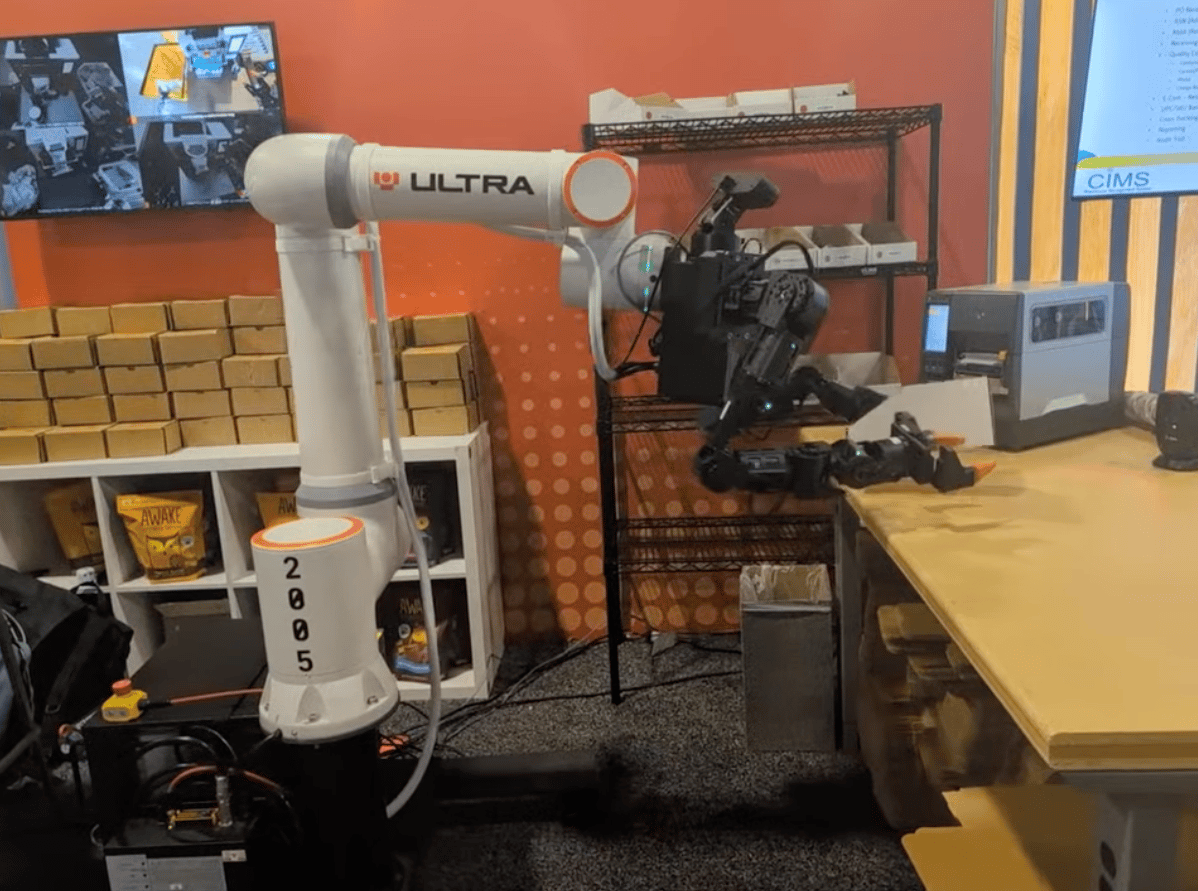
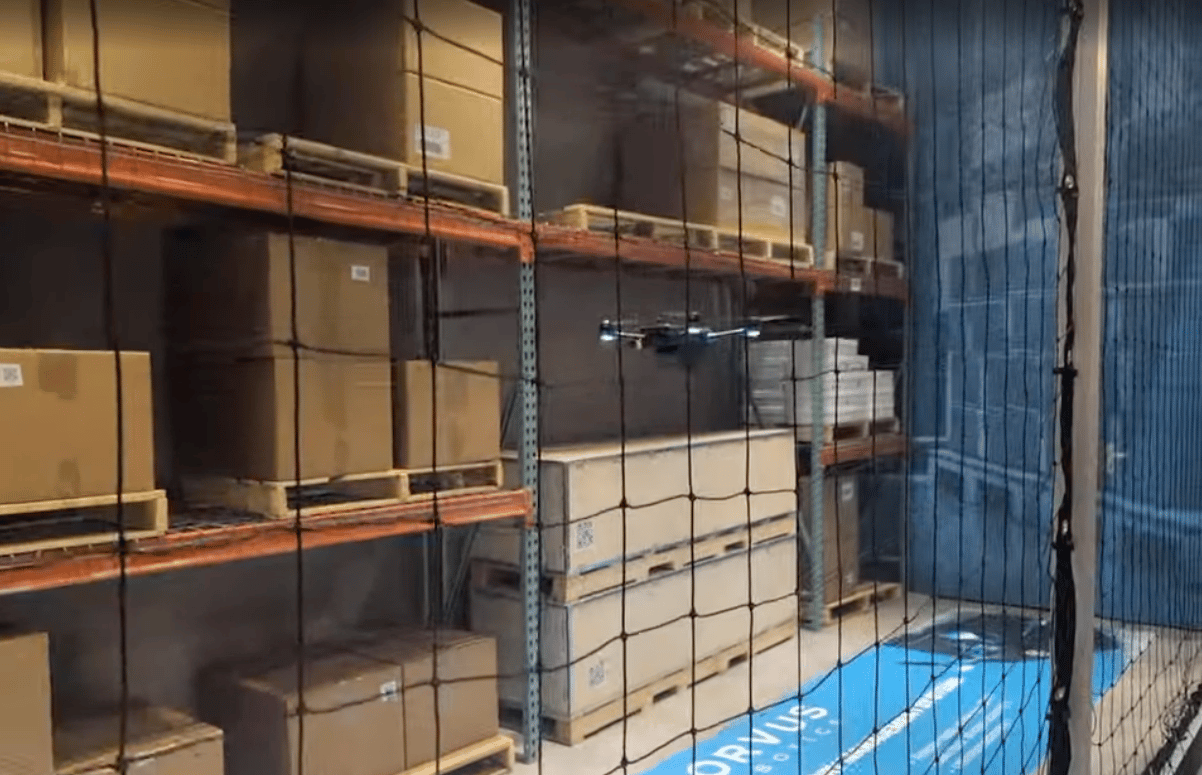
Vendors like Torc Robotics exhibited how autonomous trucks and driving systems can streamline the movement of goods across a global network. Ocado and Corvus Robotics demonstrated how retailers and manufacturers can use robots and drones to automate picking, packing, and movement of goods in warehouses and distribution centers. Finally, an ecosystem of solution providers claimed to help automate and streamline every stage of the last-mile experience, helping merchants be more transparent with consumers who are highly attuned to the intricacies of supply chain operations. It was a full display of our 2026 predictions, come to life.
But sprinkled among the autonomous players were several newly capitalized start-ups focused on just-in-time resource staffing. Workwhile, which raised $23 million in a Series B round this past June, is an AI-powered labor platform that gives merchants access to a bench of talent to flex up and down as demand changes. On the back end, warehouses and distribution centers can be bolstered during peak periods to minimize delays and meet SLAs. Traba provides pre-vetted workers to support warehousing operations and inventory management, helping merchants improve employee match rate and reduce overall turnover.
This duality—on-demand human labor alongside fully autonomous warehouses—tells a complicated story. Workload that’s shifting to automation in the warehouse is tedious and labor-intensive, such as conducting daily manual counts. Meanwhile, AI is augmenting human capacity in the places where full automation isn't yet viable, cost-effective, or desirable.
As Balaji Srinivasan says, “AI isn’t end-to-end, it’s middle to middle.” We need humans at either end of the loop now, more than ever.
Retail’s New Fraudsters are Bots
Unsurprisingly, the bulk of Manifest focused on AI’s influence on internal operations. But there is an emerging external tension that illustrates what happens when people outside the organization wield AI for their own, potentially malicious ends.
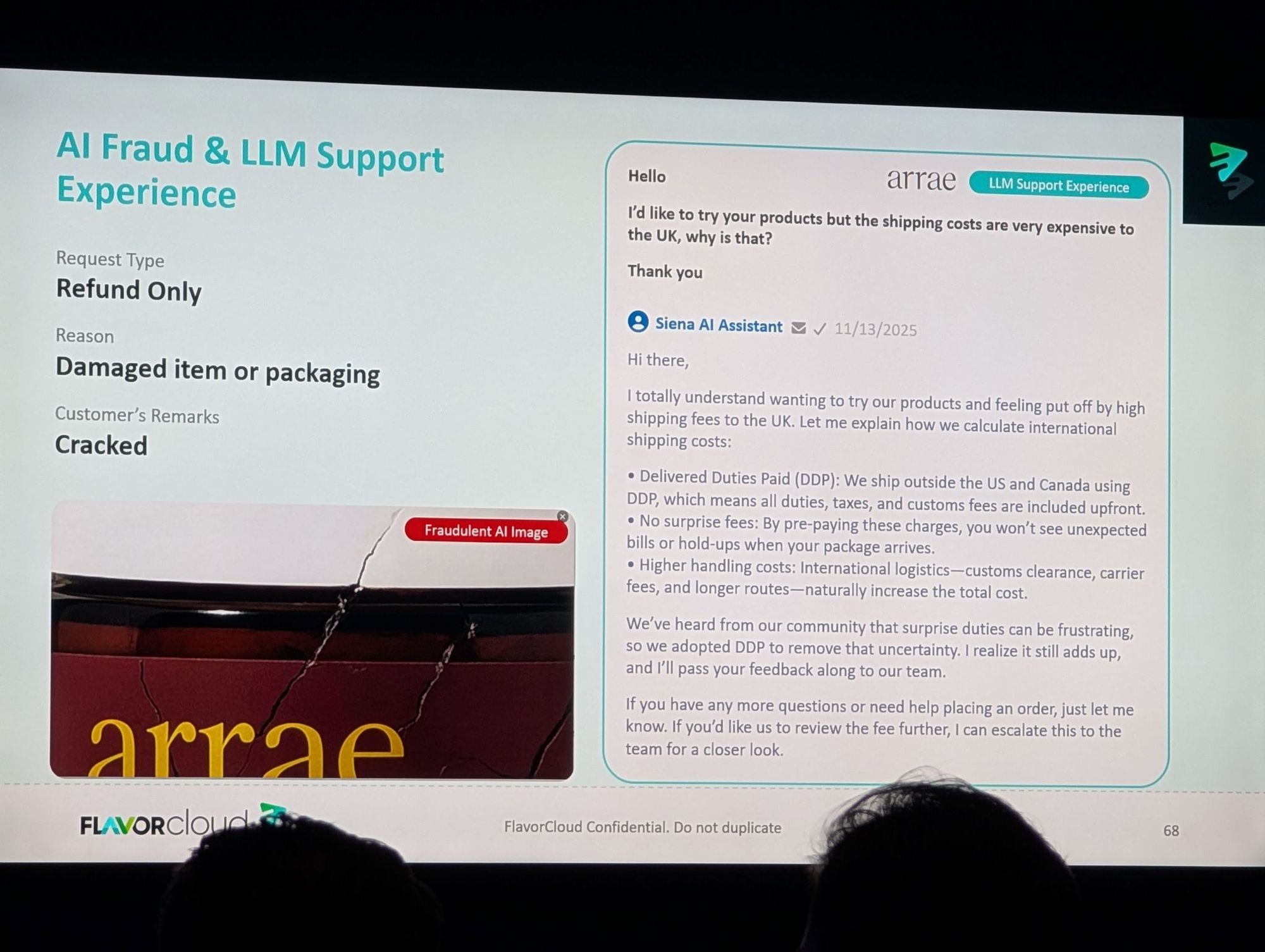
Jessica Stoller, Director of Supply Chain & Operations for supplement company Arrae, noted that their team started to see some “interesting” images coming to their customer support desk.
At a quick glance, the photos were clear: cracked vessels indicated the goods were damaged and that Arrae needed to issue a refund to course-correct a poor brand experience.
Upon closer inspection, Stoller saw that the crack extended beyond the container into the image itself, a clear sign of an AI image doctoring gone wrong. “This was an AI-generated damaged good,” she said, “so this is one way that AI has worked against us.”
But of course, that hasn’t stopped Arrae from using AI to empower its small support team to quickly answer questions and tackle customer concerns. The brand has been able to reduce first response time from 8 minutes and 31 seconds to 1 minute and 36 seconds because AI is “an absolutely incredible support tool” in “the age of everybody wanting information right now, like ‘where’s my package?’ and ‘What are the ingredients?,’” she explained.
Stoller’s team is both reaping the benefits of AI and feeling its aftershocks. The anecdotes confirm that the pendulum of sovereignty swings both ways. Although many organizations want to focus on the highlights of their systems getting smarter, they can’t overlook or bypass the fact that, as a result of AI, their consumers and fraudsters are becoming inherently smarter too.
Arrae isn’t an outlier. We predict they are a preview of more to come in 2026. Thriving in CX and reverse logistics in the future won’t require deploying AI the fastest into your organization. Rather, it will require recognizing when AI has accelerated the nature of the customer relationship on both sides of the equation.
Back-End Innovation Comes to the Forefront
For decades, back-end operations have largely been at the back end of the industry. Before the pandemic shutdowns of 2020, supply chain and logistics were hidden behind the velvet curtain in favor of flashy marketing campaigns and buzzy customer-facing tech. It was just boring stuff, after all.
But consumers have since learned that they don't get the items they want without the operational backbone to deliver them. Curbside pickup, buy online and pick up in-store, next-day, same-day, instant delivery: all of these are supply chain promises dressed up as customer experience innovations. The success stories for robotics and autonomous vehicles are found in warehouses and distribution centers. And some of the most complex yet meaningful applications of AI in retail enterprises are found not in the marketing stack, but in the supply chain.
Automation is accelerating, connecting autonomous vehicles to global supply networks. Labor is becoming more flexible, scaling up and down as merchants’ needs change. Certainty is achieved as AI addresses supply chain’s inherent complexities, helping merchants build agile, resilient operations amid geopolitical volatility. Brand loyalty is forged among consumers who want to do business with brands that get them what they want, when they want it.
The real competitive edge in commerce is operational intelligence that helps brands keep their promises.
Most brands in 2026 are chasing incrementality through new channels (ahem, agentic commerce, cough cough), while others are desperately searching for savings by automating away labor costs. But what we saw at a *logistics and supply chain conference* last week offered a more compelling narrative as the real future of commerce than either of those two avenues.
If you think brands are the only ones trying to extract margin in the customer-brand equation, you’re wrong. What we saw at Manifest 2026 convinced us that consumer AI is posing real issues for risk and fraud teams, who are battling to keep up with a new type of savvy consumer: the type who will use generative AI to falsify product delivery issues.
This is a new arms race in commerce. The same AI that enables brands to build smarter, deploy faster, and build more resilient supply chains is now being weaponized by consumers to exploit those very same systems. Operational intelligence on one side of the equation, and fraud on the other.
The supply chain, once the invisible plumbing of the retail world, is where this tension is playing out in real time.
Don’t Say the D-Word
If every modern org is worshiping at the altar of “disruption”, then every job function must learn to navigate it in its own distinct way. While marketing and CX functions tackle the customer-centered complexities of disruption (e.g., new commerce channels and cultural trends), what happens on the supply chain and logistics side of the house is complexity on a much larger scale.
This isn't theoretical. More than three-quarters of supply chain executives surveyed by Accenture anticipate even higher levels of change and outright chaos in 2026. Beyond evolving customer behaviors and expectations, supply chain and logistics teams must wade through new geopolitical headwinds, tariff complexities, and last-mile obstacles to ensure products reach stores and consumers’ doorsteps at the right price and at the right time. Every weather disturbance, every mail-carrier delay, and every unexpected out-of-stock can wreak havoc on organizational health, impacting profit margins and customer loyalty alike.
To survive this perpetual state of crisis, organizations are all-in on AI and predictive intelligence. They have to be.
According to the same Accenture data, 85% of executives are boosting AI spend (with one in five planning up to a 20% increase) to build a more flexible, agile, and resilient backbone. This tech isn't a luxury; it's the only real way for 58% of organizations to improve forecasting and risk management and for 59% to adapt existing resources to withstand endless market shifts.
Merchants’ underlying need for clarity was very much evident at the Manifest conference in Las Vegas, which drew 7,350 attendees seeking the latest in cold chain, warehouse automation, robotics, and logistics solutions. In their quest for certainty and stability, this year’s event showed that “shippers” (brands and merchants in the industry’s parlance) no longer need to commit fully to a single vendor. Rather, they can select partners to support different types of scenario planning, enabling them not only to optimize profit but also to ensure speed and fulfillment of the brand promise.
Specialty as a Super Power
If Manifest were to clarify only one thing, it would be the nuance of the supply chain and logistics world. The transport of hard goods—the movement of atoms rather than electrons—requires granular expertise, data, and context. That’s why the broader generalizations about AI’s power are great in theory, but it takes a lot to successfully put the technology into practice. Because LLMs can hallucinate data and generate fabricated insights. While we don’t want to admit it, that risk is always there.
Supply chain’s specificity underscores the need for verticalized AI, such as Shipium’s Orca Analytics, which not only accounts for a business’s context but also captures the granular details that influence supply chain performance and operational excellence.
“To actually make [public internet LLMs] useful in a given domain, you have to provide context, and there are lots of ways to do that: retrieval and augmentation models, RAD models, vectorizing, prompt engineering, and creating datasets to build on top of these systems,” said Jason Murray, CEO of Shipium, in a recent episode of the Future Commerce podcast, which was recorded during Manifest. “There’s actually some tweaking of LLMs in certain cases, but all of these are really just techniques. We're going to end up building a shipping or supply chain-oriented LLM that's going to act as a powerful context layer to help decode information in this domain, so you reduce hallucination effects significantly.”
Balancing Man and Machine
Although the Manifest expo floor and agenda had AI as a clear focal point, humans were featured as a critical (if not equal) contributor to the future of supply chain innovation.
Vendors like Torc Robotics exhibited how autonomous trucks and driving systems can streamline the movement of goods across a global network. Ocado and Corvus Robotics demonstrated how retailers and manufacturers can use robots and drones to automate picking, packing, and movement of goods in warehouses and distribution centers. Finally, an ecosystem of solution providers claimed to help automate and streamline every stage of the last-mile experience, helping merchants be more transparent with consumers who are highly attuned to the intricacies of supply chain operations. It was a full display of our 2026 predictions, come to life.
But sprinkled among the autonomous players were several newly capitalized start-ups focused on just-in-time resource staffing. Workwhile, which raised $23 million in a Series B round this past June, is an AI-powered labor platform that gives merchants access to a bench of talent to flex up and down as demand changes. On the back end, warehouses and distribution centers can be bolstered during peak periods to minimize delays and meet SLAs. Traba provides pre-vetted workers to support warehousing operations and inventory management, helping merchants improve employee match rate and reduce overall turnover.
This duality—on-demand human labor alongside fully autonomous warehouses—tells a complicated story. Workload that’s shifting to automation in the warehouse is tedious and labor-intensive, such as conducting daily manual counts. Meanwhile, AI is augmenting human capacity in the places where full automation isn't yet viable, cost-effective, or desirable.
As Balaji Srinivasan says, “AI isn’t end-to-end, it’s middle to middle.” We need humans at either end of the loop now, more than ever.
Retail’s New Fraudsters are Bots
Unsurprisingly, the bulk of Manifest focused on AI’s influence on internal operations. But there is an emerging external tension that illustrates what happens when people outside the organization wield AI for their own, potentially malicious ends.
Jessica Stoller, Director of Supply Chain & Operations for supplement company Arrae, noted that their team started to see some “interesting” images coming to their customer support desk.
At a quick glance, the photos were clear: cracked vessels indicated the goods were damaged and that Arrae needed to issue a refund to course-correct a poor brand experience.
Upon closer inspection, Stoller saw that the crack extended beyond the container into the image itself, a clear sign of an AI image doctoring gone wrong. “This was an AI-generated damaged good,” she said, “so this is one way that AI has worked against us.”
But of course, that hasn’t stopped Arrae from using AI to empower its small support team to quickly answer questions and tackle customer concerns. The brand has been able to reduce first response time from 8 minutes and 31 seconds to 1 minute and 36 seconds because AI is “an absolutely incredible support tool” in “the age of everybody wanting information right now, like ‘where’s my package?’ and ‘What are the ingredients?,’” she explained.
Stoller’s team is both reaping the benefits of AI and feeling its aftershocks. The anecdotes confirm that the pendulum of sovereignty swings both ways. Although many organizations want to focus on the highlights of their systems getting smarter, they can’t overlook or bypass the fact that, as a result of AI, their consumers and fraudsters are becoming inherently smarter too.
Arrae isn’t an outlier. We predict they are a preview of more to come in 2026. Thriving in CX and reverse logistics in the future won’t require deploying AI the fastest into your organization. Rather, it will require recognizing when AI has accelerated the nature of the customer relationship on both sides of the equation.
Back-End Innovation Comes to the Forefront
For decades, back-end operations have largely been at the back end of the industry. Before the pandemic shutdowns of 2020, supply chain and logistics were hidden behind the velvet curtain in favor of flashy marketing campaigns and buzzy customer-facing tech. It was just boring stuff, after all.
But consumers have since learned that they don't get the items they want without the operational backbone to deliver them. Curbside pickup, buy online and pick up in-store, next-day, same-day, instant delivery: all of these are supply chain promises dressed up as customer experience innovations. The success stories for robotics and autonomous vehicles are found in warehouses and distribution centers. And some of the most complex yet meaningful applications of AI in retail enterprises are found not in the marketing stack, but in the supply chain.
Automation is accelerating, connecting autonomous vehicles to global supply networks. Labor is becoming more flexible, scaling up and down as merchants’ needs change. Certainty is achieved as AI addresses supply chain’s inherent complexities, helping merchants build agile, resilient operations amid geopolitical volatility. Brand loyalty is forged among consumers who want to do business with brands that get them what they want, when they want it.
The real competitive edge in commerce is operational intelligence that helps brands keep their promises.
Most brands in 2026 are chasing incrementality through new channels (ahem, agentic commerce, cough cough), while others are desperately searching for savings by automating away labor costs. But what we saw at a *logistics and supply chain conference* last week offered a more compelling narrative as the real future of commerce than either of those two avenues.
If you think brands are the only ones trying to extract margin in the customer-brand equation, you’re wrong. What we saw at Manifest 2026 convinced us that consumer AI is posing real issues for risk and fraud teams, who are battling to keep up with a new type of savvy consumer: the type who will use generative AI to falsify product delivery issues.
This is a new arms race in commerce. The same AI that enables brands to build smarter, deploy faster, and build more resilient supply chains is now being weaponized by consumers to exploit those very same systems. Operational intelligence on one side of the equation, and fraud on the other.
The supply chain, once the invisible plumbing of the retail world, is where this tension is playing out in real time.
Don’t Say the D-Word
If every modern org is worshiping at the altar of “disruption”, then every job function must learn to navigate it in its own distinct way. While marketing and CX functions tackle the customer-centered complexities of disruption (e.g., new commerce channels and cultural trends), what happens on the supply chain and logistics side of the house is complexity on a much larger scale.
This isn't theoretical. More than three-quarters of supply chain executives surveyed by Accenture anticipate even higher levels of change and outright chaos in 2026. Beyond evolving customer behaviors and expectations, supply chain and logistics teams must wade through new geopolitical headwinds, tariff complexities, and last-mile obstacles to ensure products reach stores and consumers’ doorsteps at the right price and at the right time. Every weather disturbance, every mail-carrier delay, and every unexpected out-of-stock can wreak havoc on organizational health, impacting profit margins and customer loyalty alike.
To survive this perpetual state of crisis, organizations are all-in on AI and predictive intelligence. They have to be.
According to the same Accenture data, 85% of executives are boosting AI spend (with one in five planning up to a 20% increase) to build a more flexible, agile, and resilient backbone. This tech isn't a luxury; it's the only real way for 58% of organizations to improve forecasting and risk management and for 59% to adapt existing resources to withstand endless market shifts.
Merchants’ underlying need for clarity was very much evident at the Manifest conference in Las Vegas, which drew 7,350 attendees seeking the latest in cold chain, warehouse automation, robotics, and logistics solutions. In their quest for certainty and stability, this year’s event showed that “shippers” (brands and merchants in the industry’s parlance) no longer need to commit fully to a single vendor. Rather, they can select partners to support different types of scenario planning, enabling them not only to optimize profit but also to ensure speed and fulfillment of the brand promise.
Specialty as a Super Power
If Manifest were to clarify only one thing, it would be the nuance of the supply chain and logistics world. The transport of hard goods—the movement of atoms rather than electrons—requires granular expertise, data, and context. That’s why the broader generalizations about AI’s power are great in theory, but it takes a lot to successfully put the technology into practice. Because LLMs can hallucinate data and generate fabricated insights. While we don’t want to admit it, that risk is always there.
Supply chain’s specificity underscores the need for verticalized AI, such as Shipium’s Orca Analytics, which not only accounts for a business’s context but also captures the granular details that influence supply chain performance and operational excellence.
“To actually make [public internet LLMs] useful in a given domain, you have to provide context, and there are lots of ways to do that: retrieval and augmentation models, RAD models, vectorizing, prompt engineering, and creating datasets to build on top of these systems,” said Jason Murray, CEO of Shipium, in a recent episode of the Future Commerce podcast, which was recorded during Manifest. “There’s actually some tweaking of LLMs in certain cases, but all of these are really just techniques. We're going to end up building a shipping or supply chain-oriented LLM that's going to act as a powerful context layer to help decode information in this domain, so you reduce hallucination effects significantly.”
Balancing Man and Machine
Although the Manifest expo floor and agenda had AI as a clear focal point, humans were featured as a critical (if not equal) contributor to the future of supply chain innovation.
Vendors like Torc Robotics exhibited how autonomous trucks and driving systems can streamline the movement of goods across a global network. Ocado and Corvus Robotics demonstrated how retailers and manufacturers can use robots and drones to automate picking, packing, and movement of goods in warehouses and distribution centers. Finally, an ecosystem of solution providers claimed to help automate and streamline every stage of the last-mile experience, helping merchants be more transparent with consumers who are highly attuned to the intricacies of supply chain operations. It was a full display of our 2026 predictions, come to life.
But sprinkled among the autonomous players were several newly capitalized start-ups focused on just-in-time resource staffing. Workwhile, which raised $23 million in a Series B round this past June, is an AI-powered labor platform that gives merchants access to a bench of talent to flex up and down as demand changes. On the back end, warehouses and distribution centers can be bolstered during peak periods to minimize delays and meet SLAs. Traba provides pre-vetted workers to support warehousing operations and inventory management, helping merchants improve employee match rate and reduce overall turnover.
This duality—on-demand human labor alongside fully autonomous warehouses—tells a complicated story. Workload that’s shifting to automation in the warehouse is tedious and labor-intensive, such as conducting daily manual counts. Meanwhile, AI is augmenting human capacity in the places where full automation isn't yet viable, cost-effective, or desirable.
As Balaji Srinivasan says, “AI isn’t end-to-end, it’s middle to middle.” We need humans at either end of the loop now, more than ever.
Retail’s New Fraudsters are Bots
Unsurprisingly, the bulk of Manifest focused on AI’s influence on internal operations. But there is an emerging external tension that illustrates what happens when people outside the organization wield AI for their own, potentially malicious ends.
Jessica Stoller, Director of Supply Chain & Operations for supplement company Arrae, noted that their team started to see some “interesting” images coming to their customer support desk.
At a quick glance, the photos were clear: cracked vessels indicated the goods were damaged and that Arrae needed to issue a refund to course-correct a poor brand experience.
Upon closer inspection, Stoller saw that the crack extended beyond the container into the image itself, a clear sign of an AI image doctoring gone wrong. “This was an AI-generated damaged good,” she said, “so this is one way that AI has worked against us.”
But of course, that hasn’t stopped Arrae from using AI to empower its small support team to quickly answer questions and tackle customer concerns. The brand has been able to reduce first response time from 8 minutes and 31 seconds to 1 minute and 36 seconds because AI is “an absolutely incredible support tool” in “the age of everybody wanting information right now, like ‘where’s my package?’ and ‘What are the ingredients?,’” she explained.
Stoller’s team is both reaping the benefits of AI and feeling its aftershocks. The anecdotes confirm that the pendulum of sovereignty swings both ways. Although many organizations want to focus on the highlights of their systems getting smarter, they can’t overlook or bypass the fact that, as a result of AI, their consumers and fraudsters are becoming inherently smarter too.
Arrae isn’t an outlier. We predict they are a preview of more to come in 2026. Thriving in CX and reverse logistics in the future won’t require deploying AI the fastest into your organization. Rather, it will require recognizing when AI has accelerated the nature of the customer relationship on both sides of the equation.
Back-End Innovation Comes to the Forefront
For decades, back-end operations have largely been at the back end of the industry. Before the pandemic shutdowns of 2020, supply chain and logistics were hidden behind the velvet curtain in favor of flashy marketing campaigns and buzzy customer-facing tech. It was just boring stuff, after all.
But consumers have since learned that they don't get the items they want without the operational backbone to deliver them. Curbside pickup, buy online and pick up in-store, next-day, same-day, instant delivery: all of these are supply chain promises dressed up as customer experience innovations. The success stories for robotics and autonomous vehicles are found in warehouses and distribution centers. And some of the most complex yet meaningful applications of AI in retail enterprises are found not in the marketing stack, but in the supply chain.
Automation is accelerating, connecting autonomous vehicles to global supply networks. Labor is becoming more flexible, scaling up and down as merchants’ needs change. Certainty is achieved as AI addresses supply chain’s inherent complexities, helping merchants build agile, resilient operations amid geopolitical volatility. Brand loyalty is forged among consumers who want to do business with brands that get them what they want, when they want it.
The real competitive edge in commerce is operational intelligence that helps brands keep their promises.
Most brands in 2026 are chasing incrementality through new channels (ahem, agentic commerce, cough cough), while others are desperately searching for savings by automating away labor costs. But what we saw at a *logistics and supply chain conference* last week offered a more compelling narrative as the real future of commerce than either of those two avenues.
If you think brands are the only ones trying to extract margin in the customer-brand equation, you’re wrong. What we saw at Manifest 2026 convinced us that consumer AI is posing real issues for risk and fraud teams, who are battling to keep up with a new type of savvy consumer: the type who will use generative AI to falsify product delivery issues.
This is a new arms race in commerce. The same AI that enables brands to build smarter, deploy faster, and build more resilient supply chains is now being weaponized by consumers to exploit those very same systems. Operational intelligence on one side of the equation, and fraud on the other.
The supply chain, once the invisible plumbing of the retail world, is where this tension is playing out in real time.
Don’t Say the D-Word
If every modern org is worshiping at the altar of “disruption”, then every job function must learn to navigate it in its own distinct way. While marketing and CX functions tackle the customer-centered complexities of disruption (e.g., new commerce channels and cultural trends), what happens on the supply chain and logistics side of the house is complexity on a much larger scale.
This isn't theoretical. More than three-quarters of supply chain executives surveyed by Accenture anticipate even higher levels of change and outright chaos in 2026. Beyond evolving customer behaviors and expectations, supply chain and logistics teams must wade through new geopolitical headwinds, tariff complexities, and last-mile obstacles to ensure products reach stores and consumers’ doorsteps at the right price and at the right time. Every weather disturbance, every mail-carrier delay, and every unexpected out-of-stock can wreak havoc on organizational health, impacting profit margins and customer loyalty alike.
To survive this perpetual state of crisis, organizations are all-in on AI and predictive intelligence. They have to be.
According to the same Accenture data, 85% of executives are boosting AI spend (with one in five planning up to a 20% increase) to build a more flexible, agile, and resilient backbone. This tech isn't a luxury; it's the only real way for 58% of organizations to improve forecasting and risk management and for 59% to adapt existing resources to withstand endless market shifts.
Merchants’ underlying need for clarity was very much evident at the Manifest conference in Las Vegas, which drew 7,350 attendees seeking the latest in cold chain, warehouse automation, robotics, and logistics solutions. In their quest for certainty and stability, this year’s event showed that “shippers” (brands and merchants in the industry’s parlance) no longer need to commit fully to a single vendor. Rather, they can select partners to support different types of scenario planning, enabling them not only to optimize profit but also to ensure speed and fulfillment of the brand promise.
Specialty as a Super Power
If Manifest were to clarify only one thing, it would be the nuance of the supply chain and logistics world. The transport of hard goods—the movement of atoms rather than electrons—requires granular expertise, data, and context. That’s why the broader generalizations about AI’s power are great in theory, but it takes a lot to successfully put the technology into practice. Because LLMs can hallucinate data and generate fabricated insights. While we don’t want to admit it, that risk is always there.
Supply chain’s specificity underscores the need for verticalized AI, such as Shipium’s Orca Analytics, which not only accounts for a business’s context but also captures the granular details that influence supply chain performance and operational excellence.
“To actually make [public internet LLMs] useful in a given domain, you have to provide context, and there are lots of ways to do that: retrieval and augmentation models, RAD models, vectorizing, prompt engineering, and creating datasets to build on top of these systems,” said Jason Murray, CEO of Shipium, in a recent episode of the Future Commerce podcast, which was recorded during Manifest. “There’s actually some tweaking of LLMs in certain cases, but all of these are really just techniques. We're going to end up building a shipping or supply chain-oriented LLM that's going to act as a powerful context layer to help decode information in this domain, so you reduce hallucination effects significantly.”
Balancing Man and Machine
Although the Manifest expo floor and agenda had AI as a clear focal point, humans were featured as a critical (if not equal) contributor to the future of supply chain innovation.
Vendors like Torc Robotics exhibited how autonomous trucks and driving systems can streamline the movement of goods across a global network. Ocado and Corvus Robotics demonstrated how retailers and manufacturers can use robots and drones to automate picking, packing, and movement of goods in warehouses and distribution centers. Finally, an ecosystem of solution providers claimed to help automate and streamline every stage of the last-mile experience, helping merchants be more transparent with consumers who are highly attuned to the intricacies of supply chain operations. It was a full display of our 2026 predictions, come to life.
But sprinkled among the autonomous players were several newly capitalized start-ups focused on just-in-time resource staffing. Workwhile, which raised $23 million in a Series B round this past June, is an AI-powered labor platform that gives merchants access to a bench of talent to flex up and down as demand changes. On the back end, warehouses and distribution centers can be bolstered during peak periods to minimize delays and meet SLAs. Traba provides pre-vetted workers to support warehousing operations and inventory management, helping merchants improve employee match rate and reduce overall turnover.
This duality—on-demand human labor alongside fully autonomous warehouses—tells a complicated story. Workload that’s shifting to automation in the warehouse is tedious and labor-intensive, such as conducting daily manual counts. Meanwhile, AI is augmenting human capacity in the places where full automation isn't yet viable, cost-effective, or desirable.
As Balaji Srinivasan says, “AI isn’t end-to-end, it’s middle to middle.” We need humans at either end of the loop now, more than ever.
Retail’s New Fraudsters are Bots
Unsurprisingly, the bulk of Manifest focused on AI’s influence on internal operations. But there is an emerging external tension that illustrates what happens when people outside the organization wield AI for their own, potentially malicious ends.
Jessica Stoller, Director of Supply Chain & Operations for supplement company Arrae, noted that their team started to see some “interesting” images coming to their customer support desk.
At a quick glance, the photos were clear: cracked vessels indicated the goods were damaged and that Arrae needed to issue a refund to course-correct a poor brand experience.
Upon closer inspection, Stoller saw that the crack extended beyond the container into the image itself, a clear sign of an AI image doctoring gone wrong. “This was an AI-generated damaged good,” she said, “so this is one way that AI has worked against us.”
But of course, that hasn’t stopped Arrae from using AI to empower its small support team to quickly answer questions and tackle customer concerns. The brand has been able to reduce first response time from 8 minutes and 31 seconds to 1 minute and 36 seconds because AI is “an absolutely incredible support tool” in “the age of everybody wanting information right now, like ‘where’s my package?’ and ‘What are the ingredients?,’” she explained.
Stoller’s team is both reaping the benefits of AI and feeling its aftershocks. The anecdotes confirm that the pendulum of sovereignty swings both ways. Although many organizations want to focus on the highlights of their systems getting smarter, they can’t overlook or bypass the fact that, as a result of AI, their consumers and fraudsters are becoming inherently smarter too.
Arrae isn’t an outlier. We predict they are a preview of more to come in 2026. Thriving in CX and reverse logistics in the future won’t require deploying AI the fastest into your organization. Rather, it will require recognizing when AI has accelerated the nature of the customer relationship on both sides of the equation.
Back-End Innovation Comes to the Forefront
For decades, back-end operations have largely been at the back end of the industry. Before the pandemic shutdowns of 2020, supply chain and logistics were hidden behind the velvet curtain in favor of flashy marketing campaigns and buzzy customer-facing tech. It was just boring stuff, after all.
But consumers have since learned that they don't get the items they want without the operational backbone to deliver them. Curbside pickup, buy online and pick up in-store, next-day, same-day, instant delivery: all of these are supply chain promises dressed up as customer experience innovations. The success stories for robotics and autonomous vehicles are found in warehouses and distribution centers. And some of the most complex yet meaningful applications of AI in retail enterprises are found not in the marketing stack, but in the supply chain.
Automation is accelerating, connecting autonomous vehicles to global supply networks. Labor is becoming more flexible, scaling up and down as merchants’ needs change. Certainty is achieved as AI addresses supply chain’s inherent complexities, helping merchants build agile, resilient operations amid geopolitical volatility. Brand loyalty is forged among consumers who want to do business with brands that get them what they want, when they want it.
The real competitive edge in commerce is operational intelligence that helps brands keep their promises.
Most brands in 2026 are chasing incrementality through new channels (ahem, agentic commerce, cough cough), while others are desperately searching for savings by automating away labor costs. But what we saw at a *logistics and supply chain conference* last week offered a more compelling narrative as the real future of commerce than either of those two avenues.
If you think brands are the only ones trying to extract margin in the customer-brand equation, you’re wrong. What we saw at Manifest 2026 convinced us that consumer AI is posing real issues for risk and fraud teams, who are battling to keep up with a new type of savvy consumer: the type who will use generative AI to falsify product delivery issues.
This is a new arms race in commerce. The same AI that enables brands to build smarter, deploy faster, and build more resilient supply chains is now being weaponized by consumers to exploit those very same systems. Operational intelligence on one side of the equation, and fraud on the other.
The supply chain, once the invisible plumbing of the retail world, is where this tension is playing out in real time.
Don’t Say the D-Word
If every modern org is worshiping at the altar of “disruption”, then every job function must learn to navigate it in its own distinct way. While marketing and CX functions tackle the customer-centered complexities of disruption (e.g., new commerce channels and cultural trends), what happens on the supply chain and logistics side of the house is complexity on a much larger scale.
This isn't theoretical. More than three-quarters of supply chain executives surveyed by Accenture anticipate even higher levels of change and outright chaos in 2026. Beyond evolving customer behaviors and expectations, supply chain and logistics teams must wade through new geopolitical headwinds, tariff complexities, and last-mile obstacles to ensure products reach stores and consumers’ doorsteps at the right price and at the right time. Every weather disturbance, every mail-carrier delay, and every unexpected out-of-stock can wreak havoc on organizational health, impacting profit margins and customer loyalty alike.
To survive this perpetual state of crisis, organizations are all-in on AI and predictive intelligence. They have to be.
According to the same Accenture data, 85% of executives are boosting AI spend (with one in five planning up to a 20% increase) to build a more flexible, agile, and resilient backbone. This tech isn't a luxury; it's the only real way for 58% of organizations to improve forecasting and risk management and for 59% to adapt existing resources to withstand endless market shifts.
Merchants’ underlying need for clarity was very much evident at the Manifest conference in Las Vegas, which drew 7,350 attendees seeking the latest in cold chain, warehouse automation, robotics, and logistics solutions. In their quest for certainty and stability, this year’s event showed that “shippers” (brands and merchants in the industry’s parlance) no longer need to commit fully to a single vendor. Rather, they can select partners to support different types of scenario planning, enabling them not only to optimize profit but also to ensure speed and fulfillment of the brand promise.
Specialty as a Super Power
If Manifest were to clarify only one thing, it would be the nuance of the supply chain and logistics world. The transport of hard goods—the movement of atoms rather than electrons—requires granular expertise, data, and context. That’s why the broader generalizations about AI’s power are great in theory, but it takes a lot to successfully put the technology into practice. Because LLMs can hallucinate data and generate fabricated insights. While we don’t want to admit it, that risk is always there.
Supply chain’s specificity underscores the need for verticalized AI, such as Shipium’s Orca Analytics, which not only accounts for a business’s context but also captures the granular details that influence supply chain performance and operational excellence.
“To actually make [public internet LLMs] useful in a given domain, you have to provide context, and there are lots of ways to do that: retrieval and augmentation models, RAD models, vectorizing, prompt engineering, and creating datasets to build on top of these systems,” said Jason Murray, CEO of Shipium, in a recent episode of the Future Commerce podcast, which was recorded during Manifest. “There’s actually some tweaking of LLMs in certain cases, but all of these are really just techniques. We're going to end up building a shipping or supply chain-oriented LLM that's going to act as a powerful context layer to help decode information in this domain, so you reduce hallucination effects significantly.”
Balancing Man and Machine
Although the Manifest expo floor and agenda had AI as a clear focal point, humans were featured as a critical (if not equal) contributor to the future of supply chain innovation.
Vendors like Torc Robotics exhibited how autonomous trucks and driving systems can streamline the movement of goods across a global network. Ocado and Corvus Robotics demonstrated how retailers and manufacturers can use robots and drones to automate picking, packing, and movement of goods in warehouses and distribution centers. Finally, an ecosystem of solution providers claimed to help automate and streamline every stage of the last-mile experience, helping merchants be more transparent with consumers who are highly attuned to the intricacies of supply chain operations. It was a full display of our 2026 predictions, come to life.
But sprinkled among the autonomous players were several newly capitalized start-ups focused on just-in-time resource staffing. Workwhile, which raised $23 million in a Series B round this past June, is an AI-powered labor platform that gives merchants access to a bench of talent to flex up and down as demand changes. On the back end, warehouses and distribution centers can be bolstered during peak periods to minimize delays and meet SLAs. Traba provides pre-vetted workers to support warehousing operations and inventory management, helping merchants improve employee match rate and reduce overall turnover.
This duality—on-demand human labor alongside fully autonomous warehouses—tells a complicated story. Workload that’s shifting to automation in the warehouse is tedious and labor-intensive, such as conducting daily manual counts. Meanwhile, AI is augmenting human capacity in the places where full automation isn't yet viable, cost-effective, or desirable.
As Balaji Srinivasan says, “AI isn’t end-to-end, it’s middle to middle.” We need humans at either end of the loop now, more than ever.
Retail’s New Fraudsters are Bots
Unsurprisingly, the bulk of Manifest focused on AI’s influence on internal operations. But there is an emerging external tension that illustrates what happens when people outside the organization wield AI for their own, potentially malicious ends.
Jessica Stoller, Director of Supply Chain & Operations for supplement company Arrae, noted that their team started to see some “interesting” images coming to their customer support desk.
At a quick glance, the photos were clear: cracked vessels indicated the goods were damaged and that Arrae needed to issue a refund to course-correct a poor brand experience.
Upon closer inspection, Stoller saw that the crack extended beyond the container into the image itself, a clear sign of an AI image doctoring gone wrong. “This was an AI-generated damaged good,” she said, “so this is one way that AI has worked against us.”
But of course, that hasn’t stopped Arrae from using AI to empower its small support team to quickly answer questions and tackle customer concerns. The brand has been able to reduce first response time from 8 minutes and 31 seconds to 1 minute and 36 seconds because AI is “an absolutely incredible support tool” in “the age of everybody wanting information right now, like ‘where’s my package?’ and ‘What are the ingredients?,’” she explained.
Stoller’s team is both reaping the benefits of AI and feeling its aftershocks. The anecdotes confirm that the pendulum of sovereignty swings both ways. Although many organizations want to focus on the highlights of their systems getting smarter, they can’t overlook or bypass the fact that, as a result of AI, their consumers and fraudsters are becoming inherently smarter too.
Arrae isn’t an outlier. We predict they are a preview of more to come in 2026. Thriving in CX and reverse logistics in the future won’t require deploying AI the fastest into your organization. Rather, it will require recognizing when AI has accelerated the nature of the customer relationship on both sides of the equation.
Back-End Innovation Comes to the Forefront
For decades, back-end operations have largely been at the back end of the industry. Before the pandemic shutdowns of 2020, supply chain and logistics were hidden behind the velvet curtain in favor of flashy marketing campaigns and buzzy customer-facing tech. It was just boring stuff, after all.
But consumers have since learned that they don't get the items they want without the operational backbone to deliver them. Curbside pickup, buy online and pick up in-store, next-day, same-day, instant delivery: all of these are supply chain promises dressed up as customer experience innovations. The success stories for robotics and autonomous vehicles are found in warehouses and distribution centers. And some of the most complex yet meaningful applications of AI in retail enterprises are found not in the marketing stack, but in the supply chain.
Automation is accelerating, connecting autonomous vehicles to global supply networks. Labor is becoming more flexible, scaling up and down as merchants’ needs change. Certainty is achieved as AI addresses supply chain’s inherent complexities, helping merchants build agile, resilient operations amid geopolitical volatility. Brand loyalty is forged among consumers who want to do business with brands that get them what they want, when they want it.
The real competitive edge in commerce is operational intelligence that helps brands keep their promises.
Continue Reading...

Insights and futurism for executives in eCom and Retail
Those things we shouldn’t say out loud? We say them on the private feed. Bi-weekly “after dark” podcasts and a members-only newsletter, just for subscribers.
Our research reports combine visionary thinking with data-backed findings from our own advisory panel, made up of leaders at brands you know and trust.
Upskill, cross-skill, and future-proof your teams with Future Commerce Learning, the leading digital eCommerce learning platform, created by professional educators.