

of the United Kingdom’s capitol city.
Marshall McLuhan woke in the hospital after suffering a stroke in the fall of 1979 and said, “Eric… Brazil,” to his eldest child, my father, Eric McLuhan. It was maybe the last coherent statement he made, suffering from aphasia for the previous year and a bit, he was alive.
I’ve been to Brazil a few times now, and I always think about that.
Last year, I was there for almost two weeks helping friends at Baroes launch their book, Brand Publishing in Practice. This year, I returned. RD Station invited me to speak at their gigantic marketing extravaganza, RD Summit. It was quite an experience! Special thanks to RD Station for having me, and for not objecting to me repurposing that talk here for you.
My challenge was to give them practical, valuable lessons from my family’s work in media studies to help them navigate their changing world and audience, while adapting their work in marketing and their day-to-day lives to get through it. That talk has been “formatted to fit your screen,” as they used to announce when films were released on videotape.
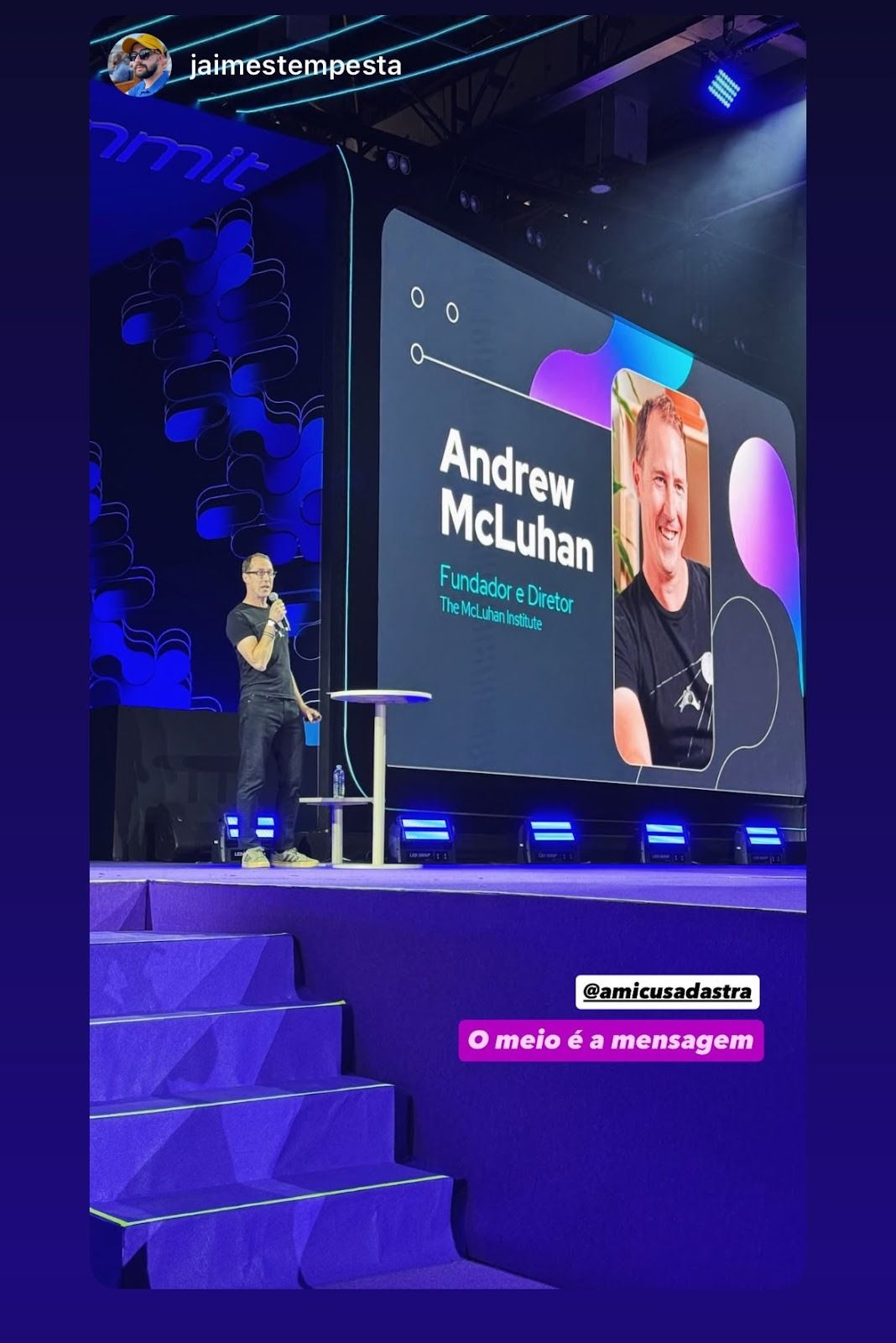
I’m here to talk to you about my grandfather, Marshall McLuhan, what he discovered about media in the 20th century, and how it can help you with marketing in the 21st century amid media turmoil.
Marshall McLuhan (b. Edmonton, Alberta, 1911 – d. Toronto, Ontario, 1980) was an English teacher who became interested in communications studies and helped found and develop the fields of media study and media ecology.
A few quotes to get us started:
“In today’s rapidly changing environment, people have two major concerns: to discover the new problems this environment poses, and to develop ways of coping with these problems.”
- City as Classroom: Understanding Language and Media, 1977
That could have been written today.
“It is misleading to suppose that there is any basic difference between education and entertainment… It’s always been true that whatever pleases teaches more effectively.”
- Classroom Without Walls, 1957
Still true.
“The early stages by which information itself became the basic economic commodity of the electric age were obscured by the ways in which advertising and entertainment put people off the track.”
- Understanding Media: The Extensions of Man, 1964
Not exactly a great way to endear yourself to the advertising industry.
Marshall was an English teacher, trained in literary criticism at Cambridge University in England in the early 1930s. It might seem like a long way from teaching English to traveling the world talking about media, but it’s not as far off as it sounds.
One of his most influential professors at Cambridge was I. A. Richards, who had recently written a book called Practical Criticism. The work laid out a new approach to studying literature by examining what it does.
Richards ran an experiment that was highly controversial at the time. He collected samples of literature from well-known and well-regarded authors, as well as from less-known and less-regarded authors, and removed the authors’ names from their work. For the more well-known and well-regarded authors, he chose work that wasn’t as popular, so it wasn’t obvious who had written what. He then passed out these packages to graduate students and critics and asked them to evaluate them.
Richards wanted to find out what made good literature good. Beyond someone saying it’s good, why do we like some work and not others?
“All media exist to invest our lives with artificial perception and arbitrary values.”
- Understanding Media: The Extensions of Man, 1964
The experiment was controversial because, when the papers came back, there was little agreement on what work was good or bad. Work by highly regarded authors was ranked lower than that of authors no one really cared about. Removing the authors’ names forced everyone to consider the work on its own terms and led Richards to propose a series of criteria for judging work based on the effect it has on the audience.
The UK to the USA
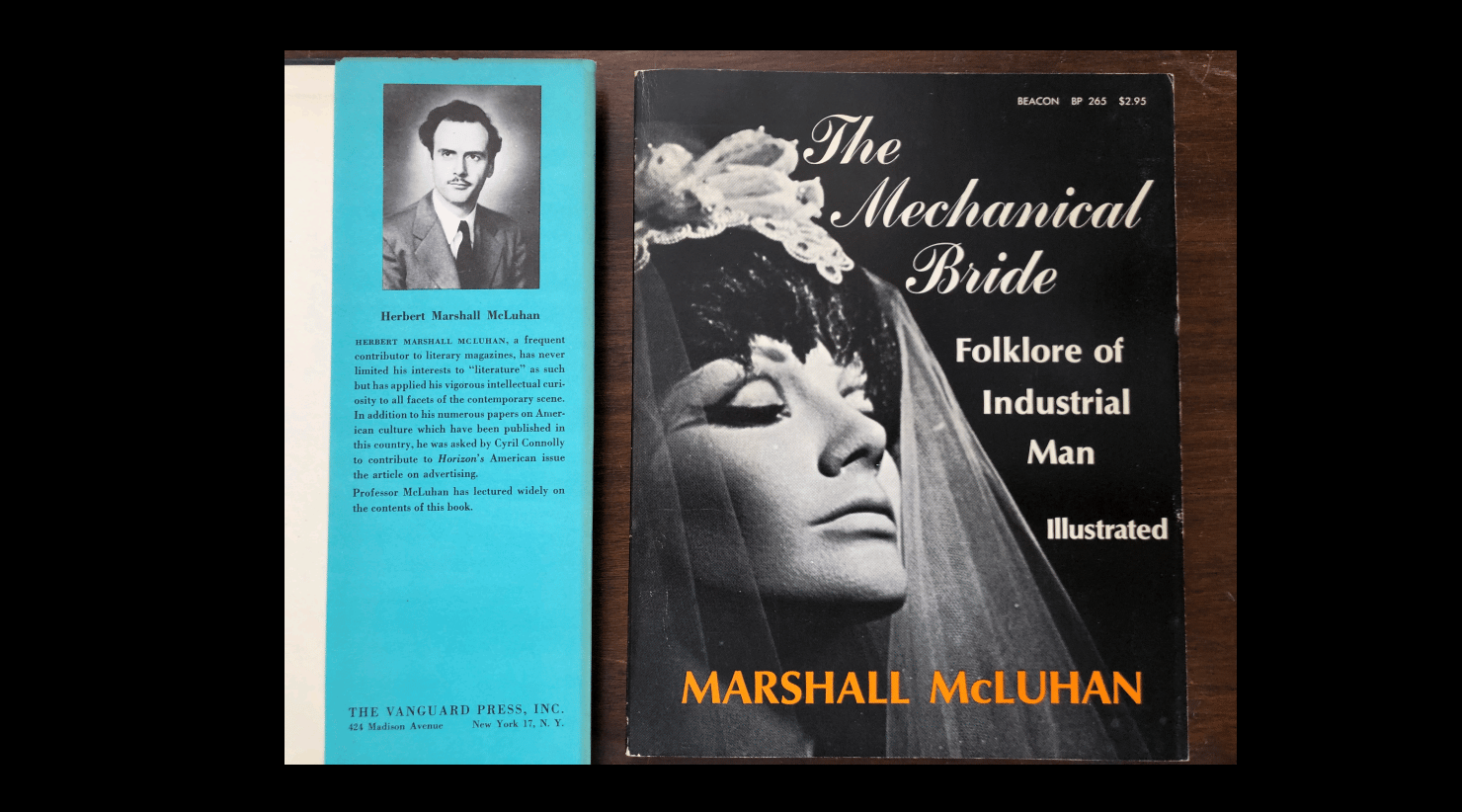
Graduating from Cambridge with a degree in English Literature, and unable to find work in Canada, Marshall got a teaching job in the US at the University of Wisconsin-Madison. It would have been quite a culture shock to go from Cambridge University to an American college. Marshall found that he couldn’t relate to the students, so he decided to look at their popular culture. He applied the skills he learned from studying literature, turning them on to comics and advertising, as they were the popular print media of the time in the late 1930s. This was a revolutionary step. Today, it is quite common to take items from popular culture as serious subjects for study, but it was not in 1936. However, his studies and the lectures he gave with them proved popular with the students, and led Marshall to write his first book, The Mechanical Bride: Folklore of Industrial Man.
The Mechanical Bride is a series of exploratory essays that take on “commercial education,” which is what they called advertising at the time. It’s hard to believe, but marketers might appreciate that they got away with classifying advertising as public education and even received tax credits for it!
Marshall, however, took a dim view. His preface announced that:
“Ours is the first age in which many thousands of the best-trained individual minds have made it their business to get inside the collective public mind. To get inside to manipulate, exploit, control, is the object now. And to generate heat, not light, is the intention.”
Applying what we might call “media literacy” today, Marshall was trying to make his students, and the public, aware that they were being manipulated. Again, this might not sound remarkable today, but it was a startling statement in 1951, when ‘The Mechanical Bride’ was published. It didn’t win him many friends in the advertising world at the time—though they would come around later when they realized his work had a lot to offer the professions of advertising and marketing.
Howard Gossage: Marketing the Messenger
If you know the name Marshall McLuhan, there’s a good chance it’s because of a man named Howard Gossage.
Howard Gossage was a legendary advertising man from California, sometimes known as the Socrates of San Francisco. He had a partner named Gerry Feigen, and one day Gerry gave Howard a book he thought he’d like. The book, which had just been published by McGraw-Hill in New York in 1964, was McLuhan’s Understanding Media: The Extensions of Man. Gerry was right, Howard loved it.
Howard was not your average '60s ad man. He was a highly respected professional, and he was a humanist. During his career, he made a point of supporting several causes, including the World Wildlife Fund, the nation of Anguilla, the Grand Canyon, and Marshall McLuhan.
“Changing the world is the only fit work for a grown man.”
- Howard Gossage
Understanding Media profoundly moved Gossage. It was then that he decided that the world needed Marshall McLuhan and that he, Howard Gossage, would do something about it. According to his wife, Howard picked up the phone, dialed Canada, and said, “Dr. McLuhan, how would you like to be famous?” I’m not sure my grandfather wanted to be famous. In fact, I’m almost certain he really didn’t. Nearly everyone enjoys the idea of fame more than the reality. Ask any influencer, celebrity, or high-profile public figure, and you will find it’s more trouble than it’s worth. Marshall certainly knew this. But he had goals.
Howard Gossage had a plan. In the spring of 1965, he spent a bunch of money and brought McLuhan to New York City, where Gossage threw dinner and cocktail parties and introduced McLuhan to the influencers of the day, journalists like Tom Wolfe. McLuhan hit them with the full force of his substantial wit and intellect. He dazzled. Gossage followed it with a Marshall McLuhan Festival in San Francisco, a weeklong extravaganza in August, shortly after articles began to appear about McLuhan.
Tom Wolfe wrote in the New York Herald Tribune:
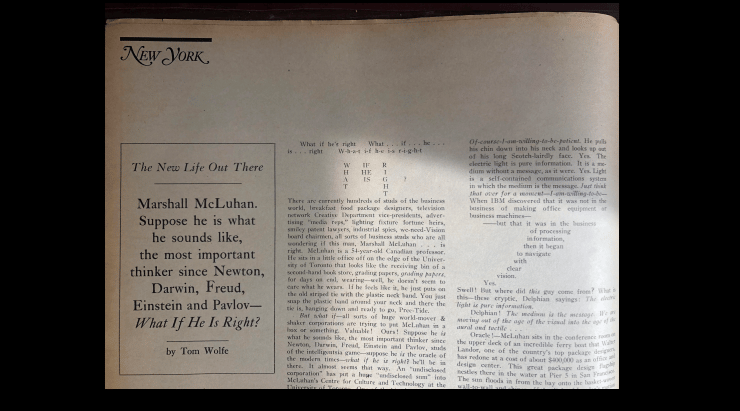
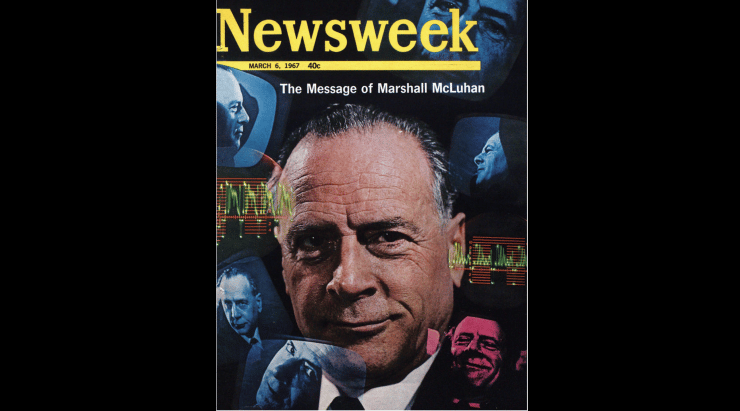
And for the rest of the 1960s, Marshall McLuhan was everywhere. His name was known across the global village.
Marshall McLuhan’s 1964 work, Understanding Media: The Extensions of Man, is what lit a fire under ad man Howard Gossage, and I’m going to try to help you understand why.
“The medium is what happens to you and that is the message.”
- 1967
Following (somewhat) in the footsteps of people like I. A. Richards from Cambridge University, Marshall McLuhan was interested in effects. What these things do to us. How we are changed as a result. At the time, communications studies mainly consisted of information theory, which is how a message gets from one place to another, from sender to receiver. McLuhan was interested in the changes that take place in the user and society as the result of the technologies of the day, something the “models of communication” don’t take into account.
This should resonate with advertising and marketing folks who should likewise be interested mainly in effect and action. In business, this ultimately means sales. The key to this is understanding your audience, or demographic, and their behavior; not only where and how to reach them, but how to make them act. To buy.
In a strictly business sense, it doesn’t matter how someone says they feel about a product. What matters is whether or not they buy it.
If you want to understand a person or their culture, you have to look to their media. Their “media” are quite literally ‘in the middle’ between them and you.
Marketers should be interested in media because media create habits. That is the marketer's goal: to shape behavior. When the media change, people change. Their habits change. A sure way to get into people’s pockets is to get into their habits.
Understanding Media: The Extensions of Man (1964)
Understanding Media upset many people because it was not what they expected from a book about communication in 1964. For one, this was about a lot more than communication and communication technologies.
In the very title, McLuhan announces one of the major themes of the book: that all media are extensions of some part of ourselves. A way to amplify or extend some sense or function. To do something or make it faster, stronger, or bigger.
The “message” of a medium, he says, is the increase in speed, scale, or pattern that it brings with it as a (usually unintended) consequence. It is all these side effects or unintended consequences that end up being far more significant than the intended use.
“What we are considering here, however, are the psychic and social consequences of the designs or patterns as they amplify or accelerate existing processes. For the “message” of any medium or technology is the change of scale or pace or pattern that it introduces into human affairs.”
- 1964
These changes are what change us, or as John Culkin put it in his article about McLuhan and his work:
“We shape our tools and thereafter our tools shape us.”
- A Schoolman’s Guide to Marshall McLuhan, John Culkin, 1965
The shaping happens from those changes in speed and scale, which force us to adjust ourselves in return or reaction.
Crucially, this happens not by the content or individual uses to which we put these things but by the resulting changes in ourselves and the world around us as a result of the introduction of the new form.
This is what Marshall McLuhan meant when he said “the medium is the message”; not that the medium shapes the message and how it’s perceived.
THE MEDIUM SHAPES US.
We are, for better or worse, living in a great time to pay attention to this sort of thing. Significant changes are happening to us and around us as we speak, faster than we can hope to adjust to.
In the confidence that a better understanding of media can make you better at marketing, here are some of my cheat codes for the book Understanding Media, which, to many, is considered the McLuhan Bible. Much of McLuhan’s early work leads up to Understanding Media, and much of his later work flows from it.
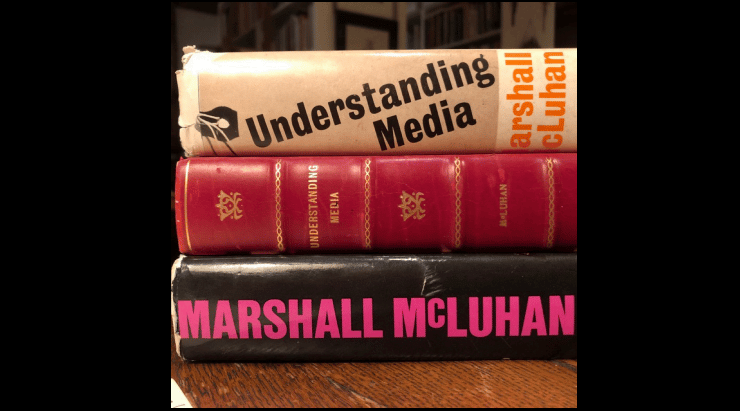
The book seems to be more philosophy and poetry than science and technology, which is a continuing source of irritation for some. But it’s a feature, not a bug. The book's style and its use of long sentences and page-long paragraphs are likewise deliberate, meant to draw attention to the form. Dense blocks of text stand in parallel with very dense ideas. Typography offers no relief. You create the gaps and fill in the blanks.
Given that McLuhan was an English professor, it should not surprise anyone that he approached the study of technology and culture through the lens of literary criticism. Still, it surprised even him that it is as fruitful as it is.
Neither poetry nor media tends to be straightforward. If you want to get the most out of this book, approach it like a book of poetry. Expect to do some work. Go deep. There are meanings within meanings, and references are rabbit holes. It was designed to open up with your effort.
Take “the medium is the message” for example. My friend PH Ferreira likened it to Einstein’s E=mc2 formula, and I think it’s a very apt analogy. They each make about as much sense, one a five-word paradox, the other a mysterious five-character equation. Einstein figured out that energy equals mass times the speed of light squared, and McLuhan figured out that the effect of a medium comes from its form more than its content. Both were flashes of insight that changed the way we understood the nature of things.
Or his line in chapter one that the “content of a medium is like the juicy piece of meat carried by the burglar to distract the watchdog of the mind.” This is borrowed (stolen, if you like, but improved when you think about it) from T. S. Eliot, who was speaking about the use of meaning in poetry. Marshall blew that open to apply it to content in media with a complex melding of metaphors where meaning is to content and a juicy piece of meat as poetry is to technology and a burglar with designs on your property, or, in the case of media, on your sensibility.
But what does “the medium is the message” mean? And what about the content?
Marshall McLuhan first said “the medium is the message” in 1958, several years before he even thought of writing Understanding Media. The context of his saying it was actually not that different from the state of the world right now.
It was at a radio broadcaster’s conference in Canada where McLuhan, a rising communications expert, had been invited to shed some light. Radio broadcasters were worried. For decades, radio had enjoyed a prominent place in people’s lives. People used radio then much the same way people today use Spotify, Netflix, TikTok, and X, though to a lesser degree. Because of this large audience regularly tuning in, radio broadcasters enjoyed substantial ad revenue.
But there was a problem, and it was quickly getting worse: television. Television sets were flying off the shelves and into people’s daily lives, taking up space that radio had once occupied. Radio was being pushed aside. Critically for radio broadcasters, ad revenues were shrinking because advertising budgets don’t tend to grow when new media come around, so much as shift. Advertisers and their budgets follow the audience.
Radio broadcasters were worried that television would kill radio. Marshall McLuhan told them that radio wasn’t going to disappear just yet, but it would be displaced. Radio provides a user experience much different from television and can do things television can’t. I’m not sure this was comforting, nor was it meant to be.
Content and Context
Content is the constant in media. As our media change and we change, content remains essentially the same, with slight variations in style and presentation. We are expressive creatures with a range of things to express: love and loss, delight and dismay, ecstasy and horror, triumph and defeat. We live, we die, we laugh, we cry. We haven’t really found many new things to express, so much as new ways to express the same things.
We have an insatiable need to create and consume content. As happens with appetites, “content consumption” is less a casual diversion than a need that seems to keep growing. When you look at screen time use statistics, it’s hard to imagine people spending even more time creating and consuming content than they already do. Still, it wasn’t all that long ago, in the long timeline of human history, that we developed, accepted, and welcomed screens into our lives. From the screen in the theatre to the screen in the home to the screen in your pocket, there has been a steady increase in the time we spend with screens. Recently, hardware has tried to make the screen disappear, but it is likely to disappear only in the same way the keyboard has.
People tend to find the suggestion that content is subordinate in its power to media difficult to accept. They get upset about it. No one is saying that content doesn’t matter or has no effect. Indeed, not a professor (and lover) of English Literature and poetry like Marshall McLuhan. But when you start to tally up the effects of the content of any medium (say, all the Zoom meetings ever) to the effects of a medium itself (how Zoom has changed us and our personal, social, and professional lives), it’s clear that content is hardly king. Context is.
While major changes in our personal and social lives don’t come from content, it plays a very important supporting role. If it weren’t for content, if it weren’t for the things we use technology for, we wouldn’t use technology. Technology wouldn’t play a starring role in our lives. Content keeps us occupied while technology takes over and becomes habitual, indispensable.
I sometimes speak to young people, ten-year-old children, about the role of technology in their lives. After spending some time discussing how essential smartphones are, how they wake up with them, use them throughout the day, and go to sleep with them at night, I ask them to imagine waking up tomorrow to a world without them. I say: “You wake up tomorrow and your smartphone doesn’t work, your friends’ smartphones don’t work, and they never will again.”
There is a shocked silence broken only by gasps of breath as they try to imagine that world and can’t.
If you take a moment to consider that, you will be equally shocked. If some strange disaster happened and smartphones stopped working today and wouldn’t work again, what impact would it have on your personal, social, and professional life? If we can pretend for a moment that there wouldn’t be near-instant chaos and anarchy, we can all agree that it would be a difficult disaster to overcome. We have become so dependent on our smartphones for so much of what we do.
This is why the medium is the message. Although the content provides so much value in utility and enjoyment, the medium is a much more important factor. The paradox is that the content carries the effect as a side effect. The content is the “spoonful of sugar that helps the medicine go down.”
So what matters is less what you use it for than that you use it at all.
“Our conventional response to all media, namely that it is how they are used that counts, is the numb stance of the technological idiot. For the ‘content’ of a medium is like the juicy piece of meat carried by the burglar to distract the watchdog of the mind.”
- 1964
The content keeps us engaged, while the medium reshapes us personally and socially.
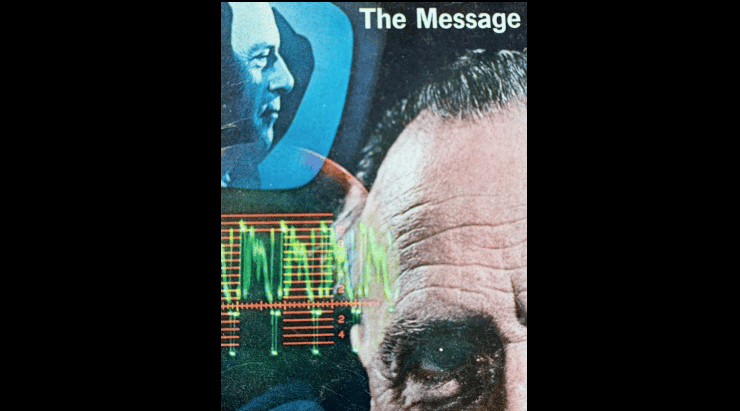
Marshall McLuhan devotes the first chapter of Understanding Media to the idea that “the medium is the message” because it is the foundation of understanding how media influence and alter us.
In addition to devoting the book to a study of form rather than content, McLuhan does a few other revolutionary things, such as burying the promise of the book almost 100 pages into it:
“The present book, in seeking to understand many media, the conflicts from which they spring, and the even greater conflicts to which they give rise, holds out the promise of reducing these conflicts by an increase of human autonomy.”
- 1964
Even that single sentence takes some effort to unpack, compressed as it is, like poetry. When McLuhan decided to “understand media” in 1958, in a study that led to the book in 1964, he developed a theory that innovation is a response to irritation, building off contemporary studies of the behavior of the human nervous system, particularly the work of Adolphe Jonas and Hans Selye.
“The section on ‘the medium is the message’ can, perhaps, be clarified by pointing out that any technology gradually creates a totally new human environment. Environments are not passive wrappings but active processes.”
- Introduction to the second edition of Understanding Media: The Extensions of Man, 1966
McLuhan takes an environmental approach to the study of technology, as he discovered that, like the natural environment around us and the biological environment within us, technology is a dynamic environment in which affecting one part affects all parts. Another word for “medium” is “environment,” which makes the study of media a kind of environmental science.
Probably the most important questions we can ask about AI are:
What new human environment is being created?
What happens to the old one?
What happens to us?
Curiously, our relation to our natural environment (the Earth), and even our biological environment (our bodies), is far more advanced than our relation to our technologies and media, or the artificial environment of technology.
We are very strict about putting unknown substances into our bodies—we have all kinds of regulations for that. The government and the public would not allow a drug company, for example, to put a new drug on the shelves without exhaustive studies and removal of (or at least warning of) damaging side effects.
But the same is not true for new technology, where we are sold the benefits with little idea of the cost.
“There is absolutely no inevitability as long as there is a willingness to contemplate the situation.”
- ‘The Medium is the Massage,’ 1967
We are rapidly integrating AI into every part of our lives, with only a very superficial regard for what it could mean even a little way down the road. This is not a strategy for success. Well, not our success anyway.
I’m reminded of what happened with the discovery of electricity, and AI seems to be a medium in the order of electricity or machine. Electricity was quickly added everywhere possible—actually, we’re still finding things to make electric like smoking (vaping). A whole new world and pattern of human activity arrived, or appeared, when we turned off the night by turning on the electric light. Electric communication meant not having to wait weeks for a letter back. Electric light meant the factory didn’t have to shut down. And so on. The human world before electricity and the human world with it bear little resemblance to each other. (As the human world before AI and after will bear little resemblance to each other.)
Consider also the world before written language, where information was passed from mouth to ear across generations—it’s incredible to think that this was how basically all human knowledge was passed down for most of human history! In the human timeline, writing in any form is very new.
Whether the world before or after writing, before or after electricity, before or after AI is better or not depends almost entirely on which side of before or after you are on. The life we can remember and feel nostalgia for, is one our children can’t even imagine much less desire.
New media lead to new habits, and new habits become new values. These new habits and values aren’t necessarily compatible with our old habits and values, so if we truly value those things, we should be careful how eager we are to replace them. They do not translate well.
McLuhan believed that we don’t need to be helpless. He wrote Understanding Media to give us tools to begin to think about and to anticipate the “unintended consequences” of technology, and in doing so to “increase human autonomy,” and made it his mission to spread the message.
McLuhan looks at all human innovation, not just communication technologies, as media; as artificial extensions of parts of ourselves, as “extensions of human powers.” Written language extends our speech, our thought, our consciousness, as clothing extends our skin, and both written language and clothing make for very different lives and a different world by their presence than their absence. All these things make for a different human, user, and experience.
McLuhan intentionally designed Understanding Media to require you to work to make the most of it. He “cooled” it down, to use his terms, to force you to participate.
He plays with words, with ideas. This may make it difficult for people without English as a first language, then again it may make it easier as you may be more inclined to think about word choice and not assume you know what certain words mean or how they’re used. The book is full of tricks and turns of phrase, metaphor and idiom, painstakingly constructed for maximum effect.
He doesn’t spell it out, but leaves it to the reader to observe and make connections.
For example, the book is two parts: Part One is seven chapters, beginning with “the medium is the message.” These chapters contain general principles of media, their nature or structure, and their human impact. The seven chapters evoke the Seven Liberal Arts of classical education. Although chances are you’ve never heard of them, they were the basis of higher education for many centuries before our time, and are where Liberal Arts Colleges got their name.
The Seven Liberal Arts of Classical Education:
Trivium
Dialectic – the word in thought
Rhetoric – the spoken word
Grammar – the written word
Quadrivium
Arithmetic – pure number
Geometry – number in space
Music – number in time
Astronomy – numbers in space and time
Part Two of Understanding Media consists of twenty-six chapters, like the letters of the phonetic alphabet, in which McLuhan essentially takes the general principles from Part One and applies them to specific technologies, from the spoken word to clothing to housing to games, and finally to automation.
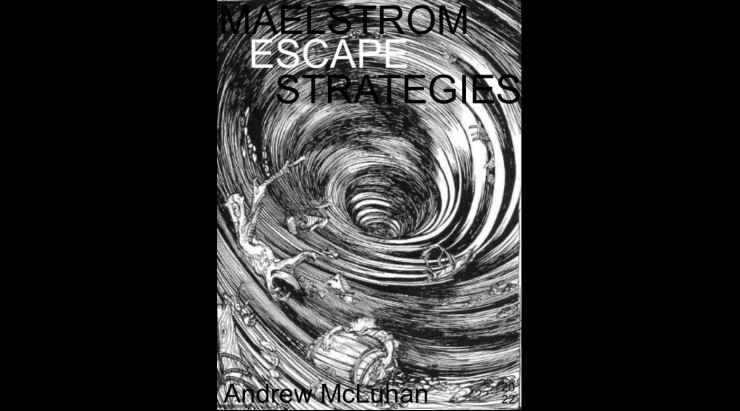
Underneath the discussion of technologies is a major war between two classes of media, which was happening in his time, the 20th century: the transition from mechanical to electrical media. It feels like we are in the grips of another great transition right now, and the pace and scale are so great that my head is spinning, and it sometimes feels like I’m being torn to pieces in gigantic technological maelstrom.
Transportation vs Transformation
For McLuhan, the key to understanding media was understanding how media transform us individually, through our senses.
“Going along with the total and, perhaps, motivated ignorance of man-made environments, is the failure of philosophers and psychologists in general to notice that our senses are not passible receptors of experience.”
- Identity, Technology, and War, 1970
This was, for McLuhan, the failure of Information Theory, which treats a medium as a sort of pipeline through which messages pass; it doesn’t account for (individual and social) changes in the user. He called it a “transportation theory” of communication and called his own one of transFORMation.
Our senses are not static; they change as we grow. When we are born, our senses are raw and open. We experience things at full volume. It’s at times uncomfortable.
Our senses are altered by what passes through them, form habits and pathways, and they dull over time. As we age, we tend not to see, hear, or taste as we once did.
They exist as an ecosystem, and like other environments, when you affect one of them you affect all of them, however subtly.
We are the sum of our senses. It can’t be overstated how important our senses are to every aspect of our lives. Our senses are what stands between what’s out there and what’s in here, are the ultimate arbiters of every experience, with the quality (the nature, the makeup) of the senses determining the quality of any experience.
All it takes is to lose a sense to find out how much we take their role for granted.
To give a drastic example, there is a book by French author and political activist Jacques Lusseyran called And There Was Light.
In his memoir, Lusseyran, who was a WWII hero in the French resistance, describes what happened when he lost his sight in a schoolyard accident at an early age.
As his vision dimmed, his other senses came alive. He found that his sense of sound and touch opened up a whole new world to him and I think he felt that it wasn’t him who was blind – it was those who see and yet experience so much less.
Different media, extending different parts of us, make different demands on us in return, and make us into different people and cultures.
You wouldn’t market a product the same way to a blind person as to sighted person, to a deaf person as to one who hears.
This is where the rubber meets the road in terms of why media studies are essential for marketing:
In the McLuhan tradition or school, media studies are the study of the influence of technologies on individuals and cultures and the human/technological environment. Marketing, to be effective, needs to not only reach but also resonate. You don’t show an ad to a blind person, you don’t sing a jingle to a deaf person.
When it comes to marketing in the age of AI, or any age, the medium is the message.
Andrew McLuhan, a grandson of Marshall McLuhan, created The McLuhan Institute in 2017 to preserve and continue his family's tradition of exploring the nature of technology and its effects on people and culture. He writes, lectures, and consults widely.
Marshall McLuhan woke in the hospital after suffering a stroke in the fall of 1979 and said, “Eric… Brazil,” to his eldest child, my father, Eric McLuhan. It was maybe the last coherent statement he made, suffering from aphasia for the previous year and a bit, he was alive.
I’ve been to Brazil a few times now, and I always think about that.
Last year, I was there for almost two weeks helping friends at Baroes launch their book, Brand Publishing in Practice. This year, I returned. RD Station invited me to speak at their gigantic marketing extravaganza, RD Summit. It was quite an experience! Special thanks to RD Station for having me, and for not objecting to me repurposing that talk here for you.
My challenge was to give them practical, valuable lessons from my family’s work in media studies to help them navigate their changing world and audience, while adapting their work in marketing and their day-to-day lives to get through it. That talk has been “formatted to fit your screen,” as they used to announce when films were released on videotape.
I’m here to talk to you about my grandfather, Marshall McLuhan, what he discovered about media in the 20th century, and how it can help you with marketing in the 21st century amid media turmoil.
Marshall McLuhan (b. Edmonton, Alberta, 1911 – d. Toronto, Ontario, 1980) was an English teacher who became interested in communications studies and helped found and develop the fields of media study and media ecology.
A few quotes to get us started:
“In today’s rapidly changing environment, people have two major concerns: to discover the new problems this environment poses, and to develop ways of coping with these problems.”
- City as Classroom: Understanding Language and Media, 1977
That could have been written today.
“It is misleading to suppose that there is any basic difference between education and entertainment… It’s always been true that whatever pleases teaches more effectively.”
- Classroom Without Walls, 1957
Still true.
“The early stages by which information itself became the basic economic commodity of the electric age were obscured by the ways in which advertising and entertainment put people off the track.”
- Understanding Media: The Extensions of Man, 1964
Not exactly a great way to endear yourself to the advertising industry.
Marshall was an English teacher, trained in literary criticism at Cambridge University in England in the early 1930s. It might seem like a long way from teaching English to traveling the world talking about media, but it’s not as far off as it sounds.
One of his most influential professors at Cambridge was I. A. Richards, who had recently written a book called Practical Criticism. The work laid out a new approach to studying literature by examining what it does.
Richards ran an experiment that was highly controversial at the time. He collected samples of literature from well-known and well-regarded authors, as well as from less-known and less-regarded authors, and removed the authors’ names from their work. For the more well-known and well-regarded authors, he chose work that wasn’t as popular, so it wasn’t obvious who had written what. He then passed out these packages to graduate students and critics and asked them to evaluate them.
Richards wanted to find out what made good literature good. Beyond someone saying it’s good, why do we like some work and not others?
“All media exist to invest our lives with artificial perception and arbitrary values.”
- Understanding Media: The Extensions of Man, 1964
The experiment was controversial because, when the papers came back, there was little agreement on what work was good or bad. Work by highly regarded authors was ranked lower than that of authors no one really cared about. Removing the authors’ names forced everyone to consider the work on its own terms and led Richards to propose a series of criteria for judging work based on the effect it has on the audience.
The UK to the USA
Graduating from Cambridge with a degree in English Literature, and unable to find work in Canada, Marshall got a teaching job in the US at the University of Wisconsin-Madison. It would have been quite a culture shock to go from Cambridge University to an American college. Marshall found that he couldn’t relate to the students, so he decided to look at their popular culture. He applied the skills he learned from studying literature, turning them on to comics and advertising, as they were the popular print media of the time in the late 1930s. This was a revolutionary step. Today, it is quite common to take items from popular culture as serious subjects for study, but it was not in 1936. However, his studies and the lectures he gave with them proved popular with the students, and led Marshall to write his first book, The Mechanical Bride: Folklore of Industrial Man.
The Mechanical Bride is a series of exploratory essays that take on “commercial education,” which is what they called advertising at the time. It’s hard to believe, but marketers might appreciate that they got away with classifying advertising as public education and even received tax credits for it!
Marshall, however, took a dim view. His preface announced that:
“Ours is the first age in which many thousands of the best-trained individual minds have made it their business to get inside the collective public mind. To get inside to manipulate, exploit, control, is the object now. And to generate heat, not light, is the intention.”
Applying what we might call “media literacy” today, Marshall was trying to make his students, and the public, aware that they were being manipulated. Again, this might not sound remarkable today, but it was a startling statement in 1951, when ‘The Mechanical Bride’ was published. It didn’t win him many friends in the advertising world at the time—though they would come around later when they realized his work had a lot to offer the professions of advertising and marketing.
Howard Gossage: Marketing the Messenger
If you know the name Marshall McLuhan, there’s a good chance it’s because of a man named Howard Gossage.
Howard Gossage was a legendary advertising man from California, sometimes known as the Socrates of San Francisco. He had a partner named Gerry Feigen, and one day Gerry gave Howard a book he thought he’d like. The book, which had just been published by McGraw-Hill in New York in 1964, was McLuhan’s Understanding Media: The Extensions of Man. Gerry was right, Howard loved it.
Howard was not your average '60s ad man. He was a highly respected professional, and he was a humanist. During his career, he made a point of supporting several causes, including the World Wildlife Fund, the nation of Anguilla, the Grand Canyon, and Marshall McLuhan.
“Changing the world is the only fit work for a grown man.”
- Howard Gossage
Understanding Media profoundly moved Gossage. It was then that he decided that the world needed Marshall McLuhan and that he, Howard Gossage, would do something about it. According to his wife, Howard picked up the phone, dialed Canada, and said, “Dr. McLuhan, how would you like to be famous?” I’m not sure my grandfather wanted to be famous. In fact, I’m almost certain he really didn’t. Nearly everyone enjoys the idea of fame more than the reality. Ask any influencer, celebrity, or high-profile public figure, and you will find it’s more trouble than it’s worth. Marshall certainly knew this. But he had goals.
Howard Gossage had a plan. In the spring of 1965, he spent a bunch of money and brought McLuhan to New York City, where Gossage threw dinner and cocktail parties and introduced McLuhan to the influencers of the day, journalists like Tom Wolfe. McLuhan hit them with the full force of his substantial wit and intellect. He dazzled. Gossage followed it with a Marshall McLuhan Festival in San Francisco, a weeklong extravaganza in August, shortly after articles began to appear about McLuhan.
Tom Wolfe wrote in the New York Herald Tribune:
And for the rest of the 1960s, Marshall McLuhan was everywhere. His name was known across the global village.
Marshall McLuhan’s 1964 work, Understanding Media: The Extensions of Man, is what lit a fire under ad man Howard Gossage, and I’m going to try to help you understand why.
“The medium is what happens to you and that is the message.”
- 1967
Following (somewhat) in the footsteps of people like I. A. Richards from Cambridge University, Marshall McLuhan was interested in effects. What these things do to us. How we are changed as a result. At the time, communications studies mainly consisted of information theory, which is how a message gets from one place to another, from sender to receiver. McLuhan was interested in the changes that take place in the user and society as the result of the technologies of the day, something the “models of communication” don’t take into account.
This should resonate with advertising and marketing folks who should likewise be interested mainly in effect and action. In business, this ultimately means sales. The key to this is understanding your audience, or demographic, and their behavior; not only where and how to reach them, but how to make them act. To buy.
In a strictly business sense, it doesn’t matter how someone says they feel about a product. What matters is whether or not they buy it.
If you want to understand a person or their culture, you have to look to their media. Their “media” are quite literally ‘in the middle’ between them and you.
Marketers should be interested in media because media create habits. That is the marketer's goal: to shape behavior. When the media change, people change. Their habits change. A sure way to get into people’s pockets is to get into their habits.
Understanding Media: The Extensions of Man (1964)
Understanding Media upset many people because it was not what they expected from a book about communication in 1964. For one, this was about a lot more than communication and communication technologies.
In the very title, McLuhan announces one of the major themes of the book: that all media are extensions of some part of ourselves. A way to amplify or extend some sense or function. To do something or make it faster, stronger, or bigger.
The “message” of a medium, he says, is the increase in speed, scale, or pattern that it brings with it as a (usually unintended) consequence. It is all these side effects or unintended consequences that end up being far more significant than the intended use.
“What we are considering here, however, are the psychic and social consequences of the designs or patterns as they amplify or accelerate existing processes. For the “message” of any medium or technology is the change of scale or pace or pattern that it introduces into human affairs.”
- 1964
These changes are what change us, or as John Culkin put it in his article about McLuhan and his work:
“We shape our tools and thereafter our tools shape us.”
- A Schoolman’s Guide to Marshall McLuhan, John Culkin, 1965
The shaping happens from those changes in speed and scale, which force us to adjust ourselves in return or reaction.
Crucially, this happens not by the content or individual uses to which we put these things but by the resulting changes in ourselves and the world around us as a result of the introduction of the new form.
This is what Marshall McLuhan meant when he said “the medium is the message”; not that the medium shapes the message and how it’s perceived.
THE MEDIUM SHAPES US.
We are, for better or worse, living in a great time to pay attention to this sort of thing. Significant changes are happening to us and around us as we speak, faster than we can hope to adjust to.
In the confidence that a better understanding of media can make you better at marketing, here are some of my cheat codes for the book Understanding Media, which, to many, is considered the McLuhan Bible. Much of McLuhan’s early work leads up to Understanding Media, and much of his later work flows from it.
The book seems to be more philosophy and poetry than science and technology, which is a continuing source of irritation for some. But it’s a feature, not a bug. The book's style and its use of long sentences and page-long paragraphs are likewise deliberate, meant to draw attention to the form. Dense blocks of text stand in parallel with very dense ideas. Typography offers no relief. You create the gaps and fill in the blanks.
Given that McLuhan was an English professor, it should not surprise anyone that he approached the study of technology and culture through the lens of literary criticism. Still, it surprised even him that it is as fruitful as it is.
Neither poetry nor media tends to be straightforward. If you want to get the most out of this book, approach it like a book of poetry. Expect to do some work. Go deep. There are meanings within meanings, and references are rabbit holes. It was designed to open up with your effort.
Take “the medium is the message” for example. My friend PH Ferreira likened it to Einstein’s E=mc2 formula, and I think it’s a very apt analogy. They each make about as much sense, one a five-word paradox, the other a mysterious five-character equation. Einstein figured out that energy equals mass times the speed of light squared, and McLuhan figured out that the effect of a medium comes from its form more than its content. Both were flashes of insight that changed the way we understood the nature of things.
Or his line in chapter one that the “content of a medium is like the juicy piece of meat carried by the burglar to distract the watchdog of the mind.” This is borrowed (stolen, if you like, but improved when you think about it) from T. S. Eliot, who was speaking about the use of meaning in poetry. Marshall blew that open to apply it to content in media with a complex melding of metaphors where meaning is to content and a juicy piece of meat as poetry is to technology and a burglar with designs on your property, or, in the case of media, on your sensibility.
But what does “the medium is the message” mean? And what about the content?
Marshall McLuhan first said “the medium is the message” in 1958, several years before he even thought of writing Understanding Media. The context of his saying it was actually not that different from the state of the world right now.
It was at a radio broadcaster’s conference in Canada where McLuhan, a rising communications expert, had been invited to shed some light. Radio broadcasters were worried. For decades, radio had enjoyed a prominent place in people’s lives. People used radio then much the same way people today use Spotify, Netflix, TikTok, and X, though to a lesser degree. Because of this large audience regularly tuning in, radio broadcasters enjoyed substantial ad revenue.
But there was a problem, and it was quickly getting worse: television. Television sets were flying off the shelves and into people’s daily lives, taking up space that radio had once occupied. Radio was being pushed aside. Critically for radio broadcasters, ad revenues were shrinking because advertising budgets don’t tend to grow when new media come around, so much as shift. Advertisers and their budgets follow the audience.
Radio broadcasters were worried that television would kill radio. Marshall McLuhan told them that radio wasn’t going to disappear just yet, but it would be displaced. Radio provides a user experience much different from television and can do things television can’t. I’m not sure this was comforting, nor was it meant to be.
Content and Context
Content is the constant in media. As our media change and we change, content remains essentially the same, with slight variations in style and presentation. We are expressive creatures with a range of things to express: love and loss, delight and dismay, ecstasy and horror, triumph and defeat. We live, we die, we laugh, we cry. We haven’t really found many new things to express, so much as new ways to express the same things.
We have an insatiable need to create and consume content. As happens with appetites, “content consumption” is less a casual diversion than a need that seems to keep growing. When you look at screen time use statistics, it’s hard to imagine people spending even more time creating and consuming content than they already do. Still, it wasn’t all that long ago, in the long timeline of human history, that we developed, accepted, and welcomed screens into our lives. From the screen in the theatre to the screen in the home to the screen in your pocket, there has been a steady increase in the time we spend with screens. Recently, hardware has tried to make the screen disappear, but it is likely to disappear only in the same way the keyboard has.
People tend to find the suggestion that content is subordinate in its power to media difficult to accept. They get upset about it. No one is saying that content doesn’t matter or has no effect. Indeed, not a professor (and lover) of English Literature and poetry like Marshall McLuhan. But when you start to tally up the effects of the content of any medium (say, all the Zoom meetings ever) to the effects of a medium itself (how Zoom has changed us and our personal, social, and professional lives), it’s clear that content is hardly king. Context is.
While major changes in our personal and social lives don’t come from content, it plays a very important supporting role. If it weren’t for content, if it weren’t for the things we use technology for, we wouldn’t use technology. Technology wouldn’t play a starring role in our lives. Content keeps us occupied while technology takes over and becomes habitual, indispensable.
I sometimes speak to young people, ten-year-old children, about the role of technology in their lives. After spending some time discussing how essential smartphones are, how they wake up with them, use them throughout the day, and go to sleep with them at night, I ask them to imagine waking up tomorrow to a world without them. I say: “You wake up tomorrow and your smartphone doesn’t work, your friends’ smartphones don’t work, and they never will again.”
There is a shocked silence broken only by gasps of breath as they try to imagine that world and can’t.
If you take a moment to consider that, you will be equally shocked. If some strange disaster happened and smartphones stopped working today and wouldn’t work again, what impact would it have on your personal, social, and professional life? If we can pretend for a moment that there wouldn’t be near-instant chaos and anarchy, we can all agree that it would be a difficult disaster to overcome. We have become so dependent on our smartphones for so much of what we do.
This is why the medium is the message. Although the content provides so much value in utility and enjoyment, the medium is a much more important factor. The paradox is that the content carries the effect as a side effect. The content is the “spoonful of sugar that helps the medicine go down.”
So what matters is less what you use it for than that you use it at all.
“Our conventional response to all media, namely that it is how they are used that counts, is the numb stance of the technological idiot. For the ‘content’ of a medium is like the juicy piece of meat carried by the burglar to distract the watchdog of the mind.”
- 1964
The content keeps us engaged, while the medium reshapes us personally and socially.
Marshall McLuhan devotes the first chapter of Understanding Media to the idea that “the medium is the message” because it is the foundation of understanding how media influence and alter us.
In addition to devoting the book to a study of form rather than content, McLuhan does a few other revolutionary things, such as burying the promise of the book almost 100 pages into it:
“The present book, in seeking to understand many media, the conflicts from which they spring, and the even greater conflicts to which they give rise, holds out the promise of reducing these conflicts by an increase of human autonomy.”
- 1964
Even that single sentence takes some effort to unpack, compressed as it is, like poetry. When McLuhan decided to “understand media” in 1958, in a study that led to the book in 1964, he developed a theory that innovation is a response to irritation, building off contemporary studies of the behavior of the human nervous system, particularly the work of Adolphe Jonas and Hans Selye.
“The section on ‘the medium is the message’ can, perhaps, be clarified by pointing out that any technology gradually creates a totally new human environment. Environments are not passive wrappings but active processes.”
- Introduction to the second edition of Understanding Media: The Extensions of Man, 1966
McLuhan takes an environmental approach to the study of technology, as he discovered that, like the natural environment around us and the biological environment within us, technology is a dynamic environment in which affecting one part affects all parts. Another word for “medium” is “environment,” which makes the study of media a kind of environmental science.
Probably the most important questions we can ask about AI are:
What new human environment is being created?
What happens to the old one?
What happens to us?
Curiously, our relation to our natural environment (the Earth), and even our biological environment (our bodies), is far more advanced than our relation to our technologies and media, or the artificial environment of technology.
We are very strict about putting unknown substances into our bodies—we have all kinds of regulations for that. The government and the public would not allow a drug company, for example, to put a new drug on the shelves without exhaustive studies and removal of (or at least warning of) damaging side effects.
But the same is not true for new technology, where we are sold the benefits with little idea of the cost.
“There is absolutely no inevitability as long as there is a willingness to contemplate the situation.”
- ‘The Medium is the Massage,’ 1967
We are rapidly integrating AI into every part of our lives, with only a very superficial regard for what it could mean even a little way down the road. This is not a strategy for success. Well, not our success anyway.
I’m reminded of what happened with the discovery of electricity, and AI seems to be a medium in the order of electricity or machine. Electricity was quickly added everywhere possible—actually, we’re still finding things to make electric like smoking (vaping). A whole new world and pattern of human activity arrived, or appeared, when we turned off the night by turning on the electric light. Electric communication meant not having to wait weeks for a letter back. Electric light meant the factory didn’t have to shut down. And so on. The human world before electricity and the human world with it bear little resemblance to each other. (As the human world before AI and after will bear little resemblance to each other.)
Consider also the world before written language, where information was passed from mouth to ear across generations—it’s incredible to think that this was how basically all human knowledge was passed down for most of human history! In the human timeline, writing in any form is very new.
Whether the world before or after writing, before or after electricity, before or after AI is better or not depends almost entirely on which side of before or after you are on. The life we can remember and feel nostalgia for, is one our children can’t even imagine much less desire.
New media lead to new habits, and new habits become new values. These new habits and values aren’t necessarily compatible with our old habits and values, so if we truly value those things, we should be careful how eager we are to replace them. They do not translate well.
McLuhan believed that we don’t need to be helpless. He wrote Understanding Media to give us tools to begin to think about and to anticipate the “unintended consequences” of technology, and in doing so to “increase human autonomy,” and made it his mission to spread the message.
McLuhan looks at all human innovation, not just communication technologies, as media; as artificial extensions of parts of ourselves, as “extensions of human powers.” Written language extends our speech, our thought, our consciousness, as clothing extends our skin, and both written language and clothing make for very different lives and a different world by their presence than their absence. All these things make for a different human, user, and experience.
McLuhan intentionally designed Understanding Media to require you to work to make the most of it. He “cooled” it down, to use his terms, to force you to participate.
He plays with words, with ideas. This may make it difficult for people without English as a first language, then again it may make it easier as you may be more inclined to think about word choice and not assume you know what certain words mean or how they’re used. The book is full of tricks and turns of phrase, metaphor and idiom, painstakingly constructed for maximum effect.
He doesn’t spell it out, but leaves it to the reader to observe and make connections.
For example, the book is two parts: Part One is seven chapters, beginning with “the medium is the message.” These chapters contain general principles of media, their nature or structure, and their human impact. The seven chapters evoke the Seven Liberal Arts of classical education. Although chances are you’ve never heard of them, they were the basis of higher education for many centuries before our time, and are where Liberal Arts Colleges got their name.
The Seven Liberal Arts of Classical Education:
Trivium
Dialectic – the word in thought
Rhetoric – the spoken word
Grammar – the written word
Quadrivium
Arithmetic – pure number
Geometry – number in space
Music – number in time
Astronomy – numbers in space and time
Part Two of Understanding Media consists of twenty-six chapters, like the letters of the phonetic alphabet, in which McLuhan essentially takes the general principles from Part One and applies them to specific technologies, from the spoken word to clothing to housing to games, and finally to automation.
Underneath the discussion of technologies is a major war between two classes of media, which was happening in his time, the 20th century: the transition from mechanical to electrical media. It feels like we are in the grips of another great transition right now, and the pace and scale are so great that my head is spinning, and it sometimes feels like I’m being torn to pieces in gigantic technological maelstrom.
Transportation vs Transformation
For McLuhan, the key to understanding media was understanding how media transform us individually, through our senses.
“Going along with the total and, perhaps, motivated ignorance of man-made environments, is the failure of philosophers and psychologists in general to notice that our senses are not passible receptors of experience.”
- Identity, Technology, and War, 1970
This was, for McLuhan, the failure of Information Theory, which treats a medium as a sort of pipeline through which messages pass; it doesn’t account for (individual and social) changes in the user. He called it a “transportation theory” of communication and called his own one of transFORMation.
Our senses are not static; they change as we grow. When we are born, our senses are raw and open. We experience things at full volume. It’s at times uncomfortable.
Our senses are altered by what passes through them, form habits and pathways, and they dull over time. As we age, we tend not to see, hear, or taste as we once did.
They exist as an ecosystem, and like other environments, when you affect one of them you affect all of them, however subtly.
We are the sum of our senses. It can’t be overstated how important our senses are to every aspect of our lives. Our senses are what stands between what’s out there and what’s in here, are the ultimate arbiters of every experience, with the quality (the nature, the makeup) of the senses determining the quality of any experience.
All it takes is to lose a sense to find out how much we take their role for granted.
To give a drastic example, there is a book by French author and political activist Jacques Lusseyran called And There Was Light.
In his memoir, Lusseyran, who was a WWII hero in the French resistance, describes what happened when he lost his sight in a schoolyard accident at an early age.
As his vision dimmed, his other senses came alive. He found that his sense of sound and touch opened up a whole new world to him and I think he felt that it wasn’t him who was blind – it was those who see and yet experience so much less.
Different media, extending different parts of us, make different demands on us in return, and make us into different people and cultures.
You wouldn’t market a product the same way to a blind person as to sighted person, to a deaf person as to one who hears.
This is where the rubber meets the road in terms of why media studies are essential for marketing:
In the McLuhan tradition or school, media studies are the study of the influence of technologies on individuals and cultures and the human/technological environment. Marketing, to be effective, needs to not only reach but also resonate. You don’t show an ad to a blind person, you don’t sing a jingle to a deaf person.
When it comes to marketing in the age of AI, or any age, the medium is the message.
Andrew McLuhan, a grandson of Marshall McLuhan, created The McLuhan Institute in 2017 to preserve and continue his family's tradition of exploring the nature of technology and its effects on people and culture. He writes, lectures, and consults widely.
Marshall McLuhan woke in the hospital after suffering a stroke in the fall of 1979 and said, “Eric… Brazil,” to his eldest child, my father, Eric McLuhan. It was maybe the last coherent statement he made, suffering from aphasia for the previous year and a bit, he was alive.
I’ve been to Brazil a few times now, and I always think about that.
Last year, I was there for almost two weeks helping friends at Baroes launch their book, Brand Publishing in Practice. This year, I returned. RD Station invited me to speak at their gigantic marketing extravaganza, RD Summit. It was quite an experience! Special thanks to RD Station for having me, and for not objecting to me repurposing that talk here for you.
My challenge was to give them practical, valuable lessons from my family’s work in media studies to help them navigate their changing world and audience, while adapting their work in marketing and their day-to-day lives to get through it. That talk has been “formatted to fit your screen,” as they used to announce when films were released on videotape.
I’m here to talk to you about my grandfather, Marshall McLuhan, what he discovered about media in the 20th century, and how it can help you with marketing in the 21st century amid media turmoil.
Marshall McLuhan (b. Edmonton, Alberta, 1911 – d. Toronto, Ontario, 1980) was an English teacher who became interested in communications studies and helped found and develop the fields of media study and media ecology.
A few quotes to get us started:
“In today’s rapidly changing environment, people have two major concerns: to discover the new problems this environment poses, and to develop ways of coping with these problems.”
- City as Classroom: Understanding Language and Media, 1977
That could have been written today.
“It is misleading to suppose that there is any basic difference between education and entertainment… It’s always been true that whatever pleases teaches more effectively.”
- Classroom Without Walls, 1957
Still true.
“The early stages by which information itself became the basic economic commodity of the electric age were obscured by the ways in which advertising and entertainment put people off the track.”
- Understanding Media: The Extensions of Man, 1964
Not exactly a great way to endear yourself to the advertising industry.
Marshall was an English teacher, trained in literary criticism at Cambridge University in England in the early 1930s. It might seem like a long way from teaching English to traveling the world talking about media, but it’s not as far off as it sounds.
One of his most influential professors at Cambridge was I. A. Richards, who had recently written a book called Practical Criticism. The work laid out a new approach to studying literature by examining what it does.
Richards ran an experiment that was highly controversial at the time. He collected samples of literature from well-known and well-regarded authors, as well as from less-known and less-regarded authors, and removed the authors’ names from their work. For the more well-known and well-regarded authors, he chose work that wasn’t as popular, so it wasn’t obvious who had written what. He then passed out these packages to graduate students and critics and asked them to evaluate them.
Richards wanted to find out what made good literature good. Beyond someone saying it’s good, why do we like some work and not others?
“All media exist to invest our lives with artificial perception and arbitrary values.”
- Understanding Media: The Extensions of Man, 1964
The experiment was controversial because, when the papers came back, there was little agreement on what work was good or bad. Work by highly regarded authors was ranked lower than that of authors no one really cared about. Removing the authors’ names forced everyone to consider the work on its own terms and led Richards to propose a series of criteria for judging work based on the effect it has on the audience.
The UK to the USA
Graduating from Cambridge with a degree in English Literature, and unable to find work in Canada, Marshall got a teaching job in the US at the University of Wisconsin-Madison. It would have been quite a culture shock to go from Cambridge University to an American college. Marshall found that he couldn’t relate to the students, so he decided to look at their popular culture. He applied the skills he learned from studying literature, turning them on to comics and advertising, as they were the popular print media of the time in the late 1930s. This was a revolutionary step. Today, it is quite common to take items from popular culture as serious subjects for study, but it was not in 1936. However, his studies and the lectures he gave with them proved popular with the students, and led Marshall to write his first book, The Mechanical Bride: Folklore of Industrial Man.
The Mechanical Bride is a series of exploratory essays that take on “commercial education,” which is what they called advertising at the time. It’s hard to believe, but marketers might appreciate that they got away with classifying advertising as public education and even received tax credits for it!
Marshall, however, took a dim view. His preface announced that:
“Ours is the first age in which many thousands of the best-trained individual minds have made it their business to get inside the collective public mind. To get inside to manipulate, exploit, control, is the object now. And to generate heat, not light, is the intention.”
Applying what we might call “media literacy” today, Marshall was trying to make his students, and the public, aware that they were being manipulated. Again, this might not sound remarkable today, but it was a startling statement in 1951, when ‘The Mechanical Bride’ was published. It didn’t win him many friends in the advertising world at the time—though they would come around later when they realized his work had a lot to offer the professions of advertising and marketing.
Howard Gossage: Marketing the Messenger
If you know the name Marshall McLuhan, there’s a good chance it’s because of a man named Howard Gossage.
Howard Gossage was a legendary advertising man from California, sometimes known as the Socrates of San Francisco. He had a partner named Gerry Feigen, and one day Gerry gave Howard a book he thought he’d like. The book, which had just been published by McGraw-Hill in New York in 1964, was McLuhan’s Understanding Media: The Extensions of Man. Gerry was right, Howard loved it.
Howard was not your average '60s ad man. He was a highly respected professional, and he was a humanist. During his career, he made a point of supporting several causes, including the World Wildlife Fund, the nation of Anguilla, the Grand Canyon, and Marshall McLuhan.
“Changing the world is the only fit work for a grown man.”
- Howard Gossage
Understanding Media profoundly moved Gossage. It was then that he decided that the world needed Marshall McLuhan and that he, Howard Gossage, would do something about it. According to his wife, Howard picked up the phone, dialed Canada, and said, “Dr. McLuhan, how would you like to be famous?” I’m not sure my grandfather wanted to be famous. In fact, I’m almost certain he really didn’t. Nearly everyone enjoys the idea of fame more than the reality. Ask any influencer, celebrity, or high-profile public figure, and you will find it’s more trouble than it’s worth. Marshall certainly knew this. But he had goals.
Howard Gossage had a plan. In the spring of 1965, he spent a bunch of money and brought McLuhan to New York City, where Gossage threw dinner and cocktail parties and introduced McLuhan to the influencers of the day, journalists like Tom Wolfe. McLuhan hit them with the full force of his substantial wit and intellect. He dazzled. Gossage followed it with a Marshall McLuhan Festival in San Francisco, a weeklong extravaganza in August, shortly after articles began to appear about McLuhan.
Tom Wolfe wrote in the New York Herald Tribune:
And for the rest of the 1960s, Marshall McLuhan was everywhere. His name was known across the global village.
Marshall McLuhan’s 1964 work, Understanding Media: The Extensions of Man, is what lit a fire under ad man Howard Gossage, and I’m going to try to help you understand why.
“The medium is what happens to you and that is the message.”
- 1967
Following (somewhat) in the footsteps of people like I. A. Richards from Cambridge University, Marshall McLuhan was interested in effects. What these things do to us. How we are changed as a result. At the time, communications studies mainly consisted of information theory, which is how a message gets from one place to another, from sender to receiver. McLuhan was interested in the changes that take place in the user and society as the result of the technologies of the day, something the “models of communication” don’t take into account.
This should resonate with advertising and marketing folks who should likewise be interested mainly in effect and action. In business, this ultimately means sales. The key to this is understanding your audience, or demographic, and their behavior; not only where and how to reach them, but how to make them act. To buy.
In a strictly business sense, it doesn’t matter how someone says they feel about a product. What matters is whether or not they buy it.
If you want to understand a person or their culture, you have to look to their media. Their “media” are quite literally ‘in the middle’ between them and you.
Marketers should be interested in media because media create habits. That is the marketer's goal: to shape behavior. When the media change, people change. Their habits change. A sure way to get into people’s pockets is to get into their habits.
Understanding Media: The Extensions of Man (1964)
Understanding Media upset many people because it was not what they expected from a book about communication in 1964. For one, this was about a lot more than communication and communication technologies.
In the very title, McLuhan announces one of the major themes of the book: that all media are extensions of some part of ourselves. A way to amplify or extend some sense or function. To do something or make it faster, stronger, or bigger.
The “message” of a medium, he says, is the increase in speed, scale, or pattern that it brings with it as a (usually unintended) consequence. It is all these side effects or unintended consequences that end up being far more significant than the intended use.
“What we are considering here, however, are the psychic and social consequences of the designs or patterns as they amplify or accelerate existing processes. For the “message” of any medium or technology is the change of scale or pace or pattern that it introduces into human affairs.”
- 1964
These changes are what change us, or as John Culkin put it in his article about McLuhan and his work:
“We shape our tools and thereafter our tools shape us.”
- A Schoolman’s Guide to Marshall McLuhan, John Culkin, 1965
The shaping happens from those changes in speed and scale, which force us to adjust ourselves in return or reaction.
Crucially, this happens not by the content or individual uses to which we put these things but by the resulting changes in ourselves and the world around us as a result of the introduction of the new form.
This is what Marshall McLuhan meant when he said “the medium is the message”; not that the medium shapes the message and how it’s perceived.
THE MEDIUM SHAPES US.
We are, for better or worse, living in a great time to pay attention to this sort of thing. Significant changes are happening to us and around us as we speak, faster than we can hope to adjust to.
In the confidence that a better understanding of media can make you better at marketing, here are some of my cheat codes for the book Understanding Media, which, to many, is considered the McLuhan Bible. Much of McLuhan’s early work leads up to Understanding Media, and much of his later work flows from it.
The book seems to be more philosophy and poetry than science and technology, which is a continuing source of irritation for some. But it’s a feature, not a bug. The book's style and its use of long sentences and page-long paragraphs are likewise deliberate, meant to draw attention to the form. Dense blocks of text stand in parallel with very dense ideas. Typography offers no relief. You create the gaps and fill in the blanks.
Given that McLuhan was an English professor, it should not surprise anyone that he approached the study of technology and culture through the lens of literary criticism. Still, it surprised even him that it is as fruitful as it is.
Neither poetry nor media tends to be straightforward. If you want to get the most out of this book, approach it like a book of poetry. Expect to do some work. Go deep. There are meanings within meanings, and references are rabbit holes. It was designed to open up with your effort.
Take “the medium is the message” for example. My friend PH Ferreira likened it to Einstein’s E=mc2 formula, and I think it’s a very apt analogy. They each make about as much sense, one a five-word paradox, the other a mysterious five-character equation. Einstein figured out that energy equals mass times the speed of light squared, and McLuhan figured out that the effect of a medium comes from its form more than its content. Both were flashes of insight that changed the way we understood the nature of things.
Or his line in chapter one that the “content of a medium is like the juicy piece of meat carried by the burglar to distract the watchdog of the mind.” This is borrowed (stolen, if you like, but improved when you think about it) from T. S. Eliot, who was speaking about the use of meaning in poetry. Marshall blew that open to apply it to content in media with a complex melding of metaphors where meaning is to content and a juicy piece of meat as poetry is to technology and a burglar with designs on your property, or, in the case of media, on your sensibility.
But what does “the medium is the message” mean? And what about the content?
Marshall McLuhan first said “the medium is the message” in 1958, several years before he even thought of writing Understanding Media. The context of his saying it was actually not that different from the state of the world right now.
It was at a radio broadcaster’s conference in Canada where McLuhan, a rising communications expert, had been invited to shed some light. Radio broadcasters were worried. For decades, radio had enjoyed a prominent place in people’s lives. People used radio then much the same way people today use Spotify, Netflix, TikTok, and X, though to a lesser degree. Because of this large audience regularly tuning in, radio broadcasters enjoyed substantial ad revenue.
But there was a problem, and it was quickly getting worse: television. Television sets were flying off the shelves and into people’s daily lives, taking up space that radio had once occupied. Radio was being pushed aside. Critically for radio broadcasters, ad revenues were shrinking because advertising budgets don’t tend to grow when new media come around, so much as shift. Advertisers and their budgets follow the audience.
Radio broadcasters were worried that television would kill radio. Marshall McLuhan told them that radio wasn’t going to disappear just yet, but it would be displaced. Radio provides a user experience much different from television and can do things television can’t. I’m not sure this was comforting, nor was it meant to be.
Content and Context
Content is the constant in media. As our media change and we change, content remains essentially the same, with slight variations in style and presentation. We are expressive creatures with a range of things to express: love and loss, delight and dismay, ecstasy and horror, triumph and defeat. We live, we die, we laugh, we cry. We haven’t really found many new things to express, so much as new ways to express the same things.
We have an insatiable need to create and consume content. As happens with appetites, “content consumption” is less a casual diversion than a need that seems to keep growing. When you look at screen time use statistics, it’s hard to imagine people spending even more time creating and consuming content than they already do. Still, it wasn’t all that long ago, in the long timeline of human history, that we developed, accepted, and welcomed screens into our lives. From the screen in the theatre to the screen in the home to the screen in your pocket, there has been a steady increase in the time we spend with screens. Recently, hardware has tried to make the screen disappear, but it is likely to disappear only in the same way the keyboard has.
People tend to find the suggestion that content is subordinate in its power to media difficult to accept. They get upset about it. No one is saying that content doesn’t matter or has no effect. Indeed, not a professor (and lover) of English Literature and poetry like Marshall McLuhan. But when you start to tally up the effects of the content of any medium (say, all the Zoom meetings ever) to the effects of a medium itself (how Zoom has changed us and our personal, social, and professional lives), it’s clear that content is hardly king. Context is.
While major changes in our personal and social lives don’t come from content, it plays a very important supporting role. If it weren’t for content, if it weren’t for the things we use technology for, we wouldn’t use technology. Technology wouldn’t play a starring role in our lives. Content keeps us occupied while technology takes over and becomes habitual, indispensable.
I sometimes speak to young people, ten-year-old children, about the role of technology in their lives. After spending some time discussing how essential smartphones are, how they wake up with them, use them throughout the day, and go to sleep with them at night, I ask them to imagine waking up tomorrow to a world without them. I say: “You wake up tomorrow and your smartphone doesn’t work, your friends’ smartphones don’t work, and they never will again.”
There is a shocked silence broken only by gasps of breath as they try to imagine that world and can’t.
If you take a moment to consider that, you will be equally shocked. If some strange disaster happened and smartphones stopped working today and wouldn’t work again, what impact would it have on your personal, social, and professional life? If we can pretend for a moment that there wouldn’t be near-instant chaos and anarchy, we can all agree that it would be a difficult disaster to overcome. We have become so dependent on our smartphones for so much of what we do.
This is why the medium is the message. Although the content provides so much value in utility and enjoyment, the medium is a much more important factor. The paradox is that the content carries the effect as a side effect. The content is the “spoonful of sugar that helps the medicine go down.”
So what matters is less what you use it for than that you use it at all.
“Our conventional response to all media, namely that it is how they are used that counts, is the numb stance of the technological idiot. For the ‘content’ of a medium is like the juicy piece of meat carried by the burglar to distract the watchdog of the mind.”
- 1964
The content keeps us engaged, while the medium reshapes us personally and socially.
Marshall McLuhan devotes the first chapter of Understanding Media to the idea that “the medium is the message” because it is the foundation of understanding how media influence and alter us.
In addition to devoting the book to a study of form rather than content, McLuhan does a few other revolutionary things, such as burying the promise of the book almost 100 pages into it:
“The present book, in seeking to understand many media, the conflicts from which they spring, and the even greater conflicts to which they give rise, holds out the promise of reducing these conflicts by an increase of human autonomy.”
- 1964
Even that single sentence takes some effort to unpack, compressed as it is, like poetry. When McLuhan decided to “understand media” in 1958, in a study that led to the book in 1964, he developed a theory that innovation is a response to irritation, building off contemporary studies of the behavior of the human nervous system, particularly the work of Adolphe Jonas and Hans Selye.
“The section on ‘the medium is the message’ can, perhaps, be clarified by pointing out that any technology gradually creates a totally new human environment. Environments are not passive wrappings but active processes.”
- Introduction to the second edition of Understanding Media: The Extensions of Man, 1966
McLuhan takes an environmental approach to the study of technology, as he discovered that, like the natural environment around us and the biological environment within us, technology is a dynamic environment in which affecting one part affects all parts. Another word for “medium” is “environment,” which makes the study of media a kind of environmental science.
Probably the most important questions we can ask about AI are:
What new human environment is being created?
What happens to the old one?
What happens to us?
Curiously, our relation to our natural environment (the Earth), and even our biological environment (our bodies), is far more advanced than our relation to our technologies and media, or the artificial environment of technology.
We are very strict about putting unknown substances into our bodies—we have all kinds of regulations for that. The government and the public would not allow a drug company, for example, to put a new drug on the shelves without exhaustive studies and removal of (or at least warning of) damaging side effects.
But the same is not true for new technology, where we are sold the benefits with little idea of the cost.
“There is absolutely no inevitability as long as there is a willingness to contemplate the situation.”
- ‘The Medium is the Massage,’ 1967
We are rapidly integrating AI into every part of our lives, with only a very superficial regard for what it could mean even a little way down the road. This is not a strategy for success. Well, not our success anyway.
I’m reminded of what happened with the discovery of electricity, and AI seems to be a medium in the order of electricity or machine. Electricity was quickly added everywhere possible—actually, we’re still finding things to make electric like smoking (vaping). A whole new world and pattern of human activity arrived, or appeared, when we turned off the night by turning on the electric light. Electric communication meant not having to wait weeks for a letter back. Electric light meant the factory didn’t have to shut down. And so on. The human world before electricity and the human world with it bear little resemblance to each other. (As the human world before AI and after will bear little resemblance to each other.)
Consider also the world before written language, where information was passed from mouth to ear across generations—it’s incredible to think that this was how basically all human knowledge was passed down for most of human history! In the human timeline, writing in any form is very new.
Whether the world before or after writing, before or after electricity, before or after AI is better or not depends almost entirely on which side of before or after you are on. The life we can remember and feel nostalgia for, is one our children can’t even imagine much less desire.
New media lead to new habits, and new habits become new values. These new habits and values aren’t necessarily compatible with our old habits and values, so if we truly value those things, we should be careful how eager we are to replace them. They do not translate well.
McLuhan believed that we don’t need to be helpless. He wrote Understanding Media to give us tools to begin to think about and to anticipate the “unintended consequences” of technology, and in doing so to “increase human autonomy,” and made it his mission to spread the message.
McLuhan looks at all human innovation, not just communication technologies, as media; as artificial extensions of parts of ourselves, as “extensions of human powers.” Written language extends our speech, our thought, our consciousness, as clothing extends our skin, and both written language and clothing make for very different lives and a different world by their presence than their absence. All these things make for a different human, user, and experience.
McLuhan intentionally designed Understanding Media to require you to work to make the most of it. He “cooled” it down, to use his terms, to force you to participate.
He plays with words, with ideas. This may make it difficult for people without English as a first language, then again it may make it easier as you may be more inclined to think about word choice and not assume you know what certain words mean or how they’re used. The book is full of tricks and turns of phrase, metaphor and idiom, painstakingly constructed for maximum effect.
He doesn’t spell it out, but leaves it to the reader to observe and make connections.
For example, the book is two parts: Part One is seven chapters, beginning with “the medium is the message.” These chapters contain general principles of media, their nature or structure, and their human impact. The seven chapters evoke the Seven Liberal Arts of classical education. Although chances are you’ve never heard of them, they were the basis of higher education for many centuries before our time, and are where Liberal Arts Colleges got their name.
The Seven Liberal Arts of Classical Education:
Trivium
Dialectic – the word in thought
Rhetoric – the spoken word
Grammar – the written word
Quadrivium
Arithmetic – pure number
Geometry – number in space
Music – number in time
Astronomy – numbers in space and time
Part Two of Understanding Media consists of twenty-six chapters, like the letters of the phonetic alphabet, in which McLuhan essentially takes the general principles from Part One and applies them to specific technologies, from the spoken word to clothing to housing to games, and finally to automation.
Underneath the discussion of technologies is a major war between two classes of media, which was happening in his time, the 20th century: the transition from mechanical to electrical media. It feels like we are in the grips of another great transition right now, and the pace and scale are so great that my head is spinning, and it sometimes feels like I’m being torn to pieces in gigantic technological maelstrom.
Transportation vs Transformation
For McLuhan, the key to understanding media was understanding how media transform us individually, through our senses.
“Going along with the total and, perhaps, motivated ignorance of man-made environments, is the failure of philosophers and psychologists in general to notice that our senses are not passible receptors of experience.”
- Identity, Technology, and War, 1970
This was, for McLuhan, the failure of Information Theory, which treats a medium as a sort of pipeline through which messages pass; it doesn’t account for (individual and social) changes in the user. He called it a “transportation theory” of communication and called his own one of transFORMation.
Our senses are not static; they change as we grow. When we are born, our senses are raw and open. We experience things at full volume. It’s at times uncomfortable.
Our senses are altered by what passes through them, form habits and pathways, and they dull over time. As we age, we tend not to see, hear, or taste as we once did.
They exist as an ecosystem, and like other environments, when you affect one of them you affect all of them, however subtly.
We are the sum of our senses. It can’t be overstated how important our senses are to every aspect of our lives. Our senses are what stands between what’s out there and what’s in here, are the ultimate arbiters of every experience, with the quality (the nature, the makeup) of the senses determining the quality of any experience.
All it takes is to lose a sense to find out how much we take their role for granted.
To give a drastic example, there is a book by French author and political activist Jacques Lusseyran called And There Was Light.
In his memoir, Lusseyran, who was a WWII hero in the French resistance, describes what happened when he lost his sight in a schoolyard accident at an early age.
As his vision dimmed, his other senses came alive. He found that his sense of sound and touch opened up a whole new world to him and I think he felt that it wasn’t him who was blind – it was those who see and yet experience so much less.
Different media, extending different parts of us, make different demands on us in return, and make us into different people and cultures.
You wouldn’t market a product the same way to a blind person as to sighted person, to a deaf person as to one who hears.
This is where the rubber meets the road in terms of why media studies are essential for marketing:
In the McLuhan tradition or school, media studies are the study of the influence of technologies on individuals and cultures and the human/technological environment. Marketing, to be effective, needs to not only reach but also resonate. You don’t show an ad to a blind person, you don’t sing a jingle to a deaf person.
When it comes to marketing in the age of AI, or any age, the medium is the message.
Andrew McLuhan, a grandson of Marshall McLuhan, created The McLuhan Institute in 2017 to preserve and continue his family's tradition of exploring the nature of technology and its effects on people and culture. He writes, lectures, and consults widely.
Marshall McLuhan woke in the hospital after suffering a stroke in the fall of 1979 and said, “Eric… Brazil,” to his eldest child, my father, Eric McLuhan. It was maybe the last coherent statement he made, suffering from aphasia for the previous year and a bit, he was alive.
I’ve been to Brazil a few times now, and I always think about that.
Last year, I was there for almost two weeks helping friends at Baroes launch their book, Brand Publishing in Practice. This year, I returned. RD Station invited me to speak at their gigantic marketing extravaganza, RD Summit. It was quite an experience! Special thanks to RD Station for having me, and for not objecting to me repurposing that talk here for you.
My challenge was to give them practical, valuable lessons from my family’s work in media studies to help them navigate their changing world and audience, while adapting their work in marketing and their day-to-day lives to get through it. That talk has been “formatted to fit your screen,” as they used to announce when films were released on videotape.
I’m here to talk to you about my grandfather, Marshall McLuhan, what he discovered about media in the 20th century, and how it can help you with marketing in the 21st century amid media turmoil.
Marshall McLuhan (b. Edmonton, Alberta, 1911 – d. Toronto, Ontario, 1980) was an English teacher who became interested in communications studies and helped found and develop the fields of media study and media ecology.
A few quotes to get us started:
“In today’s rapidly changing environment, people have two major concerns: to discover the new problems this environment poses, and to develop ways of coping with these problems.”
- City as Classroom: Understanding Language and Media, 1977
That could have been written today.
“It is misleading to suppose that there is any basic difference between education and entertainment… It’s always been true that whatever pleases teaches more effectively.”
- Classroom Without Walls, 1957
Still true.
“The early stages by which information itself became the basic economic commodity of the electric age were obscured by the ways in which advertising and entertainment put people off the track.”
- Understanding Media: The Extensions of Man, 1964
Not exactly a great way to endear yourself to the advertising industry.
Marshall was an English teacher, trained in literary criticism at Cambridge University in England in the early 1930s. It might seem like a long way from teaching English to traveling the world talking about media, but it’s not as far off as it sounds.
One of his most influential professors at Cambridge was I. A. Richards, who had recently written a book called Practical Criticism. The work laid out a new approach to studying literature by examining what it does.
Richards ran an experiment that was highly controversial at the time. He collected samples of literature from well-known and well-regarded authors, as well as from less-known and less-regarded authors, and removed the authors’ names from their work. For the more well-known and well-regarded authors, he chose work that wasn’t as popular, so it wasn’t obvious who had written what. He then passed out these packages to graduate students and critics and asked them to evaluate them.
Richards wanted to find out what made good literature good. Beyond someone saying it’s good, why do we like some work and not others?
“All media exist to invest our lives with artificial perception and arbitrary values.”
- Understanding Media: The Extensions of Man, 1964
The experiment was controversial because, when the papers came back, there was little agreement on what work was good or bad. Work by highly regarded authors was ranked lower than that of authors no one really cared about. Removing the authors’ names forced everyone to consider the work on its own terms and led Richards to propose a series of criteria for judging work based on the effect it has on the audience.
The UK to the USA
Graduating from Cambridge with a degree in English Literature, and unable to find work in Canada, Marshall got a teaching job in the US at the University of Wisconsin-Madison. It would have been quite a culture shock to go from Cambridge University to an American college. Marshall found that he couldn’t relate to the students, so he decided to look at their popular culture. He applied the skills he learned from studying literature, turning them on to comics and advertising, as they were the popular print media of the time in the late 1930s. This was a revolutionary step. Today, it is quite common to take items from popular culture as serious subjects for study, but it was not in 1936. However, his studies and the lectures he gave with them proved popular with the students, and led Marshall to write his first book, The Mechanical Bride: Folklore of Industrial Man.
The Mechanical Bride is a series of exploratory essays that take on “commercial education,” which is what they called advertising at the time. It’s hard to believe, but marketers might appreciate that they got away with classifying advertising as public education and even received tax credits for it!
Marshall, however, took a dim view. His preface announced that:
“Ours is the first age in which many thousands of the best-trained individual minds have made it their business to get inside the collective public mind. To get inside to manipulate, exploit, control, is the object now. And to generate heat, not light, is the intention.”
Applying what we might call “media literacy” today, Marshall was trying to make his students, and the public, aware that they were being manipulated. Again, this might not sound remarkable today, but it was a startling statement in 1951, when ‘The Mechanical Bride’ was published. It didn’t win him many friends in the advertising world at the time—though they would come around later when they realized his work had a lot to offer the professions of advertising and marketing.
Howard Gossage: Marketing the Messenger
If you know the name Marshall McLuhan, there’s a good chance it’s because of a man named Howard Gossage.
Howard Gossage was a legendary advertising man from California, sometimes known as the Socrates of San Francisco. He had a partner named Gerry Feigen, and one day Gerry gave Howard a book he thought he’d like. The book, which had just been published by McGraw-Hill in New York in 1964, was McLuhan’s Understanding Media: The Extensions of Man. Gerry was right, Howard loved it.
Howard was not your average '60s ad man. He was a highly respected professional, and he was a humanist. During his career, he made a point of supporting several causes, including the World Wildlife Fund, the nation of Anguilla, the Grand Canyon, and Marshall McLuhan.
“Changing the world is the only fit work for a grown man.”
- Howard Gossage
Understanding Media profoundly moved Gossage. It was then that he decided that the world needed Marshall McLuhan and that he, Howard Gossage, would do something about it. According to his wife, Howard picked up the phone, dialed Canada, and said, “Dr. McLuhan, how would you like to be famous?” I’m not sure my grandfather wanted to be famous. In fact, I’m almost certain he really didn’t. Nearly everyone enjoys the idea of fame more than the reality. Ask any influencer, celebrity, or high-profile public figure, and you will find it’s more trouble than it’s worth. Marshall certainly knew this. But he had goals.
Howard Gossage had a plan. In the spring of 1965, he spent a bunch of money and brought McLuhan to New York City, where Gossage threw dinner and cocktail parties and introduced McLuhan to the influencers of the day, journalists like Tom Wolfe. McLuhan hit them with the full force of his substantial wit and intellect. He dazzled. Gossage followed it with a Marshall McLuhan Festival in San Francisco, a weeklong extravaganza in August, shortly after articles began to appear about McLuhan.
Tom Wolfe wrote in the New York Herald Tribune:
And for the rest of the 1960s, Marshall McLuhan was everywhere. His name was known across the global village.
Marshall McLuhan’s 1964 work, Understanding Media: The Extensions of Man, is what lit a fire under ad man Howard Gossage, and I’m going to try to help you understand why.
“The medium is what happens to you and that is the message.”
- 1967
Following (somewhat) in the footsteps of people like I. A. Richards from Cambridge University, Marshall McLuhan was interested in effects. What these things do to us. How we are changed as a result. At the time, communications studies mainly consisted of information theory, which is how a message gets from one place to another, from sender to receiver. McLuhan was interested in the changes that take place in the user and society as the result of the technologies of the day, something the “models of communication” don’t take into account.
This should resonate with advertising and marketing folks who should likewise be interested mainly in effect and action. In business, this ultimately means sales. The key to this is understanding your audience, or demographic, and their behavior; not only where and how to reach them, but how to make them act. To buy.
In a strictly business sense, it doesn’t matter how someone says they feel about a product. What matters is whether or not they buy it.
If you want to understand a person or their culture, you have to look to their media. Their “media” are quite literally ‘in the middle’ between them and you.
Marketers should be interested in media because media create habits. That is the marketer's goal: to shape behavior. When the media change, people change. Their habits change. A sure way to get into people’s pockets is to get into their habits.
Understanding Media: The Extensions of Man (1964)
Understanding Media upset many people because it was not what they expected from a book about communication in 1964. For one, this was about a lot more than communication and communication technologies.
In the very title, McLuhan announces one of the major themes of the book: that all media are extensions of some part of ourselves. A way to amplify or extend some sense or function. To do something or make it faster, stronger, or bigger.
The “message” of a medium, he says, is the increase in speed, scale, or pattern that it brings with it as a (usually unintended) consequence. It is all these side effects or unintended consequences that end up being far more significant than the intended use.
“What we are considering here, however, are the psychic and social consequences of the designs or patterns as they amplify or accelerate existing processes. For the “message” of any medium or technology is the change of scale or pace or pattern that it introduces into human affairs.”
- 1964
These changes are what change us, or as John Culkin put it in his article about McLuhan and his work:
“We shape our tools and thereafter our tools shape us.”
- A Schoolman’s Guide to Marshall McLuhan, John Culkin, 1965
The shaping happens from those changes in speed and scale, which force us to adjust ourselves in return or reaction.
Crucially, this happens not by the content or individual uses to which we put these things but by the resulting changes in ourselves and the world around us as a result of the introduction of the new form.
This is what Marshall McLuhan meant when he said “the medium is the message”; not that the medium shapes the message and how it’s perceived.
THE MEDIUM SHAPES US.
We are, for better or worse, living in a great time to pay attention to this sort of thing. Significant changes are happening to us and around us as we speak, faster than we can hope to adjust to.
In the confidence that a better understanding of media can make you better at marketing, here are some of my cheat codes for the book Understanding Media, which, to many, is considered the McLuhan Bible. Much of McLuhan’s early work leads up to Understanding Media, and much of his later work flows from it.
The book seems to be more philosophy and poetry than science and technology, which is a continuing source of irritation for some. But it’s a feature, not a bug. The book's style and its use of long sentences and page-long paragraphs are likewise deliberate, meant to draw attention to the form. Dense blocks of text stand in parallel with very dense ideas. Typography offers no relief. You create the gaps and fill in the blanks.
Given that McLuhan was an English professor, it should not surprise anyone that he approached the study of technology and culture through the lens of literary criticism. Still, it surprised even him that it is as fruitful as it is.
Neither poetry nor media tends to be straightforward. If you want to get the most out of this book, approach it like a book of poetry. Expect to do some work. Go deep. There are meanings within meanings, and references are rabbit holes. It was designed to open up with your effort.
Take “the medium is the message” for example. My friend PH Ferreira likened it to Einstein’s E=mc2 formula, and I think it’s a very apt analogy. They each make about as much sense, one a five-word paradox, the other a mysterious five-character equation. Einstein figured out that energy equals mass times the speed of light squared, and McLuhan figured out that the effect of a medium comes from its form more than its content. Both were flashes of insight that changed the way we understood the nature of things.
Or his line in chapter one that the “content of a medium is like the juicy piece of meat carried by the burglar to distract the watchdog of the mind.” This is borrowed (stolen, if you like, but improved when you think about it) from T. S. Eliot, who was speaking about the use of meaning in poetry. Marshall blew that open to apply it to content in media with a complex melding of metaphors where meaning is to content and a juicy piece of meat as poetry is to technology and a burglar with designs on your property, or, in the case of media, on your sensibility.
But what does “the medium is the message” mean? And what about the content?
Marshall McLuhan first said “the medium is the message” in 1958, several years before he even thought of writing Understanding Media. The context of his saying it was actually not that different from the state of the world right now.
It was at a radio broadcaster’s conference in Canada where McLuhan, a rising communications expert, had been invited to shed some light. Radio broadcasters were worried. For decades, radio had enjoyed a prominent place in people’s lives. People used radio then much the same way people today use Spotify, Netflix, TikTok, and X, though to a lesser degree. Because of this large audience regularly tuning in, radio broadcasters enjoyed substantial ad revenue.
But there was a problem, and it was quickly getting worse: television. Television sets were flying off the shelves and into people’s daily lives, taking up space that radio had once occupied. Radio was being pushed aside. Critically for radio broadcasters, ad revenues were shrinking because advertising budgets don’t tend to grow when new media come around, so much as shift. Advertisers and their budgets follow the audience.
Radio broadcasters were worried that television would kill radio. Marshall McLuhan told them that radio wasn’t going to disappear just yet, but it would be displaced. Radio provides a user experience much different from television and can do things television can’t. I’m not sure this was comforting, nor was it meant to be.
Content and Context
Content is the constant in media. As our media change and we change, content remains essentially the same, with slight variations in style and presentation. We are expressive creatures with a range of things to express: love and loss, delight and dismay, ecstasy and horror, triumph and defeat. We live, we die, we laugh, we cry. We haven’t really found many new things to express, so much as new ways to express the same things.
We have an insatiable need to create and consume content. As happens with appetites, “content consumption” is less a casual diversion than a need that seems to keep growing. When you look at screen time use statistics, it’s hard to imagine people spending even more time creating and consuming content than they already do. Still, it wasn’t all that long ago, in the long timeline of human history, that we developed, accepted, and welcomed screens into our lives. From the screen in the theatre to the screen in the home to the screen in your pocket, there has been a steady increase in the time we spend with screens. Recently, hardware has tried to make the screen disappear, but it is likely to disappear only in the same way the keyboard has.
People tend to find the suggestion that content is subordinate in its power to media difficult to accept. They get upset about it. No one is saying that content doesn’t matter or has no effect. Indeed, not a professor (and lover) of English Literature and poetry like Marshall McLuhan. But when you start to tally up the effects of the content of any medium (say, all the Zoom meetings ever) to the effects of a medium itself (how Zoom has changed us and our personal, social, and professional lives), it’s clear that content is hardly king. Context is.
While major changes in our personal and social lives don’t come from content, it plays a very important supporting role. If it weren’t for content, if it weren’t for the things we use technology for, we wouldn’t use technology. Technology wouldn’t play a starring role in our lives. Content keeps us occupied while technology takes over and becomes habitual, indispensable.
I sometimes speak to young people, ten-year-old children, about the role of technology in their lives. After spending some time discussing how essential smartphones are, how they wake up with them, use them throughout the day, and go to sleep with them at night, I ask them to imagine waking up tomorrow to a world without them. I say: “You wake up tomorrow and your smartphone doesn’t work, your friends’ smartphones don’t work, and they never will again.”
There is a shocked silence broken only by gasps of breath as they try to imagine that world and can’t.
If you take a moment to consider that, you will be equally shocked. If some strange disaster happened and smartphones stopped working today and wouldn’t work again, what impact would it have on your personal, social, and professional life? If we can pretend for a moment that there wouldn’t be near-instant chaos and anarchy, we can all agree that it would be a difficult disaster to overcome. We have become so dependent on our smartphones for so much of what we do.
This is why the medium is the message. Although the content provides so much value in utility and enjoyment, the medium is a much more important factor. The paradox is that the content carries the effect as a side effect. The content is the “spoonful of sugar that helps the medicine go down.”
So what matters is less what you use it for than that you use it at all.
“Our conventional response to all media, namely that it is how they are used that counts, is the numb stance of the technological idiot. For the ‘content’ of a medium is like the juicy piece of meat carried by the burglar to distract the watchdog of the mind.”
- 1964
The content keeps us engaged, while the medium reshapes us personally and socially.
Marshall McLuhan devotes the first chapter of Understanding Media to the idea that “the medium is the message” because it is the foundation of understanding how media influence and alter us.
In addition to devoting the book to a study of form rather than content, McLuhan does a few other revolutionary things, such as burying the promise of the book almost 100 pages into it:
“The present book, in seeking to understand many media, the conflicts from which they spring, and the even greater conflicts to which they give rise, holds out the promise of reducing these conflicts by an increase of human autonomy.”
- 1964
Even that single sentence takes some effort to unpack, compressed as it is, like poetry. When McLuhan decided to “understand media” in 1958, in a study that led to the book in 1964, he developed a theory that innovation is a response to irritation, building off contemporary studies of the behavior of the human nervous system, particularly the work of Adolphe Jonas and Hans Selye.
“The section on ‘the medium is the message’ can, perhaps, be clarified by pointing out that any technology gradually creates a totally new human environment. Environments are not passive wrappings but active processes.”
- Introduction to the second edition of Understanding Media: The Extensions of Man, 1966
McLuhan takes an environmental approach to the study of technology, as he discovered that, like the natural environment around us and the biological environment within us, technology is a dynamic environment in which affecting one part affects all parts. Another word for “medium” is “environment,” which makes the study of media a kind of environmental science.
Probably the most important questions we can ask about AI are:
What new human environment is being created?
What happens to the old one?
What happens to us?
Curiously, our relation to our natural environment (the Earth), and even our biological environment (our bodies), is far more advanced than our relation to our technologies and media, or the artificial environment of technology.
We are very strict about putting unknown substances into our bodies—we have all kinds of regulations for that. The government and the public would not allow a drug company, for example, to put a new drug on the shelves without exhaustive studies and removal of (or at least warning of) damaging side effects.
But the same is not true for new technology, where we are sold the benefits with little idea of the cost.
“There is absolutely no inevitability as long as there is a willingness to contemplate the situation.”
- ‘The Medium is the Massage,’ 1967
We are rapidly integrating AI into every part of our lives, with only a very superficial regard for what it could mean even a little way down the road. This is not a strategy for success. Well, not our success anyway.
I’m reminded of what happened with the discovery of electricity, and AI seems to be a medium in the order of electricity or machine. Electricity was quickly added everywhere possible—actually, we’re still finding things to make electric like smoking (vaping). A whole new world and pattern of human activity arrived, or appeared, when we turned off the night by turning on the electric light. Electric communication meant not having to wait weeks for a letter back. Electric light meant the factory didn’t have to shut down. And so on. The human world before electricity and the human world with it bear little resemblance to each other. (As the human world before AI and after will bear little resemblance to each other.)
Consider also the world before written language, where information was passed from mouth to ear across generations—it’s incredible to think that this was how basically all human knowledge was passed down for most of human history! In the human timeline, writing in any form is very new.
Whether the world before or after writing, before or after electricity, before or after AI is better or not depends almost entirely on which side of before or after you are on. The life we can remember and feel nostalgia for, is one our children can’t even imagine much less desire.
New media lead to new habits, and new habits become new values. These new habits and values aren’t necessarily compatible with our old habits and values, so if we truly value those things, we should be careful how eager we are to replace them. They do not translate well.
McLuhan believed that we don’t need to be helpless. He wrote Understanding Media to give us tools to begin to think about and to anticipate the “unintended consequences” of technology, and in doing so to “increase human autonomy,” and made it his mission to spread the message.
McLuhan looks at all human innovation, not just communication technologies, as media; as artificial extensions of parts of ourselves, as “extensions of human powers.” Written language extends our speech, our thought, our consciousness, as clothing extends our skin, and both written language and clothing make for very different lives and a different world by their presence than their absence. All these things make for a different human, user, and experience.
McLuhan intentionally designed Understanding Media to require you to work to make the most of it. He “cooled” it down, to use his terms, to force you to participate.
He plays with words, with ideas. This may make it difficult for people without English as a first language, then again it may make it easier as you may be more inclined to think about word choice and not assume you know what certain words mean or how they’re used. The book is full of tricks and turns of phrase, metaphor and idiom, painstakingly constructed for maximum effect.
He doesn’t spell it out, but leaves it to the reader to observe and make connections.
For example, the book is two parts: Part One is seven chapters, beginning with “the medium is the message.” These chapters contain general principles of media, their nature or structure, and their human impact. The seven chapters evoke the Seven Liberal Arts of classical education. Although chances are you’ve never heard of them, they were the basis of higher education for many centuries before our time, and are where Liberal Arts Colleges got their name.
The Seven Liberal Arts of Classical Education:
Trivium
Dialectic – the word in thought
Rhetoric – the spoken word
Grammar – the written word
Quadrivium
Arithmetic – pure number
Geometry – number in space
Music – number in time
Astronomy – numbers in space and time
Part Two of Understanding Media consists of twenty-six chapters, like the letters of the phonetic alphabet, in which McLuhan essentially takes the general principles from Part One and applies them to specific technologies, from the spoken word to clothing to housing to games, and finally to automation.
Underneath the discussion of technologies is a major war between two classes of media, which was happening in his time, the 20th century: the transition from mechanical to electrical media. It feels like we are in the grips of another great transition right now, and the pace and scale are so great that my head is spinning, and it sometimes feels like I’m being torn to pieces in gigantic technological maelstrom.
Transportation vs Transformation
For McLuhan, the key to understanding media was understanding how media transform us individually, through our senses.
“Going along with the total and, perhaps, motivated ignorance of man-made environments, is the failure of philosophers and psychologists in general to notice that our senses are not passible receptors of experience.”
- Identity, Technology, and War, 1970
This was, for McLuhan, the failure of Information Theory, which treats a medium as a sort of pipeline through which messages pass; it doesn’t account for (individual and social) changes in the user. He called it a “transportation theory” of communication and called his own one of transFORMation.
Our senses are not static; they change as we grow. When we are born, our senses are raw and open. We experience things at full volume. It’s at times uncomfortable.
Our senses are altered by what passes through them, form habits and pathways, and they dull over time. As we age, we tend not to see, hear, or taste as we once did.
They exist as an ecosystem, and like other environments, when you affect one of them you affect all of them, however subtly.
We are the sum of our senses. It can’t be overstated how important our senses are to every aspect of our lives. Our senses are what stands between what’s out there and what’s in here, are the ultimate arbiters of every experience, with the quality (the nature, the makeup) of the senses determining the quality of any experience.
All it takes is to lose a sense to find out how much we take their role for granted.
To give a drastic example, there is a book by French author and political activist Jacques Lusseyran called And There Was Light.
In his memoir, Lusseyran, who was a WWII hero in the French resistance, describes what happened when he lost his sight in a schoolyard accident at an early age.
As his vision dimmed, his other senses came alive. He found that his sense of sound and touch opened up a whole new world to him and I think he felt that it wasn’t him who was blind – it was those who see and yet experience so much less.
Different media, extending different parts of us, make different demands on us in return, and make us into different people and cultures.
You wouldn’t market a product the same way to a blind person as to sighted person, to a deaf person as to one who hears.
This is where the rubber meets the road in terms of why media studies are essential for marketing:
In the McLuhan tradition or school, media studies are the study of the influence of technologies on individuals and cultures and the human/technological environment. Marketing, to be effective, needs to not only reach but also resonate. You don’t show an ad to a blind person, you don’t sing a jingle to a deaf person.
When it comes to marketing in the age of AI, or any age, the medium is the message.
Andrew McLuhan, a grandson of Marshall McLuhan, created The McLuhan Institute in 2017 to preserve and continue his family's tradition of exploring the nature of technology and its effects on people and culture. He writes, lectures, and consults widely.
Marshall McLuhan woke in the hospital after suffering a stroke in the fall of 1979 and said, “Eric… Brazil,” to his eldest child, my father, Eric McLuhan. It was maybe the last coherent statement he made, suffering from aphasia for the previous year and a bit, he was alive.
I’ve been to Brazil a few times now, and I always think about that.
Last year, I was there for almost two weeks helping friends at Baroes launch their book, Brand Publishing in Practice. This year, I returned. RD Station invited me to speak at their gigantic marketing extravaganza, RD Summit. It was quite an experience! Special thanks to RD Station for having me, and for not objecting to me repurposing that talk here for you.
My challenge was to give them practical, valuable lessons from my family’s work in media studies to help them navigate their changing world and audience, while adapting their work in marketing and their day-to-day lives to get through it. That talk has been “formatted to fit your screen,” as they used to announce when films were released on videotape.
I’m here to talk to you about my grandfather, Marshall McLuhan, what he discovered about media in the 20th century, and how it can help you with marketing in the 21st century amid media turmoil.
Marshall McLuhan (b. Edmonton, Alberta, 1911 – d. Toronto, Ontario, 1980) was an English teacher who became interested in communications studies and helped found and develop the fields of media study and media ecology.
A few quotes to get us started:
“In today’s rapidly changing environment, people have two major concerns: to discover the new problems this environment poses, and to develop ways of coping with these problems.”
- City as Classroom: Understanding Language and Media, 1977
That could have been written today.
“It is misleading to suppose that there is any basic difference between education and entertainment… It’s always been true that whatever pleases teaches more effectively.”
- Classroom Without Walls, 1957
Still true.
“The early stages by which information itself became the basic economic commodity of the electric age were obscured by the ways in which advertising and entertainment put people off the track.”
- Understanding Media: The Extensions of Man, 1964
Not exactly a great way to endear yourself to the advertising industry.
Marshall was an English teacher, trained in literary criticism at Cambridge University in England in the early 1930s. It might seem like a long way from teaching English to traveling the world talking about media, but it’s not as far off as it sounds.
One of his most influential professors at Cambridge was I. A. Richards, who had recently written a book called Practical Criticism. The work laid out a new approach to studying literature by examining what it does.
Richards ran an experiment that was highly controversial at the time. He collected samples of literature from well-known and well-regarded authors, as well as from less-known and less-regarded authors, and removed the authors’ names from their work. For the more well-known and well-regarded authors, he chose work that wasn’t as popular, so it wasn’t obvious who had written what. He then passed out these packages to graduate students and critics and asked them to evaluate them.
Richards wanted to find out what made good literature good. Beyond someone saying it’s good, why do we like some work and not others?
“All media exist to invest our lives with artificial perception and arbitrary values.”
- Understanding Media: The Extensions of Man, 1964
The experiment was controversial because, when the papers came back, there was little agreement on what work was good or bad. Work by highly regarded authors was ranked lower than that of authors no one really cared about. Removing the authors’ names forced everyone to consider the work on its own terms and led Richards to propose a series of criteria for judging work based on the effect it has on the audience.
The UK to the USA
Graduating from Cambridge with a degree in English Literature, and unable to find work in Canada, Marshall got a teaching job in the US at the University of Wisconsin-Madison. It would have been quite a culture shock to go from Cambridge University to an American college. Marshall found that he couldn’t relate to the students, so he decided to look at their popular culture. He applied the skills he learned from studying literature, turning them on to comics and advertising, as they were the popular print media of the time in the late 1930s. This was a revolutionary step. Today, it is quite common to take items from popular culture as serious subjects for study, but it was not in 1936. However, his studies and the lectures he gave with them proved popular with the students, and led Marshall to write his first book, The Mechanical Bride: Folklore of Industrial Man.
The Mechanical Bride is a series of exploratory essays that take on “commercial education,” which is what they called advertising at the time. It’s hard to believe, but marketers might appreciate that they got away with classifying advertising as public education and even received tax credits for it!
Marshall, however, took a dim view. His preface announced that:
“Ours is the first age in which many thousands of the best-trained individual minds have made it their business to get inside the collective public mind. To get inside to manipulate, exploit, control, is the object now. And to generate heat, not light, is the intention.”
Applying what we might call “media literacy” today, Marshall was trying to make his students, and the public, aware that they were being manipulated. Again, this might not sound remarkable today, but it was a startling statement in 1951, when ‘The Mechanical Bride’ was published. It didn’t win him many friends in the advertising world at the time—though they would come around later when they realized his work had a lot to offer the professions of advertising and marketing.
Howard Gossage: Marketing the Messenger
If you know the name Marshall McLuhan, there’s a good chance it’s because of a man named Howard Gossage.
Howard Gossage was a legendary advertising man from California, sometimes known as the Socrates of San Francisco. He had a partner named Gerry Feigen, and one day Gerry gave Howard a book he thought he’d like. The book, which had just been published by McGraw-Hill in New York in 1964, was McLuhan’s Understanding Media: The Extensions of Man. Gerry was right, Howard loved it.
Howard was not your average '60s ad man. He was a highly respected professional, and he was a humanist. During his career, he made a point of supporting several causes, including the World Wildlife Fund, the nation of Anguilla, the Grand Canyon, and Marshall McLuhan.
“Changing the world is the only fit work for a grown man.”
- Howard Gossage
Understanding Media profoundly moved Gossage. It was then that he decided that the world needed Marshall McLuhan and that he, Howard Gossage, would do something about it. According to his wife, Howard picked up the phone, dialed Canada, and said, “Dr. McLuhan, how would you like to be famous?” I’m not sure my grandfather wanted to be famous. In fact, I’m almost certain he really didn’t. Nearly everyone enjoys the idea of fame more than the reality. Ask any influencer, celebrity, or high-profile public figure, and you will find it’s more trouble than it’s worth. Marshall certainly knew this. But he had goals.
Howard Gossage had a plan. In the spring of 1965, he spent a bunch of money and brought McLuhan to New York City, where Gossage threw dinner and cocktail parties and introduced McLuhan to the influencers of the day, journalists like Tom Wolfe. McLuhan hit them with the full force of his substantial wit and intellect. He dazzled. Gossage followed it with a Marshall McLuhan Festival in San Francisco, a weeklong extravaganza in August, shortly after articles began to appear about McLuhan.
Tom Wolfe wrote in the New York Herald Tribune:
And for the rest of the 1960s, Marshall McLuhan was everywhere. His name was known across the global village.
Marshall McLuhan’s 1964 work, Understanding Media: The Extensions of Man, is what lit a fire under ad man Howard Gossage, and I’m going to try to help you understand why.
“The medium is what happens to you and that is the message.”
- 1967
Following (somewhat) in the footsteps of people like I. A. Richards from Cambridge University, Marshall McLuhan was interested in effects. What these things do to us. How we are changed as a result. At the time, communications studies mainly consisted of information theory, which is how a message gets from one place to another, from sender to receiver. McLuhan was interested in the changes that take place in the user and society as the result of the technologies of the day, something the “models of communication” don’t take into account.
This should resonate with advertising and marketing folks who should likewise be interested mainly in effect and action. In business, this ultimately means sales. The key to this is understanding your audience, or demographic, and their behavior; not only where and how to reach them, but how to make them act. To buy.
In a strictly business sense, it doesn’t matter how someone says they feel about a product. What matters is whether or not they buy it.
If you want to understand a person or their culture, you have to look to their media. Their “media” are quite literally ‘in the middle’ between them and you.
Marketers should be interested in media because media create habits. That is the marketer's goal: to shape behavior. When the media change, people change. Their habits change. A sure way to get into people’s pockets is to get into their habits.
Understanding Media: The Extensions of Man (1964)
Understanding Media upset many people because it was not what they expected from a book about communication in 1964. For one, this was about a lot more than communication and communication technologies.
In the very title, McLuhan announces one of the major themes of the book: that all media are extensions of some part of ourselves. A way to amplify or extend some sense or function. To do something or make it faster, stronger, or bigger.
The “message” of a medium, he says, is the increase in speed, scale, or pattern that it brings with it as a (usually unintended) consequence. It is all these side effects or unintended consequences that end up being far more significant than the intended use.
“What we are considering here, however, are the psychic and social consequences of the designs or patterns as they amplify or accelerate existing processes. For the “message” of any medium or technology is the change of scale or pace or pattern that it introduces into human affairs.”
- 1964
These changes are what change us, or as John Culkin put it in his article about McLuhan and his work:
“We shape our tools and thereafter our tools shape us.”
- A Schoolman’s Guide to Marshall McLuhan, John Culkin, 1965
The shaping happens from those changes in speed and scale, which force us to adjust ourselves in return or reaction.
Crucially, this happens not by the content or individual uses to which we put these things but by the resulting changes in ourselves and the world around us as a result of the introduction of the new form.
This is what Marshall McLuhan meant when he said “the medium is the message”; not that the medium shapes the message and how it’s perceived.
THE MEDIUM SHAPES US.
We are, for better or worse, living in a great time to pay attention to this sort of thing. Significant changes are happening to us and around us as we speak, faster than we can hope to adjust to.
In the confidence that a better understanding of media can make you better at marketing, here are some of my cheat codes for the book Understanding Media, which, to many, is considered the McLuhan Bible. Much of McLuhan’s early work leads up to Understanding Media, and much of his later work flows from it.
The book seems to be more philosophy and poetry than science and technology, which is a continuing source of irritation for some. But it’s a feature, not a bug. The book's style and its use of long sentences and page-long paragraphs are likewise deliberate, meant to draw attention to the form. Dense blocks of text stand in parallel with very dense ideas. Typography offers no relief. You create the gaps and fill in the blanks.
Given that McLuhan was an English professor, it should not surprise anyone that he approached the study of technology and culture through the lens of literary criticism. Still, it surprised even him that it is as fruitful as it is.
Neither poetry nor media tends to be straightforward. If you want to get the most out of this book, approach it like a book of poetry. Expect to do some work. Go deep. There are meanings within meanings, and references are rabbit holes. It was designed to open up with your effort.
Take “the medium is the message” for example. My friend PH Ferreira likened it to Einstein’s E=mc2 formula, and I think it’s a very apt analogy. They each make about as much sense, one a five-word paradox, the other a mysterious five-character equation. Einstein figured out that energy equals mass times the speed of light squared, and McLuhan figured out that the effect of a medium comes from its form more than its content. Both were flashes of insight that changed the way we understood the nature of things.
Or his line in chapter one that the “content of a medium is like the juicy piece of meat carried by the burglar to distract the watchdog of the mind.” This is borrowed (stolen, if you like, but improved when you think about it) from T. S. Eliot, who was speaking about the use of meaning in poetry. Marshall blew that open to apply it to content in media with a complex melding of metaphors where meaning is to content and a juicy piece of meat as poetry is to technology and a burglar with designs on your property, or, in the case of media, on your sensibility.
But what does “the medium is the message” mean? And what about the content?
Marshall McLuhan first said “the medium is the message” in 1958, several years before he even thought of writing Understanding Media. The context of his saying it was actually not that different from the state of the world right now.
It was at a radio broadcaster’s conference in Canada where McLuhan, a rising communications expert, had been invited to shed some light. Radio broadcasters were worried. For decades, radio had enjoyed a prominent place in people’s lives. People used radio then much the same way people today use Spotify, Netflix, TikTok, and X, though to a lesser degree. Because of this large audience regularly tuning in, radio broadcasters enjoyed substantial ad revenue.
But there was a problem, and it was quickly getting worse: television. Television sets were flying off the shelves and into people’s daily lives, taking up space that radio had once occupied. Radio was being pushed aside. Critically for radio broadcasters, ad revenues were shrinking because advertising budgets don’t tend to grow when new media come around, so much as shift. Advertisers and their budgets follow the audience.
Radio broadcasters were worried that television would kill radio. Marshall McLuhan told them that radio wasn’t going to disappear just yet, but it would be displaced. Radio provides a user experience much different from television and can do things television can’t. I’m not sure this was comforting, nor was it meant to be.
Content and Context
Content is the constant in media. As our media change and we change, content remains essentially the same, with slight variations in style and presentation. We are expressive creatures with a range of things to express: love and loss, delight and dismay, ecstasy and horror, triumph and defeat. We live, we die, we laugh, we cry. We haven’t really found many new things to express, so much as new ways to express the same things.
We have an insatiable need to create and consume content. As happens with appetites, “content consumption” is less a casual diversion than a need that seems to keep growing. When you look at screen time use statistics, it’s hard to imagine people spending even more time creating and consuming content than they already do. Still, it wasn’t all that long ago, in the long timeline of human history, that we developed, accepted, and welcomed screens into our lives. From the screen in the theatre to the screen in the home to the screen in your pocket, there has been a steady increase in the time we spend with screens. Recently, hardware has tried to make the screen disappear, but it is likely to disappear only in the same way the keyboard has.
People tend to find the suggestion that content is subordinate in its power to media difficult to accept. They get upset about it. No one is saying that content doesn’t matter or has no effect. Indeed, not a professor (and lover) of English Literature and poetry like Marshall McLuhan. But when you start to tally up the effects of the content of any medium (say, all the Zoom meetings ever) to the effects of a medium itself (how Zoom has changed us and our personal, social, and professional lives), it’s clear that content is hardly king. Context is.
While major changes in our personal and social lives don’t come from content, it plays a very important supporting role. If it weren’t for content, if it weren’t for the things we use technology for, we wouldn’t use technology. Technology wouldn’t play a starring role in our lives. Content keeps us occupied while technology takes over and becomes habitual, indispensable.
I sometimes speak to young people, ten-year-old children, about the role of technology in their lives. After spending some time discussing how essential smartphones are, how they wake up with them, use them throughout the day, and go to sleep with them at night, I ask them to imagine waking up tomorrow to a world without them. I say: “You wake up tomorrow and your smartphone doesn’t work, your friends’ smartphones don’t work, and they never will again.”
There is a shocked silence broken only by gasps of breath as they try to imagine that world and can’t.
If you take a moment to consider that, you will be equally shocked. If some strange disaster happened and smartphones stopped working today and wouldn’t work again, what impact would it have on your personal, social, and professional life? If we can pretend for a moment that there wouldn’t be near-instant chaos and anarchy, we can all agree that it would be a difficult disaster to overcome. We have become so dependent on our smartphones for so much of what we do.
This is why the medium is the message. Although the content provides so much value in utility and enjoyment, the medium is a much more important factor. The paradox is that the content carries the effect as a side effect. The content is the “spoonful of sugar that helps the medicine go down.”
So what matters is less what you use it for than that you use it at all.
“Our conventional response to all media, namely that it is how they are used that counts, is the numb stance of the technological idiot. For the ‘content’ of a medium is like the juicy piece of meat carried by the burglar to distract the watchdog of the mind.”
- 1964
The content keeps us engaged, while the medium reshapes us personally and socially.
Marshall McLuhan devotes the first chapter of Understanding Media to the idea that “the medium is the message” because it is the foundation of understanding how media influence and alter us.
In addition to devoting the book to a study of form rather than content, McLuhan does a few other revolutionary things, such as burying the promise of the book almost 100 pages into it:
“The present book, in seeking to understand many media, the conflicts from which they spring, and the even greater conflicts to which they give rise, holds out the promise of reducing these conflicts by an increase of human autonomy.”
- 1964
Even that single sentence takes some effort to unpack, compressed as it is, like poetry. When McLuhan decided to “understand media” in 1958, in a study that led to the book in 1964, he developed a theory that innovation is a response to irritation, building off contemporary studies of the behavior of the human nervous system, particularly the work of Adolphe Jonas and Hans Selye.
“The section on ‘the medium is the message’ can, perhaps, be clarified by pointing out that any technology gradually creates a totally new human environment. Environments are not passive wrappings but active processes.”
- Introduction to the second edition of Understanding Media: The Extensions of Man, 1966
McLuhan takes an environmental approach to the study of technology, as he discovered that, like the natural environment around us and the biological environment within us, technology is a dynamic environment in which affecting one part affects all parts. Another word for “medium” is “environment,” which makes the study of media a kind of environmental science.
Probably the most important questions we can ask about AI are:
What new human environment is being created?
What happens to the old one?
What happens to us?
Curiously, our relation to our natural environment (the Earth), and even our biological environment (our bodies), is far more advanced than our relation to our technologies and media, or the artificial environment of technology.
We are very strict about putting unknown substances into our bodies—we have all kinds of regulations for that. The government and the public would not allow a drug company, for example, to put a new drug on the shelves without exhaustive studies and removal of (or at least warning of) damaging side effects.
But the same is not true for new technology, where we are sold the benefits with little idea of the cost.
“There is absolutely no inevitability as long as there is a willingness to contemplate the situation.”
- ‘The Medium is the Massage,’ 1967
We are rapidly integrating AI into every part of our lives, with only a very superficial regard for what it could mean even a little way down the road. This is not a strategy for success. Well, not our success anyway.
I’m reminded of what happened with the discovery of electricity, and AI seems to be a medium in the order of electricity or machine. Electricity was quickly added everywhere possible—actually, we’re still finding things to make electric like smoking (vaping). A whole new world and pattern of human activity arrived, or appeared, when we turned off the night by turning on the electric light. Electric communication meant not having to wait weeks for a letter back. Electric light meant the factory didn’t have to shut down. And so on. The human world before electricity and the human world with it bear little resemblance to each other. (As the human world before AI and after will bear little resemblance to each other.)
Consider also the world before written language, where information was passed from mouth to ear across generations—it’s incredible to think that this was how basically all human knowledge was passed down for most of human history! In the human timeline, writing in any form is very new.
Whether the world before or after writing, before or after electricity, before or after AI is better or not depends almost entirely on which side of before or after you are on. The life we can remember and feel nostalgia for, is one our children can’t even imagine much less desire.
New media lead to new habits, and new habits become new values. These new habits and values aren’t necessarily compatible with our old habits and values, so if we truly value those things, we should be careful how eager we are to replace them. They do not translate well.
McLuhan believed that we don’t need to be helpless. He wrote Understanding Media to give us tools to begin to think about and to anticipate the “unintended consequences” of technology, and in doing so to “increase human autonomy,” and made it his mission to spread the message.
McLuhan looks at all human innovation, not just communication technologies, as media; as artificial extensions of parts of ourselves, as “extensions of human powers.” Written language extends our speech, our thought, our consciousness, as clothing extends our skin, and both written language and clothing make for very different lives and a different world by their presence than their absence. All these things make for a different human, user, and experience.
McLuhan intentionally designed Understanding Media to require you to work to make the most of it. He “cooled” it down, to use his terms, to force you to participate.
He plays with words, with ideas. This may make it difficult for people without English as a first language, then again it may make it easier as you may be more inclined to think about word choice and not assume you know what certain words mean or how they’re used. The book is full of tricks and turns of phrase, metaphor and idiom, painstakingly constructed for maximum effect.
He doesn’t spell it out, but leaves it to the reader to observe and make connections.
For example, the book is two parts: Part One is seven chapters, beginning with “the medium is the message.” These chapters contain general principles of media, their nature or structure, and their human impact. The seven chapters evoke the Seven Liberal Arts of classical education. Although chances are you’ve never heard of them, they were the basis of higher education for many centuries before our time, and are where Liberal Arts Colleges got their name.
The Seven Liberal Arts of Classical Education:
Trivium
Dialectic – the word in thought
Rhetoric – the spoken word
Grammar – the written word
Quadrivium
Arithmetic – pure number
Geometry – number in space
Music – number in time
Astronomy – numbers in space and time
Part Two of Understanding Media consists of twenty-six chapters, like the letters of the phonetic alphabet, in which McLuhan essentially takes the general principles from Part One and applies them to specific technologies, from the spoken word to clothing to housing to games, and finally to automation.
Underneath the discussion of technologies is a major war between two classes of media, which was happening in his time, the 20th century: the transition from mechanical to electrical media. It feels like we are in the grips of another great transition right now, and the pace and scale are so great that my head is spinning, and it sometimes feels like I’m being torn to pieces in gigantic technological maelstrom.
Transportation vs Transformation
For McLuhan, the key to understanding media was understanding how media transform us individually, through our senses.
“Going along with the total and, perhaps, motivated ignorance of man-made environments, is the failure of philosophers and psychologists in general to notice that our senses are not passible receptors of experience.”
- Identity, Technology, and War, 1970
This was, for McLuhan, the failure of Information Theory, which treats a medium as a sort of pipeline through which messages pass; it doesn’t account for (individual and social) changes in the user. He called it a “transportation theory” of communication and called his own one of transFORMation.
Our senses are not static; they change as we grow. When we are born, our senses are raw and open. We experience things at full volume. It’s at times uncomfortable.
Our senses are altered by what passes through them, form habits and pathways, and they dull over time. As we age, we tend not to see, hear, or taste as we once did.
They exist as an ecosystem, and like other environments, when you affect one of them you affect all of them, however subtly.
We are the sum of our senses. It can’t be overstated how important our senses are to every aspect of our lives. Our senses are what stands between what’s out there and what’s in here, are the ultimate arbiters of every experience, with the quality (the nature, the makeup) of the senses determining the quality of any experience.
All it takes is to lose a sense to find out how much we take their role for granted.
To give a drastic example, there is a book by French author and political activist Jacques Lusseyran called And There Was Light.
In his memoir, Lusseyran, who was a WWII hero in the French resistance, describes what happened when he lost his sight in a schoolyard accident at an early age.
As his vision dimmed, his other senses came alive. He found that his sense of sound and touch opened up a whole new world to him and I think he felt that it wasn’t him who was blind – it was those who see and yet experience so much less.
Different media, extending different parts of us, make different demands on us in return, and make us into different people and cultures.
You wouldn’t market a product the same way to a blind person as to sighted person, to a deaf person as to one who hears.
This is where the rubber meets the road in terms of why media studies are essential for marketing:
In the McLuhan tradition or school, media studies are the study of the influence of technologies on individuals and cultures and the human/technological environment. Marketing, to be effective, needs to not only reach but also resonate. You don’t show an ad to a blind person, you don’t sing a jingle to a deaf person.
When it comes to marketing in the age of AI, or any age, the medium is the message.
Andrew McLuhan, a grandson of Marshall McLuhan, created The McLuhan Institute in 2017 to preserve and continue his family's tradition of exploring the nature of technology and its effects on people and culture. He writes, lectures, and consults widely.
Continue Reading...

Insights and futurism for executives in eCom and Retail
Those things we shouldn’t say out loud? We say them on the private feed. Bi-weekly “after dark” podcasts and a members-only newsletter, just for subscribers.
Our research reports combine visionary thinking with data-backed findings from our own advisory panel, made up of leaders at brands you know and trust.
Upskill, cross-skill, and future-proof your teams with Future Commerce Learning, the leading digital eCommerce learning platform, created by professional educators.