

of the United Kingdom’s capitol city.
The holiday season is a critical time for new customer acquisition. Because people are so laser-focused on finding the best gifts for their friends and family, they’re more likely to try a new brand and product.
It’s your time to shine, merchants…
Standing out in a sea of competitive deals and sales has always been a challenge during this time of year. Brands have attempted to gain a competitive edge by using this time to level up their creative marketing, new product drops, services, and exclusive deals. But the stakes are especially high in The Dumpster Fire Year of 2025. Up to 77% of consumers expect the cost of holiday goods to be higher, and 57% expect the economy to get worse through the end of the year, according to Deloitte’s latest holiday survey of US consumers. In layman's terms, the economic outlook hasn’t been this bleak since 1997.
The situation is a bit melancholy, especially for a season typically accessorized with tinsel. But we believe that with the right toolbox, there’s still time for you to reach your full acquisition potential and set the stage for a successful 2026. Furthermore, we believe that toolbox is far richer and dynamic than mindlessly doling out steep discounts. That’s why we’re opening the first course of the Future Commerce Learning library and sharing a few tactical tips and best practices from our foundational course led by Orchid Bertelsen, Partner & Chief Digital Officer at &vest.
Prior to joining &vest and before that, Common Thread Collective, Bertelsen was Head of Consumer Experience Strategy and Innovation at Nestle USA, overseeing more than 40 brands, including Coffee Mate, Toll House, and DiGiorno. She was not just responsible for owned digital properties and marketing technology; she also played a central role in evaluating emerging tech such as AI, augmented reality, virtual reality, and voice assistants.
It’s About the Journey, Not the Destination
Given her history supporting such established and beloved food brands, Bertelsen knows that the funnel, as we all know it, is dead. Instead, customer-brand relationships exist in a continuous loop that spans beyond conversion and the post-purchase experience. It is the moment when your customer has a “trigger point” that sparks interest and inspires them to go on another “purchase journey.” In many cases, it’s a stellar piece of content or creative, or even a timely and high-value message delivered via SMS or email.
During the holiday shopping season, there are two possible loops: one for the initial buyer (the gift giver) and then one for the ultimate end user (the gift receiver). With every purchase, there’s an opportunity to turn two people into repeat customers. That is why sustainable growth is based on an acquisition strategy centered on value, not just price.
Tackling the New Price Predicament
Trying not to focus on price and promotions during what is arguably the most competitive time of year could feel like you’re setting yourself up for failure. But practitioners should think critically about whether they belong to a brand or category that actually wants to attract discount-driven customers. If not, a strategic approach to pricing and promotions is key.
Bertelsen shared a framework she has used, called the Four Peaks Theory, which indicates that discounts should be planned around slumps in your revenue streams.
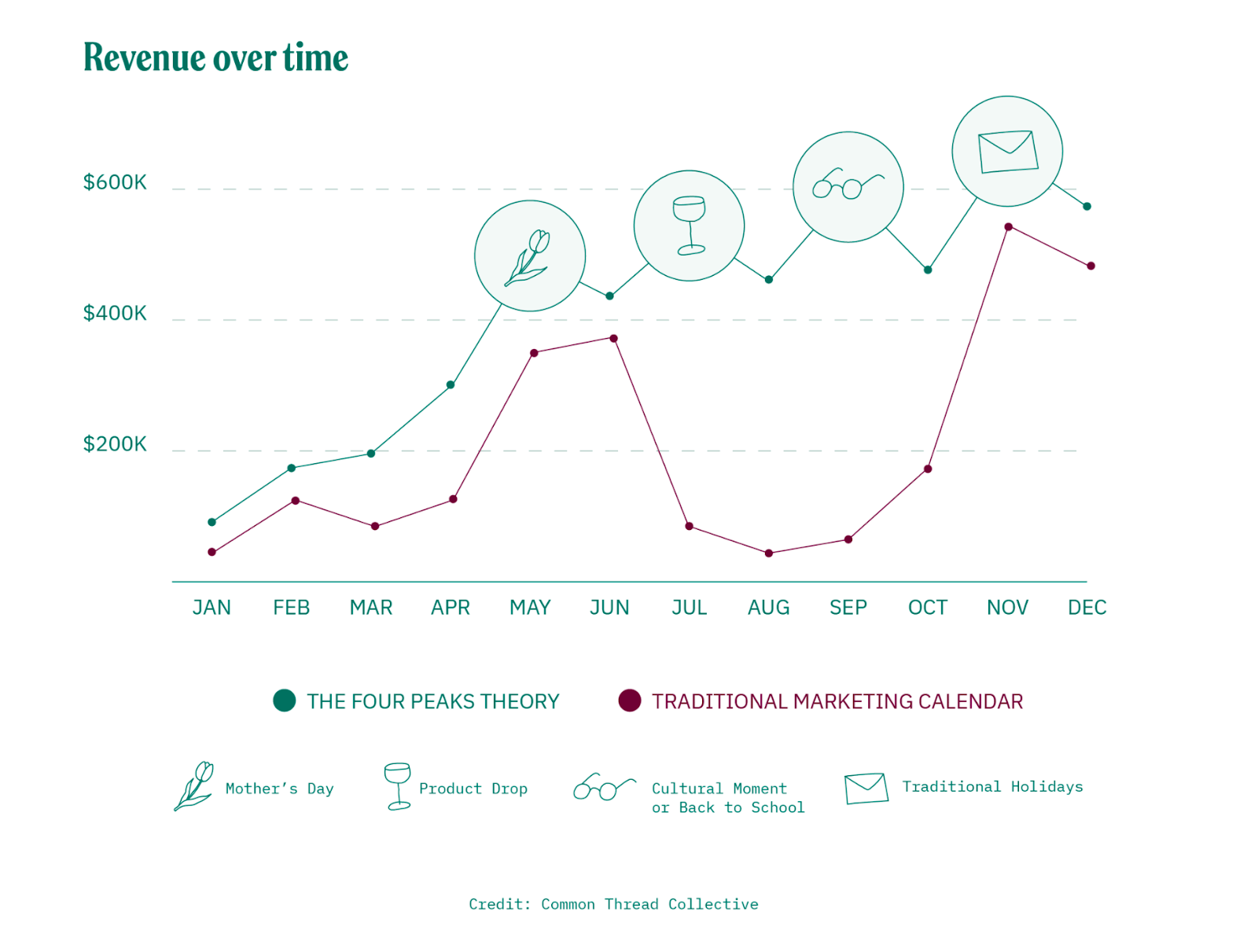
This new promotional calendar should center on holidays, as well as cultural moments and product releases.
For some categories like home and apparel, aligning products around this steady stream of behavioral and cultural activity will require an entire internal revamp. However, marketing and creative teams can adapt relatively quickly, turning to social listening and trending media moments for email, SMS, and ad campaign creative ideas.
Tell a Richer Selling Story
With a new promotional calendar in tow, you can build out which products, services, and experiences should be in the spotlight. After all, the goal is to sell solutions, not products.
This slight shift in thinking allows you to do a few things:
- Look at your product (and your brand) through a broader, more contextual lens
- Rethink your possible competition, and what you need to do to stand out
- Map out a richer customer journey, including more empathetic and engaging storytelling
Bertelsen recommends that practitioners develop a framework around functional needs and emotional needs.
While functional needs are base-level, emotional ones are higher-level and appeal to “softer” qualities that address how we feel about a brand interaction or product.
Doing this for core products and collections can help you unearth new stories to tell in your acquisition campaigns based on your most engaged, high-value customers. (Again, you may want to go through this exercise in two phases: once for gift givers and once for gift recipients.)
These are just a few tips in a rich playbook of customer acquisition tips and best practices, including how to manage inventory and plan your ad campaigns. All courses of Future Commerce Learning are available to members of our Plus community. But, because we’re getting into the time of giving, we’re unlocking this first course for free. Click here to dig deeper into the content and start finalizing your holiday plans.
The holiday season is a critical time for new customer acquisition. Because people are so laser-focused on finding the best gifts for their friends and family, they’re more likely to try a new brand and product.
It’s your time to shine, merchants…
Standing out in a sea of competitive deals and sales has always been a challenge during this time of year. Brands have attempted to gain a competitive edge by using this time to level up their creative marketing, new product drops, services, and exclusive deals. But the stakes are especially high in The Dumpster Fire Year of 2025. Up to 77% of consumers expect the cost of holiday goods to be higher, and 57% expect the economy to get worse through the end of the year, according to Deloitte’s latest holiday survey of US consumers. In layman's terms, the economic outlook hasn’t been this bleak since 1997.
The situation is a bit melancholy, especially for a season typically accessorized with tinsel. But we believe that with the right toolbox, there’s still time for you to reach your full acquisition potential and set the stage for a successful 2026. Furthermore, we believe that toolbox is far richer and dynamic than mindlessly doling out steep discounts. That’s why we’re opening the first course of the Future Commerce Learning library and sharing a few tactical tips and best practices from our foundational course led by Orchid Bertelsen, Partner & Chief Digital Officer at &vest.
Prior to joining &vest and before that, Common Thread Collective, Bertelsen was Head of Consumer Experience Strategy and Innovation at Nestle USA, overseeing more than 40 brands, including Coffee Mate, Toll House, and DiGiorno. She was not just responsible for owned digital properties and marketing technology; she also played a central role in evaluating emerging tech such as AI, augmented reality, virtual reality, and voice assistants.
It’s About the Journey, Not the Destination
Given her history supporting such established and beloved food brands, Bertelsen knows that the funnel, as we all know it, is dead. Instead, customer-brand relationships exist in a continuous loop that spans beyond conversion and the post-purchase experience. It is the moment when your customer has a “trigger point” that sparks interest and inspires them to go on another “purchase journey.” In many cases, it’s a stellar piece of content or creative, or even a timely and high-value message delivered via SMS or email.
During the holiday shopping season, there are two possible loops: one for the initial buyer (the gift giver) and then one for the ultimate end user (the gift receiver). With every purchase, there’s an opportunity to turn two people into repeat customers. That is why sustainable growth is based on an acquisition strategy centered on value, not just price.
Tackling the New Price Predicament
Trying not to focus on price and promotions during what is arguably the most competitive time of year could feel like you’re setting yourself up for failure. But practitioners should think critically about whether they belong to a brand or category that actually wants to attract discount-driven customers. If not, a strategic approach to pricing and promotions is key.
Bertelsen shared a framework she has used, called the Four Peaks Theory, which indicates that discounts should be planned around slumps in your revenue streams.
This new promotional calendar should center on holidays, as well as cultural moments and product releases.
For some categories like home and apparel, aligning products around this steady stream of behavioral and cultural activity will require an entire internal revamp. However, marketing and creative teams can adapt relatively quickly, turning to social listening and trending media moments for email, SMS, and ad campaign creative ideas.
Tell a Richer Selling Story
With a new promotional calendar in tow, you can build out which products, services, and experiences should be in the spotlight. After all, the goal is to sell solutions, not products.
This slight shift in thinking allows you to do a few things:
- Look at your product (and your brand) through a broader, more contextual lens
- Rethink your possible competition, and what you need to do to stand out
- Map out a richer customer journey, including more empathetic and engaging storytelling
Bertelsen recommends that practitioners develop a framework around functional needs and emotional needs.
While functional needs are base-level, emotional ones are higher-level and appeal to “softer” qualities that address how we feel about a brand interaction or product.
Doing this for core products and collections can help you unearth new stories to tell in your acquisition campaigns based on your most engaged, high-value customers. (Again, you may want to go through this exercise in two phases: once for gift givers and once for gift recipients.)
These are just a few tips in a rich playbook of customer acquisition tips and best practices, including how to manage inventory and plan your ad campaigns. All courses of Future Commerce Learning are available to members of our Plus community. But, because we’re getting into the time of giving, we’re unlocking this first course for free. Click here to dig deeper into the content and start finalizing your holiday plans.
The holiday season is a critical time for new customer acquisition. Because people are so laser-focused on finding the best gifts for their friends and family, they’re more likely to try a new brand and product.
It’s your time to shine, merchants…
Standing out in a sea of competitive deals and sales has always been a challenge during this time of year. Brands have attempted to gain a competitive edge by using this time to level up their creative marketing, new product drops, services, and exclusive deals. But the stakes are especially high in The Dumpster Fire Year of 2025. Up to 77% of consumers expect the cost of holiday goods to be higher, and 57% expect the economy to get worse through the end of the year, according to Deloitte’s latest holiday survey of US consumers. In layman's terms, the economic outlook hasn’t been this bleak since 1997.
The situation is a bit melancholy, especially for a season typically accessorized with tinsel. But we believe that with the right toolbox, there’s still time for you to reach your full acquisition potential and set the stage for a successful 2026. Furthermore, we believe that toolbox is far richer and dynamic than mindlessly doling out steep discounts. That’s why we’re opening the first course of the Future Commerce Learning library and sharing a few tactical tips and best practices from our foundational course led by Orchid Bertelsen, Partner & Chief Digital Officer at &vest.
Prior to joining &vest and before that, Common Thread Collective, Bertelsen was Head of Consumer Experience Strategy and Innovation at Nestle USA, overseeing more than 40 brands, including Coffee Mate, Toll House, and DiGiorno. She was not just responsible for owned digital properties and marketing technology; she also played a central role in evaluating emerging tech such as AI, augmented reality, virtual reality, and voice assistants.
It’s About the Journey, Not the Destination
Given her history supporting such established and beloved food brands, Bertelsen knows that the funnel, as we all know it, is dead. Instead, customer-brand relationships exist in a continuous loop that spans beyond conversion and the post-purchase experience. It is the moment when your customer has a “trigger point” that sparks interest and inspires them to go on another “purchase journey.” In many cases, it’s a stellar piece of content or creative, or even a timely and high-value message delivered via SMS or email.
During the holiday shopping season, there are two possible loops: one for the initial buyer (the gift giver) and then one for the ultimate end user (the gift receiver). With every purchase, there’s an opportunity to turn two people into repeat customers. That is why sustainable growth is based on an acquisition strategy centered on value, not just price.
Tackling the New Price Predicament
Trying not to focus on price and promotions during what is arguably the most competitive time of year could feel like you’re setting yourself up for failure. But practitioners should think critically about whether they belong to a brand or category that actually wants to attract discount-driven customers. If not, a strategic approach to pricing and promotions is key.
Bertelsen shared a framework she has used, called the Four Peaks Theory, which indicates that discounts should be planned around slumps in your revenue streams.
This new promotional calendar should center on holidays, as well as cultural moments and product releases.
For some categories like home and apparel, aligning products around this steady stream of behavioral and cultural activity will require an entire internal revamp. However, marketing and creative teams can adapt relatively quickly, turning to social listening and trending media moments for email, SMS, and ad campaign creative ideas.
Tell a Richer Selling Story
With a new promotional calendar in tow, you can build out which products, services, and experiences should be in the spotlight. After all, the goal is to sell solutions, not products.
This slight shift in thinking allows you to do a few things:
- Look at your product (and your brand) through a broader, more contextual lens
- Rethink your possible competition, and what you need to do to stand out
- Map out a richer customer journey, including more empathetic and engaging storytelling
Bertelsen recommends that practitioners develop a framework around functional needs and emotional needs.
While functional needs are base-level, emotional ones are higher-level and appeal to “softer” qualities that address how we feel about a brand interaction or product.
Doing this for core products and collections can help you unearth new stories to tell in your acquisition campaigns based on your most engaged, high-value customers. (Again, you may want to go through this exercise in two phases: once for gift givers and once for gift recipients.)
These are just a few tips in a rich playbook of customer acquisition tips and best practices, including how to manage inventory and plan your ad campaigns. All courses of Future Commerce Learning are available to members of our Plus community. But, because we’re getting into the time of giving, we’re unlocking this first course for free. Click here to dig deeper into the content and start finalizing your holiday plans.
The holiday season is a critical time for new customer acquisition. Because people are so laser-focused on finding the best gifts for their friends and family, they’re more likely to try a new brand and product.
It’s your time to shine, merchants…
Standing out in a sea of competitive deals and sales has always been a challenge during this time of year. Brands have attempted to gain a competitive edge by using this time to level up their creative marketing, new product drops, services, and exclusive deals. But the stakes are especially high in The Dumpster Fire Year of 2025. Up to 77% of consumers expect the cost of holiday goods to be higher, and 57% expect the economy to get worse through the end of the year, according to Deloitte’s latest holiday survey of US consumers. In layman's terms, the economic outlook hasn’t been this bleak since 1997.
The situation is a bit melancholy, especially for a season typically accessorized with tinsel. But we believe that with the right toolbox, there’s still time for you to reach your full acquisition potential and set the stage for a successful 2026. Furthermore, we believe that toolbox is far richer and dynamic than mindlessly doling out steep discounts. That’s why we’re opening the first course of the Future Commerce Learning library and sharing a few tactical tips and best practices from our foundational course led by Orchid Bertelsen, Partner & Chief Digital Officer at &vest.
Prior to joining &vest and before that, Common Thread Collective, Bertelsen was Head of Consumer Experience Strategy and Innovation at Nestle USA, overseeing more than 40 brands, including Coffee Mate, Toll House, and DiGiorno. She was not just responsible for owned digital properties and marketing technology; she also played a central role in evaluating emerging tech such as AI, augmented reality, virtual reality, and voice assistants.
It’s About the Journey, Not the Destination
Given her history supporting such established and beloved food brands, Bertelsen knows that the funnel, as we all know it, is dead. Instead, customer-brand relationships exist in a continuous loop that spans beyond conversion and the post-purchase experience. It is the moment when your customer has a “trigger point” that sparks interest and inspires them to go on another “purchase journey.” In many cases, it’s a stellar piece of content or creative, or even a timely and high-value message delivered via SMS or email.
During the holiday shopping season, there are two possible loops: one for the initial buyer (the gift giver) and then one for the ultimate end user (the gift receiver). With every purchase, there’s an opportunity to turn two people into repeat customers. That is why sustainable growth is based on an acquisition strategy centered on value, not just price.
Tackling the New Price Predicament
Trying not to focus on price and promotions during what is arguably the most competitive time of year could feel like you’re setting yourself up for failure. But practitioners should think critically about whether they belong to a brand or category that actually wants to attract discount-driven customers. If not, a strategic approach to pricing and promotions is key.
Bertelsen shared a framework she has used, called the Four Peaks Theory, which indicates that discounts should be planned around slumps in your revenue streams.
This new promotional calendar should center on holidays, as well as cultural moments and product releases.
For some categories like home and apparel, aligning products around this steady stream of behavioral and cultural activity will require an entire internal revamp. However, marketing and creative teams can adapt relatively quickly, turning to social listening and trending media moments for email, SMS, and ad campaign creative ideas.
Tell a Richer Selling Story
With a new promotional calendar in tow, you can build out which products, services, and experiences should be in the spotlight. After all, the goal is to sell solutions, not products.
This slight shift in thinking allows you to do a few things:
- Look at your product (and your brand) through a broader, more contextual lens
- Rethink your possible competition, and what you need to do to stand out
- Map out a richer customer journey, including more empathetic and engaging storytelling
Bertelsen recommends that practitioners develop a framework around functional needs and emotional needs.
While functional needs are base-level, emotional ones are higher-level and appeal to “softer” qualities that address how we feel about a brand interaction or product.
Doing this for core products and collections can help you unearth new stories to tell in your acquisition campaigns based on your most engaged, high-value customers. (Again, you may want to go through this exercise in two phases: once for gift givers and once for gift recipients.)
These are just a few tips in a rich playbook of customer acquisition tips and best practices, including how to manage inventory and plan your ad campaigns. All courses of Future Commerce Learning are available to members of our Plus community. But, because we’re getting into the time of giving, we’re unlocking this first course for free. Click here to dig deeper into the content and start finalizing your holiday plans.
The holiday season is a critical time for new customer acquisition. Because people are so laser-focused on finding the best gifts for their friends and family, they’re more likely to try a new brand and product.
It’s your time to shine, merchants…
Standing out in a sea of competitive deals and sales has always been a challenge during this time of year. Brands have attempted to gain a competitive edge by using this time to level up their creative marketing, new product drops, services, and exclusive deals. But the stakes are especially high in The Dumpster Fire Year of 2025. Up to 77% of consumers expect the cost of holiday goods to be higher, and 57% expect the economy to get worse through the end of the year, according to Deloitte’s latest holiday survey of US consumers. In layman's terms, the economic outlook hasn’t been this bleak since 1997.
The situation is a bit melancholy, especially for a season typically accessorized with tinsel. But we believe that with the right toolbox, there’s still time for you to reach your full acquisition potential and set the stage for a successful 2026. Furthermore, we believe that toolbox is far richer and dynamic than mindlessly doling out steep discounts. That’s why we’re opening the first course of the Future Commerce Learning library and sharing a few tactical tips and best practices from our foundational course led by Orchid Bertelsen, Partner & Chief Digital Officer at &vest.
Prior to joining &vest and before that, Common Thread Collective, Bertelsen was Head of Consumer Experience Strategy and Innovation at Nestle USA, overseeing more than 40 brands, including Coffee Mate, Toll House, and DiGiorno. She was not just responsible for owned digital properties and marketing technology; she also played a central role in evaluating emerging tech such as AI, augmented reality, virtual reality, and voice assistants.
It’s About the Journey, Not the Destination
Given her history supporting such established and beloved food brands, Bertelsen knows that the funnel, as we all know it, is dead. Instead, customer-brand relationships exist in a continuous loop that spans beyond conversion and the post-purchase experience. It is the moment when your customer has a “trigger point” that sparks interest and inspires them to go on another “purchase journey.” In many cases, it’s a stellar piece of content or creative, or even a timely and high-value message delivered via SMS or email.
During the holiday shopping season, there are two possible loops: one for the initial buyer (the gift giver) and then one for the ultimate end user (the gift receiver). With every purchase, there’s an opportunity to turn two people into repeat customers. That is why sustainable growth is based on an acquisition strategy centered on value, not just price.
Tackling the New Price Predicament
Trying not to focus on price and promotions during what is arguably the most competitive time of year could feel like you’re setting yourself up for failure. But practitioners should think critically about whether they belong to a brand or category that actually wants to attract discount-driven customers. If not, a strategic approach to pricing and promotions is key.
Bertelsen shared a framework she has used, called the Four Peaks Theory, which indicates that discounts should be planned around slumps in your revenue streams.
This new promotional calendar should center on holidays, as well as cultural moments and product releases.
For some categories like home and apparel, aligning products around this steady stream of behavioral and cultural activity will require an entire internal revamp. However, marketing and creative teams can adapt relatively quickly, turning to social listening and trending media moments for email, SMS, and ad campaign creative ideas.
Tell a Richer Selling Story
With a new promotional calendar in tow, you can build out which products, services, and experiences should be in the spotlight. After all, the goal is to sell solutions, not products.
This slight shift in thinking allows you to do a few things:
- Look at your product (and your brand) through a broader, more contextual lens
- Rethink your possible competition, and what you need to do to stand out
- Map out a richer customer journey, including more empathetic and engaging storytelling
Bertelsen recommends that practitioners develop a framework around functional needs and emotional needs.
While functional needs are base-level, emotional ones are higher-level and appeal to “softer” qualities that address how we feel about a brand interaction or product.
Doing this for core products and collections can help you unearth new stories to tell in your acquisition campaigns based on your most engaged, high-value customers. (Again, you may want to go through this exercise in two phases: once for gift givers and once for gift recipients.)
These are just a few tips in a rich playbook of customer acquisition tips and best practices, including how to manage inventory and plan your ad campaigns. All courses of Future Commerce Learning are available to members of our Plus community. But, because we’re getting into the time of giving, we’re unlocking this first course for free. Click here to dig deeper into the content and start finalizing your holiday plans.
Continue Reading...

Insights and futurism for executives in eCom and Retail
Those things we shouldn’t say out loud? We say them on the private feed. Bi-weekly “after dark” podcasts and a members-only newsletter, just for subscribers.
Our research reports combine visionary thinking with data-backed findings from our own advisory panel, made up of leaders at brands you know and trust.
Upskill, cross-skill, and future-proof your teams with Future Commerce Learning, the leading digital eCommerce learning platform, created by professional educators.