If Black Friday moved online… why was SoHo in line?

Happy Black Friday, futurists.
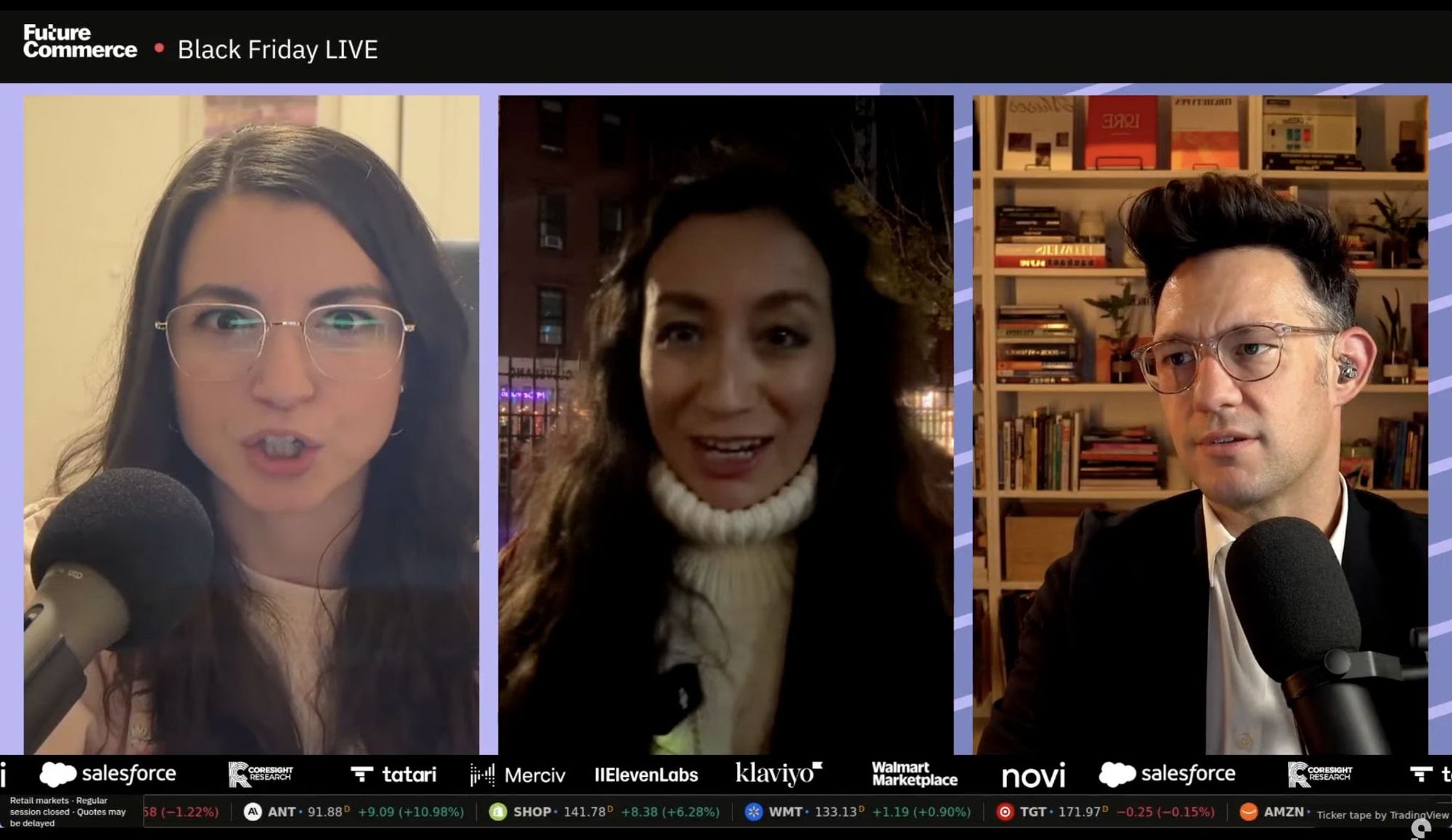
Our seven-hour Black Friday LIVE broadcast drew over 10,000 streams. Thank you all.
In the UK, Jack Stratten saw shopping move online. Meanwhile, in New York, Sandy Hernandez found lines outside SoHo food spots. So what makes people pop up off the couch for holiday shopping in 2026?
We coaxed executives from Adyen, Klaviyo, and Coresight Research onto our seven-hour BFCM livestream to share last year’s results vs. this year’s behaviors, and they even gave us an exclusive look into early returns for 2026.
Caila Schwartz, Head of Agentic Commerce Shopper Insights at Salesforce, joined the stream toward the end of the day to share how her Cyber Week predictions were starting to pan out. Some key takeaways from Shopper Insights HQ include:
Couch commerce is back: Salesforce reported that US online sales rose 5.1% year over year on Thanksgiving. Worldwide, online sales rose 4.6% to $37.2 billion.
Deals and discounts are paying off: The average discount rate for 2025 was 26%, and Schwartz noted that this number is increasing slightly, with the highest discounts being in apparel and beauty.
Agents for all: Consumers are using their agents to research, price compare, and validate purchases, and it’s paying off for brands. Retailers are also using their own branded bots to support on-site shoppers as they search and discover, and it’s already paying off this holiday season.
Don’t count social out: One in four eCommerce visitors comes from social, but TikTok Shop’s immersive, highly scrollable experience is making it a major driver of social-influenced sales this year.
Watch the Black Friday LIVE replay on X or watch on YouTube.

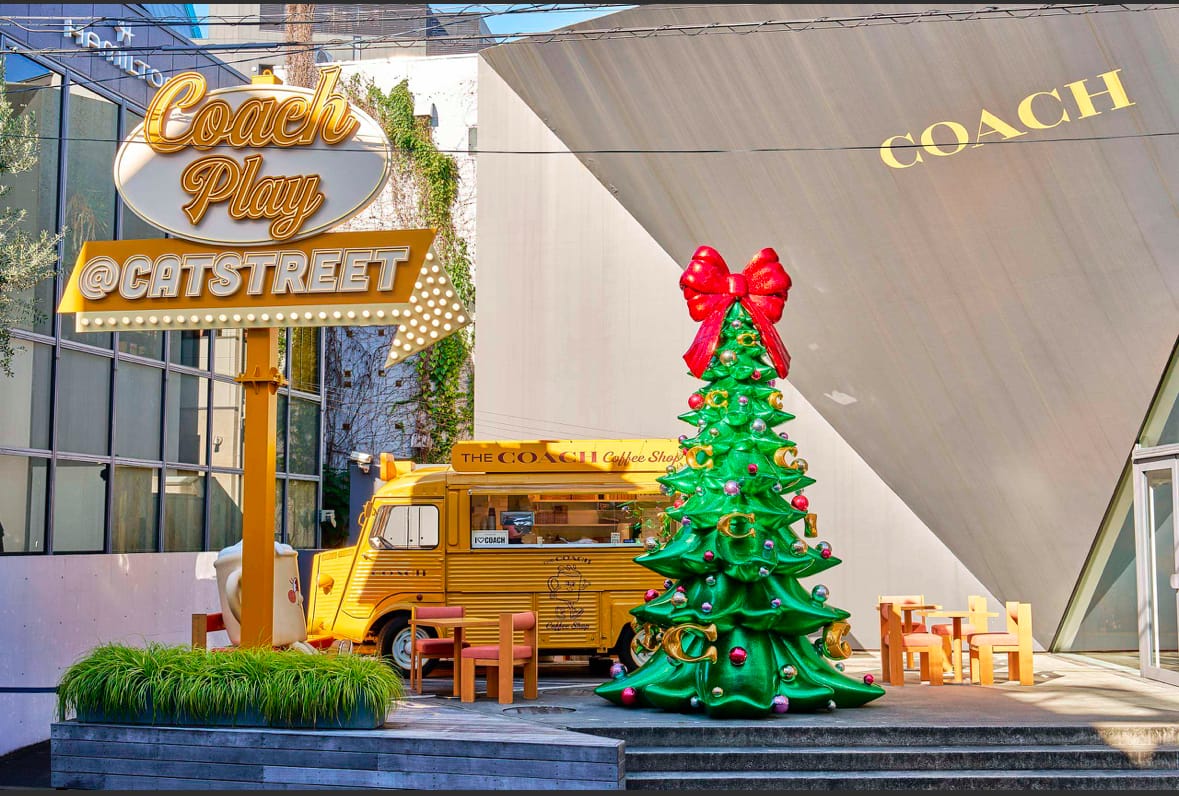
What’s Old is New Again.
Coach has decorated for the holiday season using materials from the past six years because the brand’s most valuable consumers (Gen Z) are embracing nostalgia and tradition. On our BFCM livestream, Giovanni Zaccariello, SVP of Global Visual Experience at Coach, shared how the brand is embracing the old and the new, as well as the physical and the digital, to bring its most beloved products to life.
Zaccariello also revealed how the brand is balancing holiday activations, including special experiences in its cafes, and a larger store rollout project that extends into other cultural moments.
Life on the High Street.
Jack Stratten thinks about 70% of Black Friday sales in the UK will be online. “I just don’t know how [retailers] could sustain it, if they’re selling and fulfilling those orders... if the trend continues, how can they retain any decent customer service because they’re just about at breaking point with last mile.”
“We’ve definitely switched to this being an online event,” he said. “It has been a bit of both, but now it’s becoming a real online event.” Long queues will happen, especially for hot toys like NeeDohs and Jellycats, but the real movement is happening online. From what Stratten can tell, even Pop Mart stores are relatively slow, reaffirming that the Labubu trend is flatlining.
Sandy Hernandez, the Retail Muse, had a different take. From the streets of New York, the holidays were happening. Macy’s and Nordstrom drew shoppers in with holiday warmth, nostalgia, and experiential retail, while SoHo staples, especially food spots, kicked line culture into high gear.

Discount Roulette.
Wirecutter takes a journalistic approach to deal-hunting and product comparison. That means breaking through the marketing messages and determining whether holiday sales and deals are actually worthwhile.
“Everyone falls victim to those Instagram ads, but some of them are legitimately good,” Kaitlin Mahar said. She cited REI, Patagonia, Away, and other brands that are using Black Friday (and anti-Black Friday) as an opportunity to capture demand.
But some newly added costs, like order protection fees, seem valuable but may not pay off. “It may give you peace of mind, but only you can make that call.” She also cautioned that BNPL provides a “false sense of security” that only adds up over time.
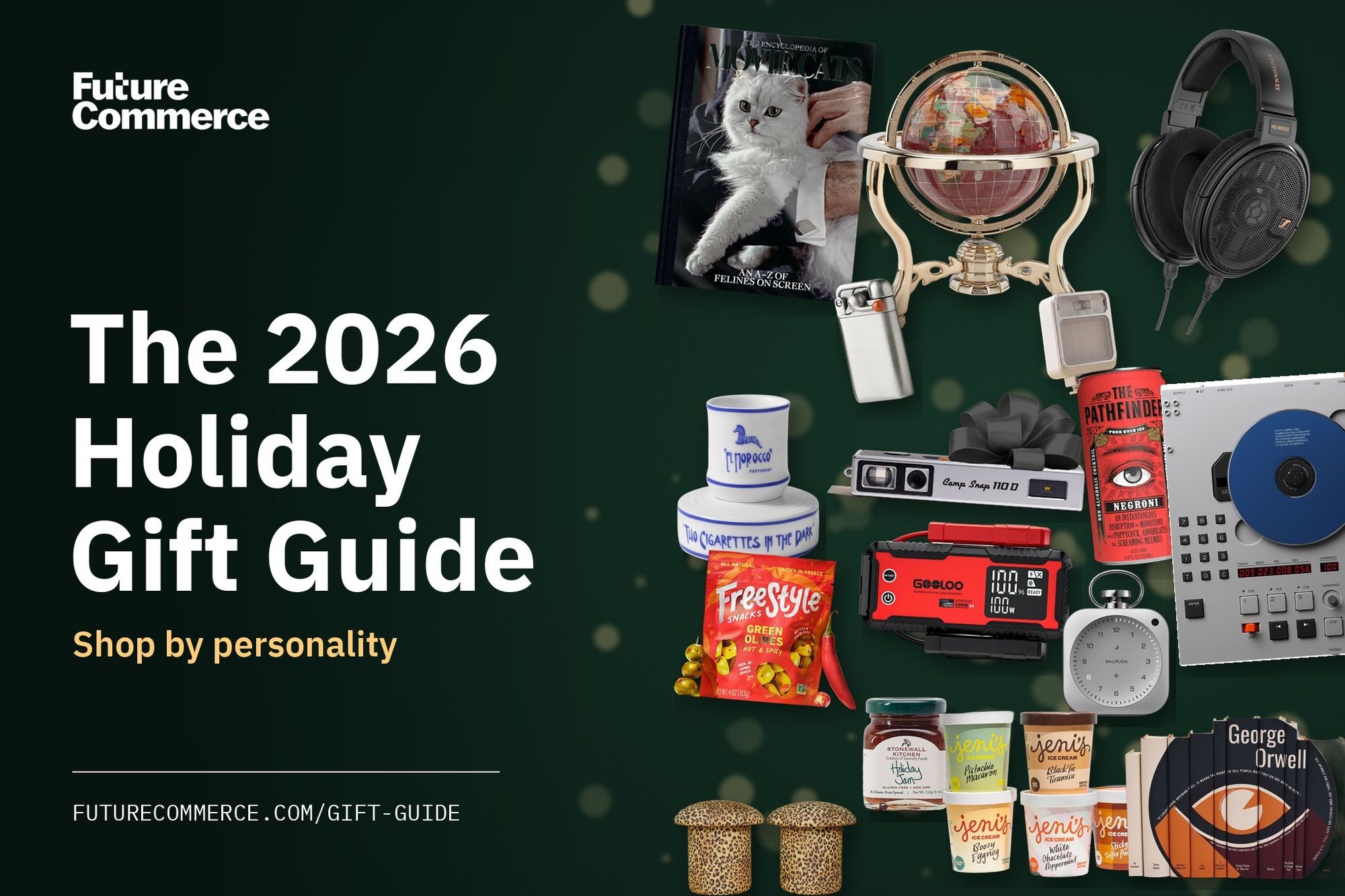
Want some gifting ideas? Wirecutter has a gift guide hand-picked by their team. But you can also check out ours too!
Wallets Do the Talking.
We know what we buy represents who we are, but Nadya Maffei, Global Head of Retail for Adyen, believes how we buy is one of the most powerful signals of consumer behavior. That’s why, all weekend long, Adyen is tracking payment activity online and in stores across key shopping hubs. It’s also monitoring payment preferences, including one-click checkout and mobile wallet.
Maffei gave us an exclusive teaser of the interactive experience and shared how retailers can use payment data and activity to their advantage, especially as they try to turn a holiday acquisition moment into a long-term customer relationship. Want to see the data as it unfolds? Click here to see the Adyen BFCM experience.

Once You Pop, the Fun Don’t Stop.
It’s been a few years since Popsmith was featured on Oprah’s Favorite Things list. That was certainly a landmark moment for the brand, but co-founder Dave Stickland noted that the brand has “catapulted so far” since then. In fact, it’s up 200% year over year and has achieved “momentous” scale by creating a few high-performing AI-generated ads.
For example, Popsmith used an existing “We’re pricey, but…” message to focus on the brand’s quality and taste. To promote its early “non-Black Friday” sale, it used the same creative, but crossed out “we’re” and wrote in “we were.” It was a simple yet effective way to signal to some people that there was a notable price shift. And the people who capitalized on the sales event ended up buying more items to offset the discount completely. This is a compelling example of deal psychology, and how the right messaging can drive meaningful results when paired with the right offer.
Inside the Blind Box.
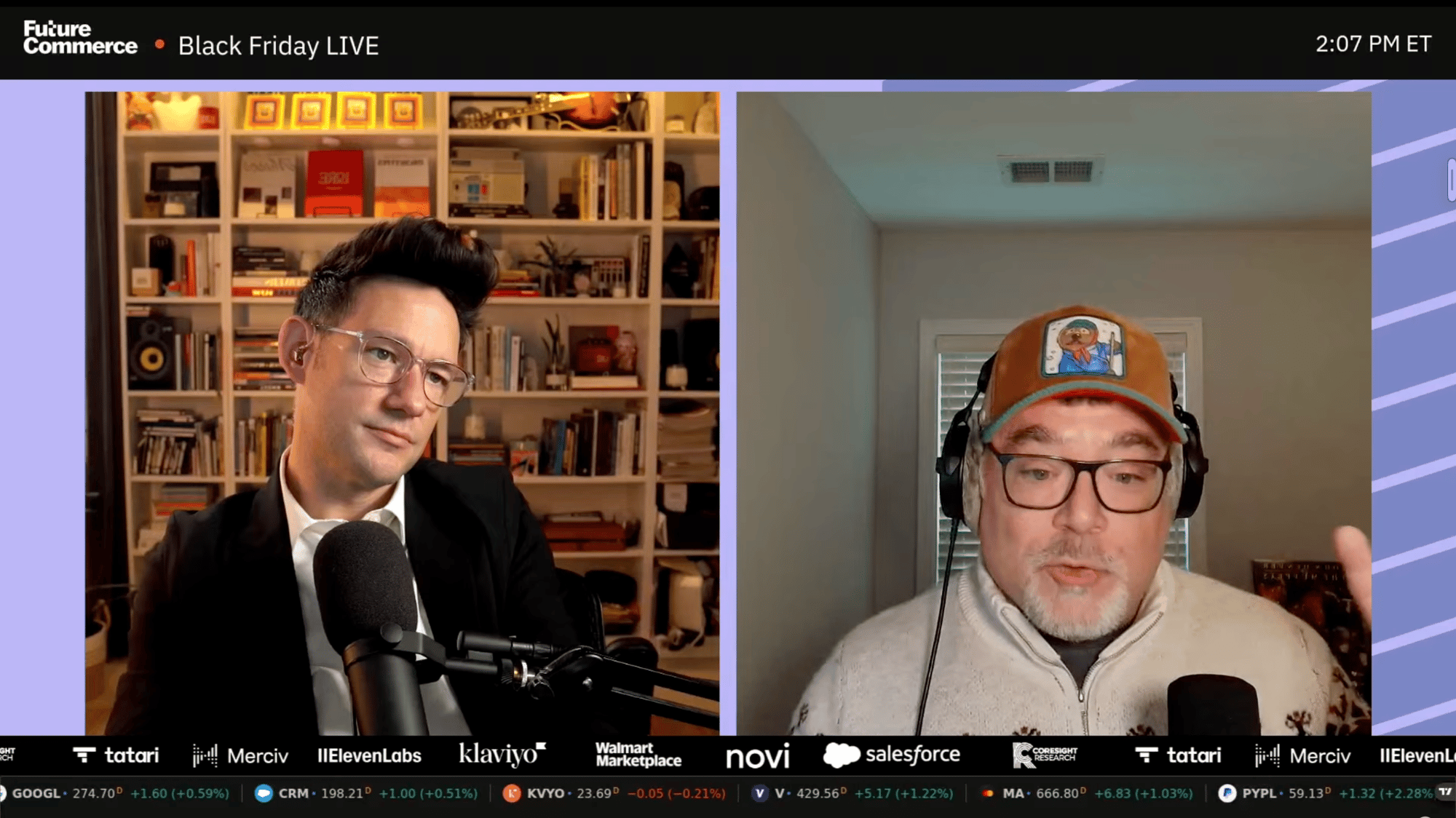
Gen Alpha is hitting the malls this holiday weekend, and they’re spending it all on blind boxes, squishies, and mini makeup. Parija Kavilanz, co-founder of Bagable Media and seasoned retail reporter, joined us for a bit of show-and-tell, highlighting what her Gen Alpha son and Gen Z daughter bought Black Friday morning. All of their purchases centered on self-expression, novelty, and the ability to share how they actively engage with the products they purchase on social media.
Another major theme Kavilanz is tracking? Fandom. Five Below, Target, and other major retailers are selling exclusive collections tied to sports teams, films, TV shows, and beloved characters.

Bot vs. Shopper.
Coresight Research found that 14.3% of consumers planned to start their holiday shopping on Black Friday, essentially in line with 2025 (14.8%). But with inflation affecting product prices, how much spending can be attributed to people buying more, rather than simply spending more? Jiayue Zhao, a strategy consultant at Coresight Research, joined us from Colorado Springs to share how he saw things shaking out on Black Friday morning.
His POV: lots of deals, and only so many products. Although many consumers use digital tools (especially AI) to find the best deals, Zhao noted that retailers with a physical presence can use their people to their advantage. After all, they have knowledge and passion for the brand that no bot can replicate, and they can influence whether consumers have a positive holiday shopping experience. You can see all of Coresight’s holiday research here.
What Stands Out in the Inbox.
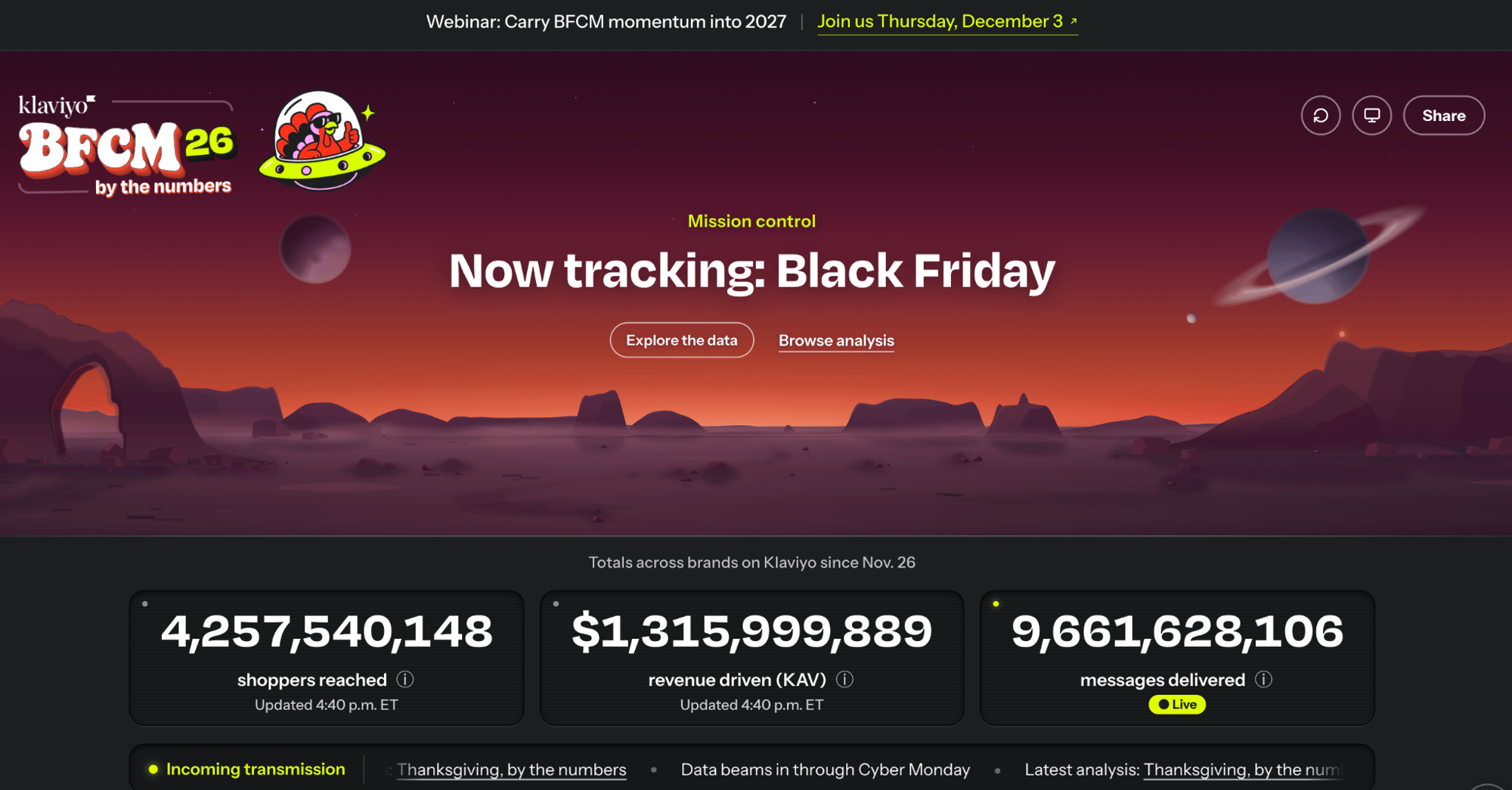
This is the tenth year Klaviyo has launched a BFCM dashboard, and it’s seeing fascinating trends in the keywords and emojis used in messages. For example, the black heart is a telltale sign of a Black Friday message or deal.
In the day and a half before Pat Twomey joined us, Klaviyo delivered 8 billion messages. Its dashboard showed 3.8 billion shoppers reached across brands, counting the same shopper again when another brand reached them. Message delivery peaked between 9 and 10 a.m. ET. Sales jumped between noon and 1 p.m. ET, and Twomey expected another lift between 6 and 9 p.m. ET.
Twomey, Klaviyo’s Head of Research and Analytics, noted that while consumers are still participating in Black Friday, brands saw a bigger sales increase in early November, especially when they used personalization effectively.
“I don’t think shoppers have the patience for a batch-and-blast, non-personalized communication, especially if you’re a loyal shopper. You just want what resonates most with you,” Twomey said.