

of the United Kingdom’s capitol city.
In brief: Etsy updated its AI policy on October 22, 2026, requiring sellers to disclose AI-made work and include at least one unedited photo of every item. Additionally, Etsy banned bot-generated listings, as well as AI-generated patterns and recipes. While these changes aim to show the marketplace’s commitment to the makers, Etsy is expanding its own AI for discovery and agentic checkout. Rafe Colburn, Etsy’s Chief Product and Technology Officer (CPTO) will break down how Etsy is turning proof of human work into a competitive asset at VISIONS Summit 2027, which will take place February 10 at the Museum of Modern Art in Manhattan.
On October 22, 2026, Etsy updated its policies to make a bold statement about AI’s role in its “handmade and human” marketplace.
“AI should support your creativity and craftsmanship, not replace them,” James Ossman, Etsy’s Vice President of Customer Operations, wrote in an update to the company’s seller handbook. “Buyers should always be able to understand the role you play in every item you sell on Etsy.”
The rules are specific, down to how sellers must now photograph their work. To some, it’s a logistical overhaul, but it also shows Etsy’s continued commitment to the humans on both sides of every transaction, while maintaining a robust technological roadmap. It’s a tricky balancing act that more businesses must navigate.
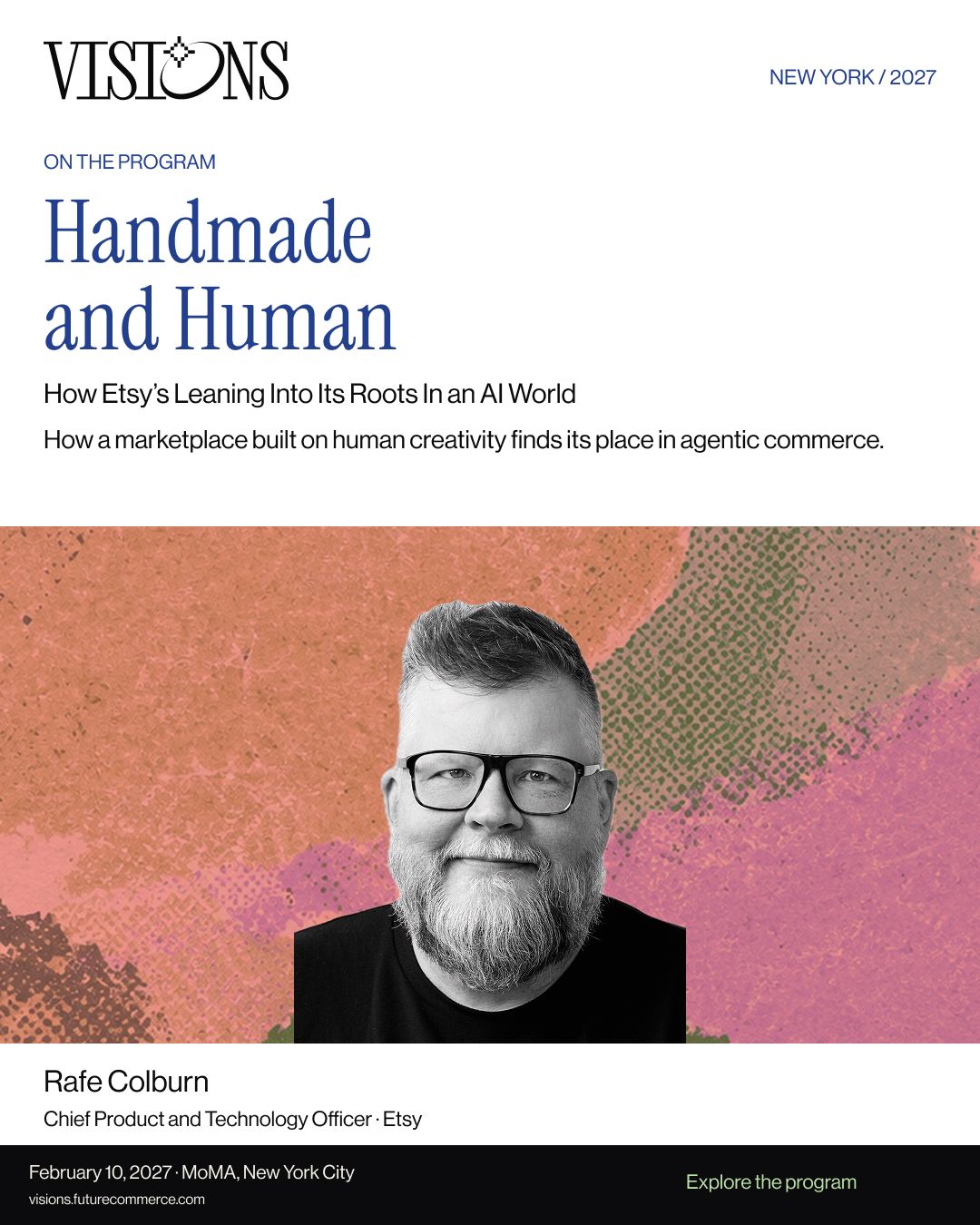
This tension sits at the heart of VISIONS 2027, where we’ll explore how AI is rewriting both culture and commerce. On February 10, leaders across retail, brand, media, and design will gather at the Museum of Modern Art to explore how AI’s rapid evolution will shape the things we make and buy. Etsy’s Chief Product and Technology Officer, Rafe Colburn, will take the VISIONS stage for a candid fireside chat with eCommerce reporter Nicole Silberstein to discuss how a marketplace of makers protects its mission while it reinvents itself with AI.
Etsy’s AI Policy Makes Authorship a Marketplace Concern
Etsy’s new rules are opening a dialogue among its seller community. On Reddit, makers are parsing the wording line by line. On Threads, they’re tallying how many hours compliance will cost them.
If Etsy detects AI-generated images in listings, it will share guidance with sellers on what and how to improve. Those detection methods will expand to existing listings over time, and Etsy will continue to monitor shopper feedback to understand how they perceive AI imagery before it triggers any removals.
Proving you’re human has become one more task on a small business owner’s to-do list, and the people shouldering it are the same independent makers Etsy exists to champion.
How Is Etsy Using AI to Power Experiences?
At the same time, Etsy’s appetite for AI keeps growing.
“We see the biggest opportunity for AI on Etsy itself,” CEO Kruti Goyal said on the company’s Q2 earnings call. Goyal described the goal simply as “connecting the right buyers with the right sellers.” Etsy’s gifting assistant gives shoppers what Goyal called “a more natural, conversational way to express what they’re looking for.” And sellers already have their own AI tools, including a writing assistant that mimics a shop’s voice.
But Etsy also has prioritized being an early entrant in the agentic era. In September 2025, it launched ChatGPT’s Instant Checkout. When we tested the feature, we could actually buy from Etsy shops. In January 2026, Etsy began selling directly through Google’s AI Mode and Gemini. Colburn framed the opportunity as large language models “closing the gap between human language and machine understanding.”
Colburn will expand upon this line of thinking during VISIONS. For a marketplace with more than 100 million items, most one-of-one or made-to-order, intentional AI use solves the platform’s oldest problem: matching a hard-to-describe want with the one person who made it.
Agentic Commerce and Etsy’s In-Between Moment
The early investment was a bold statement for Etsy, but shoppers are slow to embrace agentic commerce. Though AI referrals arrive with higher intent and higher average order values, agentic accounts for less than 1% of Etsy’s traffic.
Our own research has found a similar pattern: 77% of consumers said they preferred to click through to a merchant site after receiving an AI recommendation. While they may be influenced by the machine, they still want to discover, research, and compare. And to the brand’s benefit, the decision still lands on their own turf.
Colburn has a name for this stretch: an “in-between moment,” when conversational commerce is clearly coming, and shopper behavior hasn’t fully caught up. It’s an honest, pragmatic perspective amid the constant hype, and one reason we wanted him on the VISIONS stage.
Fresh off Etsy’s biggest season of the year—the holiday season—Colburn will join us at MoMA for an honest look at where agentic commerce stands and what it takes to keep makers at the center of an increasingly automated marketplace. He’ll discuss:
- What needs to change before shoppers are comfortable with AI checkout
- How AI can make the marketplace work better for sellers and buyers alike
- How the AI era is reshaping product leadership, engineering, and his roadmap
More to Explore at VISIONS 2027
If you’re trying to navigate the “in-between moment,” you won’t want to miss “The Say-Do Gap,” which features a panel of analysts who will dissect the gap between shopper surveys and behavioral data.
Former US Secretary of Commerce Carlos Gutierrez will give an opening keynote about his work in policy and business as Kellogg’s CEO, while Sheehan Quirke will share insights from his latest book, The Cultural Tutor. And, of course, executives from OUI the People, Hermès, and the MoMA Design Store will reveal how they’re embracing proof of work in their marketing, merchandising, and leadership.
Between sessions, attendees will get to enjoy hosted lunches, museum tours, and time to roam the beloved cultural institution.
Get Early Bird Pricing Through Black Friday
Early bird pricing is live through Black Friday. Full-Day passes are $549 (regularly $749) and VIP passes are $999 (regularly $1,199). Future Commerce Plus annual members save an additional $200, bringing passes to $349 and $799. Every pass includes a year of FC+.
Event details:
VISIONS 2027
Wednesday, February 10, 2027
Time: 10 AM ET
Location: The Museum of Modern Art, Roy and Niuta Titus Theater
Address: 11 West 53rd Street, New York, NY (53rd Street entrance)
In brief: Etsy updated its AI policy on October 22, 2026, requiring sellers to disclose AI-made work and include at least one unedited photo of every item. Additionally, Etsy banned bot-generated listings, as well as AI-generated patterns and recipes. While these changes aim to show the marketplace’s commitment to the makers, Etsy is expanding its own AI for discovery and agentic checkout. Rafe Colburn, Etsy’s Chief Product and Technology Officer (CPTO) will break down how Etsy is turning proof of human work into a competitive asset at VISIONS Summit 2027, which will take place February 10 at the Museum of Modern Art in Manhattan.
On October 22, 2026, Etsy updated its policies to make a bold statement about AI’s role in its “handmade and human” marketplace.
“AI should support your creativity and craftsmanship, not replace them,” James Ossman, Etsy’s Vice President of Customer Operations, wrote in an update to the company’s seller handbook. “Buyers should always be able to understand the role you play in every item you sell on Etsy.”
The rules are specific, down to how sellers must now photograph their work. To some, it’s a logistical overhaul, but it also shows Etsy’s continued commitment to the humans on both sides of every transaction, while maintaining a robust technological roadmap. It’s a tricky balancing act that more businesses must navigate.
This tension sits at the heart of VISIONS 2027, where we’ll explore how AI is rewriting both culture and commerce. On February 10, leaders across retail, brand, media, and design will gather at the Museum of Modern Art to explore how AI’s rapid evolution will shape the things we make and buy. Etsy’s Chief Product and Technology Officer, Rafe Colburn, will take the VISIONS stage for a candid fireside chat with eCommerce reporter Nicole Silberstein to discuss how a marketplace of makers protects its mission while it reinvents itself with AI.
Etsy’s AI Policy Makes Authorship a Marketplace Concern
Etsy’s new rules are opening a dialogue among its seller community. On Reddit, makers are parsing the wording line by line. On Threads, they’re tallying how many hours compliance will cost them.
If Etsy detects AI-generated images in listings, it will share guidance with sellers on what and how to improve. Those detection methods will expand to existing listings over time, and Etsy will continue to monitor shopper feedback to understand how they perceive AI imagery before it triggers any removals.
Proving you’re human has become one more task on a small business owner’s to-do list, and the people shouldering it are the same independent makers Etsy exists to champion.
How Is Etsy Using AI to Power Experiences?
At the same time, Etsy’s appetite for AI keeps growing.
“We see the biggest opportunity for AI on Etsy itself,” CEO Kruti Goyal said on the company’s Q2 earnings call. Goyal described the goal simply as “connecting the right buyers with the right sellers.” Etsy’s gifting assistant gives shoppers what Goyal called “a more natural, conversational way to express what they’re looking for.” And sellers already have their own AI tools, including a writing assistant that mimics a shop’s voice.
But Etsy also has prioritized being an early entrant in the agentic era. In September 2025, it launched ChatGPT’s Instant Checkout. When we tested the feature, we could actually buy from Etsy shops. In January 2026, Etsy began selling directly through Google’s AI Mode and Gemini. Colburn framed the opportunity as large language models “closing the gap between human language and machine understanding.”
Colburn will expand upon this line of thinking during VISIONS. For a marketplace with more than 100 million items, most one-of-one or made-to-order, intentional AI use solves the platform’s oldest problem: matching a hard-to-describe want with the one person who made it.
Agentic Commerce and Etsy’s In-Between Moment
The early investment was a bold statement for Etsy, but shoppers are slow to embrace agentic commerce. Though AI referrals arrive with higher intent and higher average order values, agentic accounts for less than 1% of Etsy’s traffic.
Our own research has found a similar pattern: 77% of consumers said they preferred to click through to a merchant site after receiving an AI recommendation. While they may be influenced by the machine, they still want to discover, research, and compare. And to the brand’s benefit, the decision still lands on their own turf.
Colburn has a name for this stretch: an “in-between moment,” when conversational commerce is clearly coming, and shopper behavior hasn’t fully caught up. It’s an honest, pragmatic perspective amid the constant hype, and one reason we wanted him on the VISIONS stage.
Fresh off Etsy’s biggest season of the year—the holiday season—Colburn will join us at MoMA for an honest look at where agentic commerce stands and what it takes to keep makers at the center of an increasingly automated marketplace. He’ll discuss:
- What needs to change before shoppers are comfortable with AI checkout
- How AI can make the marketplace work better for sellers and buyers alike
- How the AI era is reshaping product leadership, engineering, and his roadmap
More to Explore at VISIONS 2027
If you’re trying to navigate the “in-between moment,” you won’t want to miss “The Say-Do Gap,” which features a panel of analysts who will dissect the gap between shopper surveys and behavioral data.
Former US Secretary of Commerce Carlos Gutierrez will give an opening keynote about his work in policy and business as Kellogg’s CEO, while Sheehan Quirke will share insights from his latest book, The Cultural Tutor. And, of course, executives from OUI the People, Hermès, and the MoMA Design Store will reveal how they’re embracing proof of work in their marketing, merchandising, and leadership.
Between sessions, attendees will get to enjoy hosted lunches, museum tours, and time to roam the beloved cultural institution.
Get Early Bird Pricing Through Black Friday
Early bird pricing is live through Black Friday. Full-Day passes are $549 (regularly $749) and VIP passes are $999 (regularly $1,199). Future Commerce Plus annual members save an additional $200, bringing passes to $349 and $799. Every pass includes a year of FC+.
Event details:
VISIONS 2027
Wednesday, February 10, 2027
Time: 10 AM ET
Location: The Museum of Modern Art, Roy and Niuta Titus Theater
Address: 11 West 53rd Street, New York, NY (53rd Street entrance)
Continue Reading...

Insights and futurism for executives in eCom and Retail
Those things we shouldn’t say out loud? We say them on the private feed. Bi-weekly “after dark” podcasts and a members-only newsletter, just for subscribers.
Our research reports combine visionary thinking with data-backed findings from our own advisory panel, made up of leaders at brands you know and trust.
Upskill, cross-skill, and future-proof your teams with Future Commerce Learning, the leading digital eCommerce learning platform, created by professional educators.