

of the United Kingdom’s capitol city.
Licensed toys are outperforming the broader toy market, showing just how committed consumers are to nostalgic IP and niche fandoms. Accounting for 39% of total US toy sales, the category grew by 24%—and Miniso is one retailer capitalizing on this growth.
In fiscal 2025, Miniso raked in $466M in domestic revenue, a 53% increase from 2024. As a result, the Chinese firm was recently named the National Retail Federation’s fastest-growing US retailer, beating giants like Dick’s Sporting Goods and Costco.
“Miniso has prioritized the overseas market as a core business focus, with the US standing as our largest overseas market directly, and our most strategically important territory overall,” noted Robin Liu, VP and CMO of Miniso, in a briefing with a small group of journalists in New York City. Consumers initially flocked to the retailer for its expansive blind-box assortment, which is arguably the most significant “commerce is culture” trend of the past two years. But this “family-friendly” retail destination continues to draw in consumers of all ages for its commitment to whimsical IP and storytelling through plush toys and collectibles.
Miniso’s partnerships with Minecraft and Disney are impeccably timed with new film releases. Its collaborations with FIFA and even anime franchises like Jujutsu Kaisen ride the wave of social media chatter and cultural trend lines. This has been made possible by a robust product development pipeline that connects Miniso’s IP ecosystem to fast product cycles and strong supply chain operations.
In an intimate conversation with Liu and Tom Bartlebaugh, CEO of Miniso USA, we learned that a much larger vision is already in play, rooted in unique IP development.
“It was 72 years ago that [Walt] Disney drew a picture…he had begun to imagine Disneyland, his sales of derivatives other than cartoon movies, and so on. Today, it has become a reality, so I think we should think more forward-looking, in ten or twenty years, what kind of company [Miniso] will become and where it will go in that time.”
- Robin Liu, VP and CMO, Miniso
Liu added that Disney is “a good morale model for us to learn from,” and that “all the sources of this should return to our own IP.”
This all begins with a brand reframe. Liu doesn’t look at Miniso as simply a “toy company.” It’s currently operating as a “global IP co-branded collection store,” and the team is committed to becoming a “world-leading IP operation platform.”
The Strategy in Motion: Becoming an IP Operation Platform
A main strategic focus for Miniso is to develop branded partnerships and experiences that make its stores worth visiting over and over again. And because the retailer’s “target audience” is consumers 8 to 35 years old, there is a lot of creative ground to explore, especially as the company focuses on themes like self-expression, family connection, and value.
“That’s a big [demographic], and we’re trying to cater to that,” Bartlebaugh said. “It’s sometimes difficult to do, but I think from a family standpoint, it all becomes about time. Your life becomes more about trying to harness that time, occupy your time, so you don’t have to go to all these places.”
An unexpected byproduct of engaging such a diverse audience is that Miniso stores become destinations where older shoppers can introduce their favorite characters to younger family members, whether that be a niece, nephew, son, or daughter. “[Kidults] are continuing to purchase and collect, even as they get older,” Bartlebaugh said.
Currently, Miniso manages more than 180 global IPs that appeal to this vast demographic, and it prioritizes global launches and marketing dollars based on their timeliness, cultural resonance, and potential reach. For example, the release of Zootopia 2 and the FIFA World Cup (both major Miniso campaigns) would easily get “S” rankings because of the opportunity.
But Miniso is also working to bring new characters and stories into the world, and its in-house IP development includes an artist incubation program that taps creators from around the world.
“With copyright holders giving their intellectual property to more and more retailers and products of this brand, there is a trend of homogenization,” Liu said. “Therefore, we need to find our own differentiated and unique supply of intellectual property products.”
Miniso has already signed contracts with more than thirty artists, and a third of them have already commercialized products. With an in-house portfolio that includes characters like Kumaru, Angry Aimee, Carrot Street, and YOYO, the team is actively seeking new talent in Thailand, China, Japan, North America, and Europe to develop unique, recognizable characters with what Liu calls “universal value.” Each IP is then assigned a level of potential, tested and observed in-market, measured, and then scaled accordingly.
YOYO has been an especially valuable launch for Miniso following its launch in 2025. The character was featured in key campaigns and activations at Miniso locations. It was the centerpiece of a successful Toy Story 5-themed collector blind boxes launch, and was even featured in music videos for Katy Perry’s singles “Watch It Burn” and “Bandaids.” Fans in Asia were even bringing Miniso bags to Katy Perry concerts as pseudo accessories.
The Vision: Moments that Convey ‘Life is for Fun’
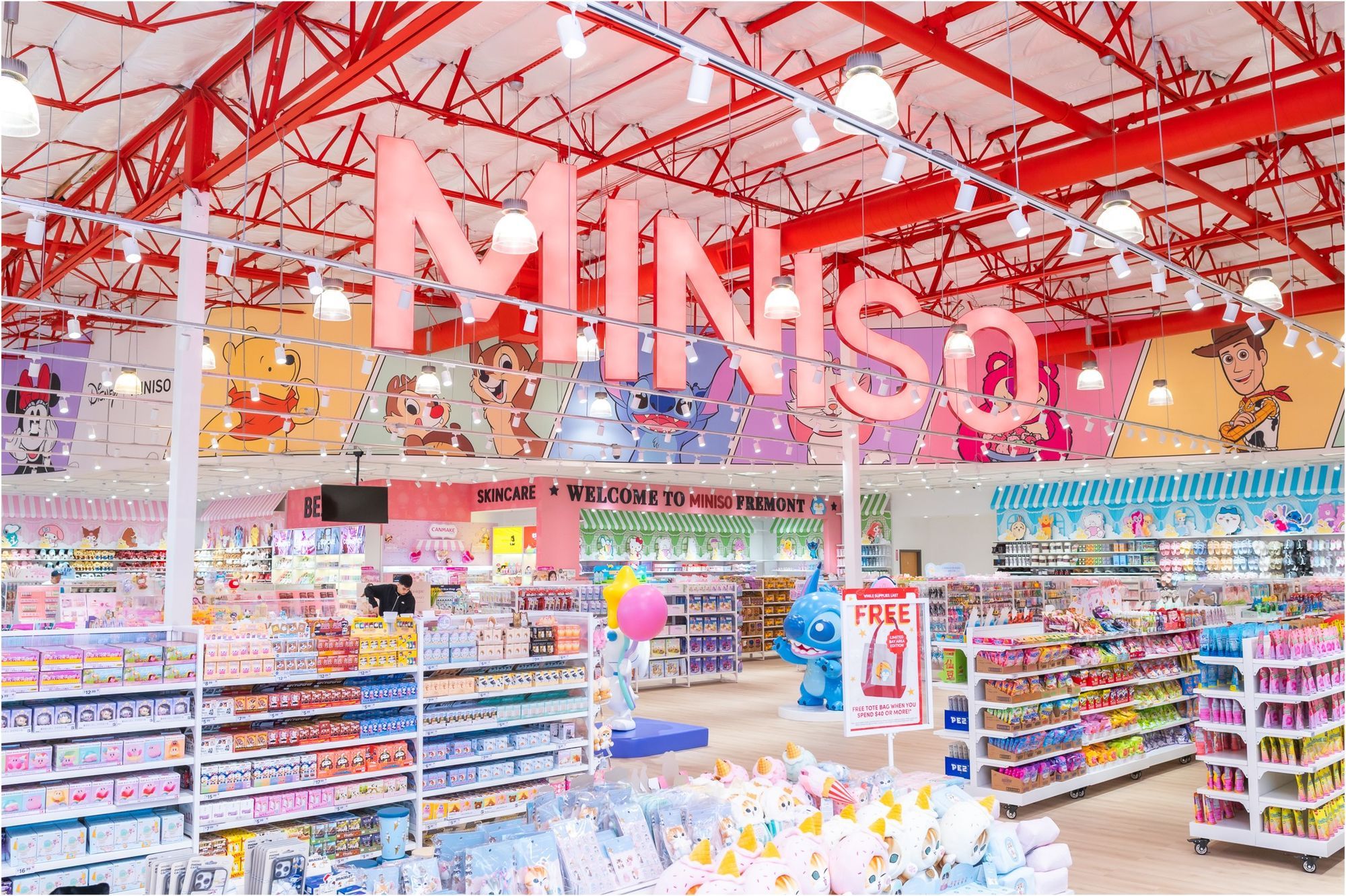
Last year, Miniso added 465 new stores outside its homeland, China, and many store openings (and new formats) are on the horizon. There are currently three core brick-and-mortar formats that the company taps to align with different markets and retail formats:
- Miniso Land: Large format and highly experiential. Locations are 15,000 square feet in size and themed around key IP. A new location in Columbus, Ohio, is set to open in Fall 2026, and the company will also open a Miniso Land location on Las Vegas Boulevard in the first half of 2027. Bartlebaugh said the goal is to open 12 of these in major US markets eventually.
- Miniso Friends: These 8,000-square-foot locations are typically built in premium mall locations. IP makes up about 80% of the product mix, and the goal is to incorporate interactive storytelling moments that center on IP. Given their growing spending power and love of all things nostalgic, Gen Z is the primary inspiration for the design.
- Mall-Format Stores: 5,000-7,000 square feet in size, these stores will pop up alongside Walmarts, Targets, and other mainstream brick-and-mortar retailers in open-air and lifestyle centers. The overall goal is to rely less on the traditional shopping mall and show up in these mixed developments where shoppers jump from store to store.
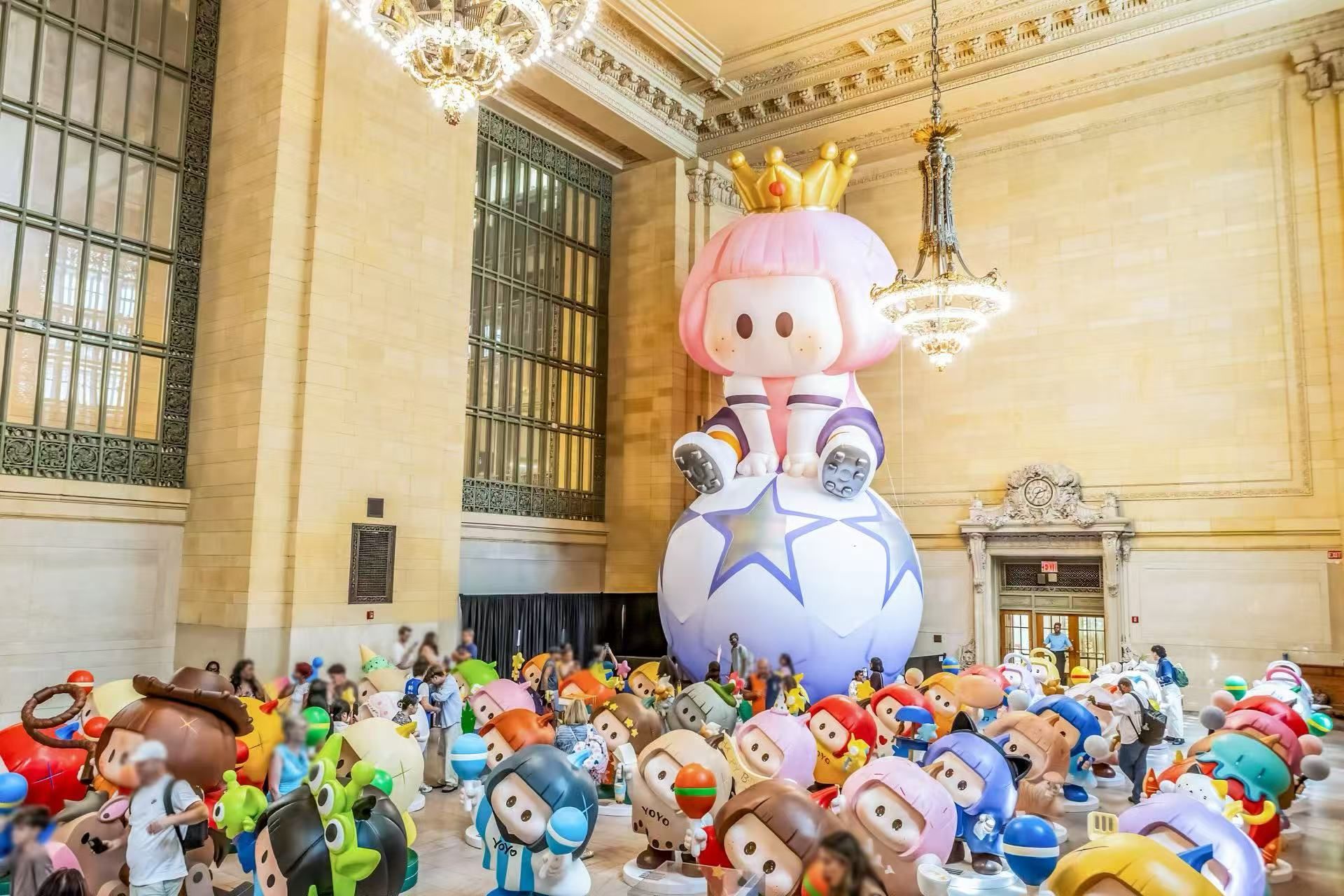
Beyond its core formats, Miniso launched twelve different pop-ups in 2025 and has fifteen on the docket for 2026. The retailer also plans to test different exhibitions that incorporate its IP in key markets. In June 2026, a YOYO art exhibition featuring fifty life-sized figures launched in Grand Central Terminal. It was the first time Miniso brought the IP into a public space in the US, but more is on the horizon.
Where Miniso “pops up” is based on market analysis and real estate, Bartlebaugh noted, “where we may not have a strong presence in the market, so we can learn whether or not we should be putting stores there, and learn how our brand and that IP is resonating in that area.”
In many ways, these exhibitions act as living labs to test the resonance of Miniso’s growing IP ecosystem, which brings the company’s vision full circle.
The ultimate goal is to go beyond the four walls of the branded Miniso experience and extend its owned IP into new environments, formats, and categories. By authorizing other brands to use this IP, Liu noted that this will not only bring Miniso an added layer of income, but also put its brands in front of more people, whether through fast-moving consumer goods, films, games, or even a full-blown amusement park.
“Frankly speaking, in terms of brand, I don’t want American consumers to regard Miniso as an Asian brand,” Liu said frankly. “We want to make Miniso an international brand. What we need to do is make good use of supply-chain advantages in Asia and China and provide consumers with cost-effective, high-quality, and unique products. Then, we hope to convey a simple brand value: ‘life is for fun.’ I believe this sentence will be recognized by consumers in the US, Asia, or Europe, so what we ultimately hope is that it will be a real global super brand.”
Licensed toys are outperforming the broader toy market, showing just how committed consumers are to nostalgic IP and niche fandoms. Accounting for 39% of total US toy sales, the category grew by 24%—and Miniso is one retailer capitalizing on this growth.
In fiscal 2025, Miniso raked in $466M in domestic revenue, a 53% increase from 2024. As a result, the Chinese firm was recently named the National Retail Federation’s fastest-growing US retailer, beating giants like Dick’s Sporting Goods and Costco.
“Miniso has prioritized the overseas market as a core business focus, with the US standing as our largest overseas market directly, and our most strategically important territory overall,” noted Robin Liu, VP and CMO of Miniso, in a briefing with a small group of journalists in New York City. Consumers initially flocked to the retailer for its expansive blind-box assortment, which is arguably the most significant “commerce is culture” trend of the past two years. But this “family-friendly” retail destination continues to draw in consumers of all ages for its commitment to whimsical IP and storytelling through plush toys and collectibles.
Miniso’s partnerships with Minecraft and Disney are impeccably timed with new film releases. Its collaborations with FIFA and even anime franchises like Jujutsu Kaisen ride the wave of social media chatter and cultural trend lines. This has been made possible by a robust product development pipeline that connects Miniso’s IP ecosystem to fast product cycles and strong supply chain operations.
In an intimate conversation with Liu and Tom Bartlebaugh, CEO of Miniso USA, we learned that a much larger vision is already in play, rooted in unique IP development.
“It was 72 years ago that [Walt] Disney drew a picture…he had begun to imagine Disneyland, his sales of derivatives other than cartoon movies, and so on. Today, it has become a reality, so I think we should think more forward-looking, in ten or twenty years, what kind of company [Miniso] will become and where it will go in that time.”
- Robin Liu, VP and CMO, Miniso
Liu added that Disney is “a good morale model for us to learn from,” and that “all the sources of this should return to our own IP.”
This all begins with a brand reframe. Liu doesn’t look at Miniso as simply a “toy company.” It’s currently operating as a “global IP co-branded collection store,” and the team is committed to becoming a “world-leading IP operation platform.”
The Strategy in Motion: Becoming an IP Operation Platform
A main strategic focus for Miniso is to develop branded partnerships and experiences that make its stores worth visiting over and over again. And because the retailer’s “target audience” is consumers 8 to 35 years old, there is a lot of creative ground to explore, especially as the company focuses on themes like self-expression, family connection, and value.
“That’s a big [demographic], and we’re trying to cater to that,” Bartlebaugh said. “It’s sometimes difficult to do, but I think from a family standpoint, it all becomes about time. Your life becomes more about trying to harness that time, occupy your time, so you don’t have to go to all these places.”
An unexpected byproduct of engaging such a diverse audience is that Miniso stores become destinations where older shoppers can introduce their favorite characters to younger family members, whether that be a niece, nephew, son, or daughter. “[Kidults] are continuing to purchase and collect, even as they get older,” Bartlebaugh said.
Currently, Miniso manages more than 180 global IPs that appeal to this vast demographic, and it prioritizes global launches and marketing dollars based on their timeliness, cultural resonance, and potential reach. For example, the release of Zootopia 2 and the FIFA World Cup (both major Miniso campaigns) would easily get “S” rankings because of the opportunity.
But Miniso is also working to bring new characters and stories into the world, and its in-house IP development includes an artist incubation program that taps creators from around the world.
“With copyright holders giving their intellectual property to more and more retailers and products of this brand, there is a trend of homogenization,” Liu said. “Therefore, we need to find our own differentiated and unique supply of intellectual property products.”
Miniso has already signed contracts with more than thirty artists, and a third of them have already commercialized products. With an in-house portfolio that includes characters like Kumaru, Angry Aimee, Carrot Street, and YOYO, the team is actively seeking new talent in Thailand, China, Japan, North America, and Europe to develop unique, recognizable characters with what Liu calls “universal value.” Each IP is then assigned a level of potential, tested and observed in-market, measured, and then scaled accordingly.
YOYO has been an especially valuable launch for Miniso following its launch in 2025. The character was featured in key campaigns and activations at Miniso locations. It was the centerpiece of a successful Toy Story 5-themed collector blind boxes launch, and was even featured in music videos for Katy Perry’s singles “Watch It Burn” and “Bandaids.” Fans in Asia were even bringing Miniso bags to Katy Perry concerts as pseudo accessories.
The Vision: Moments that Convey ‘Life is for Fun’
Last year, Miniso added 465 new stores outside its homeland, China, and many store openings (and new formats) are on the horizon. There are currently three core brick-and-mortar formats that the company taps to align with different markets and retail formats:
- Miniso Land: Large format and highly experiential. Locations are 15,000 square feet in size and themed around key IP. A new location in Columbus, Ohio, is set to open in Fall 2026, and the company will also open a Miniso Land location on Las Vegas Boulevard in the first half of 2027. Bartlebaugh said the goal is to open 12 of these in major US markets eventually.
- Miniso Friends: These 8,000-square-foot locations are typically built in premium mall locations. IP makes up about 80% of the product mix, and the goal is to incorporate interactive storytelling moments that center on IP. Given their growing spending power and love of all things nostalgic, Gen Z is the primary inspiration for the design.
- Mall-Format Stores: 5,000-7,000 square feet in size, these stores will pop up alongside Walmarts, Targets, and other mainstream brick-and-mortar retailers in open-air and lifestyle centers. The overall goal is to rely less on the traditional shopping mall and show up in these mixed developments where shoppers jump from store to store.
Beyond its core formats, Miniso launched twelve different pop-ups in 2025 and has fifteen on the docket for 2026. The retailer also plans to test different exhibitions that incorporate its IP in key markets. In June 2026, a YOYO art exhibition featuring fifty life-sized figures launched in Grand Central Terminal. It was the first time Miniso brought the IP into a public space in the US, but more is on the horizon.
Where Miniso “pops up” is based on market analysis and real estate, Bartlebaugh noted, “where we may not have a strong presence in the market, so we can learn whether or not we should be putting stores there, and learn how our brand and that IP is resonating in that area.”
In many ways, these exhibitions act as living labs to test the resonance of Miniso’s growing IP ecosystem, which brings the company’s vision full circle.
The ultimate goal is to go beyond the four walls of the branded Miniso experience and extend its owned IP into new environments, formats, and categories. By authorizing other brands to use this IP, Liu noted that this will not only bring Miniso an added layer of income, but also put its brands in front of more people, whether through fast-moving consumer goods, films, games, or even a full-blown amusement park.
“Frankly speaking, in terms of brand, I don’t want American consumers to regard Miniso as an Asian brand,” Liu said frankly. “We want to make Miniso an international brand. What we need to do is make good use of supply-chain advantages in Asia and China and provide consumers with cost-effective, high-quality, and unique products. Then, we hope to convey a simple brand value: ‘life is for fun.’ I believe this sentence will be recognized by consumers in the US, Asia, or Europe, so what we ultimately hope is that it will be a real global super brand.”
Licensed toys are outperforming the broader toy market, showing just how committed consumers are to nostalgic IP and niche fandoms. Accounting for 39% of total US toy sales, the category grew by 24%—and Miniso is one retailer capitalizing on this growth.
In fiscal 2025, Miniso raked in $466M in domestic revenue, a 53% increase from 2024. As a result, the Chinese firm was recently named the National Retail Federation’s fastest-growing US retailer, beating giants like Dick’s Sporting Goods and Costco.
“Miniso has prioritized the overseas market as a core business focus, with the US standing as our largest overseas market directly, and our most strategically important territory overall,” noted Robin Liu, VP and CMO of Miniso, in a briefing with a small group of journalists in New York City. Consumers initially flocked to the retailer for its expansive blind-box assortment, which is arguably the most significant “commerce is culture” trend of the past two years. But this “family-friendly” retail destination continues to draw in consumers of all ages for its commitment to whimsical IP and storytelling through plush toys and collectibles.
Miniso’s partnerships with Minecraft and Disney are impeccably timed with new film releases. Its collaborations with FIFA and even anime franchises like Jujutsu Kaisen ride the wave of social media chatter and cultural trend lines. This has been made possible by a robust product development pipeline that connects Miniso’s IP ecosystem to fast product cycles and strong supply chain operations.
In an intimate conversation with Liu and Tom Bartlebaugh, CEO of Miniso USA, we learned that a much larger vision is already in play, rooted in unique IP development.
“It was 72 years ago that [Walt] Disney drew a picture…he had begun to imagine Disneyland, his sales of derivatives other than cartoon movies, and so on. Today, it has become a reality, so I think we should think more forward-looking, in ten or twenty years, what kind of company [Miniso] will become and where it will go in that time.”
- Robin Liu, VP and CMO, Miniso
Liu added that Disney is “a good morale model for us to learn from,” and that “all the sources of this should return to our own IP.”
This all begins with a brand reframe. Liu doesn’t look at Miniso as simply a “toy company.” It’s currently operating as a “global IP co-branded collection store,” and the team is committed to becoming a “world-leading IP operation platform.”
The Strategy in Motion: Becoming an IP Operation Platform
A main strategic focus for Miniso is to develop branded partnerships and experiences that make its stores worth visiting over and over again. And because the retailer’s “target audience” is consumers 8 to 35 years old, there is a lot of creative ground to explore, especially as the company focuses on themes like self-expression, family connection, and value.
“That’s a big [demographic], and we’re trying to cater to that,” Bartlebaugh said. “It’s sometimes difficult to do, but I think from a family standpoint, it all becomes about time. Your life becomes more about trying to harness that time, occupy your time, so you don’t have to go to all these places.”
An unexpected byproduct of engaging such a diverse audience is that Miniso stores become destinations where older shoppers can introduce their favorite characters to younger family members, whether that be a niece, nephew, son, or daughter. “[Kidults] are continuing to purchase and collect, even as they get older,” Bartlebaugh said.
Currently, Miniso manages more than 180 global IPs that appeal to this vast demographic, and it prioritizes global launches and marketing dollars based on their timeliness, cultural resonance, and potential reach. For example, the release of Zootopia 2 and the FIFA World Cup (both major Miniso campaigns) would easily get “S” rankings because of the opportunity.
But Miniso is also working to bring new characters and stories into the world, and its in-house IP development includes an artist incubation program that taps creators from around the world.
“With copyright holders giving their intellectual property to more and more retailers and products of this brand, there is a trend of homogenization,” Liu said. “Therefore, we need to find our own differentiated and unique supply of intellectual property products.”
Miniso has already signed contracts with more than thirty artists, and a third of them have already commercialized products. With an in-house portfolio that includes characters like Kumaru, Angry Aimee, Carrot Street, and YOYO, the team is actively seeking new talent in Thailand, China, Japan, North America, and Europe to develop unique, recognizable characters with what Liu calls “universal value.” Each IP is then assigned a level of potential, tested and observed in-market, measured, and then scaled accordingly.
YOYO has been an especially valuable launch for Miniso following its launch in 2025. The character was featured in key campaigns and activations at Miniso locations. It was the centerpiece of a successful Toy Story 5-themed collector blind boxes launch, and was even featured in music videos for Katy Perry’s singles “Watch It Burn” and “Bandaids.” Fans in Asia were even bringing Miniso bags to Katy Perry concerts as pseudo accessories.
The Vision: Moments that Convey ‘Life is for Fun’
Last year, Miniso added 465 new stores outside its homeland, China, and many store openings (and new formats) are on the horizon. There are currently three core brick-and-mortar formats that the company taps to align with different markets and retail formats:
- Miniso Land: Large format and highly experiential. Locations are 15,000 square feet in size and themed around key IP. A new location in Columbus, Ohio, is set to open in Fall 2026, and the company will also open a Miniso Land location on Las Vegas Boulevard in the first half of 2027. Bartlebaugh said the goal is to open 12 of these in major US markets eventually.
- Miniso Friends: These 8,000-square-foot locations are typically built in premium mall locations. IP makes up about 80% of the product mix, and the goal is to incorporate interactive storytelling moments that center on IP. Given their growing spending power and love of all things nostalgic, Gen Z is the primary inspiration for the design.
- Mall-Format Stores: 5,000-7,000 square feet in size, these stores will pop up alongside Walmarts, Targets, and other mainstream brick-and-mortar retailers in open-air and lifestyle centers. The overall goal is to rely less on the traditional shopping mall and show up in these mixed developments where shoppers jump from store to store.
Beyond its core formats, Miniso launched twelve different pop-ups in 2025 and has fifteen on the docket for 2026. The retailer also plans to test different exhibitions that incorporate its IP in key markets. In June 2026, a YOYO art exhibition featuring fifty life-sized figures launched in Grand Central Terminal. It was the first time Miniso brought the IP into a public space in the US, but more is on the horizon.
Where Miniso “pops up” is based on market analysis and real estate, Bartlebaugh noted, “where we may not have a strong presence in the market, so we can learn whether or not we should be putting stores there, and learn how our brand and that IP is resonating in that area.”
In many ways, these exhibitions act as living labs to test the resonance of Miniso’s growing IP ecosystem, which brings the company’s vision full circle.
The ultimate goal is to go beyond the four walls of the branded Miniso experience and extend its owned IP into new environments, formats, and categories. By authorizing other brands to use this IP, Liu noted that this will not only bring Miniso an added layer of income, but also put its brands in front of more people, whether through fast-moving consumer goods, films, games, or even a full-blown amusement park.
“Frankly speaking, in terms of brand, I don’t want American consumers to regard Miniso as an Asian brand,” Liu said frankly. “We want to make Miniso an international brand. What we need to do is make good use of supply-chain advantages in Asia and China and provide consumers with cost-effective, high-quality, and unique products. Then, we hope to convey a simple brand value: ‘life is for fun.’ I believe this sentence will be recognized by consumers in the US, Asia, or Europe, so what we ultimately hope is that it will be a real global super brand.”
Licensed toys are outperforming the broader toy market, showing just how committed consumers are to nostalgic IP and niche fandoms. Accounting for 39% of total US toy sales, the category grew by 24%—and Miniso is one retailer capitalizing on this growth.
In fiscal 2025, Miniso raked in $466M in domestic revenue, a 53% increase from 2024. As a result, the Chinese firm was recently named the National Retail Federation’s fastest-growing US retailer, beating giants like Dick’s Sporting Goods and Costco.
“Miniso has prioritized the overseas market as a core business focus, with the US standing as our largest overseas market directly, and our most strategically important territory overall,” noted Robin Liu, VP and CMO of Miniso, in a briefing with a small group of journalists in New York City. Consumers initially flocked to the retailer for its expansive blind-box assortment, which is arguably the most significant “commerce is culture” trend of the past two years. But this “family-friendly” retail destination continues to draw in consumers of all ages for its commitment to whimsical IP and storytelling through plush toys and collectibles.
Miniso’s partnerships with Minecraft and Disney are impeccably timed with new film releases. Its collaborations with FIFA and even anime franchises like Jujutsu Kaisen ride the wave of social media chatter and cultural trend lines. This has been made possible by a robust product development pipeline that connects Miniso’s IP ecosystem to fast product cycles and strong supply chain operations.
In an intimate conversation with Liu and Tom Bartlebaugh, CEO of Miniso USA, we learned that a much larger vision is already in play, rooted in unique IP development.
“It was 72 years ago that [Walt] Disney drew a picture…he had begun to imagine Disneyland, his sales of derivatives other than cartoon movies, and so on. Today, it has become a reality, so I think we should think more forward-looking, in ten or twenty years, what kind of company [Miniso] will become and where it will go in that time.”
- Robin Liu, VP and CMO, Miniso
Liu added that Disney is “a good morale model for us to learn from,” and that “all the sources of this should return to our own IP.”
This all begins with a brand reframe. Liu doesn’t look at Miniso as simply a “toy company.” It’s currently operating as a “global IP co-branded collection store,” and the team is committed to becoming a “world-leading IP operation platform.”
The Strategy in Motion: Becoming an IP Operation Platform
A main strategic focus for Miniso is to develop branded partnerships and experiences that make its stores worth visiting over and over again. And because the retailer’s “target audience” is consumers 8 to 35 years old, there is a lot of creative ground to explore, especially as the company focuses on themes like self-expression, family connection, and value.
“That’s a big [demographic], and we’re trying to cater to that,” Bartlebaugh said. “It’s sometimes difficult to do, but I think from a family standpoint, it all becomes about time. Your life becomes more about trying to harness that time, occupy your time, so you don’t have to go to all these places.”
An unexpected byproduct of engaging such a diverse audience is that Miniso stores become destinations where older shoppers can introduce their favorite characters to younger family members, whether that be a niece, nephew, son, or daughter. “[Kidults] are continuing to purchase and collect, even as they get older,” Bartlebaugh said.
Currently, Miniso manages more than 180 global IPs that appeal to this vast demographic, and it prioritizes global launches and marketing dollars based on their timeliness, cultural resonance, and potential reach. For example, the release of Zootopia 2 and the FIFA World Cup (both major Miniso campaigns) would easily get “S” rankings because of the opportunity.
But Miniso is also working to bring new characters and stories into the world, and its in-house IP development includes an artist incubation program that taps creators from around the world.
“With copyright holders giving their intellectual property to more and more retailers and products of this brand, there is a trend of homogenization,” Liu said. “Therefore, we need to find our own differentiated and unique supply of intellectual property products.”
Miniso has already signed contracts with more than thirty artists, and a third of them have already commercialized products. With an in-house portfolio that includes characters like Kumaru, Angry Aimee, Carrot Street, and YOYO, the team is actively seeking new talent in Thailand, China, Japan, North America, and Europe to develop unique, recognizable characters with what Liu calls “universal value.” Each IP is then assigned a level of potential, tested and observed in-market, measured, and then scaled accordingly.
YOYO has been an especially valuable launch for Miniso following its launch in 2025. The character was featured in key campaigns and activations at Miniso locations. It was the centerpiece of a successful Toy Story 5-themed collector blind boxes launch, and was even featured in music videos for Katy Perry’s singles “Watch It Burn” and “Bandaids.” Fans in Asia were even bringing Miniso bags to Katy Perry concerts as pseudo accessories.
The Vision: Moments that Convey ‘Life is for Fun’
Last year, Miniso added 465 new stores outside its homeland, China, and many store openings (and new formats) are on the horizon. There are currently three core brick-and-mortar formats that the company taps to align with different markets and retail formats:
- Miniso Land: Large format and highly experiential. Locations are 15,000 square feet in size and themed around key IP. A new location in Columbus, Ohio, is set to open in Fall 2026, and the company will also open a Miniso Land location on Las Vegas Boulevard in the first half of 2027. Bartlebaugh said the goal is to open 12 of these in major US markets eventually.
- Miniso Friends: These 8,000-square-foot locations are typically built in premium mall locations. IP makes up about 80% of the product mix, and the goal is to incorporate interactive storytelling moments that center on IP. Given their growing spending power and love of all things nostalgic, Gen Z is the primary inspiration for the design.
- Mall-Format Stores: 5,000-7,000 square feet in size, these stores will pop up alongside Walmarts, Targets, and other mainstream brick-and-mortar retailers in open-air and lifestyle centers. The overall goal is to rely less on the traditional shopping mall and show up in these mixed developments where shoppers jump from store to store.
Beyond its core formats, Miniso launched twelve different pop-ups in 2025 and has fifteen on the docket for 2026. The retailer also plans to test different exhibitions that incorporate its IP in key markets. In June 2026, a YOYO art exhibition featuring fifty life-sized figures launched in Grand Central Terminal. It was the first time Miniso brought the IP into a public space in the US, but more is on the horizon.
Where Miniso “pops up” is based on market analysis and real estate, Bartlebaugh noted, “where we may not have a strong presence in the market, so we can learn whether or not we should be putting stores there, and learn how our brand and that IP is resonating in that area.”
In many ways, these exhibitions act as living labs to test the resonance of Miniso’s growing IP ecosystem, which brings the company’s vision full circle.
The ultimate goal is to go beyond the four walls of the branded Miniso experience and extend its owned IP into new environments, formats, and categories. By authorizing other brands to use this IP, Liu noted that this will not only bring Miniso an added layer of income, but also put its brands in front of more people, whether through fast-moving consumer goods, films, games, or even a full-blown amusement park.
“Frankly speaking, in terms of brand, I don’t want American consumers to regard Miniso as an Asian brand,” Liu said frankly. “We want to make Miniso an international brand. What we need to do is make good use of supply-chain advantages in Asia and China and provide consumers with cost-effective, high-quality, and unique products. Then, we hope to convey a simple brand value: ‘life is for fun.’ I believe this sentence will be recognized by consumers in the US, Asia, or Europe, so what we ultimately hope is that it will be a real global super brand.”
Licensed toys are outperforming the broader toy market, showing just how committed consumers are to nostalgic IP and niche fandoms. Accounting for 39% of total US toy sales, the category grew by 24%—and Miniso is one retailer capitalizing on this growth.
In fiscal 2025, Miniso raked in $466M in domestic revenue, a 53% increase from 2024. As a result, the Chinese firm was recently named the National Retail Federation’s fastest-growing US retailer, beating giants like Dick’s Sporting Goods and Costco.
“Miniso has prioritized the overseas market as a core business focus, with the US standing as our largest overseas market directly, and our most strategically important territory overall,” noted Robin Liu, VP and CMO of Miniso, in a briefing with a small group of journalists in New York City. Consumers initially flocked to the retailer for its expansive blind-box assortment, which is arguably the most significant “commerce is culture” trend of the past two years. But this “family-friendly” retail destination continues to draw in consumers of all ages for its commitment to whimsical IP and storytelling through plush toys and collectibles.
Miniso’s partnerships with Minecraft and Disney are impeccably timed with new film releases. Its collaborations with FIFA and even anime franchises like Jujutsu Kaisen ride the wave of social media chatter and cultural trend lines. This has been made possible by a robust product development pipeline that connects Miniso’s IP ecosystem to fast product cycles and strong supply chain operations.
In an intimate conversation with Liu and Tom Bartlebaugh, CEO of Miniso USA, we learned that a much larger vision is already in play, rooted in unique IP development.
“It was 72 years ago that [Walt] Disney drew a picture…he had begun to imagine Disneyland, his sales of derivatives other than cartoon movies, and so on. Today, it has become a reality, so I think we should think more forward-looking, in ten or twenty years, what kind of company [Miniso] will become and where it will go in that time.”
- Robin Liu, VP and CMO, Miniso
Liu added that Disney is “a good morale model for us to learn from,” and that “all the sources of this should return to our own IP.”
This all begins with a brand reframe. Liu doesn’t look at Miniso as simply a “toy company.” It’s currently operating as a “global IP co-branded collection store,” and the team is committed to becoming a “world-leading IP operation platform.”
The Strategy in Motion: Becoming an IP Operation Platform
A main strategic focus for Miniso is to develop branded partnerships and experiences that make its stores worth visiting over and over again. And because the retailer’s “target audience” is consumers 8 to 35 years old, there is a lot of creative ground to explore, especially as the company focuses on themes like self-expression, family connection, and value.
“That’s a big [demographic], and we’re trying to cater to that,” Bartlebaugh said. “It’s sometimes difficult to do, but I think from a family standpoint, it all becomes about time. Your life becomes more about trying to harness that time, occupy your time, so you don’t have to go to all these places.”
An unexpected byproduct of engaging such a diverse audience is that Miniso stores become destinations where older shoppers can introduce their favorite characters to younger family members, whether that be a niece, nephew, son, or daughter. “[Kidults] are continuing to purchase and collect, even as they get older,” Bartlebaugh said.
Currently, Miniso manages more than 180 global IPs that appeal to this vast demographic, and it prioritizes global launches and marketing dollars based on their timeliness, cultural resonance, and potential reach. For example, the release of Zootopia 2 and the FIFA World Cup (both major Miniso campaigns) would easily get “S” rankings because of the opportunity.
But Miniso is also working to bring new characters and stories into the world, and its in-house IP development includes an artist incubation program that taps creators from around the world.
“With copyright holders giving their intellectual property to more and more retailers and products of this brand, there is a trend of homogenization,” Liu said. “Therefore, we need to find our own differentiated and unique supply of intellectual property products.”
Miniso has already signed contracts with more than thirty artists, and a third of them have already commercialized products. With an in-house portfolio that includes characters like Kumaru, Angry Aimee, Carrot Street, and YOYO, the team is actively seeking new talent in Thailand, China, Japan, North America, and Europe to develop unique, recognizable characters with what Liu calls “universal value.” Each IP is then assigned a level of potential, tested and observed in-market, measured, and then scaled accordingly.
YOYO has been an especially valuable launch for Miniso following its launch in 2025. The character was featured in key campaigns and activations at Miniso locations. It was the centerpiece of a successful Toy Story 5-themed collector blind boxes launch, and was even featured in music videos for Katy Perry’s singles “Watch It Burn” and “Bandaids.” Fans in Asia were even bringing Miniso bags to Katy Perry concerts as pseudo accessories.
The Vision: Moments that Convey ‘Life is for Fun’
Last year, Miniso added 465 new stores outside its homeland, China, and many store openings (and new formats) are on the horizon. There are currently three core brick-and-mortar formats that the company taps to align with different markets and retail formats:
- Miniso Land: Large format and highly experiential. Locations are 15,000 square feet in size and themed around key IP. A new location in Columbus, Ohio, is set to open in Fall 2026, and the company will also open a Miniso Land location on Las Vegas Boulevard in the first half of 2027. Bartlebaugh said the goal is to open 12 of these in major US markets eventually.
- Miniso Friends: These 8,000-square-foot locations are typically built in premium mall locations. IP makes up about 80% of the product mix, and the goal is to incorporate interactive storytelling moments that center on IP. Given their growing spending power and love of all things nostalgic, Gen Z is the primary inspiration for the design.
- Mall-Format Stores: 5,000-7,000 square feet in size, these stores will pop up alongside Walmarts, Targets, and other mainstream brick-and-mortar retailers in open-air and lifestyle centers. The overall goal is to rely less on the traditional shopping mall and show up in these mixed developments where shoppers jump from store to store.
Beyond its core formats, Miniso launched twelve different pop-ups in 2025 and has fifteen on the docket for 2026. The retailer also plans to test different exhibitions that incorporate its IP in key markets. In June 2026, a YOYO art exhibition featuring fifty life-sized figures launched in Grand Central Terminal. It was the first time Miniso brought the IP into a public space in the US, but more is on the horizon.
Where Miniso “pops up” is based on market analysis and real estate, Bartlebaugh noted, “where we may not have a strong presence in the market, so we can learn whether or not we should be putting stores there, and learn how our brand and that IP is resonating in that area.”
In many ways, these exhibitions act as living labs to test the resonance of Miniso’s growing IP ecosystem, which brings the company’s vision full circle.
The ultimate goal is to go beyond the four walls of the branded Miniso experience and extend its owned IP into new environments, formats, and categories. By authorizing other brands to use this IP, Liu noted that this will not only bring Miniso an added layer of income, but also put its brands in front of more people, whether through fast-moving consumer goods, films, games, or even a full-blown amusement park.
“Frankly speaking, in terms of brand, I don’t want American consumers to regard Miniso as an Asian brand,” Liu said frankly. “We want to make Miniso an international brand. What we need to do is make good use of supply-chain advantages in Asia and China and provide consumers with cost-effective, high-quality, and unique products. Then, we hope to convey a simple brand value: ‘life is for fun.’ I believe this sentence will be recognized by consumers in the US, Asia, or Europe, so what we ultimately hope is that it will be a real global super brand.”
Continue Reading...

Insights and futurism for executives in eCom and Retail
Those things we shouldn’t say out loud? We say them on the private feed. Bi-weekly “after dark” podcasts and a members-only newsletter, just for subscribers.
Our research reports combine visionary thinking with data-backed findings from our own advisory panel, made up of leaders at brands you know and trust.
Upskill, cross-skill, and future-proof your teams with Future Commerce Learning, the leading digital eCommerce learning platform, created by professional educators.