

of the United Kingdom’s capitol city.
In brief: US retail media spending will reach an estimated $74.4 billion in 2026, and Amazon and Walmart hold 88% of the category’s market share. But other networks are capturing market and mindshare by designing for two consumers: the human who treasures brand storytelling and favors in-store shopping, and the AI agent that researches and buys on consumers’ behalf.
Executives from RedVest Media, Macy’s Media Network, and Simon Media Network will reveal how they’re building for disruption today, and how they’re plotting for what comes next at VISIONS 2027 on February 10 at the Museum of Modern Art.
Commerce media analysts and commentators have spent the last year circling the same fundamental question: what happens to ad inventory when AI agents do the shopping?
The stakes are clear for every leader: global retail media spending is on track to reach $200.4B in 2026 and $223.4B in 2027, according to WARC. Amazon and Walmart hold 88% of that market share, and they’re tackling the agent question in completely different ways. While Amazon has blocked most major AI shopping agents, the latest being Meta’s Muse, Walmart has essentially rolled out the red carpet, launching an Agent Gateway that lets agents connect to a shopper's account with purchase approvals and spending limits.
Every other retail media network now has to pick a lane, and the most innovative responses come from leaders thinking beyond the search results page. Instead, they’re looking at store aisles, in shopping malls, and even in creator feeds.
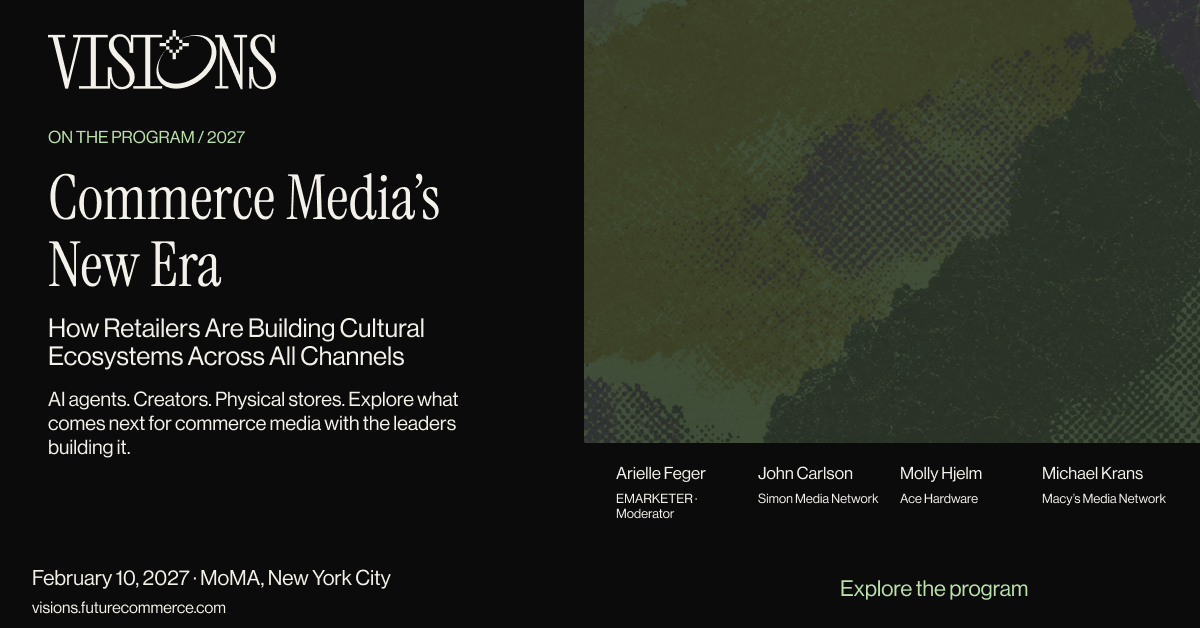
We’re bringing these leaders together for a panel at VISIONS 2027 to explore how AI is rewriting both commerce and culture. John Carlson of Simon Media Network, Molly Hjelm of Ace Hardware, and Michael Krans of Macy’s Media Network will join EMARKETER's Arielle Feger for Commerce Media's New Era: How Retailers Are Building Cultural Ecosystems Across All Channels.
And they’re bringing some of the year’s most dynamic data and trends into the conversation.
Retail Media in 2026, by the Numbers
- US retail media spend: an estimated $74.4 billion in 2026, up 22.6% year over year (EMARKETER, via Reuters)
- The slowdown signal: Amazon's ad revenue grew 11% in Q3 2026, its slowest pace in nearly four years (LSEG, via Reuters)
- AI traffic: Adobe forecasts AI-referred visits to US retail sites will rise 130% this holiday season
- Agent reliability: in Visa's test of 22 AI shopping agents, purchases succeeded only about 57% of the time (Fortune)
- Consolidation: DoorDash agreed to buy Instacart for $17 billion in October, after Instacart’s ad revenue grew 23% to $331 million in a single quarter (Future Commerce, The Senses)
AI Agents Test the Commerce Media Model
Commerce media emerged when ad engagement followed a predictable, repeatable loop. When a shopper searched, they saw various product listings, including a sponsored product ad. They would click the ad and then convert, creating a closed-loop experience that both the brand and the network could measure.
An agent shopping on someone’s behalf can skip one, if not all, of these steps. It reads structured product data, compares prices across retailers and hands back a recommendation, often without ever rendering the ad a brand paid for. For example, Google’s Universal Cart, which launched in AI Mode and Gemini, allows shoppers to fill a single cart from multiple retailers and quickly complete a purchase.
The IAB's Collin Colburn framed it well on our podcast this summer. Brands have always competed for the shelf, from the physical aisle to search rankings to sponsored listings. The agentic shelf is one more “shelf” to manage. Not to mention, not all consumers are eagerly using agents to browse and buy. We found that shoppers largely rely on AI to research, then click through to eCommerce sites to validate their decisions. Winning retailers will make themselves legible to agents while maintaining a direct relationship with the human overseeing them.
With the average agent successfully managing shopping scenarios about 57% of the time, commerce media networks must still design offerings that speak the emotional and logical “modes” of both man and machine.
Stores Become the Most Compelling Media Channel
As agents compress the digital shelf, the physical one becomes more valuable. Shoppers still go to stores to see and validate what they buy, and retailers are finally measuring that moment.
In August, Simon launched Simon Media Network across more than 200 shopping, dining, and entertainment destinations, giving advertisers closed-loop attribution for visits and transactions. That same month, Ace Hardware’s RedVest Media hosted its first-ever upfront, putting more than 80 million Ace Rewards members and 5,300-plus stores behind new incrementality measurement for advertisers.
Macy’s, a retailer steeped in heritage and lore, has also focused on using its rich history (often found in its stores) to create new advertising opportunities for both endemic and non-endemic partners. Advertising, marketing, and merchandising are collaborating to create advertiser value without damaging the integrity and value of the in-store shopping experience.
“We are attempting to move beyond Macy’s Media Network being a transactional line item,” Macy’s Media Network VP Michael Krans told Beet.TV in April. “We don’t see storytelling and sales as competing forces.”
Commerce media networks are creating value by becoming cultural ecosystems; places where brands tell stories across stores, screens, feeds and partners, with customer relationship at the center. It’s a far bigger ambition than a sponsored listing, and it’s the kind of ambition AI agents will test.
The Future of the Category: Creators and Social Commerce
But every brand knows culture doesn’t exist only within the four walls of a store; it’s forming and evolving on social feeds and publishing platforms. Now, retail and commerce media players are trying to get a piece of that attention.
RedVest Media recently added creator partnerships through Influential and sponsored ads inside the Ace storefront on DoorDash. And EMARKETER’s Sarah Marzano told us this summer that commerce media is shifting its focus toward creating demand as it looks for growth beyond on-site ads. Social creators hold the key to that shift.
Whether this expansion becomes a viable reality remains to be seen, largely because every new ad offering brings new complexities. Measurement can get murky, and consumers can smell a forced ad from a mile away. At Shoptalk this spring, analyst Andrew Lipsman reminded us that retailers are “learning how to be media businesses. This is not a core competency at all. It’s hard.”
Commerce Media’s New Era at VISIONS 2027
On February 10, Arielle Feger, Senior Analyst for Commerce Media and Retail at EMARKETER, will moderate a conversation with:
- John Carlson, Vice President, Simon Media Network
- Molly Hjelm, Corporate Vice President and Head of Retail Media, Ace Hardware
- Michael Krans, Vice President, Macy’s Media Network
Together they’ll dig into:
- How AI is reshaping media planning and measurement
- How retail media operations can create real advertiser value without hindering the customer experience
- How retailers protect their relationships and margins as more consumer conversations happen inside LLMs, outside the retailer’s four walls
- Whether commerce media’s expansion into social and creator commerce is a real growth lane or a hype cycle
More to Explore at VISIONS 2027
The commerce media panel sits inside a program built for the current AI moment. Former US Secretary of Commerce Carlos Gutierrez will open the day discussing his memoir, Sheer Will, and the future of the Commerce Department. Sheehan Quirke, author of The Cultural Tutor, will also deliver a keynote on how AI is impacting the way we create and participate in culture.
These sessions book-end a day of deep-dive fireside chats which feature executives from Etsy, 11:11 Media, OUI the People, MoMA Design Store, and many more. Analysts from EMARKETER, PwC, WGSN, and GWI will unpack the gap between what consumers say about AI and what they actually buy.
Get Your Early Bird Ticket Through Black Friday
Early bird pricing is live through Black Friday. Full-day passes are $549 (regularly $749) and VIP passes are $999 (regularly $1,199). Future Commerce Plus annual members save an additional $200, bringing passes to $349 and $799. Every pass includes a year of FC+, which will give you on-demand access to in-depth content, including the official VISIONS Summit archive.
Event details:
VISIONS 2027
Wednesday, February 10, 2027
Time: 10 AM ET
Location: The Museum of Modern Art, Roy and Niuta Titus Theater
Address: 11 West 53rd Street, New York, NY (53rd Street entrance)
In brief: US retail media spending will reach an estimated $74.4 billion in 2026, and Amazon and Walmart hold 88% of the category’s market share. But other networks are capturing market and mindshare by designing for two consumers: the human who treasures brand storytelling and favors in-store shopping, and the AI agent that researches and buys on consumers’ behalf.
Executives from RedVest Media, Macy’s Media Network, and Simon Media Network will reveal how they’re building for disruption today, and how they’re plotting for what comes next at VISIONS 2027 on February 10 at the Museum of Modern Art.
Commerce media analysts and commentators have spent the last year circling the same fundamental question: what happens to ad inventory when AI agents do the shopping?
The stakes are clear for every leader: global retail media spending is on track to reach $200.4B in 2026 and $223.4B in 2027, according to WARC. Amazon and Walmart hold 88% of that market share, and they’re tackling the agent question in completely different ways. While Amazon has blocked most major AI shopping agents, the latest being Meta’s Muse, Walmart has essentially rolled out the red carpet, launching an Agent Gateway that lets agents connect to a shopper's account with purchase approvals and spending limits.
Every other retail media network now has to pick a lane, and the most innovative responses come from leaders thinking beyond the search results page. Instead, they’re looking at store aisles, in shopping malls, and even in creator feeds.
We’re bringing these leaders together for a panel at VISIONS 2027 to explore how AI is rewriting both commerce and culture. John Carlson of Simon Media Network, Molly Hjelm of Ace Hardware, and Michael Krans of Macy’s Media Network will join EMARKETER's Arielle Feger for Commerce Media's New Era: How Retailers Are Building Cultural Ecosystems Across All Channels.
And they’re bringing some of the year’s most dynamic data and trends into the conversation.
Retail Media in 2026, by the Numbers
- US retail media spend: an estimated $74.4 billion in 2026, up 22.6% year over year (EMARKETER, via Reuters)
- The slowdown signal: Amazon's ad revenue grew 11% in Q3 2026, its slowest pace in nearly four years (LSEG, via Reuters)
- AI traffic: Adobe forecasts AI-referred visits to US retail sites will rise 130% this holiday season
- Agent reliability: in Visa's test of 22 AI shopping agents, purchases succeeded only about 57% of the time (Fortune)
- Consolidation: DoorDash agreed to buy Instacart for $17 billion in October, after Instacart’s ad revenue grew 23% to $331 million in a single quarter (Future Commerce, The Senses)
AI Agents Test the Commerce Media Model
Commerce media emerged when ad engagement followed a predictable, repeatable loop. When a shopper searched, they saw various product listings, including a sponsored product ad. They would click the ad and then convert, creating a closed-loop experience that both the brand and the network could measure.
An agent shopping on someone’s behalf can skip one, if not all, of these steps. It reads structured product data, compares prices across retailers and hands back a recommendation, often without ever rendering the ad a brand paid for. For example, Google’s Universal Cart, which launched in AI Mode and Gemini, allows shoppers to fill a single cart from multiple retailers and quickly complete a purchase.
The IAB's Collin Colburn framed it well on our podcast this summer. Brands have always competed for the shelf, from the physical aisle to search rankings to sponsored listings. The agentic shelf is one more “shelf” to manage. Not to mention, not all consumers are eagerly using agents to browse and buy. We found that shoppers largely rely on AI to research, then click through to eCommerce sites to validate their decisions. Winning retailers will make themselves legible to agents while maintaining a direct relationship with the human overseeing them.
With the average agent successfully managing shopping scenarios about 57% of the time, commerce media networks must still design offerings that speak the emotional and logical “modes” of both man and machine.
Stores Become the Most Compelling Media Channel
As agents compress the digital shelf, the physical one becomes more valuable. Shoppers still go to stores to see and validate what they buy, and retailers are finally measuring that moment.
In August, Simon launched Simon Media Network across more than 200 shopping, dining, and entertainment destinations, giving advertisers closed-loop attribution for visits and transactions. That same month, Ace Hardware’s RedVest Media hosted its first-ever upfront, putting more than 80 million Ace Rewards members and 5,300-plus stores behind new incrementality measurement for advertisers.
Macy’s, a retailer steeped in heritage and lore, has also focused on using its rich history (often found in its stores) to create new advertising opportunities for both endemic and non-endemic partners. Advertising, marketing, and merchandising are collaborating to create advertiser value without damaging the integrity and value of the in-store shopping experience.
“We are attempting to move beyond Macy’s Media Network being a transactional line item,” Macy’s Media Network VP Michael Krans told Beet.TV in April. “We don’t see storytelling and sales as competing forces.”
Commerce media networks are creating value by becoming cultural ecosystems; places where brands tell stories across stores, screens, feeds and partners, with customer relationship at the center. It’s a far bigger ambition than a sponsored listing, and it’s the kind of ambition AI agents will test.
The Future of the Category: Creators and Social Commerce
But every brand knows culture doesn’t exist only within the four walls of a store; it’s forming and evolving on social feeds and publishing platforms. Now, retail and commerce media players are trying to get a piece of that attention.
RedVest Media recently added creator partnerships through Influential and sponsored ads inside the Ace storefront on DoorDash. And EMARKETER’s Sarah Marzano told us this summer that commerce media is shifting its focus toward creating demand as it looks for growth beyond on-site ads. Social creators hold the key to that shift.
Whether this expansion becomes a viable reality remains to be seen, largely because every new ad offering brings new complexities. Measurement can get murky, and consumers can smell a forced ad from a mile away. At Shoptalk this spring, analyst Andrew Lipsman reminded us that retailers are “learning how to be media businesses. This is not a core competency at all. It’s hard.”
Commerce Media’s New Era at VISIONS 2027
On February 10, Arielle Feger, Senior Analyst for Commerce Media and Retail at EMARKETER, will moderate a conversation with:
- John Carlson, Vice President, Simon Media Network
- Molly Hjelm, Corporate Vice President and Head of Retail Media, Ace Hardware
- Michael Krans, Vice President, Macy’s Media Network
Together they’ll dig into:
- How AI is reshaping media planning and measurement
- How retail media operations can create real advertiser value without hindering the customer experience
- How retailers protect their relationships and margins as more consumer conversations happen inside LLMs, outside the retailer’s four walls
- Whether commerce media’s expansion into social and creator commerce is a real growth lane or a hype cycle
More to Explore at VISIONS 2027
The commerce media panel sits inside a program built for the current AI moment. Former US Secretary of Commerce Carlos Gutierrez will open the day discussing his memoir, Sheer Will, and the future of the Commerce Department. Sheehan Quirke, author of The Cultural Tutor, will also deliver a keynote on how AI is impacting the way we create and participate in culture.
These sessions book-end a day of deep-dive fireside chats which feature executives from Etsy, 11:11 Media, OUI the People, MoMA Design Store, and many more. Analysts from EMARKETER, PwC, WGSN, and GWI will unpack the gap between what consumers say about AI and what they actually buy.
Get Your Early Bird Ticket Through Black Friday
Early bird pricing is live through Black Friday. Full-day passes are $549 (regularly $749) and VIP passes are $999 (regularly $1,199). Future Commerce Plus annual members save an additional $200, bringing passes to $349 and $799. Every pass includes a year of FC+, which will give you on-demand access to in-depth content, including the official VISIONS Summit archive.
Event details:
VISIONS 2027
Wednesday, February 10, 2027
Time: 10 AM ET
Location: The Museum of Modern Art, Roy and Niuta Titus Theater
Address: 11 West 53rd Street, New York, NY (53rd Street entrance)
Continue Reading...

Insights and futurism for executives in eCom and Retail
Those things we shouldn’t say out loud? We say them on the private feed. Bi-weekly “after dark” podcasts and a members-only newsletter, just for subscribers.
Our research reports combine visionary thinking with data-backed findings from our own advisory panel, made up of leaders at brands you know and trust.
Upskill, cross-skill, and future-proof your teams with Future Commerce Learning, the leading digital eCommerce learning platform, created by professional educators.