.jpg)


of the United Kingdom’s capitol city.
If AI isn’t the ‘main character’ these days, it’s at the very least the villain of every social media feed.
Consumers have boycotted local businesses because they used AI to create their menus. Gucci saw extreme backlash for posting generative images ahead of its fashion show. And big tech? They have implemented new tools to flag and filter AI content because of end-user pushback.

Some of that sentiment carries into shopping behaviors, but not completely. When we surveyed 1,000 consumers about how they use AI to shop, trust held back only about 20%. And overall trust rates were about on par with search engines and brand websites. Gen Z, the cohort most fluent in AI backlash, was also more likely to trust AI than social media (21%).
This is what we call the “say-do” gap, and it runs rampant in most consumer research. That’s why most analyst firms and trend forecasters use a mix of survey data, POS data, and good ol’ observation. Because the space between what people say and what they do is where vision is found and strategy is shaped.
During VISIONS 2026, executive leaders and analysts will converge to unpack what the data is saying, what people are doing, and how combining both is unlocking new retail trends and opportunities.
Unpacking AI’s Cultural Implications
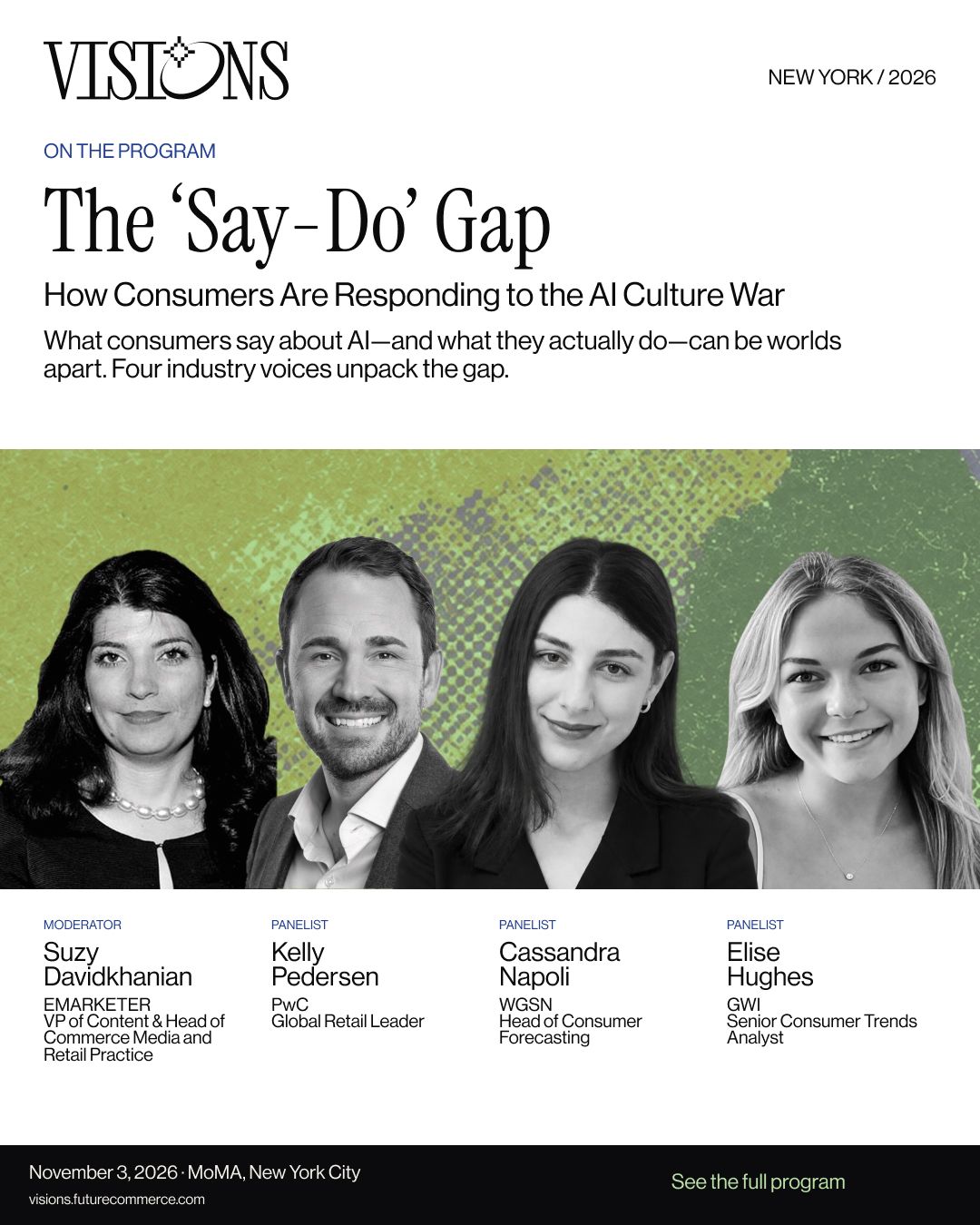
Suzy Davidkhanian, VP of Content and Head of the Commerce Media and Retail Practice at EMARKETER, will moderate a panel featuring Kelly Pedersen, Global Retail Leader at PwC, Cassandra Napoli, Head of Consumer Forecasting at WGSN, and Elise Hughes, Senior Consumer Trends Analyst at GWI.
These analysts have had a front-row seat to AI’s rise and have a unique perspective on how culture, commerce, and society have changed as a result. Their job is to cut through the noise and show how consumers are responding to the age of autonomy, including shifts in how they create, shop, and share. They will discuss where behavior contradicts survey data most, and what that tells us about how society is evolving for or against AI, and how that is leading to a new kind of culture war.
Brand and marketing leaders have long heard the adage “authenticity is key,” but what does that mean when AI is powering personalization at scale?
Communities Forged in Analog’s Return
Gen Z was once heralded as the most tech-savvy generation. But it’s also the generation feeling the heaviest toll of constant connection. This has sparked a mass pushback against hyper-polished algorithms and AI’s flattening of culture.
The result is a return to chaotic, imperfect real-world spaces that help them feel closer to culture and community. Malls, of all places, have become Gen Z’s favorite place to spend time.
Three in five Gen Z shoppers visit stores to experience a brand’s community, according to MG2 Advisory research. Research has shown these behaviors are even starting to trickle down to Gen Alpha.
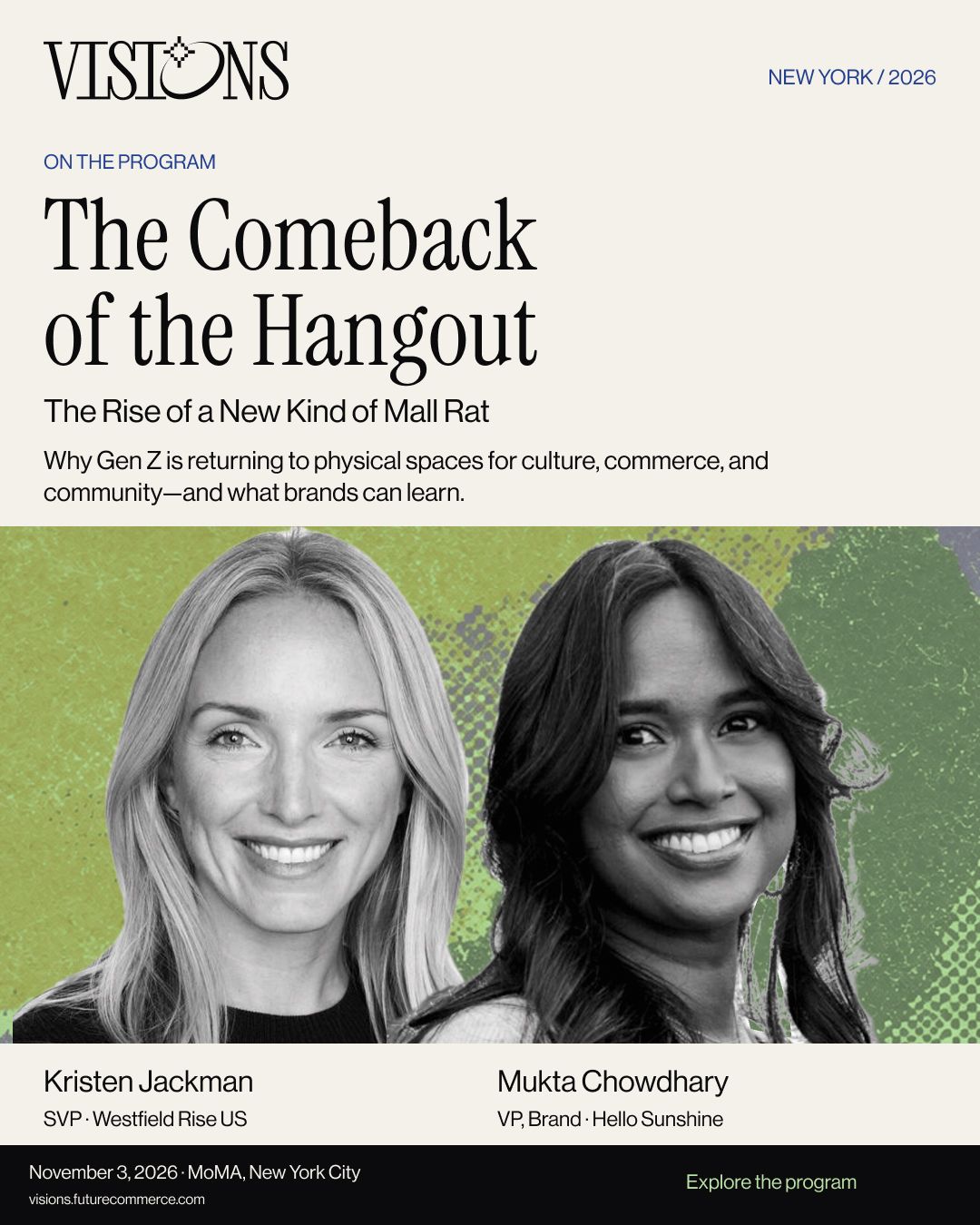
Drawing on collaborative research from Westfield Rise and Sunnie, Hello Sunshine’s Gen Z brand, Kristen Jackman, SVP of Westfield Rise US, and Mukta Chowdhary, VP of Brand for Hello Sunshine, will unpack the trends and cultural signals behind that shift, and share practical frameworks for building experiences that feel social and worth showing up for.
AI Is Rewriting Commerce. Culture Is Next.
These sessions show just how deeply complex our relationships with AI are. We will happily hand over certain errands and manual tasks to a machine. Yet there are incredibly precious experiences, such as community connection and the creative process, that we’ll never want to automate.
We will unpack the nuance further at the Museum of Modern Art on November 3. The day-long program includes former US Secretary of Commerce Carlos Gutierrez, as well as executives from, Hermès, OUI the People, MoMA Design Store, and more than 20 other speakers in retail, media, brand, and tech.
Register now to join the conversation.
If AI isn’t the ‘main character’ these days, it’s at the very least the villain of every social media feed.
Consumers have boycotted local businesses because they used AI to create their menus. Gucci saw extreme backlash for posting generative images ahead of its fashion show. And big tech? They have implemented new tools to flag and filter AI content because of end-user pushback.
Some of that sentiment carries into shopping behaviors, but not completely. When we surveyed 1,000 consumers about how they use AI to shop, trust held back only about 20%. And overall trust rates were about on par with search engines and brand websites. Gen Z, the cohort most fluent in AI backlash, was also more likely to trust AI than social media (21%).
This is what we call the “say-do” gap, and it runs rampant in most consumer research. That’s why most analyst firms and trend forecasters use a mix of survey data, POS data, and good ol’ observation. Because the space between what people say and what they do is where vision is found and strategy is shaped.
During VISIONS 2026, executive leaders and analysts will converge to unpack what the data is saying, what people are doing, and how combining both is unlocking new retail trends and opportunities.
Unpacking AI’s Cultural Implications
Suzy Davidkhanian, VP of Content and Head of the Commerce Media and Retail Practice at EMARKETER, will moderate a panel featuring Kelly Pedersen, Global Retail Leader at PwC, Cassandra Napoli, Head of Consumer Forecasting at WGSN, and Elise Hughes, Senior Consumer Trends Analyst at GWI.
These analysts have had a front-row seat to AI’s rise and have a unique perspective on how culture, commerce, and society have changed as a result. Their job is to cut through the noise and show how consumers are responding to the age of autonomy, including shifts in how they create, shop, and share. They will discuss where behavior contradicts survey data most, and what that tells us about how society is evolving for or against AI, and how that is leading to a new kind of culture war.
Brand and marketing leaders have long heard the adage “authenticity is key,” but what does that mean when AI is powering personalization at scale?
Communities Forged in Analog’s Return
Gen Z was once heralded as the most tech-savvy generation. But it’s also the generation feeling the heaviest toll of constant connection. This has sparked a mass pushback against hyper-polished algorithms and AI’s flattening of culture.
The result is a return to chaotic, imperfect real-world spaces that help them feel closer to culture and community. Malls, of all places, have become Gen Z’s favorite place to spend time.
Three in five Gen Z shoppers visit stores to experience a brand’s community, according to MG2 Advisory research. Research has shown these behaviors are even starting to trickle down to Gen Alpha.
Drawing on collaborative research from Westfield Rise and Sunnie, Hello Sunshine’s Gen Z brand, Kristen Jackman, SVP of Westfield Rise US, and Mukta Chowdhary, VP of Brand for Hello Sunshine, will unpack the trends and cultural signals behind that shift, and share practical frameworks for building experiences that feel social and worth showing up for.
AI Is Rewriting Commerce. Culture Is Next.
These sessions show just how deeply complex our relationships with AI are. We will happily hand over certain errands and manual tasks to a machine. Yet there are incredibly precious experiences, such as community connection and the creative process, that we’ll never want to automate.
We will unpack the nuance further at the Museum of Modern Art on November 3. The day-long program includes former US Secretary of Commerce Carlos Gutierrez, as well as executives from, Hermès, OUI the People, MoMA Design Store, and more than 20 other speakers in retail, media, brand, and tech.
Register now to join the conversation.
If AI isn’t the ‘main character’ these days, it’s at the very least the villain of every social media feed.
Consumers have boycotted local businesses because they used AI to create their menus. Gucci saw extreme backlash for posting generative images ahead of its fashion show. And big tech? They have implemented new tools to flag and filter AI content because of end-user pushback.
Some of that sentiment carries into shopping behaviors, but not completely. When we surveyed 1,000 consumers about how they use AI to shop, trust held back only about 20%. And overall trust rates were about on par with search engines and brand websites. Gen Z, the cohort most fluent in AI backlash, was also more likely to trust AI than social media (21%).
This is what we call the “say-do” gap, and it runs rampant in most consumer research. That’s why most analyst firms and trend forecasters use a mix of survey data, POS data, and good ol’ observation. Because the space between what people say and what they do is where vision is found and strategy is shaped.
During VISIONS 2026, executive leaders and analysts will converge to unpack what the data is saying, what people are doing, and how combining both is unlocking new retail trends and opportunities.
Unpacking AI’s Cultural Implications
Suzy Davidkhanian, VP of Content and Head of the Commerce Media and Retail Practice at EMARKETER, will moderate a panel featuring Kelly Pedersen, Global Retail Leader at PwC, Cassandra Napoli, Head of Consumer Forecasting at WGSN, and Elise Hughes, Senior Consumer Trends Analyst at GWI.
These analysts have had a front-row seat to AI’s rise and have a unique perspective on how culture, commerce, and society have changed as a result. Their job is to cut through the noise and show how consumers are responding to the age of autonomy, including shifts in how they create, shop, and share. They will discuss where behavior contradicts survey data most, and what that tells us about how society is evolving for or against AI, and how that is leading to a new kind of culture war.
Brand and marketing leaders have long heard the adage “authenticity is key,” but what does that mean when AI is powering personalization at scale?
Communities Forged in Analog’s Return
Gen Z was once heralded as the most tech-savvy generation. But it’s also the generation feeling the heaviest toll of constant connection. This has sparked a mass pushback against hyper-polished algorithms and AI’s flattening of culture.
The result is a return to chaotic, imperfect real-world spaces that help them feel closer to culture and community. Malls, of all places, have become Gen Z’s favorite place to spend time.
Three in five Gen Z shoppers visit stores to experience a brand’s community, according to MG2 Advisory research. Research has shown these behaviors are even starting to trickle down to Gen Alpha.
Drawing on collaborative research from Westfield Rise and Sunnie, Hello Sunshine’s Gen Z brand, Kristen Jackman, SVP of Westfield Rise US, and Mukta Chowdhary, VP of Brand for Hello Sunshine, will unpack the trends and cultural signals behind that shift, and share practical frameworks for building experiences that feel social and worth showing up for.
AI Is Rewriting Commerce. Culture Is Next.
These sessions show just how deeply complex our relationships with AI are. We will happily hand over certain errands and manual tasks to a machine. Yet there are incredibly precious experiences, such as community connection and the creative process, that we’ll never want to automate.
We will unpack the nuance further at the Museum of Modern Art on November 3. The day-long program includes former US Secretary of Commerce Carlos Gutierrez, as well as executives from, Hermès, OUI the People, MoMA Design Store, and more than 20 other speakers in retail, media, brand, and tech.
Register now to join the conversation.
If AI isn’t the ‘main character’ these days, it’s at the very least the villain of every social media feed.
Consumers have boycotted local businesses because they used AI to create their menus. Gucci saw extreme backlash for posting generative images ahead of its fashion show. And big tech? They have implemented new tools to flag and filter AI content because of end-user pushback.
Some of that sentiment carries into shopping behaviors, but not completely. When we surveyed 1,000 consumers about how they use AI to shop, trust held back only about 20%. And overall trust rates were about on par with search engines and brand websites. Gen Z, the cohort most fluent in AI backlash, was also more likely to trust AI than social media (21%).
This is what we call the “say-do” gap, and it runs rampant in most consumer research. That’s why most analyst firms and trend forecasters use a mix of survey data, POS data, and good ol’ observation. Because the space between what people say and what they do is where vision is found and strategy is shaped.
During VISIONS 2026, executive leaders and analysts will converge to unpack what the data is saying, what people are doing, and how combining both is unlocking new retail trends and opportunities.
Unpacking AI’s Cultural Implications
Suzy Davidkhanian, VP of Content and Head of the Commerce Media and Retail Practice at EMARKETER, will moderate a panel featuring Kelly Pedersen, Global Retail Leader at PwC, Cassandra Napoli, Head of Consumer Forecasting at WGSN, and Elise Hughes, Senior Consumer Trends Analyst at GWI.
These analysts have had a front-row seat to AI’s rise and have a unique perspective on how culture, commerce, and society have changed as a result. Their job is to cut through the noise and show how consumers are responding to the age of autonomy, including shifts in how they create, shop, and share. They will discuss where behavior contradicts survey data most, and what that tells us about how society is evolving for or against AI, and how that is leading to a new kind of culture war.
Brand and marketing leaders have long heard the adage “authenticity is key,” but what does that mean when AI is powering personalization at scale?
Communities Forged in Analog’s Return
Gen Z was once heralded as the most tech-savvy generation. But it’s also the generation feeling the heaviest toll of constant connection. This has sparked a mass pushback against hyper-polished algorithms and AI’s flattening of culture.
The result is a return to chaotic, imperfect real-world spaces that help them feel closer to culture and community. Malls, of all places, have become Gen Z’s favorite place to spend time.
Three in five Gen Z shoppers visit stores to experience a brand’s community, according to MG2 Advisory research. Research has shown these behaviors are even starting to trickle down to Gen Alpha.
Drawing on collaborative research from Westfield Rise and Sunnie, Hello Sunshine’s Gen Z brand, Kristen Jackman, SVP of Westfield Rise US, and Mukta Chowdhary, VP of Brand for Hello Sunshine, will unpack the trends and cultural signals behind that shift, and share practical frameworks for building experiences that feel social and worth showing up for.
AI Is Rewriting Commerce. Culture Is Next.
These sessions show just how deeply complex our relationships with AI are. We will happily hand over certain errands and manual tasks to a machine. Yet there are incredibly precious experiences, such as community connection and the creative process, that we’ll never want to automate.
We will unpack the nuance further at the Museum of Modern Art on November 3. The day-long program includes former US Secretary of Commerce Carlos Gutierrez, as well as executives from, Hermès, OUI the People, MoMA Design Store, and more than 20 other speakers in retail, media, brand, and tech.
Register now to join the conversation.
If AI isn’t the ‘main character’ these days, it’s at the very least the villain of every social media feed.
Consumers have boycotted local businesses because they used AI to create their menus. Gucci saw extreme backlash for posting generative images ahead of its fashion show. And big tech? They have implemented new tools to flag and filter AI content because of end-user pushback.
Some of that sentiment carries into shopping behaviors, but not completely. When we surveyed 1,000 consumers about how they use AI to shop, trust held back only about 20%. And overall trust rates were about on par with search engines and brand websites. Gen Z, the cohort most fluent in AI backlash, was also more likely to trust AI than social media (21%).
This is what we call the “say-do” gap, and it runs rampant in most consumer research. That’s why most analyst firms and trend forecasters use a mix of survey data, POS data, and good ol’ observation. Because the space between what people say and what they do is where vision is found and strategy is shaped.
During VISIONS 2026, executive leaders and analysts will converge to unpack what the data is saying, what people are doing, and how combining both is unlocking new retail trends and opportunities.
Unpacking AI’s Cultural Implications
Suzy Davidkhanian, VP of Content and Head of the Commerce Media and Retail Practice at EMARKETER, will moderate a panel featuring Kelly Pedersen, Global Retail Leader at PwC, Cassandra Napoli, Head of Consumer Forecasting at WGSN, and Elise Hughes, Senior Consumer Trends Analyst at GWI.
These analysts have had a front-row seat to AI’s rise and have a unique perspective on how culture, commerce, and society have changed as a result. Their job is to cut through the noise and show how consumers are responding to the age of autonomy, including shifts in how they create, shop, and share. They will discuss where behavior contradicts survey data most, and what that tells us about how society is evolving for or against AI, and how that is leading to a new kind of culture war.
Brand and marketing leaders have long heard the adage “authenticity is key,” but what does that mean when AI is powering personalization at scale?
Communities Forged in Analog’s Return
Gen Z was once heralded as the most tech-savvy generation. But it’s also the generation feeling the heaviest toll of constant connection. This has sparked a mass pushback against hyper-polished algorithms and AI’s flattening of culture.
The result is a return to chaotic, imperfect real-world spaces that help them feel closer to culture and community. Malls, of all places, have become Gen Z’s favorite place to spend time.
Three in five Gen Z shoppers visit stores to experience a brand’s community, according to MG2 Advisory research. Research has shown these behaviors are even starting to trickle down to Gen Alpha.
Drawing on collaborative research from Westfield Rise and Sunnie, Hello Sunshine’s Gen Z brand, Kristen Jackman, SVP of Westfield Rise US, and Mukta Chowdhary, VP of Brand for Hello Sunshine, will unpack the trends and cultural signals behind that shift, and share practical frameworks for building experiences that feel social and worth showing up for.
AI Is Rewriting Commerce. Culture Is Next.
These sessions show just how deeply complex our relationships with AI are. We will happily hand over certain errands and manual tasks to a machine. Yet there are incredibly precious experiences, such as community connection and the creative process, that we’ll never want to automate.
We will unpack the nuance further at the Museum of Modern Art on November 3. The day-long program includes former US Secretary of Commerce Carlos Gutierrez, as well as executives from, Hermès, OUI the People, MoMA Design Store, and more than 20 other speakers in retail, media, brand, and tech.
Register now to join the conversation.
Continue Reading...

Insights and futurism for executives in eCom and Retail
Those things we shouldn’t say out loud? We say them on the private feed. Bi-weekly “after dark” podcasts and a members-only newsletter, just for subscribers.
Our research reports combine visionary thinking with data-backed findings from our own advisory panel, made up of leaders at brands you know and trust.
Upskill, cross-skill, and future-proof your teams with Future Commerce Learning, the leading digital eCommerce learning platform, created by professional educators.