

of the United Kingdom’s capitol city.
Bill Ready has always been very honest about what he thinks about social media.
From his first day as Pinterest’s CEO in 2022, Ready has boldly compared social media’s behavior-driven mechanics to the addiction that powers “Big Tobacco.” He has used it as a call to arms for marketers using these platforms to acquire customers, but also as a way to show how Pinterest differs from its competitors.
The narrative has worked well for years, largely because competing social platforms have continued to prioritize KPIs like “time in-app” and “total watch hours” over quality of users’ lives—especially their younger cohorts. In fact, he called social media’s war against teens “the largest social experiment in history.”
Earlier this week, Ready made that argument the foundation of Pinterest Presents, the company’s annual update for brands and advertising partners. It was the first time Pinterest staged the event for a live audience, and Future Commerce was in the room to unpack what Ready’s viewpoints mean in the age of AI, when advertisers’ value lies in driving advertising outcomes.
Same Play, Bigger Implications
With AI, social media platforms are running the same plays. They’re using the technology to drive engagement and conversions at all costs, and now, the tech can talk back and “pretend to be a friend,” making its influence far more significant.
Ready claimed that “the best thing you can find online is a reason to go offline.” This is the official tagline of Pinterest’s latest brand campaign, and it’s a narrative that the platform has used as it has popped up at cultural events over the past year. But Pinterest is selling AI, too.
On the same stage where Ready warned about the psychosocial impacts of AI, Pinterest unveiled a new version of Pinterest Assistant, its own conversational AI. Ready also declared Pinterest “a performance platform,” and performance platforms answer to advertisers and investors who reward growth. In its latest Q2 earnings results, Pinterest reported an 18% year-over-year revenue increase.
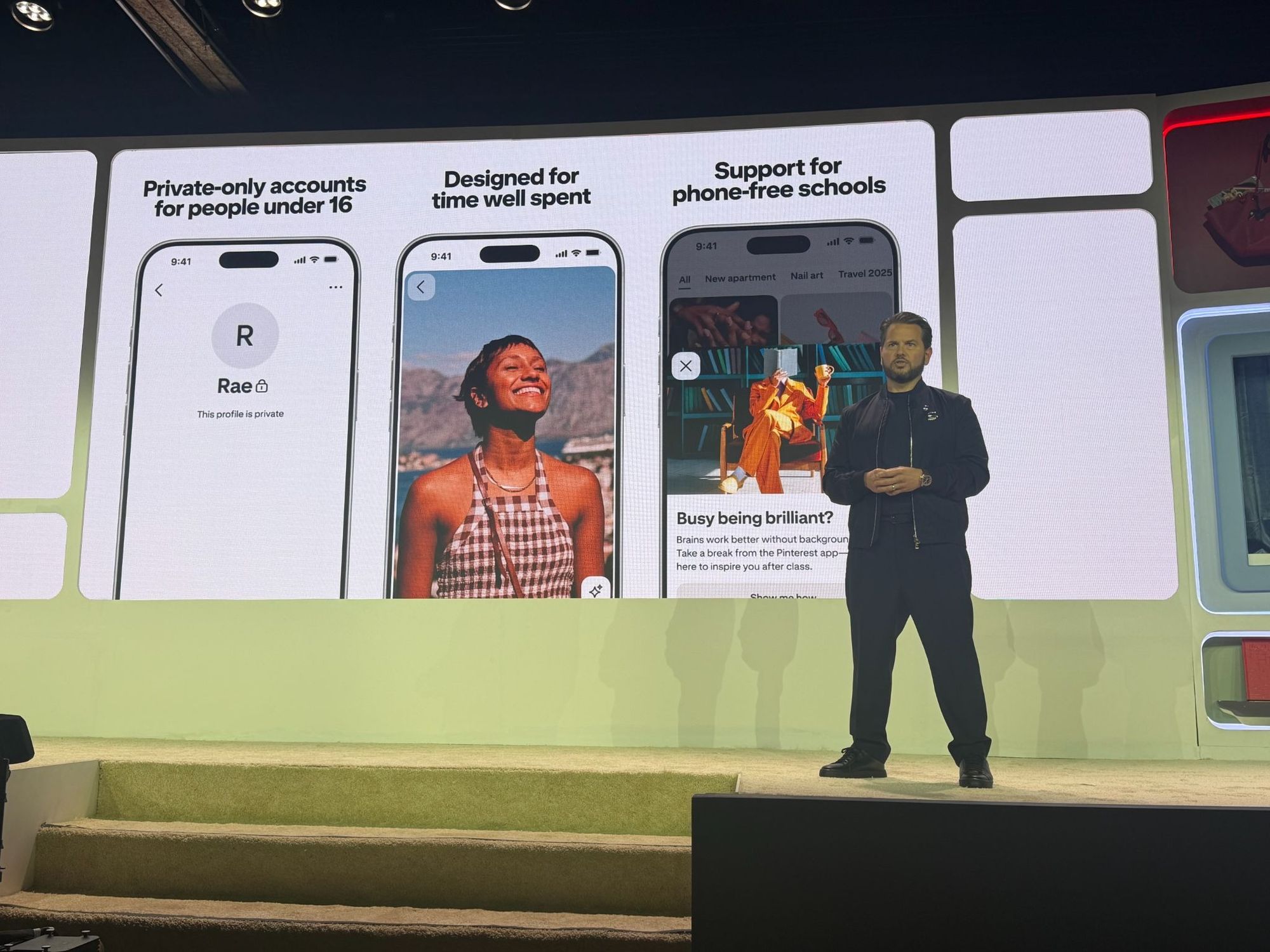
Pinterest’s answer is experience design: making accounts private for users under 16, pushing prompts that push students to close the app during the school day, and restricting people under 18 from certain AI features. Some of the discourse said these decisions would slow growth, especially among Gen Z. But Pinterest now reaches 640 million people each month, and this coveted cohort now makes up more than half of them.
This growth is arguably powered by the underlying narrative Pinterest has spent the last few years developing. Consumers are souring on attention hacking and are turning to the platform for tips on how to unplug, find a new hobby, or embrace the latest crafting trend. Consumers are taking control of their time, and they’re using the platform to live intentionally.
‘Intention’ is the New Metric
Marketing teams now face a clear tension with the return to analog. Consumers embracing “dumb tech,” tactile hobbies, and a return to nature is incredibly refreshing and, frankly, good for humankind. “Touching grass is awesome,” admitted Chief Marketing Officer Claudine Cheever. “But we’re also marketers, and we have numbers to hit.”
Her answer is to rethink how we measure success. Time spent and last-click attribution reward the brands that hold a shopper’s gaze longest or touched them last. But Cheever argued that the brands winning the next chapter will be the ones that “ignite intention” by meeting people while they’re actively deciding what to buy next.
Pinterest’s data illustrates the “high intent, high inspiration” use case. More than half of the platform’s roughly 80 billion monthly searches are commercial, and 96% are unbranded. Shoppers show up with a goal and an open mind, and that’s where brands can find value.
‘I Know It When I See It’
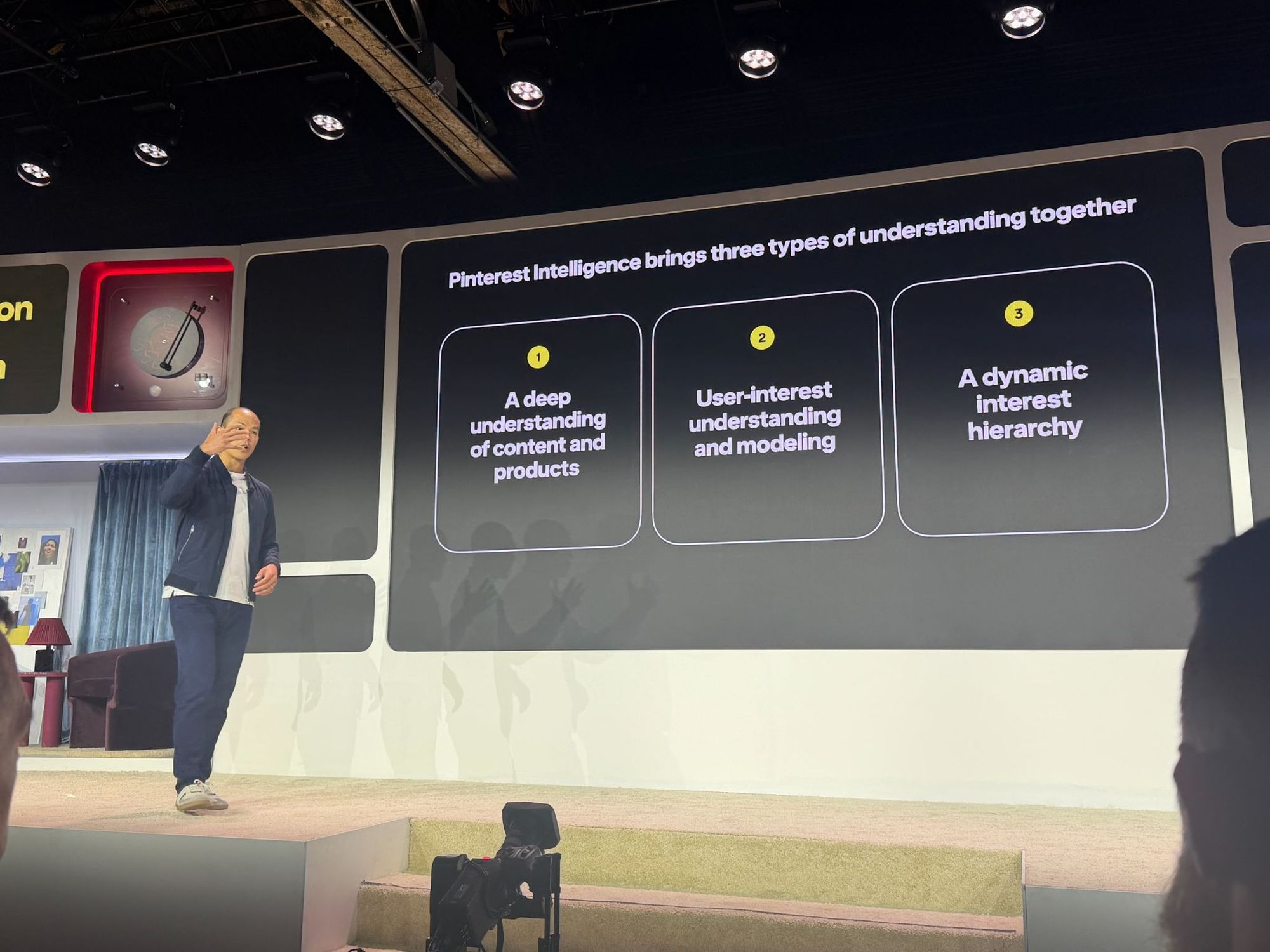
Pinterest’s version of AI is built around a very human problem that only it can solve. People often can’t describe what they want, “but they know it when they see it.” Chief Product and Technology Officer Matt Madrigal shared how this happens in real life using an anecdote about his daughter hunting for the perfect nail art for the family’s upcoming trip to Hawaii.
“She didn’t have a specific idea in mind, just more of a vibe,” he said. “Something that felt tropical and colorful, but nothing too obvious.”
The internet has made this abstract journey harder, because with more options and infinite tabs, there are infinite answers. Pinterest has spent more than a decade collecting those signals through boards users have created around their ideas, goals, and life moments. The engine behind it is Pinterest Intelligence, a mix of first-party data, recommendation systems, visual understanding, and purpose-built AI models. Much of the industry races toward agents that complete the purchase, but Madrigal described Pinterest’s version of agentic commerce as being rooted in discovery and natural adjacent extensions. Search for a fire pit, and Pinterest might surface grilling recipes because you’re probably planning a party. Madrigal called it “personalization through anticipation.”
This new psychology rewrites the creative brief to inspire discovery and provide little digital breadcrumbs that make someone stop and say, “That’s it.”
From 'What If?' to 'That’s It'
Pinterest’s latest consumer tools show how the platform is making this mission a reality and becoming the “taste engine” that so many shoppers now seek.
Pinterest Assistant
Pinterest Assistant is the conversational tool Pinterest first introduced in beta last fall. A new update brings AI to the foreground of the app to simplify complex, multi-turn shopping journeys. On stage, Global Ads Product Marketing Lead Jet Cessant restyled a vanity by referencing an aesthetic on one of his boards and uploading a photo reference. The final output was tweaked and refined using text-based language until Cessant found the perfect look.
“Because of how people search and save ideas here, Pinterest knows their taste already,” Cessant said. “It just gets them. So when a product shows up, it's the answer they've been looking for.”
This is where Ready’s argument gets tested. Pinterest is betting that an assistant grounded in images and personal taste will help people decide and then get on with their lives.
Restyle
Restyle is a new feature that lets people snap a photo of their space, reimagine it in a different style or aesthetic, and then shop the products that make their vision a reality. It launches in beta in the US and Canada in the coming weeks. For home and furniture brands, it collapses the gap between “Would this work in my living room?” and “How fast can we get it?”
Bring My Pinterest to Life, Season Two
Pinterest’s premium CTV series, which pairs Pinterest users with expert creators to turn their boards into real-life transformations, is returning to Roku in spring 2027. Season one sponsors earned more than 45 million added-value impressions, and all four title sponsor slots are already sold. This is a prime example of how Pinterest is tapping creators with real-life experience and expertise, which adds a level of taste and credibility to the platform’s partnerships. David Brinker, Global Head of Content at Pinterest, called this a competitive differentiator and a reason users don’t just go there for inspiration, but to validate purchases.
Capturing the Moment
These new consumer offerings connect authentically to the investments Pinterest has made to become a true performance platform. And according to Chloe Wix, VP of Go-to-Market, Pinterest is officially there. She unveiled the news through the lens of three strategic areas: performance, simplicity, and standout creative
Visual Search Ads
Visual Search Ads give brands a prominent placement in search results and Pin closeups, pairing keyword relevance with a compelling visual format that sends shoppers directly to a brand’s site. Ready said people are now “expressing themselves in much richer ways” than keywords allow. The format closes this gap while supporting lower-funnel objectives. Visual Search Ads enters beta for eligible advertisers in all Pinterest ad markets in the coming weeks, and because it works with Pinterest Performance+, it clearly signals how the platform is trying to redefine itself.
Pinterest Performance+
Advertisers can now steer the automation the powers Pinterest Performance+. Priority Products allows brands to raise bids on key product groups during launches and seasonal pushes while still promoting their full catalogs. A new customer acquisition setting lets advertisers assign more value to first-time buyers, and interest and keyword suggestions guide the algorithm toward more relevant audiences.
For the first time, A/B testing is also fully self-serve in Pinterest Ads Manager across all ad-eligible markets. Pinterest pointed to Australian fashion retailer Princess Polly, which saw a 21x increase in return on ad spend (ROAS) and a 70% lower cost per acquisition with Performance+.
App Promotion
App Promotion is a new format to support app installs, in-app actions, and customer re-engagement. New mobile measurement partners connect it to the systems brands already use. One advertiser saw up to an 85% improvement in cost per install compared with previous workarounds. App Promotion is now in global beta with qualified advertisers and slated for global availability by the end of 2026
Connected TV
Five months after acquiring tvScientific, Pinterest now lets brands run standalone connected TV campaigns designed for any outcome. Starting this month, advertisers can also add CTV to Spotlight buys for up to 75% greater potential reach.
Creative Formats
Performance+ Creative gains call-to-action and title optimization, plus Smart Assembly, which opens automated creative to advertisers without a product catalog. Collage ads bring one of Pinterest’s most popular native features into paid media, and Max Width collections are now available in all markets. Premier Spotlight category takeovers, now in testing in the U.S., give brands reserved placements for launches and major tentpole moments.
Business Assistant and Pinterest MCP
Business Assistant, the AI collaborator inside Ads Manager, is now in beta in multiple markets. For teams that live outside Ads Manager, Pinterest MCP is the secure translation layer between advertisers’ own AI tools and Pinterest’s data and campaigns. Pinterest said it’s building the integration with input from partners including Innovid and Pacvue.
Measuring the Middle
Cheever called Pinterest’s sweet spot, where consumers are curating, comparing, and putting things together, the “messy middle” of the funnel. Intention and context are notoriously hard to see through a last-click lens.
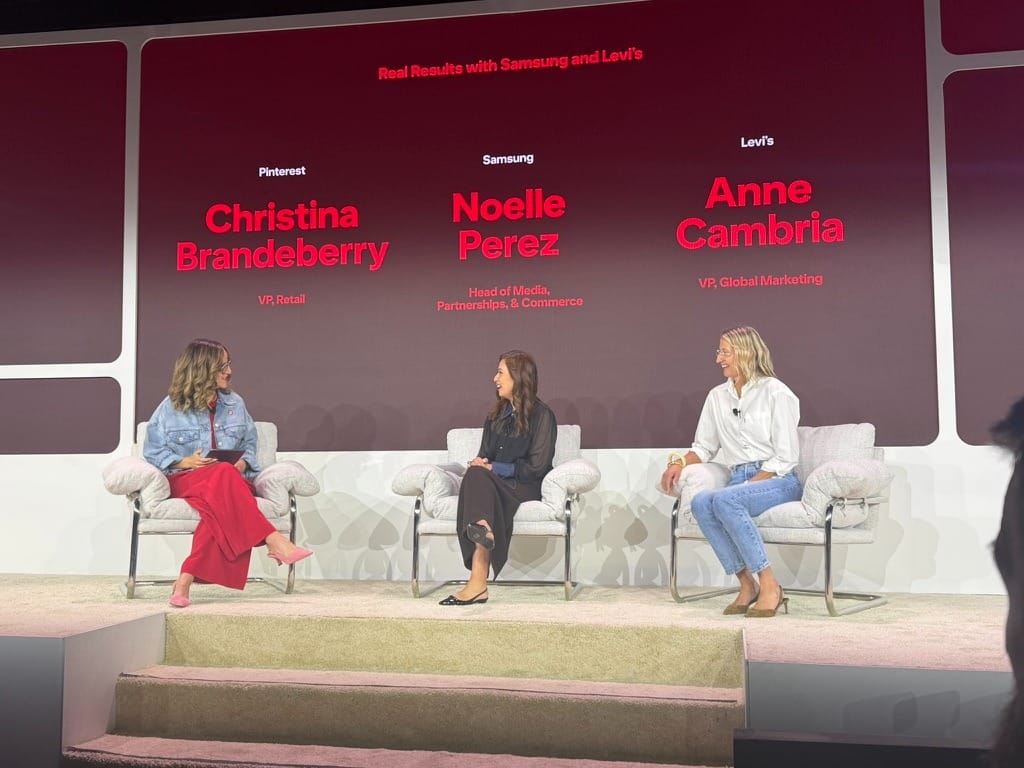
The retail partners on stage showed where that hidden value lives. Anne Cambria, VP of Global Marketing for Levi’s, said Pinterest search data revealed loose fits as the top denim style, with low-rise searches running three times higher than high-waisted. That insight inspired the brand’s fall campaign for its “Low Loose” style, which paired talent-driven awareness with a featured board built for consideration. According to Levi’s paid social marketing mix modeling, the Pinterest content outperformed its other paid social.
Samsung saw a similar effect. Its foldable phone campaign tied to Sony’s Spider-Man: Brand New Day, where the phones were organically placed in-scene more than 60 times. The associated campaign delivered more than five times the industry benchmark in mid-funnel performance. Noelle Perez, Head of U.S. Media & Partnerships at Samsung Electronics America, noted that culture-driven campaigns tend to emphasize the upper funnel. “But this is actually showing you that we’re driving people within the platform from upper-funnel awareness all the way down to mid- and lower-funnel,” she said
These examples reaffirm the power of Pinterest Performance+ and its advanced A/B testing tools. Brands can now test various formats and make more sense of that “messy middle.”
A Marketer’s Call to Action
Ready said the most important thing about AI is being intentional about what we ask it to do. Pinterest has become a business that grows when people log off. Now it needs advertisers to believe that disconnection can actually lead to meaningful results.
Bill Ready has always been very honest about what he thinks about social media.
From his first day as Pinterest’s CEO in 2022, Ready has boldly compared social media’s behavior-driven mechanics to the addiction that powers “Big Tobacco.” He has used it as a call to arms for marketers using these platforms to acquire customers, but also as a way to show how Pinterest differs from its competitors.
The narrative has worked well for years, largely because competing social platforms have continued to prioritize KPIs like “time in-app” and “total watch hours” over quality of users’ lives—especially their younger cohorts. In fact, he called social media’s war against teens “the largest social experiment in history.”
Earlier this week, Ready made that argument the foundation of Pinterest Presents, the company’s annual update for brands and advertising partners. It was the first time Pinterest staged the event for a live audience, and Future Commerce was in the room to unpack what Ready’s viewpoints mean in the age of AI, when advertisers’ value lies in driving advertising outcomes.
Same Play, Bigger Implications
With AI, social media platforms are running the same plays. They’re using the technology to drive engagement and conversions at all costs, and now, the tech can talk back and “pretend to be a friend,” making its influence far more significant.
Ready claimed that “the best thing you can find online is a reason to go offline.” This is the official tagline of Pinterest’s latest brand campaign, and it’s a narrative that the platform has used as it has popped up at cultural events over the past year. But Pinterest is selling AI, too.
On the same stage where Ready warned about the psychosocial impacts of AI, Pinterest unveiled a new version of Pinterest Assistant, its own conversational AI. Ready also declared Pinterest “a performance platform,” and performance platforms answer to advertisers and investors who reward growth. In its latest Q2 earnings results, Pinterest reported an 18% year-over-year revenue increase.
Pinterest’s answer is experience design: making accounts private for users under 16, pushing prompts that push students to close the app during the school day, and restricting people under 18 from certain AI features. Some of the discourse said these decisions would slow growth, especially among Gen Z. But Pinterest now reaches 640 million people each month, and this coveted cohort now makes up more than half of them.
This growth is arguably powered by the underlying narrative Pinterest has spent the last few years developing. Consumers are souring on attention hacking and are turning to the platform for tips on how to unplug, find a new hobby, or embrace the latest crafting trend. Consumers are taking control of their time, and they’re using the platform to live intentionally.
‘Intention’ is the New Metric
Marketing teams now face a clear tension with the return to analog. Consumers embracing “dumb tech,” tactile hobbies, and a return to nature is incredibly refreshing and, frankly, good for humankind. “Touching grass is awesome,” admitted Chief Marketing Officer Claudine Cheever. “But we’re also marketers, and we have numbers to hit.”
Her answer is to rethink how we measure success. Time spent and last-click attribution reward the brands that hold a shopper’s gaze longest or touched them last. But Cheever argued that the brands winning the next chapter will be the ones that “ignite intention” by meeting people while they’re actively deciding what to buy next.
Pinterest’s data illustrates the “high intent, high inspiration” use case. More than half of the platform’s roughly 80 billion monthly searches are commercial, and 96% are unbranded. Shoppers show up with a goal and an open mind, and that’s where brands can find value.
‘I Know It When I See It’
Pinterest’s version of AI is built around a very human problem that only it can solve. People often can’t describe what they want, “but they know it when they see it.” Chief Product and Technology Officer Matt Madrigal shared how this happens in real life using an anecdote about his daughter hunting for the perfect nail art for the family’s upcoming trip to Hawaii.
“She didn’t have a specific idea in mind, just more of a vibe,” he said. “Something that felt tropical and colorful, but nothing too obvious.”
The internet has made this abstract journey harder, because with more options and infinite tabs, there are infinite answers. Pinterest has spent more than a decade collecting those signals through boards users have created around their ideas, goals, and life moments. The engine behind it is Pinterest Intelligence, a mix of first-party data, recommendation systems, visual understanding, and purpose-built AI models. Much of the industry races toward agents that complete the purchase, but Madrigal described Pinterest’s version of agentic commerce as being rooted in discovery and natural adjacent extensions. Search for a fire pit, and Pinterest might surface grilling recipes because you’re probably planning a party. Madrigal called it “personalization through anticipation.”
This new psychology rewrites the creative brief to inspire discovery and provide little digital breadcrumbs that make someone stop and say, “That’s it.”
From 'What If?' to 'That’s It'
Pinterest’s latest consumer tools show how the platform is making this mission a reality and becoming the “taste engine” that so many shoppers now seek.
Pinterest Assistant
Pinterest Assistant is the conversational tool Pinterest first introduced in beta last fall. A new update brings AI to the foreground of the app to simplify complex, multi-turn shopping journeys. On stage, Global Ads Product Marketing Lead Jet Cessant restyled a vanity by referencing an aesthetic on one of his boards and uploading a photo reference. The final output was tweaked and refined using text-based language until Cessant found the perfect look.
“Because of how people search and save ideas here, Pinterest knows their taste already,” Cessant said. “It just gets them. So when a product shows up, it's the answer they've been looking for.”
This is where Ready’s argument gets tested. Pinterest is betting that an assistant grounded in images and personal taste will help people decide and then get on with their lives.
Restyle
Restyle is a new feature that lets people snap a photo of their space, reimagine it in a different style or aesthetic, and then shop the products that make their vision a reality. It launches in beta in the US and Canada in the coming weeks. For home and furniture brands, it collapses the gap between “Would this work in my living room?” and “How fast can we get it?”
Bring My Pinterest to Life, Season Two
Pinterest’s premium CTV series, which pairs Pinterest users with expert creators to turn their boards into real-life transformations, is returning to Roku in spring 2027. Season one sponsors earned more than 45 million added-value impressions, and all four title sponsor slots are already sold. This is a prime example of how Pinterest is tapping creators with real-life experience and expertise, which adds a level of taste and credibility to the platform’s partnerships. David Brinker, Global Head of Content at Pinterest, called this a competitive differentiator and a reason users don’t just go there for inspiration, but to validate purchases.
Capturing the Moment
These new consumer offerings connect authentically to the investments Pinterest has made to become a true performance platform. And according to Chloe Wix, VP of Go-to-Market, Pinterest is officially there. She unveiled the news through the lens of three strategic areas: performance, simplicity, and standout creative
Visual Search Ads
Visual Search Ads give brands a prominent placement in search results and Pin closeups, pairing keyword relevance with a compelling visual format that sends shoppers directly to a brand’s site. Ready said people are now “expressing themselves in much richer ways” than keywords allow. The format closes this gap while supporting lower-funnel objectives. Visual Search Ads enters beta for eligible advertisers in all Pinterest ad markets in the coming weeks, and because it works with Pinterest Performance+, it clearly signals how the platform is trying to redefine itself.
Pinterest Performance+
Advertisers can now steer the automation the powers Pinterest Performance+. Priority Products allows brands to raise bids on key product groups during launches and seasonal pushes while still promoting their full catalogs. A new customer acquisition setting lets advertisers assign more value to first-time buyers, and interest and keyword suggestions guide the algorithm toward more relevant audiences.
For the first time, A/B testing is also fully self-serve in Pinterest Ads Manager across all ad-eligible markets. Pinterest pointed to Australian fashion retailer Princess Polly, which saw a 21x increase in return on ad spend (ROAS) and a 70% lower cost per acquisition with Performance+.
App Promotion
App Promotion is a new format to support app installs, in-app actions, and customer re-engagement. New mobile measurement partners connect it to the systems brands already use. One advertiser saw up to an 85% improvement in cost per install compared with previous workarounds. App Promotion is now in global beta with qualified advertisers and slated for global availability by the end of 2026
Connected TV
Five months after acquiring tvScientific, Pinterest now lets brands run standalone connected TV campaigns designed for any outcome. Starting this month, advertisers can also add CTV to Spotlight buys for up to 75% greater potential reach.
Creative Formats
Performance+ Creative gains call-to-action and title optimization, plus Smart Assembly, which opens automated creative to advertisers without a product catalog. Collage ads bring one of Pinterest’s most popular native features into paid media, and Max Width collections are now available in all markets. Premier Spotlight category takeovers, now in testing in the U.S., give brands reserved placements for launches and major tentpole moments.
Business Assistant and Pinterest MCP
Business Assistant, the AI collaborator inside Ads Manager, is now in beta in multiple markets. For teams that live outside Ads Manager, Pinterest MCP is the secure translation layer between advertisers’ own AI tools and Pinterest’s data and campaigns. Pinterest said it’s building the integration with input from partners including Innovid and Pacvue.
Measuring the Middle
Cheever called Pinterest’s sweet spot, where consumers are curating, comparing, and putting things together, the “messy middle” of the funnel. Intention and context are notoriously hard to see through a last-click lens.
The retail partners on stage showed where that hidden value lives. Anne Cambria, VP of Global Marketing for Levi’s, said Pinterest search data revealed loose fits as the top denim style, with low-rise searches running three times higher than high-waisted. That insight inspired the brand’s fall campaign for its “Low Loose” style, which paired talent-driven awareness with a featured board built for consideration. According to Levi’s paid social marketing mix modeling, the Pinterest content outperformed its other paid social.
Samsung saw a similar effect. Its foldable phone campaign tied to Sony’s Spider-Man: Brand New Day, where the phones were organically placed in-scene more than 60 times. The associated campaign delivered more than five times the industry benchmark in mid-funnel performance. Noelle Perez, Head of U.S. Media & Partnerships at Samsung Electronics America, noted that culture-driven campaigns tend to emphasize the upper funnel. “But this is actually showing you that we’re driving people within the platform from upper-funnel awareness all the way down to mid- and lower-funnel,” she said
These examples reaffirm the power of Pinterest Performance+ and its advanced A/B testing tools. Brands can now test various formats and make more sense of that “messy middle.”
A Marketer’s Call to Action
Ready said the most important thing about AI is being intentional about what we ask it to do. Pinterest has become a business that grows when people log off. Now it needs advertisers to believe that disconnection can actually lead to meaningful results.
Bill Ready has always been very honest about what he thinks about social media.
From his first day as Pinterest’s CEO in 2022, Ready has boldly compared social media’s behavior-driven mechanics to the addiction that powers “Big Tobacco.” He has used it as a call to arms for marketers using these platforms to acquire customers, but also as a way to show how Pinterest differs from its competitors.
The narrative has worked well for years, largely because competing social platforms have continued to prioritize KPIs like “time in-app” and “total watch hours” over quality of users’ lives—especially their younger cohorts. In fact, he called social media’s war against teens “the largest social experiment in history.”
Earlier this week, Ready made that argument the foundation of Pinterest Presents, the company’s annual update for brands and advertising partners. It was the first time Pinterest staged the event for a live audience, and Future Commerce was in the room to unpack what Ready’s viewpoints mean in the age of AI, when advertisers’ value lies in driving advertising outcomes.
Same Play, Bigger Implications
With AI, social media platforms are running the same plays. They’re using the technology to drive engagement and conversions at all costs, and now, the tech can talk back and “pretend to be a friend,” making its influence far more significant.
Ready claimed that “the best thing you can find online is a reason to go offline.” This is the official tagline of Pinterest’s latest brand campaign, and it’s a narrative that the platform has used as it has popped up at cultural events over the past year. But Pinterest is selling AI, too.
On the same stage where Ready warned about the psychosocial impacts of AI, Pinterest unveiled a new version of Pinterest Assistant, its own conversational AI. Ready also declared Pinterest “a performance platform,” and performance platforms answer to advertisers and investors who reward growth. In its latest Q2 earnings results, Pinterest reported an 18% year-over-year revenue increase.
Pinterest’s answer is experience design: making accounts private for users under 16, pushing prompts that push students to close the app during the school day, and restricting people under 18 from certain AI features. Some of the discourse said these decisions would slow growth, especially among Gen Z. But Pinterest now reaches 640 million people each month, and this coveted cohort now makes up more than half of them.
This growth is arguably powered by the underlying narrative Pinterest has spent the last few years developing. Consumers are souring on attention hacking and are turning to the platform for tips on how to unplug, find a new hobby, or embrace the latest crafting trend. Consumers are taking control of their time, and they’re using the platform to live intentionally.
‘Intention’ is the New Metric
Marketing teams now face a clear tension with the return to analog. Consumers embracing “dumb tech,” tactile hobbies, and a return to nature is incredibly refreshing and, frankly, good for humankind. “Touching grass is awesome,” admitted Chief Marketing Officer Claudine Cheever. “But we’re also marketers, and we have numbers to hit.”
Her answer is to rethink how we measure success. Time spent and last-click attribution reward the brands that hold a shopper’s gaze longest or touched them last. But Cheever argued that the brands winning the next chapter will be the ones that “ignite intention” by meeting people while they’re actively deciding what to buy next.
Pinterest’s data illustrates the “high intent, high inspiration” use case. More than half of the platform’s roughly 80 billion monthly searches are commercial, and 96% are unbranded. Shoppers show up with a goal and an open mind, and that’s where brands can find value.
‘I Know It When I See It’
Pinterest’s version of AI is built around a very human problem that only it can solve. People often can’t describe what they want, “but they know it when they see it.” Chief Product and Technology Officer Matt Madrigal shared how this happens in real life using an anecdote about his daughter hunting for the perfect nail art for the family’s upcoming trip to Hawaii.
“She didn’t have a specific idea in mind, just more of a vibe,” he said. “Something that felt tropical and colorful, but nothing too obvious.”
The internet has made this abstract journey harder, because with more options and infinite tabs, there are infinite answers. Pinterest has spent more than a decade collecting those signals through boards users have created around their ideas, goals, and life moments. The engine behind it is Pinterest Intelligence, a mix of first-party data, recommendation systems, visual understanding, and purpose-built AI models. Much of the industry races toward agents that complete the purchase, but Madrigal described Pinterest’s version of agentic commerce as being rooted in discovery and natural adjacent extensions. Search for a fire pit, and Pinterest might surface grilling recipes because you’re probably planning a party. Madrigal called it “personalization through anticipation.”
This new psychology rewrites the creative brief to inspire discovery and provide little digital breadcrumbs that make someone stop and say, “That’s it.”
From 'What If?' to 'That’s It'
Pinterest’s latest consumer tools show how the platform is making this mission a reality and becoming the “taste engine” that so many shoppers now seek.
Pinterest Assistant
Pinterest Assistant is the conversational tool Pinterest first introduced in beta last fall. A new update brings AI to the foreground of the app to simplify complex, multi-turn shopping journeys. On stage, Global Ads Product Marketing Lead Jet Cessant restyled a vanity by referencing an aesthetic on one of his boards and uploading a photo reference. The final output was tweaked and refined using text-based language until Cessant found the perfect look.
“Because of how people search and save ideas here, Pinterest knows their taste already,” Cessant said. “It just gets them. So when a product shows up, it's the answer they've been looking for.”
This is where Ready’s argument gets tested. Pinterest is betting that an assistant grounded in images and personal taste will help people decide and then get on with their lives.
Restyle
Restyle is a new feature that lets people snap a photo of their space, reimagine it in a different style or aesthetic, and then shop the products that make their vision a reality. It launches in beta in the US and Canada in the coming weeks. For home and furniture brands, it collapses the gap between “Would this work in my living room?” and “How fast can we get it?”
Bring My Pinterest to Life, Season Two
Pinterest’s premium CTV series, which pairs Pinterest users with expert creators to turn their boards into real-life transformations, is returning to Roku in spring 2027. Season one sponsors earned more than 45 million added-value impressions, and all four title sponsor slots are already sold. This is a prime example of how Pinterest is tapping creators with real-life experience and expertise, which adds a level of taste and credibility to the platform’s partnerships. David Brinker, Global Head of Content at Pinterest, called this a competitive differentiator and a reason users don’t just go there for inspiration, but to validate purchases.
Capturing the Moment
These new consumer offerings connect authentically to the investments Pinterest has made to become a true performance platform. And according to Chloe Wix, VP of Go-to-Market, Pinterest is officially there. She unveiled the news through the lens of three strategic areas: performance, simplicity, and standout creative
Visual Search Ads
Visual Search Ads give brands a prominent placement in search results and Pin closeups, pairing keyword relevance with a compelling visual format that sends shoppers directly to a brand’s site. Ready said people are now “expressing themselves in much richer ways” than keywords allow. The format closes this gap while supporting lower-funnel objectives. Visual Search Ads enters beta for eligible advertisers in all Pinterest ad markets in the coming weeks, and because it works with Pinterest Performance+, it clearly signals how the platform is trying to redefine itself.
Pinterest Performance+
Advertisers can now steer the automation the powers Pinterest Performance+. Priority Products allows brands to raise bids on key product groups during launches and seasonal pushes while still promoting their full catalogs. A new customer acquisition setting lets advertisers assign more value to first-time buyers, and interest and keyword suggestions guide the algorithm toward more relevant audiences.
For the first time, A/B testing is also fully self-serve in Pinterest Ads Manager across all ad-eligible markets. Pinterest pointed to Australian fashion retailer Princess Polly, which saw a 21x increase in return on ad spend (ROAS) and a 70% lower cost per acquisition with Performance+.
App Promotion
App Promotion is a new format to support app installs, in-app actions, and customer re-engagement. New mobile measurement partners connect it to the systems brands already use. One advertiser saw up to an 85% improvement in cost per install compared with previous workarounds. App Promotion is now in global beta with qualified advertisers and slated for global availability by the end of 2026
Connected TV
Five months after acquiring tvScientific, Pinterest now lets brands run standalone connected TV campaigns designed for any outcome. Starting this month, advertisers can also add CTV to Spotlight buys for up to 75% greater potential reach.
Creative Formats
Performance+ Creative gains call-to-action and title optimization, plus Smart Assembly, which opens automated creative to advertisers without a product catalog. Collage ads bring one of Pinterest’s most popular native features into paid media, and Max Width collections are now available in all markets. Premier Spotlight category takeovers, now in testing in the U.S., give brands reserved placements for launches and major tentpole moments.
Business Assistant and Pinterest MCP
Business Assistant, the AI collaborator inside Ads Manager, is now in beta in multiple markets. For teams that live outside Ads Manager, Pinterest MCP is the secure translation layer between advertisers’ own AI tools and Pinterest’s data and campaigns. Pinterest said it’s building the integration with input from partners including Innovid and Pacvue.
Measuring the Middle
Cheever called Pinterest’s sweet spot, where consumers are curating, comparing, and putting things together, the “messy middle” of the funnel. Intention and context are notoriously hard to see through a last-click lens.
The retail partners on stage showed where that hidden value lives. Anne Cambria, VP of Global Marketing for Levi’s, said Pinterest search data revealed loose fits as the top denim style, with low-rise searches running three times higher than high-waisted. That insight inspired the brand’s fall campaign for its “Low Loose” style, which paired talent-driven awareness with a featured board built for consideration. According to Levi’s paid social marketing mix modeling, the Pinterest content outperformed its other paid social.
Samsung saw a similar effect. Its foldable phone campaign tied to Sony’s Spider-Man: Brand New Day, where the phones were organically placed in-scene more than 60 times. The associated campaign delivered more than five times the industry benchmark in mid-funnel performance. Noelle Perez, Head of U.S. Media & Partnerships at Samsung Electronics America, noted that culture-driven campaigns tend to emphasize the upper funnel. “But this is actually showing you that we’re driving people within the platform from upper-funnel awareness all the way down to mid- and lower-funnel,” she said
These examples reaffirm the power of Pinterest Performance+ and its advanced A/B testing tools. Brands can now test various formats and make more sense of that “messy middle.”
A Marketer’s Call to Action
Ready said the most important thing about AI is being intentional about what we ask it to do. Pinterest has become a business that grows when people log off. Now it needs advertisers to believe that disconnection can actually lead to meaningful results.
Bill Ready has always been very honest about what he thinks about social media.
From his first day as Pinterest’s CEO in 2022, Ready has boldly compared social media’s behavior-driven mechanics to the addiction that powers “Big Tobacco.” He has used it as a call to arms for marketers using these platforms to acquire customers, but also as a way to show how Pinterest differs from its competitors.
The narrative has worked well for years, largely because competing social platforms have continued to prioritize KPIs like “time in-app” and “total watch hours” over quality of users’ lives—especially their younger cohorts. In fact, he called social media’s war against teens “the largest social experiment in history.”
Earlier this week, Ready made that argument the foundation of Pinterest Presents, the company’s annual update for brands and advertising partners. It was the first time Pinterest staged the event for a live audience, and Future Commerce was in the room to unpack what Ready’s viewpoints mean in the age of AI, when advertisers’ value lies in driving advertising outcomes.
Same Play, Bigger Implications
With AI, social media platforms are running the same plays. They’re using the technology to drive engagement and conversions at all costs, and now, the tech can talk back and “pretend to be a friend,” making its influence far more significant.
Ready claimed that “the best thing you can find online is a reason to go offline.” This is the official tagline of Pinterest’s latest brand campaign, and it’s a narrative that the platform has used as it has popped up at cultural events over the past year. But Pinterest is selling AI, too.
On the same stage where Ready warned about the psychosocial impacts of AI, Pinterest unveiled a new version of Pinterest Assistant, its own conversational AI. Ready also declared Pinterest “a performance platform,” and performance platforms answer to advertisers and investors who reward growth. In its latest Q2 earnings results, Pinterest reported an 18% year-over-year revenue increase.
Pinterest’s answer is experience design: making accounts private for users under 16, pushing prompts that push students to close the app during the school day, and restricting people under 18 from certain AI features. Some of the discourse said these decisions would slow growth, especially among Gen Z. But Pinterest now reaches 640 million people each month, and this coveted cohort now makes up more than half of them.
This growth is arguably powered by the underlying narrative Pinterest has spent the last few years developing. Consumers are souring on attention hacking and are turning to the platform for tips on how to unplug, find a new hobby, or embrace the latest crafting trend. Consumers are taking control of their time, and they’re using the platform to live intentionally.
‘Intention’ is the New Metric
Marketing teams now face a clear tension with the return to analog. Consumers embracing “dumb tech,” tactile hobbies, and a return to nature is incredibly refreshing and, frankly, good for humankind. “Touching grass is awesome,” admitted Chief Marketing Officer Claudine Cheever. “But we’re also marketers, and we have numbers to hit.”
Her answer is to rethink how we measure success. Time spent and last-click attribution reward the brands that hold a shopper’s gaze longest or touched them last. But Cheever argued that the brands winning the next chapter will be the ones that “ignite intention” by meeting people while they’re actively deciding what to buy next.
Pinterest’s data illustrates the “high intent, high inspiration” use case. More than half of the platform’s roughly 80 billion monthly searches are commercial, and 96% are unbranded. Shoppers show up with a goal and an open mind, and that’s where brands can find value.
‘I Know It When I See It’
Pinterest’s version of AI is built around a very human problem that only it can solve. People often can’t describe what they want, “but they know it when they see it.” Chief Product and Technology Officer Matt Madrigal shared how this happens in real life using an anecdote about his daughter hunting for the perfect nail art for the family’s upcoming trip to Hawaii.
“She didn’t have a specific idea in mind, just more of a vibe,” he said. “Something that felt tropical and colorful, but nothing too obvious.”
The internet has made this abstract journey harder, because with more options and infinite tabs, there are infinite answers. Pinterest has spent more than a decade collecting those signals through boards users have created around their ideas, goals, and life moments. The engine behind it is Pinterest Intelligence, a mix of first-party data, recommendation systems, visual understanding, and purpose-built AI models. Much of the industry races toward agents that complete the purchase, but Madrigal described Pinterest’s version of agentic commerce as being rooted in discovery and natural adjacent extensions. Search for a fire pit, and Pinterest might surface grilling recipes because you’re probably planning a party. Madrigal called it “personalization through anticipation.”
This new psychology rewrites the creative brief to inspire discovery and provide little digital breadcrumbs that make someone stop and say, “That’s it.”
From 'What If?' to 'That’s It'
Pinterest’s latest consumer tools show how the platform is making this mission a reality and becoming the “taste engine” that so many shoppers now seek.
Pinterest Assistant
Pinterest Assistant is the conversational tool Pinterest first introduced in beta last fall. A new update brings AI to the foreground of the app to simplify complex, multi-turn shopping journeys. On stage, Global Ads Product Marketing Lead Jet Cessant restyled a vanity by referencing an aesthetic on one of his boards and uploading a photo reference. The final output was tweaked and refined using text-based language until Cessant found the perfect look.
“Because of how people search and save ideas here, Pinterest knows their taste already,” Cessant said. “It just gets them. So when a product shows up, it's the answer they've been looking for.”
This is where Ready’s argument gets tested. Pinterest is betting that an assistant grounded in images and personal taste will help people decide and then get on with their lives.
Restyle
Restyle is a new feature that lets people snap a photo of their space, reimagine it in a different style or aesthetic, and then shop the products that make their vision a reality. It launches in beta in the US and Canada in the coming weeks. For home and furniture brands, it collapses the gap between “Would this work in my living room?” and “How fast can we get it?”
Bring My Pinterest to Life, Season Two
Pinterest’s premium CTV series, which pairs Pinterest users with expert creators to turn their boards into real-life transformations, is returning to Roku in spring 2027. Season one sponsors earned more than 45 million added-value impressions, and all four title sponsor slots are already sold. This is a prime example of how Pinterest is tapping creators with real-life experience and expertise, which adds a level of taste and credibility to the platform’s partnerships. David Brinker, Global Head of Content at Pinterest, called this a competitive differentiator and a reason users don’t just go there for inspiration, but to validate purchases.
Capturing the Moment
These new consumer offerings connect authentically to the investments Pinterest has made to become a true performance platform. And according to Chloe Wix, VP of Go-to-Market, Pinterest is officially there. She unveiled the news through the lens of three strategic areas: performance, simplicity, and standout creative
Visual Search Ads
Visual Search Ads give brands a prominent placement in search results and Pin closeups, pairing keyword relevance with a compelling visual format that sends shoppers directly to a brand’s site. Ready said people are now “expressing themselves in much richer ways” than keywords allow. The format closes this gap while supporting lower-funnel objectives. Visual Search Ads enters beta for eligible advertisers in all Pinterest ad markets in the coming weeks, and because it works with Pinterest Performance+, it clearly signals how the platform is trying to redefine itself.
Pinterest Performance+
Advertisers can now steer the automation the powers Pinterest Performance+. Priority Products allows brands to raise bids on key product groups during launches and seasonal pushes while still promoting their full catalogs. A new customer acquisition setting lets advertisers assign more value to first-time buyers, and interest and keyword suggestions guide the algorithm toward more relevant audiences.
For the first time, A/B testing is also fully self-serve in Pinterest Ads Manager across all ad-eligible markets. Pinterest pointed to Australian fashion retailer Princess Polly, which saw a 21x increase in return on ad spend (ROAS) and a 70% lower cost per acquisition with Performance+.
App Promotion
App Promotion is a new format to support app installs, in-app actions, and customer re-engagement. New mobile measurement partners connect it to the systems brands already use. One advertiser saw up to an 85% improvement in cost per install compared with previous workarounds. App Promotion is now in global beta with qualified advertisers and slated for global availability by the end of 2026
Connected TV
Five months after acquiring tvScientific, Pinterest now lets brands run standalone connected TV campaigns designed for any outcome. Starting this month, advertisers can also add CTV to Spotlight buys for up to 75% greater potential reach.
Creative Formats
Performance+ Creative gains call-to-action and title optimization, plus Smart Assembly, which opens automated creative to advertisers without a product catalog. Collage ads bring one of Pinterest’s most popular native features into paid media, and Max Width collections are now available in all markets. Premier Spotlight category takeovers, now in testing in the U.S., give brands reserved placements for launches and major tentpole moments.
Business Assistant and Pinterest MCP
Business Assistant, the AI collaborator inside Ads Manager, is now in beta in multiple markets. For teams that live outside Ads Manager, Pinterest MCP is the secure translation layer between advertisers’ own AI tools and Pinterest’s data and campaigns. Pinterest said it’s building the integration with input from partners including Innovid and Pacvue.
Measuring the Middle
Cheever called Pinterest’s sweet spot, where consumers are curating, comparing, and putting things together, the “messy middle” of the funnel. Intention and context are notoriously hard to see through a last-click lens.
The retail partners on stage showed where that hidden value lives. Anne Cambria, VP of Global Marketing for Levi’s, said Pinterest search data revealed loose fits as the top denim style, with low-rise searches running three times higher than high-waisted. That insight inspired the brand’s fall campaign for its “Low Loose” style, which paired talent-driven awareness with a featured board built for consideration. According to Levi’s paid social marketing mix modeling, the Pinterest content outperformed its other paid social.
Samsung saw a similar effect. Its foldable phone campaign tied to Sony’s Spider-Man: Brand New Day, where the phones were organically placed in-scene more than 60 times. The associated campaign delivered more than five times the industry benchmark in mid-funnel performance. Noelle Perez, Head of U.S. Media & Partnerships at Samsung Electronics America, noted that culture-driven campaigns tend to emphasize the upper funnel. “But this is actually showing you that we’re driving people within the platform from upper-funnel awareness all the way down to mid- and lower-funnel,” she said
These examples reaffirm the power of Pinterest Performance+ and its advanced A/B testing tools. Brands can now test various formats and make more sense of that “messy middle.”
A Marketer’s Call to Action
Ready said the most important thing about AI is being intentional about what we ask it to do. Pinterest has become a business that grows when people log off. Now it needs advertisers to believe that disconnection can actually lead to meaningful results.
Bill Ready has always been very honest about what he thinks about social media.
From his first day as Pinterest’s CEO in 2022, Ready has boldly compared social media’s behavior-driven mechanics to the addiction that powers “Big Tobacco.” He has used it as a call to arms for marketers using these platforms to acquire customers, but also as a way to show how Pinterest differs from its competitors.
The narrative has worked well for years, largely because competing social platforms have continued to prioritize KPIs like “time in-app” and “total watch hours” over quality of users’ lives—especially their younger cohorts. In fact, he called social media’s war against teens “the largest social experiment in history.”
Earlier this week, Ready made that argument the foundation of Pinterest Presents, the company’s annual update for brands and advertising partners. It was the first time Pinterest staged the event for a live audience, and Future Commerce was in the room to unpack what Ready’s viewpoints mean in the age of AI, when advertisers’ value lies in driving advertising outcomes.
Same Play, Bigger Implications
With AI, social media platforms are running the same plays. They’re using the technology to drive engagement and conversions at all costs, and now, the tech can talk back and “pretend to be a friend,” making its influence far more significant.
Ready claimed that “the best thing you can find online is a reason to go offline.” This is the official tagline of Pinterest’s latest brand campaign, and it’s a narrative that the platform has used as it has popped up at cultural events over the past year. But Pinterest is selling AI, too.
On the same stage where Ready warned about the psychosocial impacts of AI, Pinterest unveiled a new version of Pinterest Assistant, its own conversational AI. Ready also declared Pinterest “a performance platform,” and performance platforms answer to advertisers and investors who reward growth. In its latest Q2 earnings results, Pinterest reported an 18% year-over-year revenue increase.
Pinterest’s answer is experience design: making accounts private for users under 16, pushing prompts that push students to close the app during the school day, and restricting people under 18 from certain AI features. Some of the discourse said these decisions would slow growth, especially among Gen Z. But Pinterest now reaches 640 million people each month, and this coveted cohort now makes up more than half of them.
This growth is arguably powered by the underlying narrative Pinterest has spent the last few years developing. Consumers are souring on attention hacking and are turning to the platform for tips on how to unplug, find a new hobby, or embrace the latest crafting trend. Consumers are taking control of their time, and they’re using the platform to live intentionally.
‘Intention’ is the New Metric
Marketing teams now face a clear tension with the return to analog. Consumers embracing “dumb tech,” tactile hobbies, and a return to nature is incredibly refreshing and, frankly, good for humankind. “Touching grass is awesome,” admitted Chief Marketing Officer Claudine Cheever. “But we’re also marketers, and we have numbers to hit.”
Her answer is to rethink how we measure success. Time spent and last-click attribution reward the brands that hold a shopper’s gaze longest or touched them last. But Cheever argued that the brands winning the next chapter will be the ones that “ignite intention” by meeting people while they’re actively deciding what to buy next.
Pinterest’s data illustrates the “high intent, high inspiration” use case. More than half of the platform’s roughly 80 billion monthly searches are commercial, and 96% are unbranded. Shoppers show up with a goal and an open mind, and that’s where brands can find value.
‘I Know It When I See It’
Pinterest’s version of AI is built around a very human problem that only it can solve. People often can’t describe what they want, “but they know it when they see it.” Chief Product and Technology Officer Matt Madrigal shared how this happens in real life using an anecdote about his daughter hunting for the perfect nail art for the family’s upcoming trip to Hawaii.
“She didn’t have a specific idea in mind, just more of a vibe,” he said. “Something that felt tropical and colorful, but nothing too obvious.”
The internet has made this abstract journey harder, because with more options and infinite tabs, there are infinite answers. Pinterest has spent more than a decade collecting those signals through boards users have created around their ideas, goals, and life moments. The engine behind it is Pinterest Intelligence, a mix of first-party data, recommendation systems, visual understanding, and purpose-built AI models. Much of the industry races toward agents that complete the purchase, but Madrigal described Pinterest’s version of agentic commerce as being rooted in discovery and natural adjacent extensions. Search for a fire pit, and Pinterest might surface grilling recipes because you’re probably planning a party. Madrigal called it “personalization through anticipation.”
This new psychology rewrites the creative brief to inspire discovery and provide little digital breadcrumbs that make someone stop and say, “That’s it.”
From 'What If?' to 'That’s It'
Pinterest’s latest consumer tools show how the platform is making this mission a reality and becoming the “taste engine” that so many shoppers now seek.
Pinterest Assistant
Pinterest Assistant is the conversational tool Pinterest first introduced in beta last fall. A new update brings AI to the foreground of the app to simplify complex, multi-turn shopping journeys. On stage, Global Ads Product Marketing Lead Jet Cessant restyled a vanity by referencing an aesthetic on one of his boards and uploading a photo reference. The final output was tweaked and refined using text-based language until Cessant found the perfect look.
“Because of how people search and save ideas here, Pinterest knows their taste already,” Cessant said. “It just gets them. So when a product shows up, it's the answer they've been looking for.”
This is where Ready’s argument gets tested. Pinterest is betting that an assistant grounded in images and personal taste will help people decide and then get on with their lives.
Restyle
Restyle is a new feature that lets people snap a photo of their space, reimagine it in a different style or aesthetic, and then shop the products that make their vision a reality. It launches in beta in the US and Canada in the coming weeks. For home and furniture brands, it collapses the gap between “Would this work in my living room?” and “How fast can we get it?”
Bring My Pinterest to Life, Season Two
Pinterest’s premium CTV series, which pairs Pinterest users with expert creators to turn their boards into real-life transformations, is returning to Roku in spring 2027. Season one sponsors earned more than 45 million added-value impressions, and all four title sponsor slots are already sold. This is a prime example of how Pinterest is tapping creators with real-life experience and expertise, which adds a level of taste and credibility to the platform’s partnerships. David Brinker, Global Head of Content at Pinterest, called this a competitive differentiator and a reason users don’t just go there for inspiration, but to validate purchases.
Capturing the Moment
These new consumer offerings connect authentically to the investments Pinterest has made to become a true performance platform. And according to Chloe Wix, VP of Go-to-Market, Pinterest is officially there. She unveiled the news through the lens of three strategic areas: performance, simplicity, and standout creative
Visual Search Ads
Visual Search Ads give brands a prominent placement in search results and Pin closeups, pairing keyword relevance with a compelling visual format that sends shoppers directly to a brand’s site. Ready said people are now “expressing themselves in much richer ways” than keywords allow. The format closes this gap while supporting lower-funnel objectives. Visual Search Ads enters beta for eligible advertisers in all Pinterest ad markets in the coming weeks, and because it works with Pinterest Performance+, it clearly signals how the platform is trying to redefine itself.
Pinterest Performance+
Advertisers can now steer the automation the powers Pinterest Performance+. Priority Products allows brands to raise bids on key product groups during launches and seasonal pushes while still promoting their full catalogs. A new customer acquisition setting lets advertisers assign more value to first-time buyers, and interest and keyword suggestions guide the algorithm toward more relevant audiences.
For the first time, A/B testing is also fully self-serve in Pinterest Ads Manager across all ad-eligible markets. Pinterest pointed to Australian fashion retailer Princess Polly, which saw a 21x increase in return on ad spend (ROAS) and a 70% lower cost per acquisition with Performance+.
App Promotion
App Promotion is a new format to support app installs, in-app actions, and customer re-engagement. New mobile measurement partners connect it to the systems brands already use. One advertiser saw up to an 85% improvement in cost per install compared with previous workarounds. App Promotion is now in global beta with qualified advertisers and slated for global availability by the end of 2026
Connected TV
Five months after acquiring tvScientific, Pinterest now lets brands run standalone connected TV campaigns designed for any outcome. Starting this month, advertisers can also add CTV to Spotlight buys for up to 75% greater potential reach.
Creative Formats
Performance+ Creative gains call-to-action and title optimization, plus Smart Assembly, which opens automated creative to advertisers without a product catalog. Collage ads bring one of Pinterest’s most popular native features into paid media, and Max Width collections are now available in all markets. Premier Spotlight category takeovers, now in testing in the U.S., give brands reserved placements for launches and major tentpole moments.
Business Assistant and Pinterest MCP
Business Assistant, the AI collaborator inside Ads Manager, is now in beta in multiple markets. For teams that live outside Ads Manager, Pinterest MCP is the secure translation layer between advertisers’ own AI tools and Pinterest’s data and campaigns. Pinterest said it’s building the integration with input from partners including Innovid and Pacvue.
Measuring the Middle
Cheever called Pinterest’s sweet spot, where consumers are curating, comparing, and putting things together, the “messy middle” of the funnel. Intention and context are notoriously hard to see through a last-click lens.
The retail partners on stage showed where that hidden value lives. Anne Cambria, VP of Global Marketing for Levi’s, said Pinterest search data revealed loose fits as the top denim style, with low-rise searches running three times higher than high-waisted. That insight inspired the brand’s fall campaign for its “Low Loose” style, which paired talent-driven awareness with a featured board built for consideration. According to Levi’s paid social marketing mix modeling, the Pinterest content outperformed its other paid social.
Samsung saw a similar effect. Its foldable phone campaign tied to Sony’s Spider-Man: Brand New Day, where the phones were organically placed in-scene more than 60 times. The associated campaign delivered more than five times the industry benchmark in mid-funnel performance. Noelle Perez, Head of U.S. Media & Partnerships at Samsung Electronics America, noted that culture-driven campaigns tend to emphasize the upper funnel. “But this is actually showing you that we’re driving people within the platform from upper-funnel awareness all the way down to mid- and lower-funnel,” she said
These examples reaffirm the power of Pinterest Performance+ and its advanced A/B testing tools. Brands can now test various formats and make more sense of that “messy middle.”
A Marketer’s Call to Action
Ready said the most important thing about AI is being intentional about what we ask it to do. Pinterest has become a business that grows when people log off. Now it needs advertisers to believe that disconnection can actually lead to meaningful results.
Continue Reading...

Insights and futurism for executives in eCom and Retail
Those things we shouldn’t say out loud? We say them on the private feed. Bi-weekly “after dark” podcasts and a members-only newsletter, just for subscribers.
Our research reports combine visionary thinking with data-backed findings from our own advisory panel, made up of leaders at brands you know and trust.
Upskill, cross-skill, and future-proof your teams with Future Commerce Learning, the leading digital eCommerce learning platform, created by professional educators.