

of the United Kingdom’s capitol city.
Like many people, I was raised to believe holidays were magical. But my cultural upbringing immersed me in a whirlwind of holiday traditions that have forever shaped how I see and participate in this time of year.
As the granddaughter of a second-generation Italian, I followed a fair number of religious and familial customs, like the Feast of the Seven Fishes, making freshly baked cookies and zeppole (the twisted kind, thank you very much), and hiding the baby Jesus from our nativity until midnight on Christmas “morning” when he was officially born. Because of our deep roots in Brooklyn and Long Island, we never missed a holiday without visiting Rockefeller Center, Macy’s, and Radio City Music Hall to watch the Rockettes high kick while dressed as wooden soldiers. Both sides of my identity had their own assortment of cultural rites of passage.
Every year, one core person held it all together. My grandmother was the orchestrator. She set the customs and made sure we followed them as we grew and started families of our own. She was the purveyor of North Pole pixie dust. She insisted we put out cookies and milk on Christmas Eve night and that we never saw any gifts until that magical morning finally came. (Except for that one gift we were allowed to open on Christmas Eve, of course.)
She was the magic-maker.
As I grew up, I got a peek behind the whimsical curtain. Anecdotes were shared freely, and I started to hear just how much work it all was. I learned that for the first seven years of my mom’s life, my grandparents stayed up all night wrapping gifts and decorating the house, so she and my aunt believed Santa came and left everything on his journey around the world.
We all laughed as my grandmother sheepishly admitted to falling asleep the next morning once the action really began. And as I was brought into every new custom, learning the recipes and the “rules” of every tradition, she shared more with me about all of the time, effort, and yes, the exhaustion.
Once she was gone—and I became a parent myself—I started to see her differently. Sure, I always appreciated her, but this is when I started to truly empathize with her because I became the magic-maker myself.
With that distinction comes a lot of responsibility, especially in an era when there’s so much pressure to keep up, to provide, and to succeed. A Basis and GWI study found that parents are more likely to over-index on creating and sharing holiday traditions with their kids (80%) compared to all consumers (61%).
That’s why so many parents, myself included, now use technology like AI to ease some of the mental and emotional burden: 80% of shoppers we surveyed last holiday season said they turned to AI platforms first when researching gifts and holiday purchases. It marked the emergence of the Concierge Economy, where LLMs cut the time we spent scrolling and relentlessly searching for answers.
There is clear value in offloading some work to a conversational machine that knows us and learns from our context. But as adoption grows, it raises an especially pertinent question as we enter the most magical time of year: As we automate and delegate more of the holiday shopping experience to machines, from planning to shopping to hosting, is the meaning and the magic starting to fade? Or is this logistical offloading giving us the space to focus on what truly matters?
The ‘Helper’s High’ is a Commercial Engine
Here’s the most puzzling part about being a magic-maker: the stress doesn’t make it any less exciting or joyful. Because when you acquire this honorable distinction, you essentially have glitter in your veins.
You start to build your budget in September “just for fun,” and you begin collecting gifts around the same time because “well, I know they would just love it.” As your calendar gets more crammed, holiday dinner recipes and decor aesthetics creep into your Pinterest boards and Instagram collections. And then, bam, you start to get Elf on a Shelf tutorials because it’s already November 1. It’s an algorithmic avalanche that is overwhelming, but more so invigorating.
70% of gift givers are at least somewhat excited for 2026 holiday gift shopping. 54% say their primary gifting goal is to find something meaningful or personal.
- Basis x GWI
Allan Luks distilled this feeling into one underlying theory: the helper’s high. The nonprofit leader first used the term in his book, The Healing Power of Doing Good, to describe the euphoric rush we feel after giving or helping. Economist James Andreoni’s warm-glow giving theory describes the same reward from an economic perspective. Giving feels good in itself, apart from what it does for the recipient. This satisfaction, or “warm glow,” touches everything from collective action to charitable giving and, yes, gifting behaviors. In all cases, people derive a “selfish pleasure” from doing good, largely due to the credit, compliments, or recognition they get for their actions.
These psychological concepts are powerful commercial triggers. I personally get so much joy out of finding the perfect gift for someone. The time, effort, and care I put into that one purchase show them how much I hear, understand, and care. I know I’m not the only person constantly chasing that deep feeling of joy that comes when you see someone’s face light up after opening a gift.
In times of economic strain, though, our innate desire for that warm glow can also motivate magic-makers to adopt new behaviors, especially if the goal is to create magic by any means necessary.
Means-Tested Meaning
Early holiday data is already painting a fascinating picture of where consumers are mentally, emotionally, and financially. They still want the holidays to feel like magic, for themselves and their loved ones, but it comes with a certain amount of baggage.
Most consumers (70%) claimed they were excited to holiday shop this year. And while more than half said their top goal was to find something “meaningful,” high earners were more likely to chase that meaning (62%) than lower earners (46%). For 25% of consumers, sticking to the budget was more important than anything else.
Our means test our ability to find and create meaning.
Accenture also found that most consumers (53%) expect to spend more on gifts this year because of rising costs. These expectations fan beyond gift-giving to hosting, decorating, and more, especially for parents of kids under 18.
A NerdWallet survey of 2,000 Americans found that the average holiday budget for parents ($3,417) is markedly higher than everyone else’s ($2,032). Across all spenders, 13% expect to overspend to meet friends’ or family’s expectations, and 18% expect to overspend simply because they enjoy giving a good gift. Some shoppers even feel pressure from social media (9%) and brand marketing campaigns (6%).
Many consumers now use AI to filter out the noise. Instead of being bombarded with ads, consumers can use personal agents to focus on what matters to them. New research from Accenture shows shoppers expect gen AI to influence 45% of their holiday spending this year.
The Concierge Economy: A Cause or a Symptom?
In our survey of 2,000 consumers, we found that holiday shoppers relied on AI for utility: filtering options, finding deals, and scraping promo codes to save money. Accenture’s data shows a similar pattern, especially as consumers strive to find value, which Kelly Askew, the firm’s global retail lead, astutely called out, “isn’t always the same as the lowest price.”
“Some might say that consumers are spending more than they would have because AI can explain the value or sell them on the attributes of a product,” Askew said in an interview with Future Commerce. “For example, if you’re buying a suitcase for somebody, it can talk to you about the warranty, the lining, the durability of the wheels, and how likely the handle is to break, whereas you may have just said, ‘I’m going to get a known brand that’s $300-$500.’”
Finding deals is the top use case for AI (39%), followed by comparing options (31%), and deciding where to buy (30%).
- Accenture
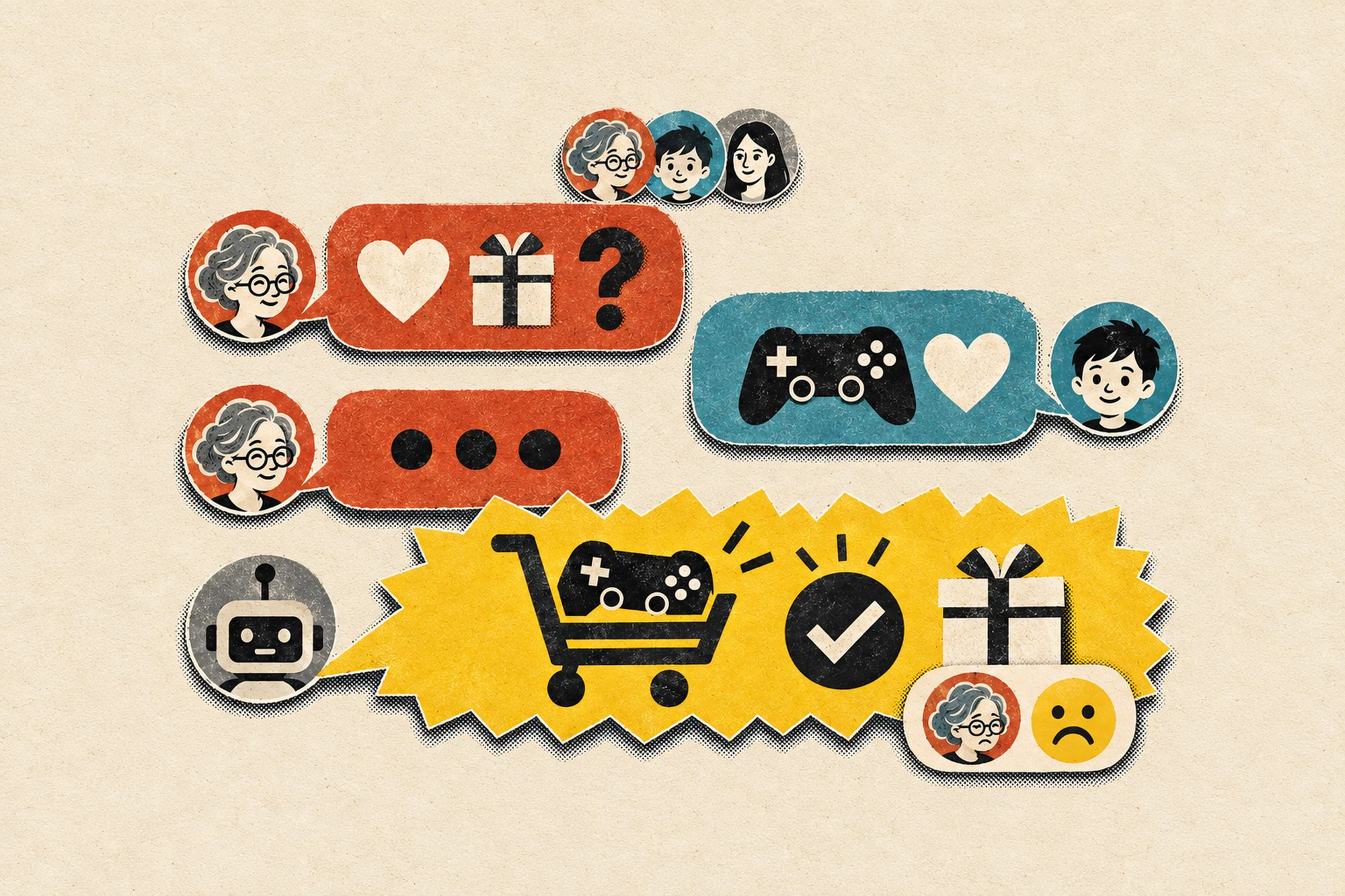
Similarly, Accenture found that consumers increasingly use AI for advice and to find harder-to-buy gifts. Take, for instance, the tween girl in her Korean skincare phase or the younger gamer that seems to have everything. In these scenarios especially—when the gift recipient is savvy/chronically online, and the parent just wants to create a bit of holiday magic—AI becomes a helpful companion. In fact, one in three consumers surveyed by Accenture said they would trust an AI recommendation more than their own judgment.
“On the surface, this may seem counterintuitive,” Askew said. “If you have a gut-feel of what to get, why would you trust what an AI agent is telling you over what you initially had in mind? But when you reflect on it, it’s almost like the democratization of the personal shopper.”
Askew shared an example of him buying a luxury handbag for someone. “I don’t know a whole lot about luxury handbags other than that they’re expensive,” he admitted. But when he chats with AI, he can get to the heart of the recipient, what’s on trend, and what to look for as he weighs his options. Of course, these concierge services have long existed in luxury, but AI has now extended them to other categories, too.
But consumers still have limits on when and how they use AI. While 73% are open to collaborating with an AI agent and 58% would even let it complete a task on their behalf, only 22% would let it decide what to buy, and just 8% would let it make purchases independently.
The Proof (and Magic) of Work
Some may chalk the AI use gap up to security concerns. We enjoy the conversational back-and-forth with an all-knowing agent that also understands our personal needs, behaviors, and preferences. However, we don’t want to sacrifice our sovereignty when it comes time to close the deal. Clicking “buy” feels personal, even intimate. It’s a final call made based on my own knowledge, beliefs, and feelings. There’s certainly a security aspect (I won’t even schedule recurring payments for some bills), but for gifting, it largely comes down to the emotional connection to the decision, and the work being put into the process.
That emotion is why stores continue to capture an equal share of holiday shopping, according to Askew, and why consumers increasingly flock to malls to participate in holiday customs like Black Friday. “AI is complementary to the store. It’s helping consumers find and discover things, but some consumers love the vibe, energy, and excitement around a store. They like the discoverability and the ability to see things in a presentation that feels more natural than a two-dimensional screen. And they like to be able to get recommendations not just from store associates but from other customers.”
The magic-makers want some levity, but they don’t want to outsource the work entirely. Because the work is part of the journey. It’s where our cultural customs and traditions form. And it’s where love and joy are found.
Continue Reading...

Insights and futurism for executives in eCom and Retail
Those things we shouldn’t say out loud? We say them on the private feed. Bi-weekly “after dark” podcasts and a members-only newsletter, just for subscribers.
Our research reports combine visionary thinking with data-backed findings from our own advisory panel, made up of leaders at brands you know and trust.
Upskill, cross-skill, and future-proof your teams with Future Commerce Learning, the leading digital eCommerce learning platform, created by professional educators.