

of the United Kingdom’s capitol city.
If you thought the collectibles market was relegated to trading cards or sneakers, let Walmart be your barometer for how widespread and expansive the Collector Economy has become.
Because Bentonville is running draws now.
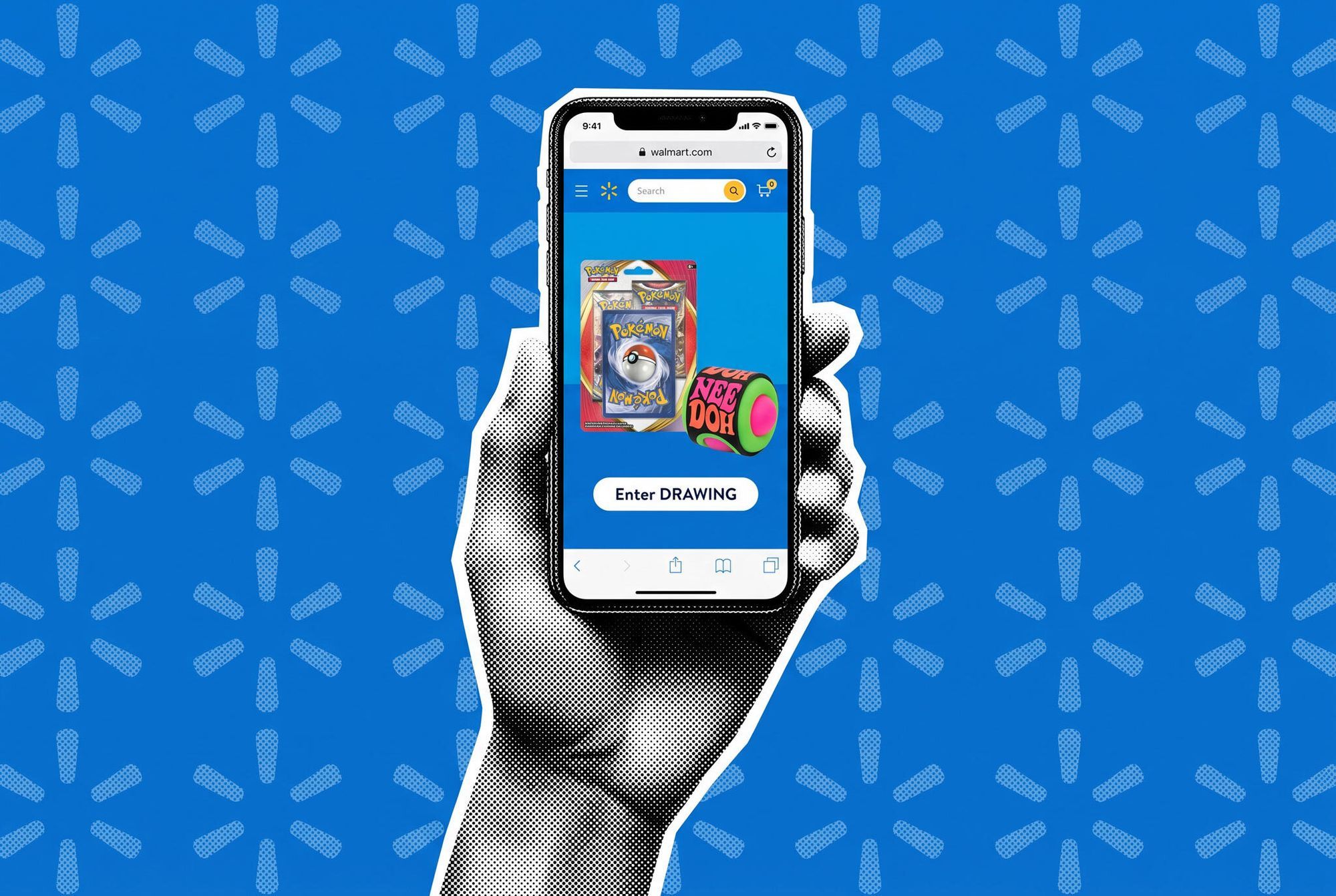
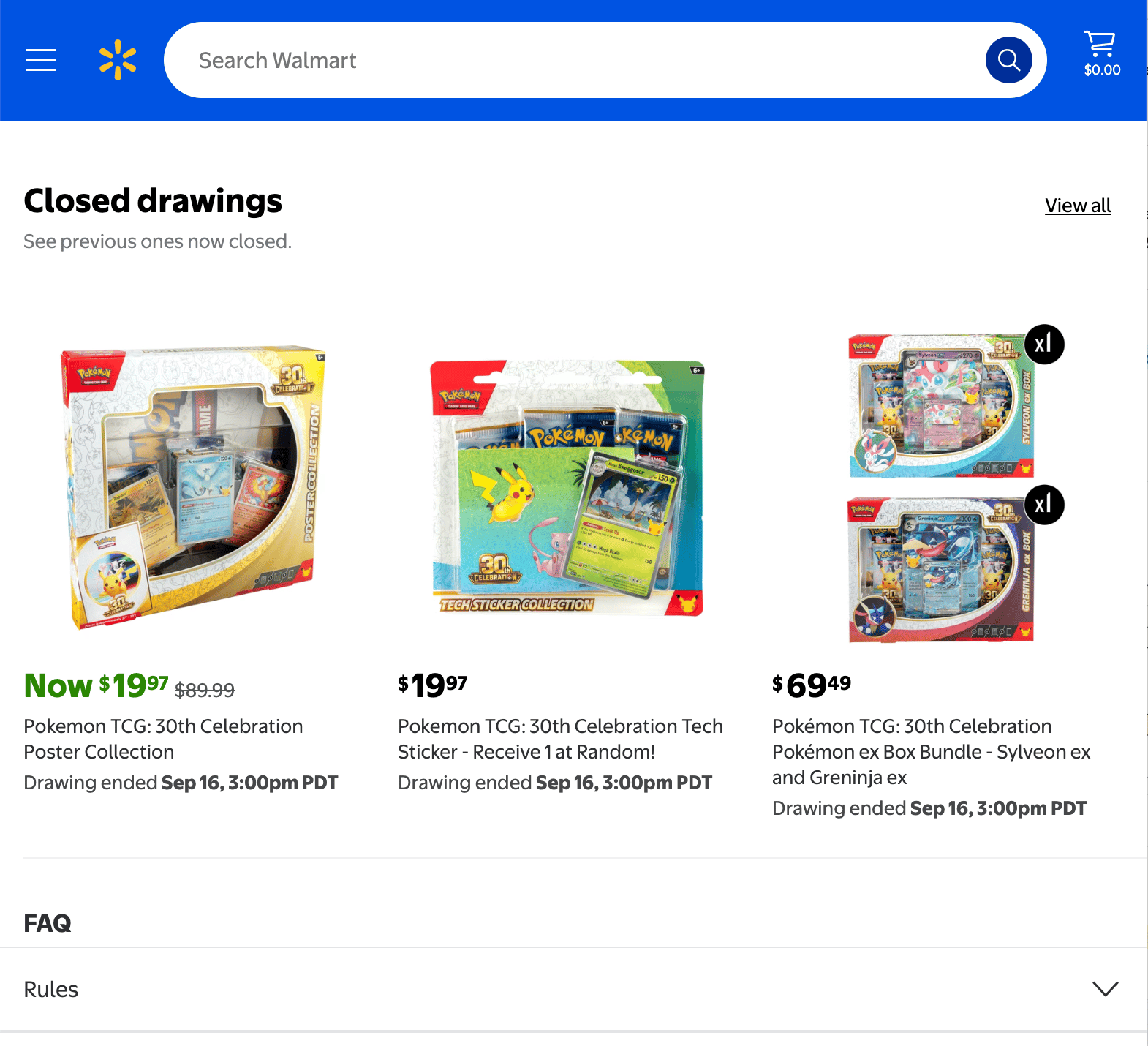
It all started on August 24 with a couple of basketball cards and two NeeDoh fidget toys, each retailing for $5.97. The real test came when the drawing for a $69 Pokémon Scarlet & Violet Prismatic Evolutions Elite Trainer Box opened. It’s a product with enough heat behind it to break most things it touches. Entry was free, and the window opened at 6:00 pm PT.
When the auction closed, Walmart randomly selected the winners and immediately placed the orders on their behalf.
The drawing had several hundred thousand people checking their email to see if they were among the lucky winners. This outcome alone shows how gaming psychology can influence customer engagement, but it’s worth taking a deeper look at the halo behaviors. Collectors passed the entry time around for days beforehand. Alert accounts posted walkthroughs of the rules. Reddit and Threads were filled with people working out whether random selection would keep the bots out and what happened to a saved card if they got picked. Underneath it all was a core sentiment: nobody wanted to miss out on the action.
That is not how people typically interact with a product page.
But anyone who has purchased a pair of sneakers recognizes the flow. Nike, Adidas, and many streetwear brands have run versions of it for over a decade. The mechanic isn’t new, but with one of the world’s largest retailers adopting it, the format has gotten a new lease on life, and the mainstream audience that has never entered a draw before is eagerly participating.
Understanding a Draw vs. a Drop
While both strategies leverage scarcity and drive engagement, a drop releases inventory on a first-come, first-served basis; often creating a race against time and bots. In contrast, a draw (or raffle) opens a window for users to enter, equalizing the playing field through randomized selection and removing the speed penalty for human participants.
Before we dig in, I should share about myself. I work at EQL, which is a launch platform for popular products. We’ve run close to 10,000 launches since early 2024 and managed 15 million entries against nearly 4 million units. We’ve run launches for Foot Locker, Levi’s, Stanley, POP MART, Funko, and Topps, as well as sneaker retailers like UNDEFEATED. We’ve also executed them for the Royal Australian Mint, which releases coins the same way a sneaker brand releases a shoe.
So we have firsthand experience watching the evolution of the drop-and-draw model; you could say we’ve even helped shape it.
And we have an idea of where it’ll head next.
Fandom Is Something You Do
I spent time at the Lakers and Kobalt before I got into commerce. Despite being very different, both companies understood that fandom is participatory.
Nobody in sports or music would suggest that the ideal fan experience is one where the fan does as little as possible. The queue outside the arena is part of the night. Standing at the merch table after the show is part of the show.
The waiting, the checking, the group chat at 5:58 pm, all of it is the thing people are there for.
A loyalty program tells you how often somebody returns. It says nothing of whether they’d even notice if your brand ceased to exist. Any brand trying to win in culture needs to measure the latter, and that only shows up where there’s something tangible to participate in.
Loyalty is about numbers, while fandom is about growing and harnessing energy.
“A loyalty program tells you how often somebody comes back. It says nothing about whether they’d care if you disappeared.”
The problem is, commerce went in the other direction when we started removing friction. We spent twenty years deleting steps (fewer clicks, saved cards, one-tap checkout), and suddenly conversion became instantaneous—from wanting to owning. This is the “collapsed funnel” we hear so much about.
For products like detergent (or even the makeup an influencer sells) that’s a high-utility design decision, and it has made everyone money. But along the way, we decided that wanting something badly should be resolved as quickly as possible. That’s a strange thing to believe about products people build their weekends around.
A draw gives a fan something to do. You find out when the window opens. You tell your friends. You spend a few days anticipating it. Then, on the day you enter or you get access, you wait some more. Then, you come back to see what happened. That sequence is a story a person can tell. A one-click checkout has no story, and doesn’t drive any engagement.
The Friction That Gives Back
You’ve probably read here on Future Commerce that retailers have reached peak conversion optimization.
But when we focus on making sure every site loads in a second, saves your card, and ships in two days, we’re forced to only compete on things like price and delivery window. It’s a commodity fight that most brands lose slowly. And when brands win in this fight, they do so on a margin they’d rather not have spent.
“A one-click checkout has no story, and doesn’t drive any engagement.”
A launch is one of the few things in commerce that discounting can’t match. It’s a moment, and moments belong to whoever runs them well. When a retailer becomes known and trusted for its launch experiences, it builds something a competitor can’t undercut. What’s on offer is the experience of caring about something alongside other people who care about it.
Then there’s the question of what happens to everyone who doesn’t get the product. Conversion logic treats a person who leaves without buying as a failed session, and the entire apparatus exists to shrink that number. In a launch, that framing doesn’t exist because most people who show up were never going to get one. There isn’t enough product. Optimizing them away is meaningless, and once you stop trying, the only question left is what kind of experience they had and whether they’d do it again.
Let’s address the fair objections. A launch adds engineering work, support burdens, and comms headaches. It removes the likelihood of impulse purchases. It introduces delayed gratification between the wanting and the having; when the customer is at peak intent.
I have two responses to these concerns:
- The impulse purchase on a genuinely scarce product is mostly imaginary, because the thing was going to be gone in ninety seconds and the person tapping buy was going to lose to someone faster.
- This is for the handful of products a year where demand outruns supply. Of course, nobody is proposing you apply this to the entire catalog. It’s a small enough set that the engineering cost is a real decision, not an obvious no.
This is where friction gets practical. Friction that asks something of a fan and gives something back is worth having. Anticipation. A shared entry time. An experience that’s layered in storytelling and content. A result they’re waiting on—a reason to talk to other people about it.
Bad friction takes consumers’ time and returns nothing of value. If a site falls over with every new launch or has meaningless rules that are hard to figure out, it will do far more damage than a slow checkout experience. The test is whether a fan would describe the process as part of the experience or as something standing in front of it.
“Would a fan describe the process as part of the experience or as something standing in its way?”
Manufacture the Moment, Not the Hype
The easy way to dismiss all this is to decide it’s a story available only to sneaker and trading-card brands sitting on products the internet has already lost its mind over. That gets the causation backward. Heat is partly a property of the product and partly a property of how the release is run. The latter is the part every brand controls.
Hype is a claim about how much other people want something, and it falls apart when it isn’t true. A moment is a thing you build, and it’s true because you built it. Brands should be manufacturing moments. Almost every mechanism in a launch exists to turn a sales event into an occasion:
- Giving early access to the people who have been around the longest.
- Opening an entry window everyone shows up for at the same time.
- Holding an invite-only release for a local audience.
- Letting people collect in-store rather than shipping.
None of that invents demand. All of it gives the affection a brand already has somewhere to gather, and a shape people can take part in.
That’s the honest limit too. This works where some real feeling exists, and the release has been quietly wasting it. A brand with a genuinely indifferent customer base can run the most elegant entry window in retail and get forty entries and a worse reputation than it started with. Most brands have the opposite problem: people who care, and a checkout flow that gives them nothing to do with it.
Start With One Product
Someone has to own the rules and publish them before the window opens because ambiguity turns a launch into an inevitable surge in support inquiries. Someone has to write the comms for people who weren’t selected, which is harder craft than the winning email, yet only gets about six minutes of attention. Someone has to decide what verification you’re doing, and that decision sits upstream of everything else. That’s why you should start with one product, not a program.
Measure it on something other than sell-through. A hyped product will sell, so sell-through tells you almost nothing about whether the launch worked. The question worth asking is whether the launch left people feeling like they’d been somewhere.
The Point Is Who You Sell To
Good launches are hard to run, which is why the draw mechanic stayed inside sneakers for a decade. A fan wants to know that the thing was fair. A retailer wants the product to reach the people it’s meant to reach, and the tools to make it easy to orchestrate. Those are part of the same challenge. Creating more work only to have it become a pool of bots and resale accounts isn’t just failing to manage the moment; it also prevents you from maximizing it.
It all comes down to getting the right people in the “room.” A boutique may want locals and long-standing members. A mainstream retailer may want first-time buyers. A brand releasing the second half of a collaboration may want whoever bought the first half. Among people who have entered five or more launches on our platform, about a third have never been selected once, and they keep entering. They keep turning up. That makes the experience of not being selected worth taking seriously.
Walmart has reminded the rest of the retail industry that a standard product page isn’t the only, right, best way to sell something; especially if people care about it.
What I hope happens next is that brands treat launches as connective tissue between themselves and their best customers, not as instructions for slightly better queues.
Mitchell Holder is Chief Growth and Marketing Officer at EQL, the launch platform behind Run Fair®, where he leads sales, marketing, and customer success. He previously worked at the Los Angeles Lakers, Ogilvy, and Kobalt Music.
If you thought the collectibles market was relegated to trading cards or sneakers, let Walmart be your barometer for how widespread and expansive the Collector Economy has become.
Because Bentonville is running draws now.
It all started on August 24 with a couple of basketball cards and two NeeDoh fidget toys, each retailing for $5.97. The real test came when the drawing for a $69 Pokémon Scarlet & Violet Prismatic Evolutions Elite Trainer Box opened. It’s a product with enough heat behind it to break most things it touches. Entry was free, and the window opened at 6:00 pm PT.
When the auction closed, Walmart randomly selected the winners and immediately placed the orders on their behalf.
The drawing had several hundred thousand people checking their email to see if they were among the lucky winners. This outcome alone shows how gaming psychology can influence customer engagement, but it’s worth taking a deeper look at the halo behaviors. Collectors passed the entry time around for days beforehand. Alert accounts posted walkthroughs of the rules. Reddit and Threads were filled with people working out whether random selection would keep the bots out and what happened to a saved card if they got picked. Underneath it all was a core sentiment: nobody wanted to miss out on the action.
That is not how people typically interact with a product page.
But anyone who has purchased a pair of sneakers recognizes the flow. Nike, Adidas, and many streetwear brands have run versions of it for over a decade. The mechanic isn’t new, but with one of the world’s largest retailers adopting it, the format has gotten a new lease on life, and the mainstream audience that has never entered a draw before is eagerly participating.
Understanding a Draw vs. a Drop
While both strategies leverage scarcity and drive engagement, a drop releases inventory on a first-come, first-served basis; often creating a race against time and bots. In contrast, a draw (or raffle) opens a window for users to enter, equalizing the playing field through randomized selection and removing the speed penalty for human participants.
Before we dig in, I should share about myself. I work at EQL, which is a launch platform for popular products. We’ve run close to 10,000 launches since early 2024 and managed 15 million entries against nearly 4 million units. We’ve run launches for Foot Locker, Levi’s, Stanley, POP MART, Funko, and Topps, as well as sneaker retailers like UNDEFEATED. We’ve also executed them for the Royal Australian Mint, which releases coins the same way a sneaker brand releases a shoe.
So we have firsthand experience watching the evolution of the drop-and-draw model; you could say we’ve even helped shape it.
And we have an idea of where it’ll head next.
Fandom Is Something You Do
I spent time at the Lakers and Kobalt before I got into commerce. Despite being very different, both companies understood that fandom is participatory.
Nobody in sports or music would suggest that the ideal fan experience is one where the fan does as little as possible. The queue outside the arena is part of the night. Standing at the merch table after the show is part of the show.
The waiting, the checking, the group chat at 5:58 pm, all of it is the thing people are there for.
A loyalty program tells you how often somebody returns. It says nothing of whether they’d even notice if your brand ceased to exist. Any brand trying to win in culture needs to measure the latter, and that only shows up where there’s something tangible to participate in.
Loyalty is about numbers, while fandom is about growing and harnessing energy.
“A loyalty program tells you how often somebody comes back. It says nothing about whether they’d care if you disappeared.”
The problem is, commerce went in the other direction when we started removing friction. We spent twenty years deleting steps (fewer clicks, saved cards, one-tap checkout), and suddenly conversion became instantaneous—from wanting to owning. This is the “collapsed funnel” we hear so much about.
For products like detergent (or even the makeup an influencer sells) that’s a high-utility design decision, and it has made everyone money. But along the way, we decided that wanting something badly should be resolved as quickly as possible. That’s a strange thing to believe about products people build their weekends around.
A draw gives a fan something to do. You find out when the window opens. You tell your friends. You spend a few days anticipating it. Then, on the day you enter or you get access, you wait some more. Then, you come back to see what happened. That sequence is a story a person can tell. A one-click checkout has no story, and doesn’t drive any engagement.
The Friction That Gives Back
You’ve probably read here on Future Commerce that retailers have reached peak conversion optimization.
But when we focus on making sure every site loads in a second, saves your card, and ships in two days, we’re forced to only compete on things like price and delivery window. It’s a commodity fight that most brands lose slowly. And when brands win in this fight, they do so on a margin they’d rather not have spent.
“A one-click checkout has no story, and doesn’t drive any engagement.”
A launch is one of the few things in commerce that discounting can’t match. It’s a moment, and moments belong to whoever runs them well. When a retailer becomes known and trusted for its launch experiences, it builds something a competitor can’t undercut. What’s on offer is the experience of caring about something alongside other people who care about it.
Then there’s the question of what happens to everyone who doesn’t get the product. Conversion logic treats a person who leaves without buying as a failed session, and the entire apparatus exists to shrink that number. In a launch, that framing doesn’t exist because most people who show up were never going to get one. There isn’t enough product. Optimizing them away is meaningless, and once you stop trying, the only question left is what kind of experience they had and whether they’d do it again.
Let’s address the fair objections. A launch adds engineering work, support burdens, and comms headaches. It removes the likelihood of impulse purchases. It introduces delayed gratification between the wanting and the having; when the customer is at peak intent.
I have two responses to these concerns:
- The impulse purchase on a genuinely scarce product is mostly imaginary, because the thing was going to be gone in ninety seconds and the person tapping buy was going to lose to someone faster.
- This is for the handful of products a year where demand outruns supply. Of course, nobody is proposing you apply this to the entire catalog. It’s a small enough set that the engineering cost is a real decision, not an obvious no.
This is where friction gets practical. Friction that asks something of a fan and gives something back is worth having. Anticipation. A shared entry time. An experience that’s layered in storytelling and content. A result they’re waiting on—a reason to talk to other people about it.
Bad friction takes consumers’ time and returns nothing of value. If a site falls over with every new launch or has meaningless rules that are hard to figure out, it will do far more damage than a slow checkout experience. The test is whether a fan would describe the process as part of the experience or as something standing in front of it.
“Would a fan describe the process as part of the experience or as something standing in its way?”
Manufacture the Moment, Not the Hype
The easy way to dismiss all this is to decide it’s a story available only to sneaker and trading-card brands sitting on products the internet has already lost its mind over. That gets the causation backward. Heat is partly a property of the product and partly a property of how the release is run. The latter is the part every brand controls.
Hype is a claim about how much other people want something, and it falls apart when it isn’t true. A moment is a thing you build, and it’s true because you built it. Brands should be manufacturing moments. Almost every mechanism in a launch exists to turn a sales event into an occasion:
- Giving early access to the people who have been around the longest.
- Opening an entry window everyone shows up for at the same time.
- Holding an invite-only release for a local audience.
- Letting people collect in-store rather than shipping.
None of that invents demand. All of it gives the affection a brand already has somewhere to gather, and a shape people can take part in.
That’s the honest limit too. This works where some real feeling exists, and the release has been quietly wasting it. A brand with a genuinely indifferent customer base can run the most elegant entry window in retail and get forty entries and a worse reputation than it started with. Most brands have the opposite problem: people who care, and a checkout flow that gives them nothing to do with it.
Start With One Product
Someone has to own the rules and publish them before the window opens because ambiguity turns a launch into an inevitable surge in support inquiries. Someone has to write the comms for people who weren’t selected, which is harder craft than the winning email, yet only gets about six minutes of attention. Someone has to decide what verification you’re doing, and that decision sits upstream of everything else. That’s why you should start with one product, not a program.
Measure it on something other than sell-through. A hyped product will sell, so sell-through tells you almost nothing about whether the launch worked. The question worth asking is whether the launch left people feeling like they’d been somewhere.
The Point Is Who You Sell To
Good launches are hard to run, which is why the draw mechanic stayed inside sneakers for a decade. A fan wants to know that the thing was fair. A retailer wants the product to reach the people it’s meant to reach, and the tools to make it easy to orchestrate. Those are part of the same challenge. Creating more work only to have it become a pool of bots and resale accounts isn’t just failing to manage the moment; it also prevents you from maximizing it.
It all comes down to getting the right people in the “room.” A boutique may want locals and long-standing members. A mainstream retailer may want first-time buyers. A brand releasing the second half of a collaboration may want whoever bought the first half. Among people who have entered five or more launches on our platform, about a third have never been selected once, and they keep entering. They keep turning up. That makes the experience of not being selected worth taking seriously.
Walmart has reminded the rest of the retail industry that a standard product page isn’t the only, right, best way to sell something; especially if people care about it.
What I hope happens next is that brands treat launches as connective tissue between themselves and their best customers, not as instructions for slightly better queues.
Mitchell Holder is Chief Growth and Marketing Officer at EQL, the launch platform behind Run Fair®, where he leads sales, marketing, and customer success. He previously worked at the Los Angeles Lakers, Ogilvy, and Kobalt Music.
If you thought the collectibles market was relegated to trading cards or sneakers, let Walmart be your barometer for how widespread and expansive the Collector Economy has become.
Because Bentonville is running draws now.
It all started on August 24 with a couple of basketball cards and two NeeDoh fidget toys, each retailing for $5.97. The real test came when the drawing for a $69 Pokémon Scarlet & Violet Prismatic Evolutions Elite Trainer Box opened. It’s a product with enough heat behind it to break most things it touches. Entry was free, and the window opened at 6:00 pm PT.
When the auction closed, Walmart randomly selected the winners and immediately placed the orders on their behalf.
The drawing had several hundred thousand people checking their email to see if they were among the lucky winners. This outcome alone shows how gaming psychology can influence customer engagement, but it’s worth taking a deeper look at the halo behaviors. Collectors passed the entry time around for days beforehand. Alert accounts posted walkthroughs of the rules. Reddit and Threads were filled with people working out whether random selection would keep the bots out and what happened to a saved card if they got picked. Underneath it all was a core sentiment: nobody wanted to miss out on the action.
That is not how people typically interact with a product page.
But anyone who has purchased a pair of sneakers recognizes the flow. Nike, Adidas, and many streetwear brands have run versions of it for over a decade. The mechanic isn’t new, but with one of the world’s largest retailers adopting it, the format has gotten a new lease on life, and the mainstream audience that has never entered a draw before is eagerly participating.
Understanding a Draw vs. a Drop
While both strategies leverage scarcity and drive engagement, a drop releases inventory on a first-come, first-served basis; often creating a race against time and bots. In contrast, a draw (or raffle) opens a window for users to enter, equalizing the playing field through randomized selection and removing the speed penalty for human participants.
Before we dig in, I should share about myself. I work at EQL, which is a launch platform for popular products. We’ve run close to 10,000 launches since early 2024 and managed 15 million entries against nearly 4 million units. We’ve run launches for Foot Locker, Levi’s, Stanley, POP MART, Funko, and Topps, as well as sneaker retailers like UNDEFEATED. We’ve also executed them for the Royal Australian Mint, which releases coins the same way a sneaker brand releases a shoe.
So we have firsthand experience watching the evolution of the drop-and-draw model; you could say we’ve even helped shape it.
And we have an idea of where it’ll head next.
Fandom Is Something You Do
I spent time at the Lakers and Kobalt before I got into commerce. Despite being very different, both companies understood that fandom is participatory.
Nobody in sports or music would suggest that the ideal fan experience is one where the fan does as little as possible. The queue outside the arena is part of the night. Standing at the merch table after the show is part of the show.
The waiting, the checking, the group chat at 5:58 pm, all of it is the thing people are there for.
A loyalty program tells you how often somebody returns. It says nothing of whether they’d even notice if your brand ceased to exist. Any brand trying to win in culture needs to measure the latter, and that only shows up where there’s something tangible to participate in.
Loyalty is about numbers, while fandom is about growing and harnessing energy.
“A loyalty program tells you how often somebody comes back. It says nothing about whether they’d care if you disappeared.”
The problem is, commerce went in the other direction when we started removing friction. We spent twenty years deleting steps (fewer clicks, saved cards, one-tap checkout), and suddenly conversion became instantaneous—from wanting to owning. This is the “collapsed funnel” we hear so much about.
For products like detergent (or even the makeup an influencer sells) that’s a high-utility design decision, and it has made everyone money. But along the way, we decided that wanting something badly should be resolved as quickly as possible. That’s a strange thing to believe about products people build their weekends around.
A draw gives a fan something to do. You find out when the window opens. You tell your friends. You spend a few days anticipating it. Then, on the day you enter or you get access, you wait some more. Then, you come back to see what happened. That sequence is a story a person can tell. A one-click checkout has no story, and doesn’t drive any engagement.
The Friction That Gives Back
You’ve probably read here on Future Commerce that retailers have reached peak conversion optimization.
But when we focus on making sure every site loads in a second, saves your card, and ships in two days, we’re forced to only compete on things like price and delivery window. It’s a commodity fight that most brands lose slowly. And when brands win in this fight, they do so on a margin they’d rather not have spent.
“A one-click checkout has no story, and doesn’t drive any engagement.”
A launch is one of the few things in commerce that discounting can’t match. It’s a moment, and moments belong to whoever runs them well. When a retailer becomes known and trusted for its launch experiences, it builds something a competitor can’t undercut. What’s on offer is the experience of caring about something alongside other people who care about it.
Then there’s the question of what happens to everyone who doesn’t get the product. Conversion logic treats a person who leaves without buying as a failed session, and the entire apparatus exists to shrink that number. In a launch, that framing doesn’t exist because most people who show up were never going to get one. There isn’t enough product. Optimizing them away is meaningless, and once you stop trying, the only question left is what kind of experience they had and whether they’d do it again.
Let’s address the fair objections. A launch adds engineering work, support burdens, and comms headaches. It removes the likelihood of impulse purchases. It introduces delayed gratification between the wanting and the having; when the customer is at peak intent.
I have two responses to these concerns:
- The impulse purchase on a genuinely scarce product is mostly imaginary, because the thing was going to be gone in ninety seconds and the person tapping buy was going to lose to someone faster.
- This is for the handful of products a year where demand outruns supply. Of course, nobody is proposing you apply this to the entire catalog. It’s a small enough set that the engineering cost is a real decision, not an obvious no.
This is where friction gets practical. Friction that asks something of a fan and gives something back is worth having. Anticipation. A shared entry time. An experience that’s layered in storytelling and content. A result they’re waiting on—a reason to talk to other people about it.
Bad friction takes consumers’ time and returns nothing of value. If a site falls over with every new launch or has meaningless rules that are hard to figure out, it will do far more damage than a slow checkout experience. The test is whether a fan would describe the process as part of the experience or as something standing in front of it.
“Would a fan describe the process as part of the experience or as something standing in its way?”
Manufacture the Moment, Not the Hype
The easy way to dismiss all this is to decide it’s a story available only to sneaker and trading-card brands sitting on products the internet has already lost its mind over. That gets the causation backward. Heat is partly a property of the product and partly a property of how the release is run. The latter is the part every brand controls.
Hype is a claim about how much other people want something, and it falls apart when it isn’t true. A moment is a thing you build, and it’s true because you built it. Brands should be manufacturing moments. Almost every mechanism in a launch exists to turn a sales event into an occasion:
- Giving early access to the people who have been around the longest.
- Opening an entry window everyone shows up for at the same time.
- Holding an invite-only release for a local audience.
- Letting people collect in-store rather than shipping.
None of that invents demand. All of it gives the affection a brand already has somewhere to gather, and a shape people can take part in.
That’s the honest limit too. This works where some real feeling exists, and the release has been quietly wasting it. A brand with a genuinely indifferent customer base can run the most elegant entry window in retail and get forty entries and a worse reputation than it started with. Most brands have the opposite problem: people who care, and a checkout flow that gives them nothing to do with it.
Start With One Product
Someone has to own the rules and publish them before the window opens because ambiguity turns a launch into an inevitable surge in support inquiries. Someone has to write the comms for people who weren’t selected, which is harder craft than the winning email, yet only gets about six minutes of attention. Someone has to decide what verification you’re doing, and that decision sits upstream of everything else. That’s why you should start with one product, not a program.
Measure it on something other than sell-through. A hyped product will sell, so sell-through tells you almost nothing about whether the launch worked. The question worth asking is whether the launch left people feeling like they’d been somewhere.
The Point Is Who You Sell To
Good launches are hard to run, which is why the draw mechanic stayed inside sneakers for a decade. A fan wants to know that the thing was fair. A retailer wants the product to reach the people it’s meant to reach, and the tools to make it easy to orchestrate. Those are part of the same challenge. Creating more work only to have it become a pool of bots and resale accounts isn’t just failing to manage the moment; it also prevents you from maximizing it.
It all comes down to getting the right people in the “room.” A boutique may want locals and long-standing members. A mainstream retailer may want first-time buyers. A brand releasing the second half of a collaboration may want whoever bought the first half. Among people who have entered five or more launches on our platform, about a third have never been selected once, and they keep entering. They keep turning up. That makes the experience of not being selected worth taking seriously.
Walmart has reminded the rest of the retail industry that a standard product page isn’t the only, right, best way to sell something; especially if people care about it.
What I hope happens next is that brands treat launches as connective tissue between themselves and their best customers, not as instructions for slightly better queues.
Mitchell Holder is Chief Growth and Marketing Officer at EQL, the launch platform behind Run Fair®, where he leads sales, marketing, and customer success. He previously worked at the Los Angeles Lakers, Ogilvy, and Kobalt Music.
If you thought the collectibles market was relegated to trading cards or sneakers, let Walmart be your barometer for how widespread and expansive the Collector Economy has become.
Because Bentonville is running draws now.
It all started on August 24 with a couple of basketball cards and two NeeDoh fidget toys, each retailing for $5.97. The real test came when the drawing for a $69 Pokémon Scarlet & Violet Prismatic Evolutions Elite Trainer Box opened. It’s a product with enough heat behind it to break most things it touches. Entry was free, and the window opened at 6:00 pm PT.
When the auction closed, Walmart randomly selected the winners and immediately placed the orders on their behalf.
The drawing had several hundred thousand people checking their email to see if they were among the lucky winners. This outcome alone shows how gaming psychology can influence customer engagement, but it’s worth taking a deeper look at the halo behaviors. Collectors passed the entry time around for days beforehand. Alert accounts posted walkthroughs of the rules. Reddit and Threads were filled with people working out whether random selection would keep the bots out and what happened to a saved card if they got picked. Underneath it all was a core sentiment: nobody wanted to miss out on the action.
That is not how people typically interact with a product page.
But anyone who has purchased a pair of sneakers recognizes the flow. Nike, Adidas, and many streetwear brands have run versions of it for over a decade. The mechanic isn’t new, but with one of the world’s largest retailers adopting it, the format has gotten a new lease on life, and the mainstream audience that has never entered a draw before is eagerly participating.
Understanding a Draw vs. a Drop
While both strategies leverage scarcity and drive engagement, a drop releases inventory on a first-come, first-served basis; often creating a race against time and bots. In contrast, a draw (or raffle) opens a window for users to enter, equalizing the playing field through randomized selection and removing the speed penalty for human participants.
Before we dig in, I should share about myself. I work at EQL, which is a launch platform for popular products. We’ve run close to 10,000 launches since early 2024 and managed 15 million entries against nearly 4 million units. We’ve run launches for Foot Locker, Levi’s, Stanley, POP MART, Funko, and Topps, as well as sneaker retailers like UNDEFEATED. We’ve also executed them for the Royal Australian Mint, which releases coins the same way a sneaker brand releases a shoe.
So we have firsthand experience watching the evolution of the drop-and-draw model; you could say we’ve even helped shape it.
And we have an idea of where it’ll head next.
Fandom Is Something You Do
I spent time at the Lakers and Kobalt before I got into commerce. Despite being very different, both companies understood that fandom is participatory.
Nobody in sports or music would suggest that the ideal fan experience is one where the fan does as little as possible. The queue outside the arena is part of the night. Standing at the merch table after the show is part of the show.
The waiting, the checking, the group chat at 5:58 pm, all of it is the thing people are there for.
A loyalty program tells you how often somebody returns. It says nothing of whether they’d even notice if your brand ceased to exist. Any brand trying to win in culture needs to measure the latter, and that only shows up where there’s something tangible to participate in.
Loyalty is about numbers, while fandom is about growing and harnessing energy.
“A loyalty program tells you how often somebody comes back. It says nothing about whether they’d care if you disappeared.”
The problem is, commerce went in the other direction when we started removing friction. We spent twenty years deleting steps (fewer clicks, saved cards, one-tap checkout), and suddenly conversion became instantaneous—from wanting to owning. This is the “collapsed funnel” we hear so much about.
For products like detergent (or even the makeup an influencer sells) that’s a high-utility design decision, and it has made everyone money. But along the way, we decided that wanting something badly should be resolved as quickly as possible. That’s a strange thing to believe about products people build their weekends around.
A draw gives a fan something to do. You find out when the window opens. You tell your friends. You spend a few days anticipating it. Then, on the day you enter or you get access, you wait some more. Then, you come back to see what happened. That sequence is a story a person can tell. A one-click checkout has no story, and doesn’t drive any engagement.
The Friction That Gives Back
You’ve probably read here on Future Commerce that retailers have reached peak conversion optimization.
But when we focus on making sure every site loads in a second, saves your card, and ships in two days, we’re forced to only compete on things like price and delivery window. It’s a commodity fight that most brands lose slowly. And when brands win in this fight, they do so on a margin they’d rather not have spent.
“A one-click checkout has no story, and doesn’t drive any engagement.”
A launch is one of the few things in commerce that discounting can’t match. It’s a moment, and moments belong to whoever runs them well. When a retailer becomes known and trusted for its launch experiences, it builds something a competitor can’t undercut. What’s on offer is the experience of caring about something alongside other people who care about it.
Then there’s the question of what happens to everyone who doesn’t get the product. Conversion logic treats a person who leaves without buying as a failed session, and the entire apparatus exists to shrink that number. In a launch, that framing doesn’t exist because most people who show up were never going to get one. There isn’t enough product. Optimizing them away is meaningless, and once you stop trying, the only question left is what kind of experience they had and whether they’d do it again.
Let’s address the fair objections. A launch adds engineering work, support burdens, and comms headaches. It removes the likelihood of impulse purchases. It introduces delayed gratification between the wanting and the having; when the customer is at peak intent.
I have two responses to these concerns:
- The impulse purchase on a genuinely scarce product is mostly imaginary, because the thing was going to be gone in ninety seconds and the person tapping buy was going to lose to someone faster.
- This is for the handful of products a year where demand outruns supply. Of course, nobody is proposing you apply this to the entire catalog. It’s a small enough set that the engineering cost is a real decision, not an obvious no.
This is where friction gets practical. Friction that asks something of a fan and gives something back is worth having. Anticipation. A shared entry time. An experience that’s layered in storytelling and content. A result they’re waiting on—a reason to talk to other people about it.
Bad friction takes consumers’ time and returns nothing of value. If a site falls over with every new launch or has meaningless rules that are hard to figure out, it will do far more damage than a slow checkout experience. The test is whether a fan would describe the process as part of the experience or as something standing in front of it.
“Would a fan describe the process as part of the experience or as something standing in its way?”
Manufacture the Moment, Not the Hype
The easy way to dismiss all this is to decide it’s a story available only to sneaker and trading-card brands sitting on products the internet has already lost its mind over. That gets the causation backward. Heat is partly a property of the product and partly a property of how the release is run. The latter is the part every brand controls.
Hype is a claim about how much other people want something, and it falls apart when it isn’t true. A moment is a thing you build, and it’s true because you built it. Brands should be manufacturing moments. Almost every mechanism in a launch exists to turn a sales event into an occasion:
- Giving early access to the people who have been around the longest.
- Opening an entry window everyone shows up for at the same time.
- Holding an invite-only release for a local audience.
- Letting people collect in-store rather than shipping.
None of that invents demand. All of it gives the affection a brand already has somewhere to gather, and a shape people can take part in.
That’s the honest limit too. This works where some real feeling exists, and the release has been quietly wasting it. A brand with a genuinely indifferent customer base can run the most elegant entry window in retail and get forty entries and a worse reputation than it started with. Most brands have the opposite problem: people who care, and a checkout flow that gives them nothing to do with it.
Start With One Product
Someone has to own the rules and publish them before the window opens because ambiguity turns a launch into an inevitable surge in support inquiries. Someone has to write the comms for people who weren’t selected, which is harder craft than the winning email, yet only gets about six minutes of attention. Someone has to decide what verification you’re doing, and that decision sits upstream of everything else. That’s why you should start with one product, not a program.
Measure it on something other than sell-through. A hyped product will sell, so sell-through tells you almost nothing about whether the launch worked. The question worth asking is whether the launch left people feeling like they’d been somewhere.
The Point Is Who You Sell To
Good launches are hard to run, which is why the draw mechanic stayed inside sneakers for a decade. A fan wants to know that the thing was fair. A retailer wants the product to reach the people it’s meant to reach, and the tools to make it easy to orchestrate. Those are part of the same challenge. Creating more work only to have it become a pool of bots and resale accounts isn’t just failing to manage the moment; it also prevents you from maximizing it.
It all comes down to getting the right people in the “room.” A boutique may want locals and long-standing members. A mainstream retailer may want first-time buyers. A brand releasing the second half of a collaboration may want whoever bought the first half. Among people who have entered five or more launches on our platform, about a third have never been selected once, and they keep entering. They keep turning up. That makes the experience of not being selected worth taking seriously.
Walmart has reminded the rest of the retail industry that a standard product page isn’t the only, right, best way to sell something; especially if people care about it.
What I hope happens next is that brands treat launches as connective tissue between themselves and their best customers, not as instructions for slightly better queues.
Mitchell Holder is Chief Growth and Marketing Officer at EQL, the launch platform behind Run Fair®, where he leads sales, marketing, and customer success. He previously worked at the Los Angeles Lakers, Ogilvy, and Kobalt Music.
If you thought the collectibles market was relegated to trading cards or sneakers, let Walmart be your barometer for how widespread and expansive the Collector Economy has become.
Because Bentonville is running draws now.
It all started on August 24 with a couple of basketball cards and two NeeDoh fidget toys, each retailing for $5.97. The real test came when the drawing for a $69 Pokémon Scarlet & Violet Prismatic Evolutions Elite Trainer Box opened. It’s a product with enough heat behind it to break most things it touches. Entry was free, and the window opened at 6:00 pm PT.
When the auction closed, Walmart randomly selected the winners and immediately placed the orders on their behalf.
The drawing had several hundred thousand people checking their email to see if they were among the lucky winners. This outcome alone shows how gaming psychology can influence customer engagement, but it’s worth taking a deeper look at the halo behaviors. Collectors passed the entry time around for days beforehand. Alert accounts posted walkthroughs of the rules. Reddit and Threads were filled with people working out whether random selection would keep the bots out and what happened to a saved card if they got picked. Underneath it all was a core sentiment: nobody wanted to miss out on the action.
That is not how people typically interact with a product page.
But anyone who has purchased a pair of sneakers recognizes the flow. Nike, Adidas, and many streetwear brands have run versions of it for over a decade. The mechanic isn’t new, but with one of the world’s largest retailers adopting it, the format has gotten a new lease on life, and the mainstream audience that has never entered a draw before is eagerly participating.
Understanding a Draw vs. a Drop
While both strategies leverage scarcity and drive engagement, a drop releases inventory on a first-come, first-served basis; often creating a race against time and bots. In contrast, a draw (or raffle) opens a window for users to enter, equalizing the playing field through randomized selection and removing the speed penalty for human participants.
Before we dig in, I should share about myself. I work at EQL, which is a launch platform for popular products. We’ve run close to 10,000 launches since early 2024 and managed 15 million entries against nearly 4 million units. We’ve run launches for Foot Locker, Levi’s, Stanley, POP MART, Funko, and Topps, as well as sneaker retailers like UNDEFEATED. We’ve also executed them for the Royal Australian Mint, which releases coins the same way a sneaker brand releases a shoe.
So we have firsthand experience watching the evolution of the drop-and-draw model; you could say we’ve even helped shape it.
And we have an idea of where it’ll head next.
Fandom Is Something You Do
I spent time at the Lakers and Kobalt before I got into commerce. Despite being very different, both companies understood that fandom is participatory.
Nobody in sports or music would suggest that the ideal fan experience is one where the fan does as little as possible. The queue outside the arena is part of the night. Standing at the merch table after the show is part of the show.
The waiting, the checking, the group chat at 5:58 pm, all of it is the thing people are there for.
A loyalty program tells you how often somebody returns. It says nothing of whether they’d even notice if your brand ceased to exist. Any brand trying to win in culture needs to measure the latter, and that only shows up where there’s something tangible to participate in.
Loyalty is about numbers, while fandom is about growing and harnessing energy.
“A loyalty program tells you how often somebody comes back. It says nothing about whether they’d care if you disappeared.”
The problem is, commerce went in the other direction when we started removing friction. We spent twenty years deleting steps (fewer clicks, saved cards, one-tap checkout), and suddenly conversion became instantaneous—from wanting to owning. This is the “collapsed funnel” we hear so much about.
For products like detergent (or even the makeup an influencer sells) that’s a high-utility design decision, and it has made everyone money. But along the way, we decided that wanting something badly should be resolved as quickly as possible. That’s a strange thing to believe about products people build their weekends around.
A draw gives a fan something to do. You find out when the window opens. You tell your friends. You spend a few days anticipating it. Then, on the day you enter or you get access, you wait some more. Then, you come back to see what happened. That sequence is a story a person can tell. A one-click checkout has no story, and doesn’t drive any engagement.
The Friction That Gives Back
You’ve probably read here on Future Commerce that retailers have reached peak conversion optimization.
But when we focus on making sure every site loads in a second, saves your card, and ships in two days, we’re forced to only compete on things like price and delivery window. It’s a commodity fight that most brands lose slowly. And when brands win in this fight, they do so on a margin they’d rather not have spent.
“A one-click checkout has no story, and doesn’t drive any engagement.”
A launch is one of the few things in commerce that discounting can’t match. It’s a moment, and moments belong to whoever runs them well. When a retailer becomes known and trusted for its launch experiences, it builds something a competitor can’t undercut. What’s on offer is the experience of caring about something alongside other people who care about it.
Then there’s the question of what happens to everyone who doesn’t get the product. Conversion logic treats a person who leaves without buying as a failed session, and the entire apparatus exists to shrink that number. In a launch, that framing doesn’t exist because most people who show up were never going to get one. There isn’t enough product. Optimizing them away is meaningless, and once you stop trying, the only question left is what kind of experience they had and whether they’d do it again.
Let’s address the fair objections. A launch adds engineering work, support burdens, and comms headaches. It removes the likelihood of impulse purchases. It introduces delayed gratification between the wanting and the having; when the customer is at peak intent.
I have two responses to these concerns:
- The impulse purchase on a genuinely scarce product is mostly imaginary, because the thing was going to be gone in ninety seconds and the person tapping buy was going to lose to someone faster.
- This is for the handful of products a year where demand outruns supply. Of course, nobody is proposing you apply this to the entire catalog. It’s a small enough set that the engineering cost is a real decision, not an obvious no.
This is where friction gets practical. Friction that asks something of a fan and gives something back is worth having. Anticipation. A shared entry time. An experience that’s layered in storytelling and content. A result they’re waiting on—a reason to talk to other people about it.
Bad friction takes consumers’ time and returns nothing of value. If a site falls over with every new launch or has meaningless rules that are hard to figure out, it will do far more damage than a slow checkout experience. The test is whether a fan would describe the process as part of the experience or as something standing in front of it.
“Would a fan describe the process as part of the experience or as something standing in its way?”
Manufacture the Moment, Not the Hype
The easy way to dismiss all this is to decide it’s a story available only to sneaker and trading-card brands sitting on products the internet has already lost its mind over. That gets the causation backward. Heat is partly a property of the product and partly a property of how the release is run. The latter is the part every brand controls.
Hype is a claim about how much other people want something, and it falls apart when it isn’t true. A moment is a thing you build, and it’s true because you built it. Brands should be manufacturing moments. Almost every mechanism in a launch exists to turn a sales event into an occasion:
- Giving early access to the people who have been around the longest.
- Opening an entry window everyone shows up for at the same time.
- Holding an invite-only release for a local audience.
- Letting people collect in-store rather than shipping.
None of that invents demand. All of it gives the affection a brand already has somewhere to gather, and a shape people can take part in.
That’s the honest limit too. This works where some real feeling exists, and the release has been quietly wasting it. A brand with a genuinely indifferent customer base can run the most elegant entry window in retail and get forty entries and a worse reputation than it started with. Most brands have the opposite problem: people who care, and a checkout flow that gives them nothing to do with it.
Start With One Product
Someone has to own the rules and publish them before the window opens because ambiguity turns a launch into an inevitable surge in support inquiries. Someone has to write the comms for people who weren’t selected, which is harder craft than the winning email, yet only gets about six minutes of attention. Someone has to decide what verification you’re doing, and that decision sits upstream of everything else. That’s why you should start with one product, not a program.
Measure it on something other than sell-through. A hyped product will sell, so sell-through tells you almost nothing about whether the launch worked. The question worth asking is whether the launch left people feeling like they’d been somewhere.
The Point Is Who You Sell To
Good launches are hard to run, which is why the draw mechanic stayed inside sneakers for a decade. A fan wants to know that the thing was fair. A retailer wants the product to reach the people it’s meant to reach, and the tools to make it easy to orchestrate. Those are part of the same challenge. Creating more work only to have it become a pool of bots and resale accounts isn’t just failing to manage the moment; it also prevents you from maximizing it.
It all comes down to getting the right people in the “room.” A boutique may want locals and long-standing members. A mainstream retailer may want first-time buyers. A brand releasing the second half of a collaboration may want whoever bought the first half. Among people who have entered five or more launches on our platform, about a third have never been selected once, and they keep entering. They keep turning up. That makes the experience of not being selected worth taking seriously.
Walmart has reminded the rest of the retail industry that a standard product page isn’t the only, right, best way to sell something; especially if people care about it.
What I hope happens next is that brands treat launches as connective tissue between themselves and their best customers, not as instructions for slightly better queues.
Mitchell Holder is Chief Growth and Marketing Officer at EQL, the launch platform behind Run Fair®, where he leads sales, marketing, and customer success. He previously worked at the Los Angeles Lakers, Ogilvy, and Kobalt Music.
Continue Reading...

Insights and futurism for executives in eCom and Retail
Those things we shouldn’t say out loud? We say them on the private feed. Bi-weekly “after dark” podcasts and a members-only newsletter, just for subscribers.
Our research reports combine visionary thinking with data-backed findings from our own advisory panel, made up of leaders at brands you know and trust.
Upskill, cross-skill, and future-proof your teams with Future Commerce Learning, the leading digital eCommerce learning platform, created by professional educators.