

of the United Kingdom’s capitol city.
Consumers are still discovering brands in the feed, but they’ve stopped believing most of what they find there, especially if it’s coming directly from a brand.
Up to 88% of people say they have less trust in what they see on social due to the proliferation of AI-generated content. And 56% say they encounter “AI slop” often or very often, according to Sprout Social data. As a result, two-thirds of consumers are now more selective about what they engage with than a year ago.
Half of Gen Z claim they have already blocked, muted, or unfollowed a brand or creator whose content felt machine-made.
Consumers are clamoring for in-person experiences that digital tools can’t impersonate or replicate. Forrester’s 2025 data showed that 52% of US online adults were actively pursuing in-person, tactile experiences, and this year, the firm predicts that a third of consumers will opt for offline over online brand experiences this year.
The science behind sensory marketing lies in memory. Oxford experimental psychologist Charles Spence, who heads the university’s Crossmodal Research Laboratory, has described the superiority of multisensory over single-sensory encoding of memory. We retain more when more of the body is involved, and we recall those experiences more when we actively participate in them.


Our annual summit / November 3
Before we build it, we have to envision it.
On November 3, join the visionaries taking the stage at VISIONS. A summit on commerce, culture, and AI at MoMA in New York.
Explore VISIONSBut the added layer of the argument, especially in the year 2026, lies in proof of human work and thought. A scent can’t be rendered, and a texture can’t be prompted. In a market where 93% of consumers say they want to know how digital content was made, brands that put time and money behind building sensory experiences gain the advantage.
Three trends in sensory marketing show brands making the right bets, and they reveal what separates intentional engagement from loud novelty.
Consumers are still discovering brands in the feed, but they’ve stopped believing most of what they find there, especially if it’s coming directly from a brand.
Up to 88% of people say they have less trust in what they see on social due to the proliferation of AI-generated content. And 56% say they encounter “AI slop” often or very often, according to Sprout Social data. As a result, two-thirds of consumers are now more selective about what they engage with than a year ago.
Half of Gen Z claim they have already blocked, muted, or unfollowed a brand or creator whose content felt machine-made.
Consumers are clamoring for in-person experiences that digital tools can’t impersonate or replicate. Forrester’s 2025 data showed that 52% of US online adults were actively pursuing in-person, tactile experiences, and this year, the firm predicts that a third of consumers will opt for offline over online brand experiences this year.
The science behind sensory marketing lies in memory. Oxford experimental psychologist Charles Spence, who heads the university’s Crossmodal Research Laboratory, has described the superiority of multisensory over single-sensory encoding of memory. We retain more when more of the body is involved, and we recall those experiences more when we actively participate in them.
Our annual summit / November 3
Before we build it, we have to envision it.
On November 3, join the visionaries taking the stage at VISIONS. A summit on commerce, culture, and AI at MoMA in New York.
Explore VISIONSBut the added layer of the argument, especially in the year 2026, lies in proof of human work and thought. A scent can’t be rendered, and a texture can’t be prompted. In a market where 93% of consumers say they want to know how digital content was made, brands that put time and money behind building sensory experiences gain the advantage.
Three trends in sensory marketing show brands making the right bets, and they reveal what separates intentional engagement from loud novelty.
Consumers are still discovering brands in the feed, but they’ve stopped believing most of what they find there, especially if it’s coming directly from a brand.
Up to 88% of people say they have less trust in what they see on social due to the proliferation of AI-generated content. And 56% say they encounter “AI slop” often or very often, according to Sprout Social data. As a result, two-thirds of consumers are now more selective about what they engage with than a year ago.
Half of Gen Z claim they have already blocked, muted, or unfollowed a brand or creator whose content felt machine-made.
Consumers are clamoring for in-person experiences that digital tools can’t impersonate or replicate. Forrester’s 2025 data showed that 52% of US online adults were actively pursuing in-person, tactile experiences, and this year, the firm predicts that a third of consumers will opt for offline over online brand experiences this year.
The science behind sensory marketing lies in memory. Oxford experimental psychologist Charles Spence, who heads the university’s Crossmodal Research Laboratory, has described the superiority of multisensory over single-sensory encoding of memory. We retain more when more of the body is involved, and we recall those experiences more when we actively participate in them.
Our annual summit / November 3
Before we build it, we have to envision it.
On November 3, join the visionaries taking the stage at VISIONS. A summit on commerce, culture, and AI at MoMA in New York.
Explore VISIONSBut the added layer of the argument, especially in the year 2026, lies in proof of human work and thought. A scent can’t be rendered, and a texture can’t be prompted. In a market where 93% of consumers say they want to know how digital content was made, brands that put time and money behind building sensory experiences gain the advantage.
Three trends in sensory marketing show brands making the right bets, and they reveal what separates intentional engagement from loud novelty.
Consumers are still discovering brands in the feed, but they’ve stopped believing most of what they find there, especially if it’s coming directly from a brand.
Up to 88% of people say they have less trust in what they see on social due to the proliferation of AI-generated content. And 56% say they encounter “AI slop” often or very often, according to Sprout Social data. As a result, two-thirds of consumers are now more selective about what they engage with than a year ago.
Half of Gen Z claim they have already blocked, muted, or unfollowed a brand or creator whose content felt machine-made.
Consumers are clamoring for in-person experiences that digital tools can’t impersonate or replicate. Forrester’s 2025 data showed that 52% of US online adults were actively pursuing in-person, tactile experiences, and this year, the firm predicts that a third of consumers will opt for offline over online brand experiences this year.
The science behind sensory marketing lies in memory. Oxford experimental psychologist Charles Spence, who heads the university’s Crossmodal Research Laboratory, has described the superiority of multisensory over single-sensory encoding of memory. We retain more when more of the body is involved, and we recall those experiences more when we actively participate in them.
Our annual summit / November 3
Before we build it, we have to envision it.
On November 3, join the visionaries taking the stage at VISIONS. A summit on commerce, culture, and AI at MoMA in New York.
Explore VISIONSBut the added layer of the argument, especially in the year 2026, lies in proof of human work and thought. A scent can’t be rendered, and a texture can’t be prompted. In a market where 93% of consumers say they want to know how digital content was made, brands that put time and money behind building sensory experiences gain the advantage.
Three trends in sensory marketing show brands making the right bets, and they reveal what separates intentional engagement from loud novelty.
Consumers are still discovering brands in the feed, but they’ve stopped believing most of what they find there, especially if it’s coming directly from a brand.
Up to 88% of people say they have less trust in what they see on social due to the proliferation of AI-generated content. And 56% say they encounter “AI slop” often or very often, according to Sprout Social data. As a result, two-thirds of consumers are now more selective about what they engage with than a year ago.
Half of Gen Z claim they have already blocked, muted, or unfollowed a brand or creator whose content felt machine-made.
Consumers are clamoring for in-person experiences that digital tools can’t impersonate or replicate. Forrester’s 2025 data showed that 52% of US online adults were actively pursuing in-person, tactile experiences, and this year, the firm predicts that a third of consumers will opt for offline over online brand experiences this year.
The science behind sensory marketing lies in memory. Oxford experimental psychologist Charles Spence, who heads the university’s Crossmodal Research Laboratory, has described the superiority of multisensory over single-sensory encoding of memory. We retain more when more of the body is involved, and we recall those experiences more when we actively participate in them.
Our annual summit / November 3
Before we build it, we have to envision it.
On November 3, join the visionaries taking the stage at VISIONS. A summit on commerce, culture, and AI at MoMA in New York.
Explore VISIONSBut the added layer of the argument, especially in the year 2026, lies in proof of human work and thought. A scent can’t be rendered, and a texture can’t be prompted. In a market where 93% of consumers say they want to know how digital content was made, brands that put time and money behind building sensory experiences gain the advantage.
Three trends in sensory marketing show brands making the right bets, and they reveal what separates intentional engagement from loud novelty.
Continue Reading...

Insights and futurism for executives in eCom and Retail
Those things we shouldn’t say out loud? We say them on the private feed. Bi-weekly “after dark” podcasts and a members-only newsletter, just for subscribers.
Our research reports combine visionary thinking with data-backed findings from our own advisory panel, made up of leaders at brands you know and trust.
Upskill, cross-skill, and future-proof your teams with Future Commerce Learning, the leading digital eCommerce learning platform, created by professional educators.
THIS IS FOR MEMBERS ONLY
1. The Olfactory Billboard
Historically, scent has been used in a fairly predictable way. Retailers pump their stores with “signature scents” to envelop consumers in their world. Magazine inserts turn fragrances into guerrilla marketing tools. But there’s an opportunity to go further, especially knowing that scent can unlock a memory and drive product recall.
Some brands are already cashing in, using the sensory impact of smell to level up their out-of-home (OOH) advertising.
For companies like McDonald’s, a smell is synonymous with the brand. If you smell their fries, you’re instantly transported to a moment and a feeling. McDonald’s Netherlands harnessed this association with “Smells Like McDonald’s,” a campaign featuring blank red-and-yellow billboards that emitted the scent of its legendary fries via specialized ventilation systems. The billboards were strategically placed near McDonald’s locations in Utrecht and Leiden, so once consumers were lured in, they had an impactful call to action to get their hands on a fresh order of fries. This is intentional technology that drove human connection.
The campaign had a monetary impact, with restaurants near the billboards seeing a 14% sales increase during the campaign. But the campaign also helped build and reaffirm brand value: A staggering 89% of consumers surveyed near the billboards recognized the scent, with 71% specifically naming the fries. The campaign drove €49.9 million in earned media value.
Body care brand Billie had to take a different approach. While it have a loyal customer base, it certainly does not have the same global recognition as McDonald’s. That’s why the brand used scent as a brand awareness tool and to educate consumers about its newest aluminum-free deodorant.
Billie tapped into its bold and direct tone to create a series of scratch-and-sniff billboards that were placed throughout NYC. The core creative was simple and direct: each billboard featured an image of a woman’s armpit with a cue to “scratch and sniff.” The product and supporting content were featured alongside the core creative. It was a simple yet extremely effective way to grab pedestrians’ attention and use the power of the product’s scent to create a clear follow-through. Billie’s launch partnership with NYC creator @whatisnewyork captured 4M earned impressions, while the overall campaign drove 5M in-person interactions, 1.75B earned impressions, and media placements on Good Morning America, Late Night with Seth Meyers, ABC News, and more.
The campaign’s creative use of scent also earned Billie some industry props. The brand was named an 18th annual Shorty Awards winner in fashion and beauty, and won the Gold Honor in the “Integration with Traditional Media” category.
Some brands have tried their own hand at scratch-and-sniff OOH. Some have taken a more cut-and-dry approach, but others have leaned heavily into innuendo and the innate awkwardness of their product category. There is a vast creative canvas scent can carry, especially when teams stay away from senseless gimmicks and lean into actual storytelling.
2. The Food-ified Activation
We’ve all heard the saying, “It looks/smells so good, I could eat it!” Beauty and fragrance brands are now taking the phrase literally by launching marketing campaigns and activations that lean heavily into foodie culture.
Brands like Flamingo Estate and Loewe activated the trend, incorporating food into their creative briefs to convey indulgence. We’re seeing it extend further into more brands and use cases. SKIMS launched a specialty diner pop-up to celebrate a flagship store grand opening. Jacquemus went viral when it leaned into playful irreverence when it made a banana the star of its launch. Rhode has a history of incorporating food-centric messaging and visuals into its product launches, and is even rumored to be starting its own culinary brand.
In the best cases, the “foodification” of branding shows how the culinary arts influence culture and commerce. It is what makes each “lifestyle brand” so. In the more haphazard cases, food is used as a draw, creating an Instagrammable moment that is simply here today and gone tomorrow.
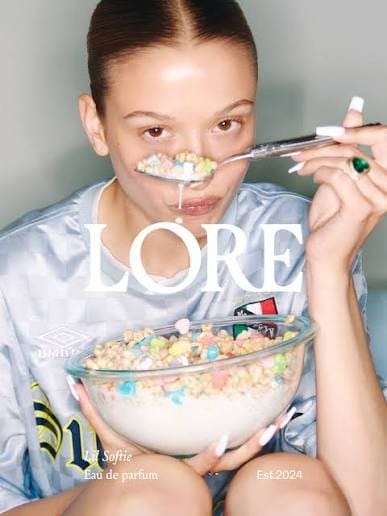
Fragrance brand Lore (no relation) is showing how food can not just influence but star in a product ecosystem. The brand recently partnered with Happier Grocery in NYC to create an exclusive pop called Lil Softie, an homage to its latest fragrance of the same name. This weekend-long activation was one piece of a much larger campaign that has leaned heavily into soft nostalgia. Its social feeds are brimming with imagery of cushy pillows, soft materials, and marshmallow-filled cereals, creating not just an aesthetic but a feeling around the fragrance. And that’s what’s getting people so excited.
Food can evoke feelings of nostalgia, even anemoia; it can communicate exclusivity and, conversely, feelings of community and belonging. It’s a powerful tool and, when used effectively, can add depth and dimension to brand stories that hit only one or two sensory levers.
3. The Fidget Mailer
This trend is an iteration of the PR mailer, which has largely prioritized samples or giveaways to get people to touch, test, and share their experiences ahead of an official launch. This marketing “mode” has been around for years, but new creative interpretations are showing how it can evolve to be more interactive, tactile, and, in turn, more memorable.
Miu Miu garnered incredible buzz for its PR mailer promoting its newest fragrance, Miu Miu Fleur de Lait. Featuring a branded thermal pouch and a container of kinetic sand disguised as ice cream, recipients had to use a special branded ice cream scoop to literally scoop a bottle of the fragrance out. Sure, the brand was called out for over-indexing on materiality and generating waste, but the broader cultural response was favorable because people loved the participation required. Similar to blind boxes, the mailer tapped a powerful combination of mystery, action, and reward to keep people bought into the experience. The novelty of the entire experience was strong enough to inspire sharing on social media.
@chupachupsuk If you thought we were hard to open before, you will have to rethink that. Impossible to open. And that’s a fact. 🙂↕️ #chupachups #impossible #fyp ♬ original sound - chupachupsuk
Chupa Chups iterated on the playbook with a line of impenetrable lollipops, encased in a carbon composite shell, wrapped in aramid fibers, coated in silicon carbide, and dipped in liquid rubber. The result didn’t have the aesthetic pay-off that Miu Miu’s campaign did, but the content created and amplified by influencers on social media was pure brand gold. The idea stemmed from a long-term complaint about Chupa Chups’ packaging, and was used to celebrate a new, easier-to-open wrapper, creating a full-circle “if-you-know-you-know” feeling for loyal customers.
Miu Miu and Chupa Chups are at vastly different sides of the product and price spectrum, but they both managed to create value through touch and tactile dissection. Their community was doing more than passively opening and snapping photos of a mailer; they were becoming part of the campaign itself.
Let the Senses Be Your Guide
Sensory marketing is so powerful because there truly is no silver-bullet solution. These trends illustrate how very different brands with very different goals can tap into human participation and sensory responses to conjure a deeper connection through their campaigns.
But the most effective examples within these trends also show how important it is to be intentional when you play with others’ senses. An activation that feels like novelty for its own sake, or that leaves a pile of landfill behind it, does not read as neutral. It reads as a brand that spent money to be noticed rather than to be useful, and audiences are now fluent enough to say so publicly.
Some key questions to ask include:
- What is your end goal? What do you want participants to do or learn?
- Which sense (or senses) align with the product or service you’re promoting?
- Do you “own” the scent, or are you trying to claim it?
- What do you want people to feel while going through the experience?
- What do you want them to share after they engage with your campaign?
- What happens to the materials after the campaign is over? (This is an especially important question if you plan to send mailers or PR packages.)
- How will you measure success?
Sensory marketing is high value, but it’s also high-stakes. Brands are making a claim and proving their value through physical proof. If the evidence doesn’t prove out for consumers, they will have no problem sharing their findings with the world.