


.jpg)
Taxonomy Alert: Gray Patterns

Welcome to Friday, futurists.
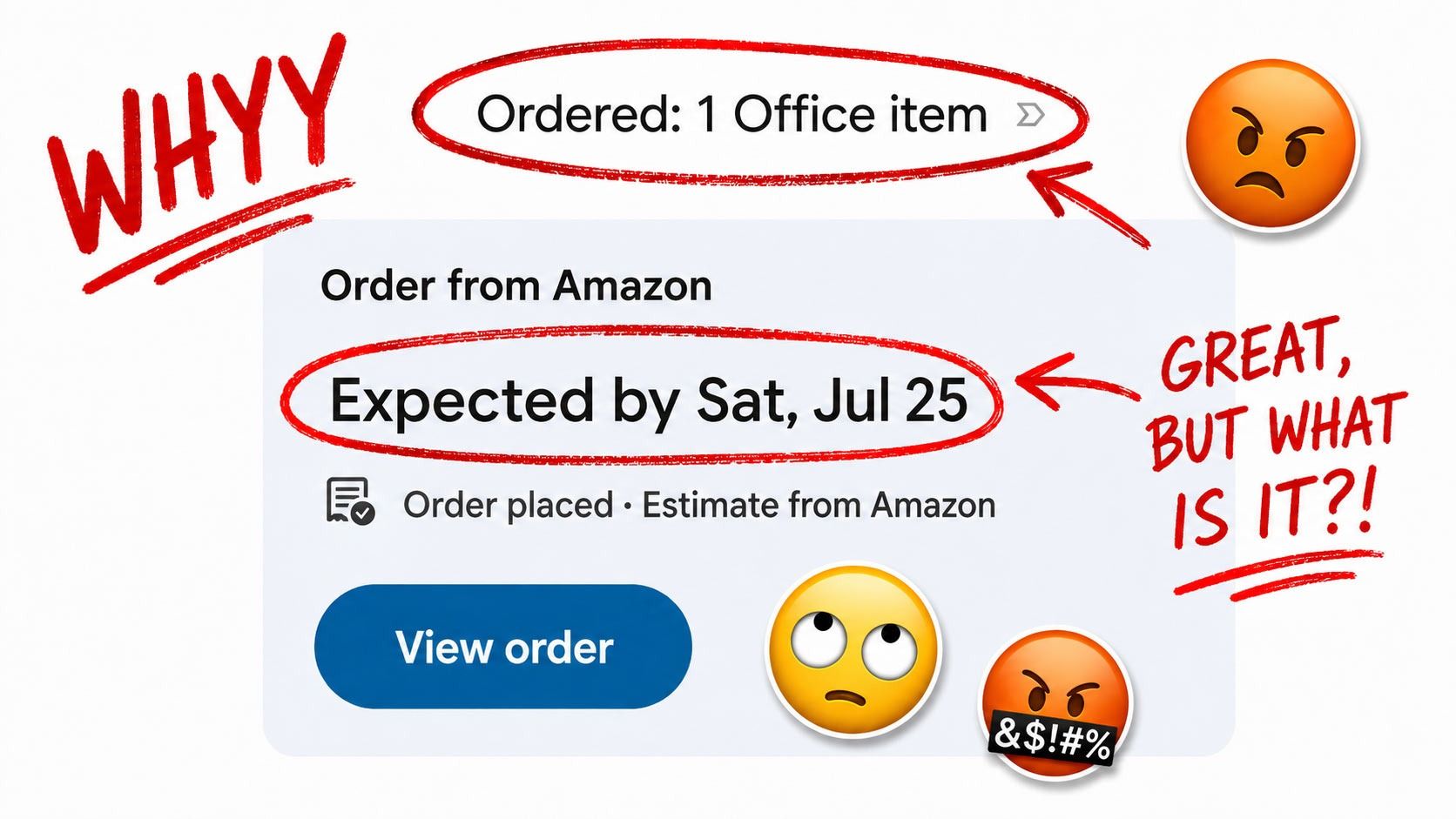
On July 8, Amazon's order confirmations in your inbox changed.
In an apparent defensive move against Google’s Gemini and other prying eyes in your inbox, the critical details of your purchases were now gone from the HTML body and from the plaintext.
Let me be clear: nobody at Amazon sat in a room and decided to make your inbox worse… they decided to make Gemini's inbox worse, and yours is downstream of that.
We started Future Commerce a decade ago talking about the dark patterns that brands used to employ (greenwashing, confirmshaming). But this is different. It’s not harmful directly to the consumer; the end user is merely collateral damage in Amazon’s war against other LLMs.
Gray Patterns
It's a dark pattern with no intent behind the harm, which is arguably worse. The power of the crowd may be able to publicly shame a company out of Roach Moteling, but shame a business out of a trillion-dollar existential threat? Good luck.
So let's name it. This is the emergence of what Future Commerce is calling a Gray Pattern.
A Gray Pattern is a design decision aimed at a machine reader that degrades the human one as a side effect.
Harry Brignull gave us dark patterns in 2010, and every installment into its lexicon since has assumed a human marketer conceiving with a consumer on the receiving end. Dark patterns are malicious by design. Gray Patterns are indifferent by design.
Amazon first piloted a change in 2020 to defend against inbox scraping because receipt mining as an industry has existed for nearly a decade. Slice was among the largest, with Edison and Cleanfox also scraping inboxes and selling purchase panels to Bain and McKinsey for years.
And, to be charitable, Amazon didn't completely eliminate receipt itemization (which is a huge deal to anyone who has ever needed to expense something). It’s “merely” moved it behind a login. Even if Gemini vanished tomorrow, those item names in the subject line are never coming back.
How to spot a Gray Pattern
Here are four questions that separate a Gray Pattern from ordinary brand and security hygiene:
- Who is the intended target of the change? If the change targets an agent or algorithm, does it also impact the consumer?
- Does the platform still retain what it withheld from you? Does the change force a user to change their behavior or alter their usage to prioritize your platform?
- Can the customer take it with them? Viewing is not exporting.
- If the change were reverted, is there a historical fallout? Is there a residual data issue that persists if you were to walk back your decision?
You might say “this is just Cloaking.” And, to wit, Cloaking served crawlers one page and humans another back in the nineties. LinkedIn and Airbnb have obfuscated their markup for years. Glaze and Nightshade are technologies that poison images against training. But this is the first time that the technique has turned on a company’s own persistent copy of customer data.
Five years ago we wrote about Algorithm Anxiety (in the year before ChatGPT, mind you), where the consumer lived with a latent fear of upsetting their Spotify or Instagram feeds, treating it as a form of omniscience, always watching over you.
The person feeling the anxiety now isn’t the customer. It’s the platform.
Anthropic is ripping out book spines like they’re Sub Zero in Mortal Kombat. Maybe Earth's largest bookstore has a reason to be afraid, after all? That email was the last portable, user-owned, ctrl-F-able artifact of your commercial life.
And just like every other fragmented experience of our digital lives, they're demanding that their app become the final source of truth.
Amazon removed the proof from proof of purchase.
— Phillip


The Stars of Back-to-School.
American Eagle leans on soccer star Lamine Yamal for a campaign that centers on malls, campus life, and sports culture, while UGG hands the mic to pop band Muna. Journeys is taking a combined approach, bringing Gen Z-centric musicians, creators, and athletes together to encourage teenage experimentation through fashion and self-expression. (We know that’s missing right now.) Despite focusing on back-to-school, SNIPES is leaning into an oldie. Not sure hiring DJ Khaled to pose in front of a school bus gets the job done, but we’ll see. Conversely, Academy Sports just asked actual kids to participate in a dialogue about “what's in.” (How’s that for a novel idea?)
Every brand wants to be the stars of the halls this year, but they don’t want to acknowledge the major takeaway: parents are financing the whole thing on BNPL and they're also apparently swapping the new-fit fantasy for a pack of pencils. Target and Walmart have the greatest advantage as they double down on ease and value.
The New C-Level.
It was a big week for new executive hires. The one making the biggest headlines is Babylist founder and CEO stepping down to let Rent the Runway’s Jennifer Hyman take over as the company’s second-ever Chief Executive. It’s a big move when the company is your (sort-of literal) baby.
Two other brands are showing their growth by adding to their C-suite. SKIMS has promoted its VP of Communications to its first Chief Communications Officer. Tracy Nguyen will manage global comms and brand collabs, while also overseeing sports and entertainment partnerships. She’ll remain the co-manager of NikeSKIMS. Teen skincare brand Bubble has also hired its first Chief Marketer. Diana Rubin joins the company from Sol de Janeiro, indicating that brand elevation and expansion are likely on the docket.


The Collab Carousel.
Pacsun and Ulta Beauty are launching a joint fashion-and-beauty line in August as Wrangler and LoveShackFancy pair heritage denim with vintage romance. It’s a case of seemingly very different brands coming together to create something that makes total sense, if only for the sake of novelty.
Toy Aisle Power Moves.
Barbie is honoring basketball star Angel Reese with a signature doll and matching Reebok kicks, while Mattel and Lucha Libre AAA go worldwide with a wrestling licensing deal.

Earnings Season Appetite.
There was a bevy of food and bev earnings calls this week. AB InBev saw its beer portfolio, including Corona, Stella Artois, and Michelob Ultra, grow double digits outside their home markets. Starbucks saw net income nearly double, despite revenue dropping by 1%. And Cheesecake Factory posted a record $1.03B quarter with margins reaching a decade high, while Yum Brands posted mixed numbers and tackled the Taco Bell cyclospora drama head-on.
Smells Like Deflection.
Gap brought back its 1990s fragrances, a nostalgic sensory catalog for middle-aged women everywhere. It’s a strategic lever to pull after Hailey Bieber’s viral jeans drop, and a genius way to correct the horrid revisit of its Happy Stripe design.

M(AI)ting Season.
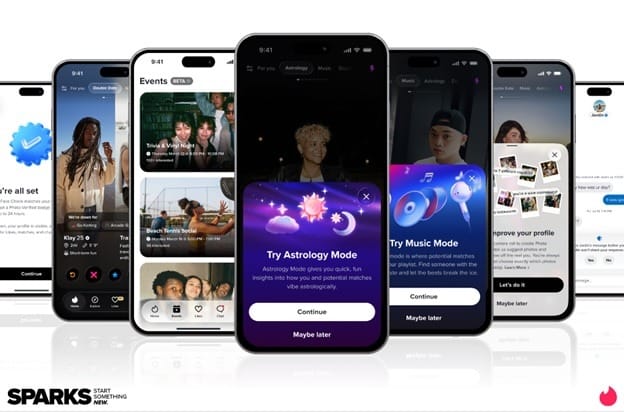
Tinder pulled its AI photo-enhance tool after users noticed it was being a little too heavy-handed with its edits. This case of forced catfishing is just one of several ways AI has infiltrated dating apps. Users are now "chatfishing" potential partners, outsourcing their responses to ChatGPT and Claude to increase their chances of a real-life meet-up.
Our Take: Both stories track with what we explored in The Reality Engine. People are becoming active architects of their own realities, scripting versions of themselves that land better than their original (and authentic) selves. When we outsource our thoughts, feelings, and personalities to AI engines, how does that impact the way we show up in a dating profile, or even the real world? Assistance becomes synthetic existence, which makes authentic connection impossible. Why not just start a relationship with your LLM instead?
Dupe, There it Isn’t.
Temu is giving folks a look into its intellectual property (IP) protection operations, and it shows that the platform has made real moves to protect sellers from malicious dupes and fraudsters. More than 15,000 brands are now being monitored, and Temu’s proactive strategy for removing potentially infringing listings has outnumbered reactive takedowns by a ratio of 331 to 1. More than 47M images and 9.5M keywords are included in its detection database, which powers the operation. All the data is in an official report, which offers a fascinating look into how this side of the business actually works—and how it’s paying off for sellers.
.jpg)
.jpg)

.svg)
