

of the United Kingdom’s capitol city.
We spoke with food trendcasters and CPG analysts to understand how social media is altering holiday tables, and what it says about commerce, culture, and ourselves. In the process, we were reminded that our family traditions and memories are linked to the media we consume.
That media has changed. It has become social. And now so has the traditional holiday fare.
Trading Turkey for Taste
The recipes we hold most dear, the ones we recreate and return to time and again, are a time capsule. They’re a combination of our heritage, our lifestyle, and moments of culinary exploration. This is especially true during the holiday seasons, when dining room tables are curated to include dishes that blend commercialized cuisine, cultural heritage, and memory.
My culinary roots are contained in a dilapidated Ziploc bag filled with handwritten recipes passed down through telephone conversations, magazine clippings from old editions of Food Network Magazine, and tattered labels from old Cool Whip containers. They were passed down, replicated, stored, and shared over years, even generations. The holidays are when I’m most likely to break them out, so I can give my family and friends a little taste of the flavors that color our past and the memories stored in the back corners of our minds.
But now, our cultures are being remixed with social media food fads and influenced by the “sworn testimonials” of modern creators and influencers. The “viral” CPG brands and flavor combinations overtaking algorithmic feeds are being dished out onto our family tables. In some cases, we’re reimagining holiday classics—and in others, we’re creating new customs altogether. On the surface, we’re creating new traditions that speak to the complexity of who we are as humans, but underneath the layers of novelty and nostalgia is a deep-seated need to communicate our worldliness and personal taste.
Embracing a Past Never Experienced
Many laud Gen Z as a generation of disruptors. Consumers who seek to break new ground and challenge the status quo. But increasingly, this cohort is seeking the comforts of the past; in some cases, a past they never got to experience.
According to Tastewise’s Thanksgiving report, which analyzes US consumer food moments at home and in restaurants, all five of the fastest-growing Thanksgiving dishes among Gen Z are classics: sweet potato soufflé (+259%), cornbread (+46%), pumpkin pie (+44%), green bean casserole (+37%), and roasted turkey (+33%). While surprising, Miriam Aniel Oved, Head of Integrated Marketing at Tastewise, believes it aligns with the volatility of our present and this cohort’s eagerness for stability and familiarity.
“Tradition, in some ways, is rooted escapism. It’s like escaping back to a time period here because of a specific emotional feeling. We often see that in moments of cultural upheaval, which we’re definitely in.”
- Miriam Aniel Oved, Head of Integrated Marketing, Tastewise
That’s why “Ralph Lauren Christmas” has become a core holiday aesthetic: when we’re constantly bombarded by trends fighting for our attention and dollars, the ones that stick are the ones that calm our nervous system.
Other times, we gravitate towards the trends that activate a lost idea or memory. And the olfactory system makes that connection between taste and memory so strong. The olfactory bulb and insular cortex are closely connected to the amygdala, which supports emotional learning. And because the olfactory nerve is also close to the hippocampus, which supports memory, we can quickly connect smells and tastes to our past.
“Generally, we are seeing a lot of nostalgia, a draw to tradition, really kind of a longing for predictable tradition, and that translates to food as well as other categories,” said Liz Miller, Global Client Director, Knit. “I would expect that we’re going to see some real doubling down on holiday traditions. Not necessarily in terms of spend, but traditional approaches to what the holidays look like.”
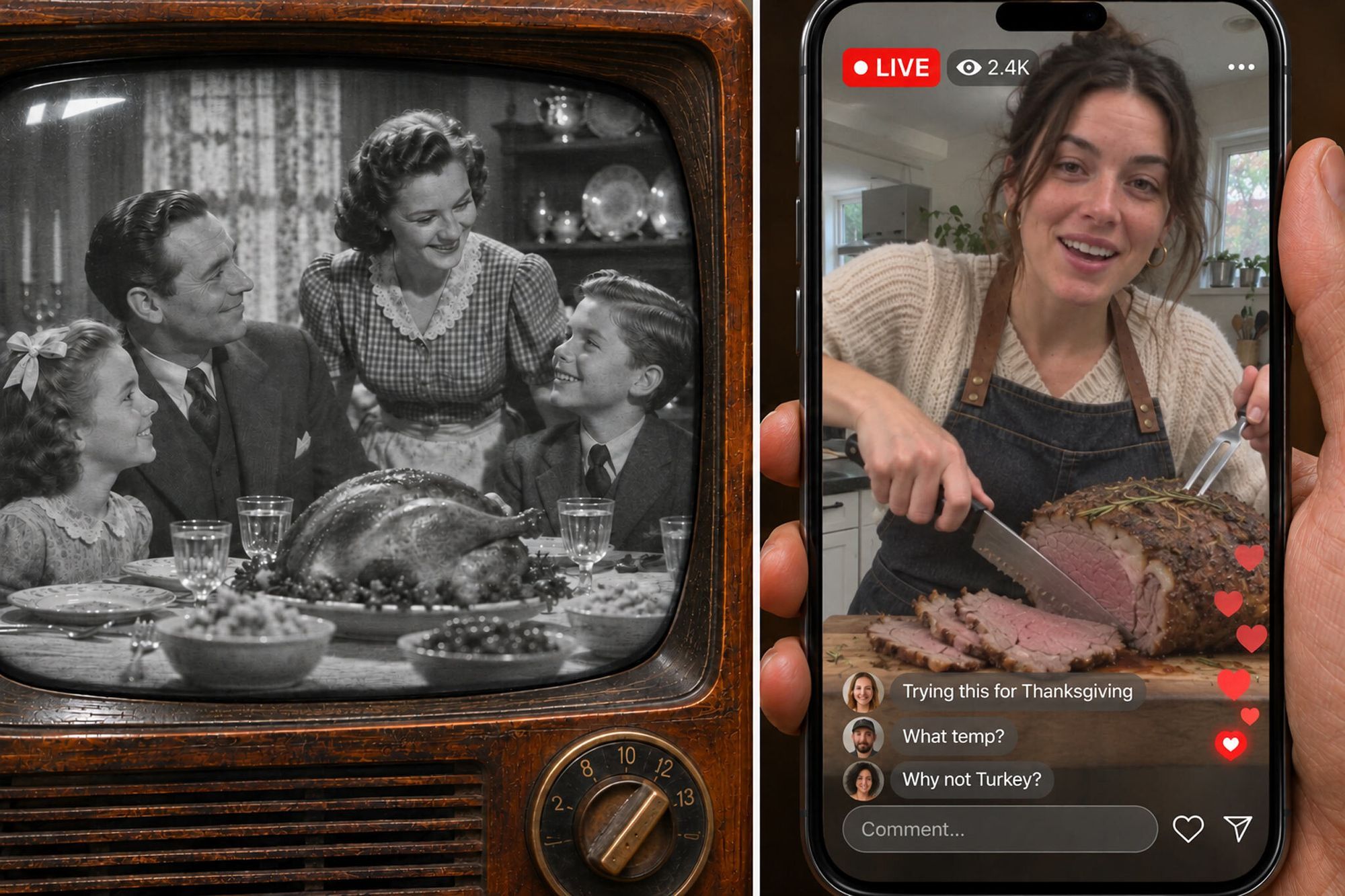
While some consumers are seeking comfort and familiarity, others are looking to take ownership of their present. Millennials, for instance, use established traditions as historical context and then tap into new media (including social) for ideation, creating new customs that reflect their personal tastes and preferences. Tastewise research found that this demographic is swapping the traditional turkey for prime rib (+115%) and Cornish hen (+107%).
The ‘Taste’ Factor
Shared recipes and “anchor” foods unite dinner tables, but culinary trends have local roots. Sally Lyons Wyatt, Global EVP & Chief Advisor, Consumer Goods & Foodservice Insights at Circana, pointed to pumpkin spice as an obvious example. While the trend originated in the US, it now has a global reach, with different territories, brands, and creators putting their own spin on it.
American households are recreating anchor foods around the “wider American story,” Oved explained. “What does it look like when we think about nostalgia for Mexican American communities? What does it look like when we think about the immigrant story and what that serves as nostalgia? And what time periods are they thinking about?”
Social media is helping consumers acquire this broader context. Even if a certain dish, ingredient, or flavor profile doesn’t fully align with their cultural experience, they’re using the holidays as an opportunity to try them on. And many consumers are using social media not just to discover these recipes, but to share them because it conveys a certain level of taste and cultural awareness.
“Trying the latest, most unexpected, culturally relevant flavor can really communicate that someone is adventurous and culturally plugged in.”
- Sally Lyons Wyatt, Global EVP & Chief Advisor, Consumer Goods & Foodservice Insights, Circana
Wyatt noted that Korean flavors are especially popular right now, so you may try a side dish with Korean inspiration. “When you think through the social phenomenon with everything Korean, from beauty to music to Korean flavors, it all ties into that tradition, but yet a new twist, and I think that’s where this collides,” she said.
This notion of “flavor tourism” started in the COVID era, when people couldn’t travel. They turned to social media feeds to break free from the boundaries of their homes, using cooking as a creative outlet and a form of escapism. Now, culinary research and discovery go beyond recipe curation on Pinterest. It’s found in mukbang videos on TikTok, product reviews on YouTube, and “day in the life” Reels on Instagram that show how creators build their weekly menus.
“A flavor can begin in a specific culture or community, and gain visibility by creators on social media. Then it becomes a viral recipe, a sensory challenge, or it’s just somebody showing they’re enjoying the product and that it tastes great,” Wyatt explained. “Social media accelerates awareness, discovery, and trial more than any other platform we’ve ever seen.”
Commercializing Customs
Dubai chocolate and matcha exemplify how a product can go from under the radar to a global sensation. Although many brands and retailers are still riding these flavor waves, Oved noted that “by the time you see something on social and it's peaking on TikTok, you’ve missed the moment. Because by the time you get that signal, then you have to create a limited-time offer.” By the time brands finalize formulation, sourcing, and manufacturing, the opportunity has long passed.
For instance, Tastewise's strawberry matcha analysis shows social demand peaking first and then search and menus following suit. Retail sales, including ready-to-drink, are just peaking now, more than a year after social signals started emerging. In a more Thanksgiving-specific example, the number of US restaurants carrying sweet potato soufflé fell 21% from September 2025 to September 2026, but Gen Z demand rose 259%.
No specific flavor trend is quite reaching “Dubai chocolate scale” this holiday season. Instead, trends are fragmenting, shaping holiday menus around what the person cooking deems “feed-worthy.” Wyatt called out bold heat combinations like chili-lime, Tajín, all things pickled, and sour flavors, especially in desserts. Oved, meanwhile, expects Latin American layered beverages like coffee with sweetened condensed milk to take off in 2027, gaining ground during the holiday season.
While social media influencers often amplify viral foods and flavors, both Wyatt and Oved cautioned that brands shouldn’t simply latch onto whatever the algorithm favors. Instead, they should use social insights to monitor the trends being shaped and shared by credible cultural voices.
“I mentioned influencers, but really [it’s about] getting with credible cultural voices, where either they came from or where their ancestors came from, and preserving the integrity of the flavor rather than really stripping it down just to make it viral,” Wyatt said.
Oved points to another source that has both context and credibility. “Food service, restaurants, and chefs tend to be the vanguard of trends, so we tend to see things pop first in restaurants, and depending on the trend, we’ll see it in home kitchens as well,” Oved said. “They tend to be the percolators of trends, and only then do we see it crop up more and more in retail, CPG, and limited-time offers.”
The Path to Value: Dollars Saved or Culture Consumed?
Taste is becoming a form of intellectual property. The twist we put on a classic dish, or the new brand we feature on the dining room table, can impact how the world sees us.
Oved compared it to a pair of Crocs. The clog’s specialized charms, Jibbitz, allow us to visually curate our likes, interests, and fandoms. While the clogs themselves signal our preferences, the Jibbitz illustrate our taste and style. They turn a basic need (shoes) into a visualization of our lifestyle and identity. “How do you capture a monumental thing and then bespokify it into your personal sense? I think that’s the genesis of a lot of trends,” she said.
Yet there is always the inherent risk that comes with every culinary experiment. And with 77% of US Thanksgiving hosts already planning to adjust shopping lists for food prices, Knit’s Miller notes that the “value equation” will become even more complex this year. It will account for not just money, time, and certainty, but also cultural exploration and taste.
“It’s very important for people to feel they’re getting a good value and they’re making smart shopping choices, and that value equation is complicated,” Miller said. “If your budget is already tight, then you're not going to risk a lower-cost substitution for something you know you can trust.”
Nobody is going to gamble away a dish the family expects, and they’re not going to trade down a brand with the perfect stuffing seasoning. Knit found that taste and past experience impacted 85% of in-store purchase decisions, ahead of promotions, price, brand name, and packaging. That’s why novelty lives on the edges of the table, whether it’s a remixed appetizer, dessert, or batch-made cocktail. That is where the cultural exploration lives, and where consumers are finding new ways to expand (and show off) their taste.
Continue Reading...

Insights and futurism for executives in eCom and Retail
Those things we shouldn’t say out loud? We say them on the private feed. Bi-weekly “after dark” podcasts and a members-only newsletter, just for subscribers.
Our research reports combine visionary thinking with data-backed findings from our own advisory panel, made up of leaders at brands you know and trust.
Upskill, cross-skill, and future-proof your teams with Future Commerce Learning, the leading digital eCommerce learning platform, created by professional educators.
THIS IS FOR MEMBERS ONLY
Recommended reading

Holiday magic was always powered by someone’s labor. AI now lightens the load for parents, yet Accenture data reveals that shoppers still insist on clicking “buy” themselves. Meaning lives in the effort, and magic-makers know it.

When people are distressed, angry, sad, scared, or feeling hopeless, our natural inclination is to escape to a place that feels safe and just. Since the future can be as scary as the present, we look to the past for comfort.
Food as an experience has become increasingly opulent and unattainable, and actual nourishment is harder than ever to find, and more mindless than ever before.