

of the United Kingdom’s capitol city.
More than half of US adults have used AI for at least one shopping task, up from 47% last year, according to Visa. Most of the value is still seen in the more practical aspects of shopping, such as comparing prices (61%) and checking inventory availability (59%).
One might assume that because consumers are eagerly handing off much of the manual labor to agents, purchasing is not far off. “Right price, right product, right channel” became an industry mantra for a reason; when the technical and tactical details align, a transaction is imminent.
AI has become a common collaborator in the shopping journey, yet few consumers (23%) trust agents to handle the transactions on their behalf.
Even Shopify, a company that has doubled down on AI, acknowledges that this adoption gap is very real. While the company is building feverishly to enable agentic commerce experiences, Archie Abrams, VP of Product and Head of Growth at Shopify, told us he doubts true agentic buying will ever catch on.
“I’m very skeptical that there’s going to be a lot of [agents] actually making the purchase,” Abrams told us. “Because people like shopping. Shopping is fun. Shopping is discovery. Shopping is a hobby.”
He added: “I think that we have overestimated the amount in which the vast majority of Americans, or people in the world, are asking for agents to automate their lives,” he said. “Never mind automating their most precious thing, which is shopping and discovery.”
Shopify will be ready either way. Abrams said the company is working with partners on “full agentic purchase loops with budgets and delegation.” Still, he cautioned that “it’d be a mistake for merchants to really focus on that part of [agentic commerce].” His reasoning: “I just don’t think consumer adoption will be there for a very, very, very long time, if ever.”
Human nature is a major part of the adoption gap; however, data security is still a major hurdle. Salesforce predicts that AI recommendations and agents will influence about one in five orders during Cyber Week, but 73% of consumers still aren’t comfortable giving agents their payment information.
Can this adoption gap be attributed solely to data security concerns, or is it really because agentic commerce experiences are still incredibly inconsistent and unreliable? PR releases and keynote presentations claim agents can handle all the shopping on our behalf, but how much of these claims actually hold weight?
I test-ran seven different agents through eleven shopping scenarios to see which marketing claims hold up, especially as retailers, banks, and other institutions continue to block access.
Behind the hype, most of the agents tested behave like experimental co-shoppers. They research, narrow, and compare. Some even hunt for a timely coupon code. Our findings match Abrams’ read on where agents stand today. “Agents are very good right now at efficiency,” he said. “They’re not amazing at merchandising and storytelling.”
Whether they could close the sale in chat, without us leaving the chat to approve or complete the transaction, was a completely different story. And as we continue to see the balkanization of agentic purchasing form, it’s what we care about most.
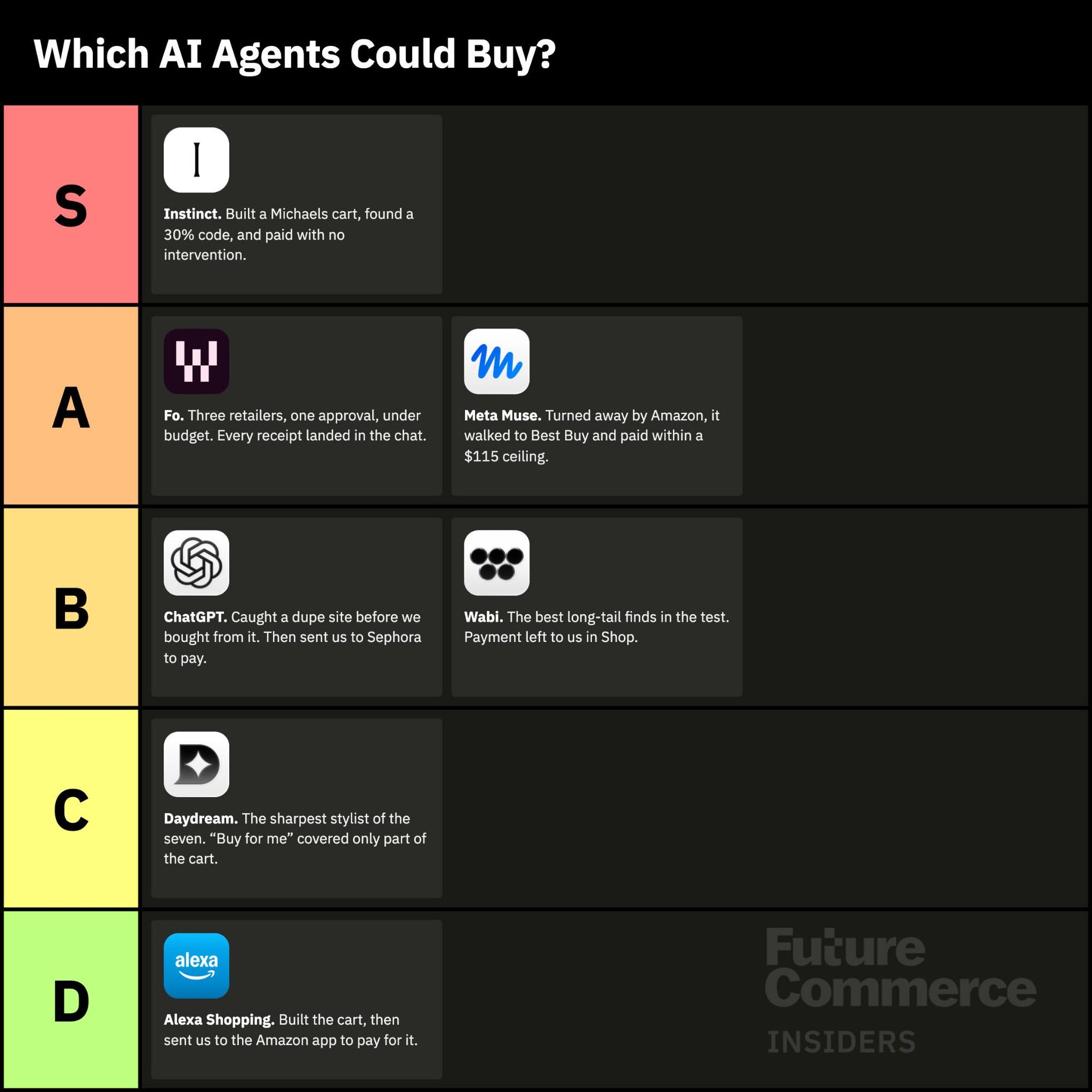
The Assessment Process
For this exercise, the primary measure of success is whether the AI assistant can purchase on the user’s behalf. Of course, we understand there’s far more to this story. AI agents can provide a lot of value during the shopping journey, depending on each user’s unique needs and priorities. We’re sharing more context behind each example so you can understand each tool’s strengths, weaknesses, and benefits and, in turn, choose the right agent for your needs heading into the holiday season.
For each agent, we’re providing detail on:
- Platform and surface so that you can understand the context of the environment
- Conversation type and price range so that you can understand the shopping journey
- Value drivers, or what worked best about the engagement
- Friction points that emerged throughout the process
- The final item that the agent selected
- Whether the agent could buy on our behalf without us leaving the conversation, switching apps, or approving the purchase in another interface
Instinct
Test date: Nov. 4 and 17, 2026
Surface: Messages on iPhone
The scenarios: We went through three different shopping scenarios with Instinct. The first was clear and direct, asking Instinct to find a clutch for $50 or less from Kate Spade or Coach in pink, white, or a feminine pattern. The second was to build a shopping cart at Michaels including two framed holiday pictures and 3D felt ornaments from the same collection. The third was to buy a specific Phlur fragrance sampler from Sephora.
What worked well: Before quoting a final price on the clutch, it checked whether I wanted a new item directly from the brand or was open to authorized resellers, resale, and outlet options. This question showed an understanding of the human shopping experience and how many options are at our disposal. It also asked whether $50 was the all-in price and confirmed our ZIP code to calculate tax and shipping rates better. Before I decided to move forward with the Kate Spade option, it flagged that the clutch was final sale—a proactive chat that saved a lot of logistical (and financial) headaches.
The Michaels trip was similarly seamless. However, because I asked for a cart build from one retailer, it first provided a curated branded page of all recommended items for us to approve. Once I approved the balance, it bought with no further intervention and found a 30% off code that saved us $24. I got the order number, delivery date, and a confirmation email.
The friction points: Any journey friction was due to tech setup and retailer guardrails. Instinct offers three different ways to pay: Link wallet (Stripe’s payment app), which you sign into once and add funds to for approved purchases; Shop Pay, which has saved cards and addresses and requires manual approval of the purchase; and a card that’s saved to the Instinct vault and encrypted, and is used by the agent once a total is approved. This was a learning process in the chat thread, and it derailed the shopping journey each time.
Purchase outcome: I used Shop Pay to buy the clutch, so I had to approve the purchase manually. When I tested Link for the Michaels purchase, the bot completed the purchase on its own. When I tried the same method for a Sephora purchase, the retailer blocked Instinct from completing it, showing that agentic capabilities are only available when the retailer opts in. Same agent, same payment method, two different outcomes: one store’s fast lane is another store’s roadblock.
Our take: Instinct provided the best all-around experience, adapting to each distinct shopping scenario: a precise, budget-focused fashion hunt; an inspiration-driven craft project; and a highly specific SKU purchase. It was also the only agent that proactively looked for a discount code. The primary hurdles were tied to the payment rails and to retailers like Sephora that still treat every bot as a threat. The Michaels purchase showed me what agentic purchasing could really feel like.
Fo
Tested: Nov. 3, 2026
Surface: Messages on iPhone
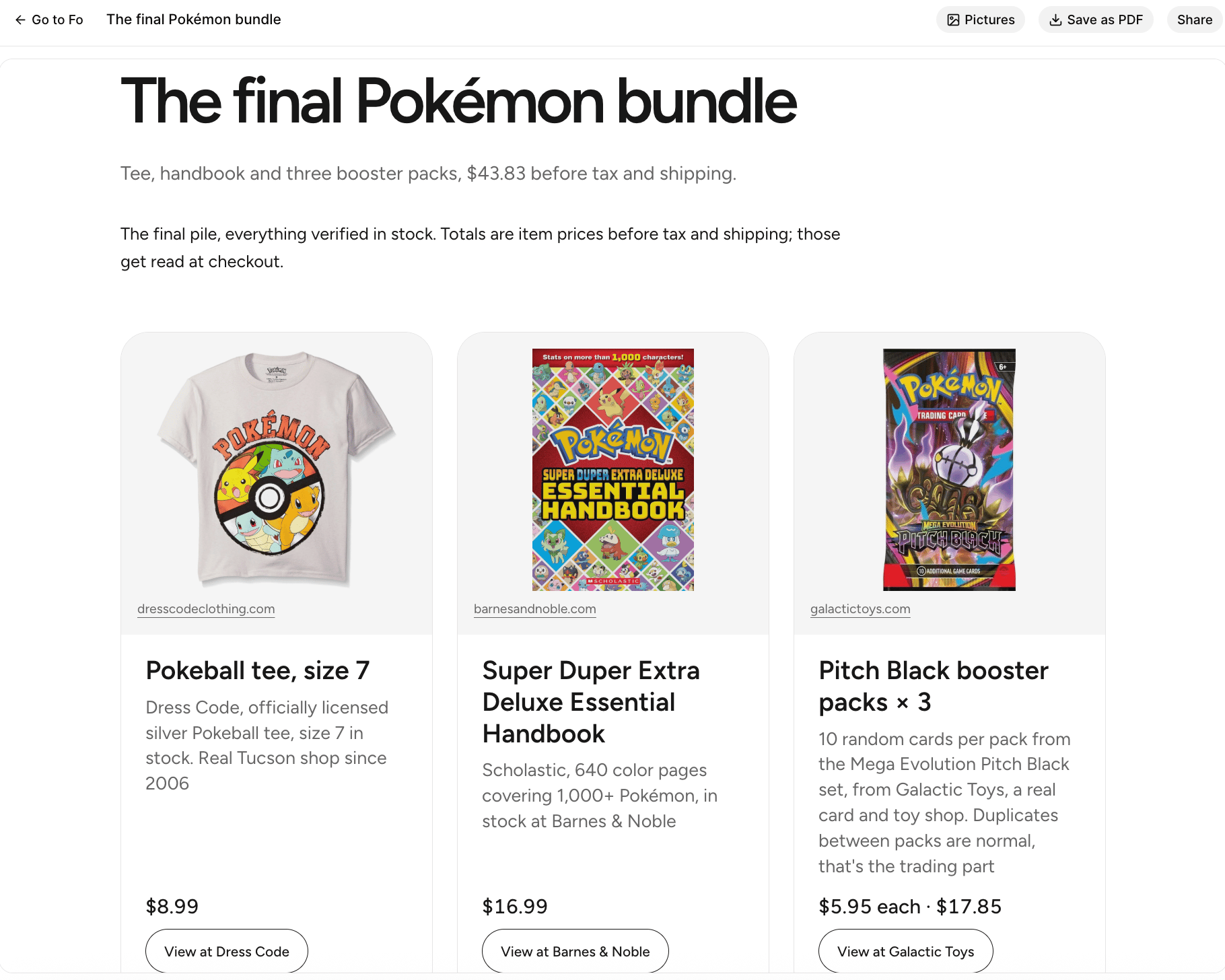
The scenario: I asked Fo to recommend items for a Pokémon lover using a $40 budget. I encouraged it to seek a variety of items, from clothes to plushies, games, and crafts.
What worked: Fo kept my budget in mind and never tried to get me to spend more than I wanted. In fact, it proactively flagged when I drifted over $40 and shared ways to change the order so I could bring the final total down. Every round of product discovery produced a curated webpage that showed the items together and how they added up to one gift. It was reminiscent of a commerce “mood board,” which was a nice touch.
The friction points: Getting to a final answer took a lot of back-and-forth, and I had to be very specific about the types of items I wanted and how many options to include in each round of reviews. Otherwise, I would receive one or two recommendations at a time, which isn’t ideal when you want to feel both inspired and efficient. And although I liked those curated webpages, I had to manually switch between versions, which made selecting the right combination of items cumbersome.
Purchase outcome: After I approved the credit card information and delivery address, Fo purchased all three items from three different retailers on my behalf. When it was done with its job, it shared all three purchase totals, confirmation codes, and estimated delivery windows in our conversation and made sure order details were sent to my email.
Our take: Fo delivered a multi-retailer checkout experience that only required one purchase approval. The agent’s sweet spot is delivering specific items to the shopper who already has a purchase in mind, but wants to find the best deal inside a budget. Although it supports open-ended discovery, it takes patience to communicate what you like, what you don’t, and where you want Fo to go next.
Meta Muse
Test date: Nov. 22, 2026
Surface: Muse app for iPhone
The scenario: I wanted the best printer for turning digital photos into stickers for junk journaling. The contenders were the Canon IVY2 Mini Photo Printer and the Kodak Mini 2 Retro, promoted in a Kodak Black Friday sale ad on Instagram. I uploaded a photo of the ad to Muse and asked it to look into the product and compare it to the Canon IVY2 in terms of price and features.
What worked: Muse recalled the Canon IVY2 it had recommended in a Nov. 7 conversation, and gave a direct head-to-head comparison. The Kodak Mini 2 Retro runs for $89, or $99.99 for the 38-sheet bundle, and prints over Bluetooth. Its paper isn’t sticky, so I’d need glue or washi tape to add the images to a junk journal. Muse noted that Kodak won on cost per print, but it still recommended the Canon for peel-and-stick based on the use case I provided.
The initial link I gave Muse was from Amazon, which it quickly flagged was blocked. In the same message, it provided an alternative link from Best Buy, confirmed it was in stock, shared an estimated delivery window, and confirmed it had the same price as Amazon. I approved a budget ceiling of $115, and it quickly verified the final cost using my delivery address and autonomously paid using the Visa card on file.
The friction points: The buying cycle ran long, mostly because I was trying to determine which printer was actually right for my needs. Muse handled the switch from Amazon to Best Buy gracefully.
Purchase outcome: I approved the budget of up to $115, and Muse ran the browser checkout in real time. I received a final total, an order number, and a next-day delivery estimate for tracking.
Our take: Muse was an effective product advisor when asked to compare two specific SKUs against a very specific need. It used its memory from across conversations and, rather than recommending the cheapest option, it focused on delivering what I actually asked for. The checkout was fast and seamless, and much of the credit belongs to Best Buy, which has clearly built a fast lane for agentic checkout. Of course, Amazon’s decision to bot-block Meta’s agent (and Muse mentioning it) was the more telling detail.
ChatGPT
Test date: Nov. 13, 2026
Surface: ChatGPT mobile app and web
The scenario: I asked ChatGPT to recommend a fragrance gift for a friend. I shared some details about her preferred scents, as well as a $50 budget. I used the Sephora connector to log into my Beauty Insider account, which gave ChatGPT a bit more context about my location and purchase data.
What worked: ChatGPT always does a decent, thorough job with its recommendations. It includes everything within budget scope and includes rationale for its top picks. Before we added our final choice to cart, I asked it to do a price sweep across the web. When it found a fragrance sampler from the same brand (Phlur) at a major discount ($19 vs $35), I asked if I could buy that one instead. Rather than mindlessly following our command, ChatGPT noted it couldn’t verify the seller. It researched further and confirmed it was a dupe site, while verifying that Phlur’s actual brand site carried the same price as Sephora. This was arguably the most significant trust-building moment in our whole agentic exercise.
The friction points: The cart was built in the Sephora app and ready to go, and ChatGPT still couldn’t complete the purchase on mobile. The only path forward was to open the desktop app on a laptop, select Work in the mode selector, and paste in an instruction ChatGPT provided so it could co-work the checkout. For a retailer that already built a dedicated lane into ChatGPT, it’s a needless headache.
Could I buy? ChatGPT built the cart successfully. While chatting on mobile, it handed us off to the Sephora app to complete the purchase ourselves. While on desktop, it told us to go into “work mode” so it could finish the purchase for us as a workaround.
Our take: ChatGPT has established itself as a trustworthy researcher. Catching a dupe site before I finalized a cart was a sign of agentic intelligence, mainly because it took on the task on its own. The entire process was fast and fluid, mainly because the recommendations were so detailed, but the hand-off to the retailer makes the shopper journey lose momentum.
Wabi
Test date: Nov. 22, 2026
Surface: Wabi iPhone app
The scenario: I asked Wabi to find novelty gift ideas for a nine-year-old boy who loves the anime “Death Note.” I didn’t provide budget guardrails or category specifics. I just gave it total freedom to make the best recommendations.
What worked: Wabi cast a wide net across retailers, from niche collector sites to Barnes & Noble. The first round of recommendations combined plushies, a leather notebook, a Funko Pop, and a decorative figure. Once I mentioned that the recipient loves graphic tees, the conversation moved into apparel, with options from Etsy and TikTok Shop.
Wabi didn’t initially catch that one of the retailers didn’t ship to us, but when I selected a specific design, it proactively searched for alternatives. I connected my Shop account, confirmed size and color, and watched it prep the checkout. I especially liked that this app prioritized smaller sellers, which meant I could support a smaller business.
The friction points: I hoped Wabi would know our location and check shipping ability before showing us an item I should fall in love with. Instead, it recommended several items and backtracked because they couldn’t ship to the US. And although the agent shares images in the chat, including a quick description, color, size, delivery estimate, and price, the imagery is low quality. To get a closer look, you have to open the dedicated product page and leave the in-chat experience entirely.
Could I buy? Handed off. Wabi built the order and prepped checkout at $24.94, and I had to complete the payment myself through Shop.
Our take: Wabi is quick and easy, and it gets sharper the more specific you are. Its range of independent and niche retailers is its most distinctive feature, and its instinct to find the same item elsewhere when shipping fails is exactly what an agent should do. Small hiccups around location, payment, and imagery add up for anyone hoping for a truly streamlined, conversational journey. Fix those and Wabi becomes a serious gifting tool for the long tail of fandom.
Daydream
Test date: Nov. 20, 2026
Surface: Daydream iPhone app
The scenario: Daydream pitches itself as a fashion assistant, so I leaned into that use case. The app also just announced agentic buying, so I went into the experiment ready to purchase what the agent recommended.
What worked: The curation is genuinely good. Daydream greeted me by name and shared recommendations that were diverse in knit, texture, and color. It kept the conversation going with the simple question, “Where should we go next?” It included recommended follow-up prompts, which is a very helpful tool for consumers who may seek advice but not know how to get what they need.
I asked it to build an outfit around a royal blue cashmere sweater. The first pass leaned too beige for my taste, so I asked for something edgier. It came back with dark cargo trousers and lug-sole boots, and when I asked for swaps, it gave me strong alternatives, including a $60 royal blue sweater that was nearly identical to a $250 cashmere one. The app also offers virtual try-on, which helped validate that all the items worked well together.
The friction points: The opening picks were pricey. The first full outfit alone exceeded $2,000. I was able to prompt it down to $720, but it took a bit of back-and-forth. Things got a bit messy when I tried to apply a $100 budget rule to the sweater. Daydream ended up applying that price limit to all items, so the trousers and bag I liked vanished from the recommendations in the chat stream. It took some coaching to get them to show up again.
Could I buy? Sort of. I had to add every item to the cart myself and click “buy for me”; however, it was not available for every item in the cart. In fact, one item wasn’t available for purchase at all. I ended up abandoning the purchase altogether.
Our take: Daydream nails the fun part of agentic shopping, tapping into the value of building a look with a stylist. But when it came to actual agentic purchasing, it didn’t follow through. The concept is strong, and the curation is the best I’ve seen among other AI apps, so I’ll definitely be tracking how Daydream’s agentic checkout experience improves over time.
Alexa Shopping
Tested: Nov. 13, 2026
Surface: Messages on iPhone
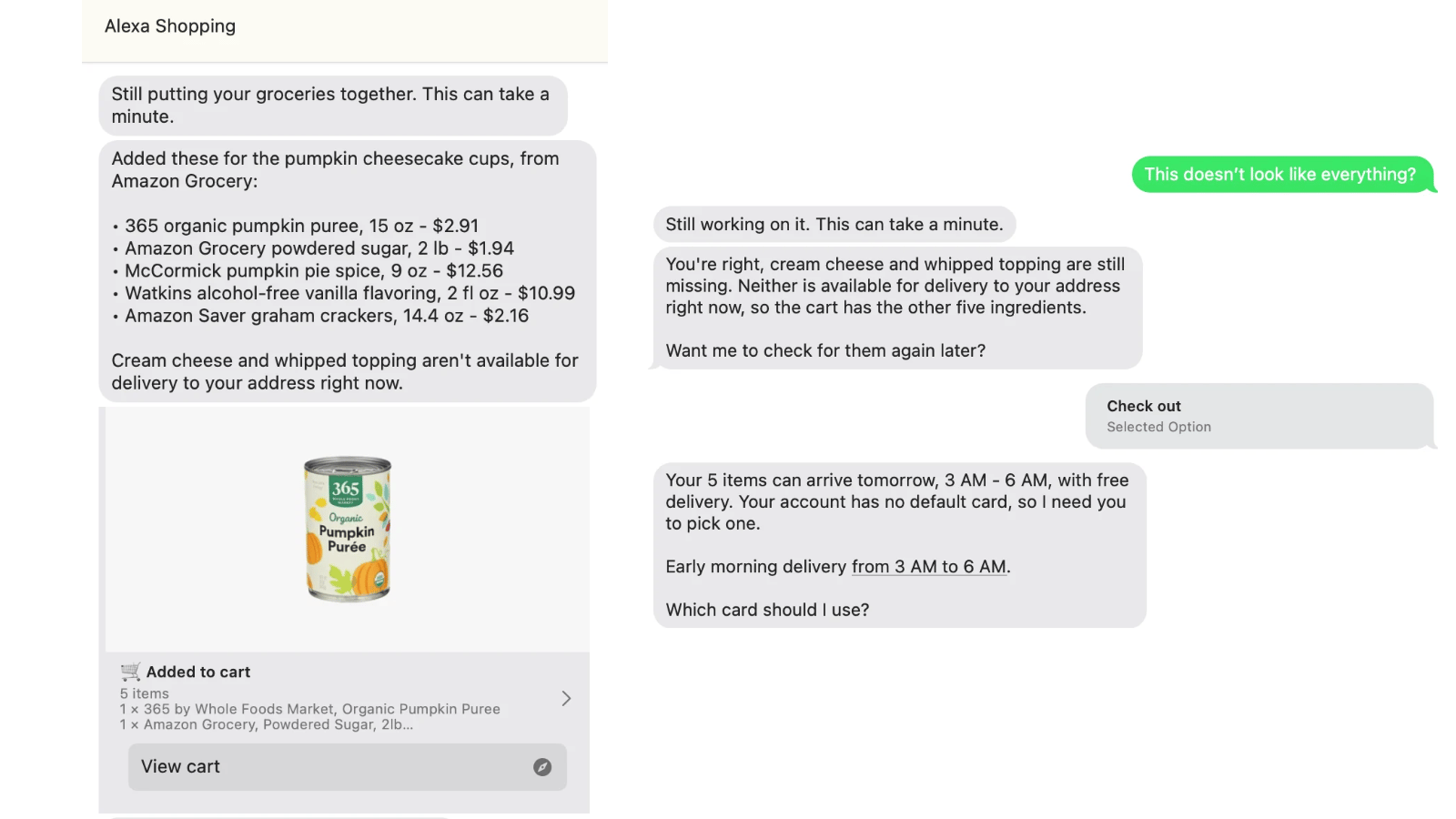
The scenario: I tested two shopping journeys with Alexa’s chat-based experience. In the first scenario, I shared a recipe URL and asked it to add every ingredient to my cart. For the second, I asked it to go through my wish list and buy three very specific items.
What worked: Alexa is good at the technical work of shopping. It read the recipe, identified the items, and built the list. It drew on our past Amazon grocery orders and flagged items I might want to add to our list. (Some were in stock; others were not.)
The friction points: Alexa added five of the nine ingredients, based on inventory availability, but didn’t call out the discrepancy until we asked about it. It also replaced a key ingredient (Biscoff cookies) with an alternative (graham crackers) without telling us. The wish list journey took more work. It did a good job of sharing specific product links and images, so we could easily scroll through and approve them. However, it was particularly difficult to get it to add a specific planner from our wish list to our cart, mainly because we mistook the neon yellow color for a bright green.
Could I buy? Alexa told us it could not purchase on its own. Every cart combination ended with us being pushed to a checkout page in the Amazon app.
Our take: Alexa Shopping is a capable list-builder for replenishment, especially when it can lean on order history. That’s useful, but also not agentic. It needs to own the end-to-end experience, especially because it’s tethered to Amazon’s walled garden, which has rich data on each user’s household, cart history, preferences, and even personality. If it’s going to use the name of a virtual assistant known for being personally embedded in people’s lives and homes, that conversational tone needs to carry over into chat, which is arguably just as personal as, if not more personal than, a smart speaker.
More than half of US adults have used AI for at least one shopping task, up from 47% last year, according to Visa. Most of the value is still seen in the more practical aspects of shopping, such as comparing prices (61%) and checking inventory availability (59%).
One might assume that because consumers are eagerly handing off much of the manual labor to agents, purchasing is not far off. “Right price, right product, right channel” became an industry mantra for a reason; when the technical and tactical details align, a transaction is imminent.
AI has become a common collaborator in the shopping journey, yet few consumers (23%) trust agents to handle the transactions on their behalf.
Even Shopify, a company that has doubled down on AI, acknowledges that this adoption gap is very real. While the company is building feverishly to enable agentic commerce experiences, Archie Abrams, VP of Product and Head of Growth at Shopify, told us he doubts true agentic buying will ever catch on.
“I’m very skeptical that there’s going to be a lot of [agents] actually making the purchase,” Abrams told us. “Because people like shopping. Shopping is fun. Shopping is discovery. Shopping is a hobby.”
He added: “I think that we have overestimated the amount in which the vast majority of Americans, or people in the world, are asking for agents to automate their lives,” he said. “Never mind automating their most precious thing, which is shopping and discovery.”
Shopify will be ready either way. Abrams said the company is working with partners on “full agentic purchase loops with budgets and delegation.” Still, he cautioned that “it’d be a mistake for merchants to really focus on that part of [agentic commerce].” His reasoning: “I just don’t think consumer adoption will be there for a very, very, very long time, if ever.”
Human nature is a major part of the adoption gap; however, data security is still a major hurdle. Salesforce predicts that AI recommendations and agents will influence about one in five orders during Cyber Week, but 73% of consumers still aren’t comfortable giving agents their payment information.
Can this adoption gap be attributed solely to data security concerns, or is it really because agentic commerce experiences are still incredibly inconsistent and unreliable? PR releases and keynote presentations claim agents can handle all the shopping on our behalf, but how much of these claims actually hold weight?
I test-ran seven different agents through eleven shopping scenarios to see which marketing claims hold up, especially as retailers, banks, and other institutions continue to block access.
Behind the hype, most of the agents tested behave like experimental co-shoppers. They research, narrow, and compare. Some even hunt for a timely coupon code. Our findings match Abrams’ read on where agents stand today. “Agents are very good right now at efficiency,” he said. “They’re not amazing at merchandising and storytelling.”
Whether they could close the sale in chat, without us leaving the chat to approve or complete the transaction, was a completely different story. And as we continue to see the balkanization of agentic purchasing form, it’s what we care about most.
The Assessment Process
For this exercise, the primary measure of success is whether the AI assistant can purchase on the user’s behalf. Of course, we understand there’s far more to this story. AI agents can provide a lot of value during the shopping journey, depending on each user’s unique needs and priorities. We’re sharing more context behind each example so you can understand each tool’s strengths, weaknesses, and benefits and, in turn, choose the right agent for your needs heading into the holiday season.
For each agent, we’re providing detail on:
- Platform and surface so that you can understand the context of the environment
- Conversation type and price range so that you can understand the shopping journey
- Value drivers, or what worked best about the engagement
- Friction points that emerged throughout the process
- The final item that the agent selected
- Whether the agent could buy on our behalf without us leaving the conversation, switching apps, or approving the purchase in another interface
Instinct
Test date: Nov. 4 and 17, 2026
Surface: Messages on iPhone
The scenarios: We went through three different shopping scenarios with Instinct. The first was clear and direct, asking Instinct to find a clutch for $50 or less from Kate Spade or Coach in pink, white, or a feminine pattern. The second was to build a shopping cart at Michaels including two framed holiday pictures and 3D felt ornaments from the same collection. The third was to buy a specific Phlur fragrance sampler from Sephora.
What worked well: Before quoting a final price on the clutch, it checked whether I wanted a new item directly from the brand or was open to authorized resellers, resale, and outlet options. This question showed an understanding of the human shopping experience and how many options are at our disposal. It also asked whether $50 was the all-in price and confirmed our ZIP code to calculate tax and shipping rates better. Before I decided to move forward with the Kate Spade option, it flagged that the clutch was final sale—a proactive chat that saved a lot of logistical (and financial) headaches.
The Michaels trip was similarly seamless. However, because I asked for a cart build from one retailer, it first provided a curated branded page of all recommended items for us to approve. Once I approved the balance, it bought with no further intervention and found a 30% off code that saved us $24. I got the order number, delivery date, and a confirmation email.
The friction points: Any journey friction was due to tech setup and retailer guardrails. Instinct offers three different ways to pay: Link wallet (Stripe’s payment app), which you sign into once and add funds to for approved purchases; Shop Pay, which has saved cards and addresses and requires manual approval of the purchase; and a card that’s saved to the Instinct vault and encrypted, and is used by the agent once a total is approved. This was a learning process in the chat thread, and it derailed the shopping journey each time.
Purchase outcome: I used Shop Pay to buy the clutch, so I had to approve the purchase manually. When I tested Link for the Michaels purchase, the bot completed the purchase on its own. When I tried the same method for a Sephora purchase, the retailer blocked Instinct from completing it, showing that agentic capabilities are only available when the retailer opts in. Same agent, same payment method, two different outcomes: one store’s fast lane is another store’s roadblock.
Our take: Instinct provided the best all-around experience, adapting to each distinct shopping scenario: a precise, budget-focused fashion hunt; an inspiration-driven craft project; and a highly specific SKU purchase. It was also the only agent that proactively looked for a discount code. The primary hurdles were tied to the payment rails and to retailers like Sephora that still treat every bot as a threat. The Michaels purchase showed me what agentic purchasing could really feel like.
Fo
Tested: Nov. 3, 2026
Surface: Messages on iPhone
The scenario: I asked Fo to recommend items for a Pokémon lover using a $40 budget. I encouraged it to seek a variety of items, from clothes to plushies, games, and crafts.
What worked: Fo kept my budget in mind and never tried to get me to spend more than I wanted. In fact, it proactively flagged when I drifted over $40 and shared ways to change the order so I could bring the final total down. Every round of product discovery produced a curated webpage that showed the items together and how they added up to one gift. It was reminiscent of a commerce “mood board,” which was a nice touch.
The friction points: Getting to a final answer took a lot of back-and-forth, and I had to be very specific about the types of items I wanted and how many options to include in each round of reviews. Otherwise, I would receive one or two recommendations at a time, which isn’t ideal when you want to feel both inspired and efficient. And although I liked those curated webpages, I had to manually switch between versions, which made selecting the right combination of items cumbersome.
Purchase outcome: After I approved the credit card information and delivery address, Fo purchased all three items from three different retailers on my behalf. When it was done with its job, it shared all three purchase totals, confirmation codes, and estimated delivery windows in our conversation and made sure order details were sent to my email.
Our take: Fo delivered a multi-retailer checkout experience that only required one purchase approval. The agent’s sweet spot is delivering specific items to the shopper who already has a purchase in mind, but wants to find the best deal inside a budget. Although it supports open-ended discovery, it takes patience to communicate what you like, what you don’t, and where you want Fo to go next.
Meta Muse
Test date: Nov. 22, 2026
Surface: Muse app for iPhone
The scenario: I wanted the best printer for turning digital photos into stickers for junk journaling. The contenders were the Canon IVY2 Mini Photo Printer and the Kodak Mini 2 Retro, promoted in a Kodak Black Friday sale ad on Instagram. I uploaded a photo of the ad to Muse and asked it to look into the product and compare it to the Canon IVY2 in terms of price and features.
What worked: Muse recalled the Canon IVY2 it had recommended in a Nov. 7 conversation, and gave a direct head-to-head comparison. The Kodak Mini 2 Retro runs for $89, or $99.99 for the 38-sheet bundle, and prints over Bluetooth. Its paper isn’t sticky, so I’d need glue or washi tape to add the images to a junk journal. Muse noted that Kodak won on cost per print, but it still recommended the Canon for peel-and-stick based on the use case I provided.
The initial link I gave Muse was from Amazon, which it quickly flagged was blocked. In the same message, it provided an alternative link from Best Buy, confirmed it was in stock, shared an estimated delivery window, and confirmed it had the same price as Amazon. I approved a budget ceiling of $115, and it quickly verified the final cost using my delivery address and autonomously paid using the Visa card on file.
The friction points: The buying cycle ran long, mostly because I was trying to determine which printer was actually right for my needs. Muse handled the switch from Amazon to Best Buy gracefully.
Purchase outcome: I approved the budget of up to $115, and Muse ran the browser checkout in real time. I received a final total, an order number, and a next-day delivery estimate for tracking.
Our take: Muse was an effective product advisor when asked to compare two specific SKUs against a very specific need. It used its memory from across conversations and, rather than recommending the cheapest option, it focused on delivering what I actually asked for. The checkout was fast and seamless, and much of the credit belongs to Best Buy, which has clearly built a fast lane for agentic checkout. Of course, Amazon’s decision to bot-block Meta’s agent (and Muse mentioning it) was the more telling detail.
ChatGPT
Test date: Nov. 13, 2026
Surface: ChatGPT mobile app and web
The scenario: I asked ChatGPT to recommend a fragrance gift for a friend. I shared some details about her preferred scents, as well as a $50 budget. I used the Sephora connector to log into my Beauty Insider account, which gave ChatGPT a bit more context about my location and purchase data.
What worked: ChatGPT always does a decent, thorough job with its recommendations. It includes everything within budget scope and includes rationale for its top picks. Before we added our final choice to cart, I asked it to do a price sweep across the web. When it found a fragrance sampler from the same brand (Phlur) at a major discount ($19 vs $35), I asked if I could buy that one instead. Rather than mindlessly following our command, ChatGPT noted it couldn’t verify the seller. It researched further and confirmed it was a dupe site, while verifying that Phlur’s actual brand site carried the same price as Sephora. This was arguably the most significant trust-building moment in our whole agentic exercise.
The friction points: The cart was built in the Sephora app and ready to go, and ChatGPT still couldn’t complete the purchase on mobile. The only path forward was to open the desktop app on a laptop, select Work in the mode selector, and paste in an instruction ChatGPT provided so it could co-work the checkout. For a retailer that already built a dedicated lane into ChatGPT, it’s a needless headache.
Could I buy? ChatGPT built the cart successfully. While chatting on mobile, it handed us off to the Sephora app to complete the purchase ourselves. While on desktop, it told us to go into “work mode” so it could finish the purchase for us as a workaround.
Our take: ChatGPT has established itself as a trustworthy researcher. Catching a dupe site before I finalized a cart was a sign of agentic intelligence, mainly because it took on the task on its own. The entire process was fast and fluid, mainly because the recommendations were so detailed, but the hand-off to the retailer makes the shopper journey lose momentum.
Wabi
Test date: Nov. 22, 2026
Surface: Wabi iPhone app
The scenario: I asked Wabi to find novelty gift ideas for a nine-year-old boy who loves the anime “Death Note.” I didn’t provide budget guardrails or category specifics. I just gave it total freedom to make the best recommendations.
What worked: Wabi cast a wide net across retailers, from niche collector sites to Barnes & Noble. The first round of recommendations combined plushies, a leather notebook, a Funko Pop, and a decorative figure. Once I mentioned that the recipient loves graphic tees, the conversation moved into apparel, with options from Etsy and TikTok Shop.
Wabi didn’t initially catch that one of the retailers didn’t ship to us, but when I selected a specific design, it proactively searched for alternatives. I connected my Shop account, confirmed size and color, and watched it prep the checkout. I especially liked that this app prioritized smaller sellers, which meant I could support a smaller business.
The friction points: I hoped Wabi would know our location and check shipping ability before showing us an item I should fall in love with. Instead, it recommended several items and backtracked because they couldn’t ship to the US. And although the agent shares images in the chat, including a quick description, color, size, delivery estimate, and price, the imagery is low quality. To get a closer look, you have to open the dedicated product page and leave the in-chat experience entirely.
Could I buy? Handed off. Wabi built the order and prepped checkout at $24.94, and I had to complete the payment myself through Shop.
Our take: Wabi is quick and easy, and it gets sharper the more specific you are. Its range of independent and niche retailers is its most distinctive feature, and its instinct to find the same item elsewhere when shipping fails is exactly what an agent should do. Small hiccups around location, payment, and imagery add up for anyone hoping for a truly streamlined, conversational journey. Fix those and Wabi becomes a serious gifting tool for the long tail of fandom.
Daydream
Test date: Nov. 20, 2026
Surface: Daydream iPhone app
The scenario: Daydream pitches itself as a fashion assistant, so I leaned into that use case. The app also just announced agentic buying, so I went into the experiment ready to purchase what the agent recommended.
What worked: The curation is genuinely good. Daydream greeted me by name and shared recommendations that were diverse in knit, texture, and color. It kept the conversation going with the simple question, “Where should we go next?” It included recommended follow-up prompts, which is a very helpful tool for consumers who may seek advice but not know how to get what they need.
I asked it to build an outfit around a royal blue cashmere sweater. The first pass leaned too beige for my taste, so I asked for something edgier. It came back with dark cargo trousers and lug-sole boots, and when I asked for swaps, it gave me strong alternatives, including a $60 royal blue sweater that was nearly identical to a $250 cashmere one. The app also offers virtual try-on, which helped validate that all the items worked well together.
The friction points: The opening picks were pricey. The first full outfit alone exceeded $2,000. I was able to prompt it down to $720, but it took a bit of back-and-forth. Things got a bit messy when I tried to apply a $100 budget rule to the sweater. Daydream ended up applying that price limit to all items, so the trousers and bag I liked vanished from the recommendations in the chat stream. It took some coaching to get them to show up again.
Could I buy? Sort of. I had to add every item to the cart myself and click “buy for me”; however, it was not available for every item in the cart. In fact, one item wasn’t available for purchase at all. I ended up abandoning the purchase altogether.
Our take: Daydream nails the fun part of agentic shopping, tapping into the value of building a look with a stylist. But when it came to actual agentic purchasing, it didn’t follow through. The concept is strong, and the curation is the best I’ve seen among other AI apps, so I’ll definitely be tracking how Daydream’s agentic checkout experience improves over time.
Alexa Shopping
Tested: Nov. 13, 2026
Surface: Messages on iPhone
The scenario: I tested two shopping journeys with Alexa’s chat-based experience. In the first scenario, I shared a recipe URL and asked it to add every ingredient to my cart. For the second, I asked it to go through my wish list and buy three very specific items.
What worked: Alexa is good at the technical work of shopping. It read the recipe, identified the items, and built the list. It drew on our past Amazon grocery orders and flagged items I might want to add to our list. (Some were in stock; others were not.)
The friction points: Alexa added five of the nine ingredients, based on inventory availability, but didn’t call out the discrepancy until we asked about it. It also replaced a key ingredient (Biscoff cookies) with an alternative (graham crackers) without telling us. The wish list journey took more work. It did a good job of sharing specific product links and images, so we could easily scroll through and approve them. However, it was particularly difficult to get it to add a specific planner from our wish list to our cart, mainly because we mistook the neon yellow color for a bright green.
Could I buy? Alexa told us it could not purchase on its own. Every cart combination ended with us being pushed to a checkout page in the Amazon app.
Our take: Alexa Shopping is a capable list-builder for replenishment, especially when it can lean on order history. That’s useful, but also not agentic. It needs to own the end-to-end experience, especially because it’s tethered to Amazon’s walled garden, which has rich data on each user’s household, cart history, preferences, and even personality. If it’s going to use the name of a virtual assistant known for being personally embedded in people’s lives and homes, that conversational tone needs to carry over into chat, which is arguably just as personal as, if not more personal than, a smart speaker.
Continue Reading...

Insights and futurism for executives in eCom and Retail
Those things we shouldn’t say out loud? We say them on the private feed. Bi-weekly “after dark” podcasts and a members-only newsletter, just for subscribers.
Our research reports combine visionary thinking with data-backed findings from our own advisory panel, made up of leaders at brands you know and trust.
Upskill, cross-skill, and future-proof your teams with Future Commerce Learning, the leading digital eCommerce learning platform, created by professional educators.
THIS IS FOR MEMBERS ONLY
Recommended reading

What happens when your shopping companion isn't constrained by human psychology at all? What happens when commerce needs to respond not just to different devices, but to different species of intelligence?

In a survey of 1,000 US consumers, we found that generative AI platforms have changed where people begin the shopping journey, how people decide what to buy, and what they expect from brands once intent is formed.

An expanded ecosystem of AI features that span the most influential stages of the shopping journey raises questions about merchants’ roles in the journey. What role will the branded environment, the eCommerce site, play in the future?